

Grateful is a good word, but it can start to feel worn when you repeat it across a thank-you note, a speech, or a piece of personal writing — and not every alternative means quite the same thing.
Quick Answer
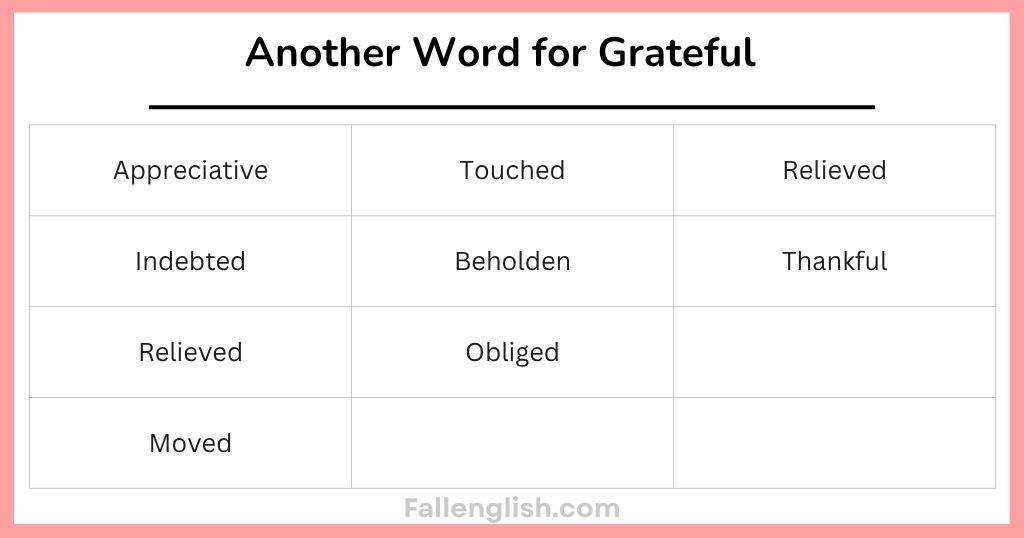
The most useful alternatives, depending on what you mean:
- Thankful — the closest swap for everyday use
- Appreciative — better when you want to sound measured or professional
- Indebted — when you want to convey that someone went far out of their way
- Relieved — when gratitude is mixed with having escaped something difficult
- Moved or touched — when the emotion is deeper than simple thanks
None of these are exact copies. Each one shifts the feeling slightly.
The Difference That Actually Matters
Grateful and thankful are so close that most readers won’t notice a swap — but there is a faint distinction worth knowing. Grateful tends to suggest a deeper or more lasting sense of appreciation, often for something significant. Thankful can feel more immediate, more tied to a specific moment or outcome.
I’m grateful for everything you’ve done for our family over the years.
I’m thankful the surgery went well.
The first sounds like it has been sitting in the chest for a while. The second sounds like relief with gratitude folded in.
In most everyday writing, the difference is small enough to ignore. In a speech, a dedication, or a heartfelt letter, it’s worth noticing.
Another Word for Grateful by What You’re Actually Trying to Say
When the feeling is genuine but measured
Appreciative works well here. It sounds considered rather than emotional, which makes it useful in professional writing, feedback, or any context where you want warmth without sentimentality.
We are appreciative of your continued support.
She was appreciative of the feedback, even when it was hard to hear.
It can sound slightly formal in casual conversation, so “I’m really appreciative” works better spoken than “I appreciate” in many situations.
When someone did something significant for you
Indebted carries weight. It implies the favor was large enough that a simple thank-you doesn’t fully cover it. Use it when you want to communicate that someone went well beyond what was expected.
I am deeply indebted to my mentor for opening those doors.
Don’t use it for small kindnesses — it overstates. Saying “I’m indebted to you for the coffee” will sound strange.
When gratitude comes with relief
Sometimes what you feel isn’t pure appreciation — it’s the specific emotion that arrives after something difficult resolves. Relieved captures that honestly. You can pair it with grateful when both are true.
I was relieved and grateful that he made it home safely.
Using only “grateful” in that sentence loses the emotional texture. The relief is part of the truth.
When the feeling is emotional rather than intellectual
Moved and touched both describe gratitude that reaches a deeper place — when someone’s kindness or gesture affects you more than you expected.
I was genuinely moved by the response from the community.
She was touched that he had remembered.
Neither word replaces grateful directly in every sentence, but both can be more honest than grateful when the emotion has a particular warmth or intensity to it.
When you want a slightly more formal or elevated tone
Beholden and obliged appear in this space, though they carry different implications.
Beholden suggests you owe something back — it carries a faint sense of obligation that grateful does not.
She felt beholden to her benefactor in a way that made her uncomfortable.
Obliged has old-fashioned charm and appears in formal correspondence — “much obliged” still surfaces in British English — but it has a slightly stiff quality in modern American writing.
Use these carefully. They can sound slightly cold or transactional if the context is personal.
Another Word for Grateful Comparison at a Glance
| Word | Tone | Best used when |
| Thankful | Warm, everyday | A specific outcome or moment |
| Appreciative | Measured, professional | Feedback, workplace, formal contexts |
| Indebted | Heavy, serious | A very significant favor |
| Moved | Emotional, sincere | Deep or unexpected kindness |
| Touched | Warm, gentle | A personal or thoughtful gesture |
| Beholden | Formal, slightly obligatory | Formal writing; use carefully |
| Relieved | Mixed with released tension | Gratitude after a difficult outcome |
What Not to Substitute Directly
Thankful and grateful are nearly interchangeable, but not every alternative is.
Indebted, beholden, and obliged all imply some degree of owing something back. Grateful carries no such implication — it’s a pure emotional response. Substituting one of these in a warm personal context can accidentally make your gratitude sound like an acknowledgment of a debt.
Moved and touched describe an emotional state more than a relational response. You can feel moved without feeling grateful, and you can feel grateful without feeling particularly moved. They overlap but don’t cover the same ground.
When the Choice Changes the Sentence
I am grateful for your help.
Swap in appreciative and the sentence sounds slightly more composed and less personal — better in an email to a colleague than a note to a close friend.
Swap in indebted and the help suddenly sounds much larger than “help” suggests — consider whether that’s accurate.
Swap in thankful and almost nothing changes, which is exactly why it’s the safest everyday replacement.
The Practical Decision
If you need a direct swap with no side effects, thankful is the reliable choice. If you want to signal depth, appreciative or indebted can do that — but only when the context justifies the weight those words carry. And if what you actually felt was something warmer or more specific than gratitude, there’s often a more honest word available than any synonym for grateful: the one that names the feeling precisely.
The best replacement isn’t always the most impressive-sounding one. It’s the one that says what you actually mean.
Read more you also like:
Another Word for Interest: Choosing the Right Alternative for Every Context
Another Word for In Addition: Choosing the Right Connective
Another Word for Meaningful: Alternatives That Actually Fit
Another Word for Perfect: Choosing the Right Alternative

FallEnglish is run by a language enthusiast who explains word and text meanings in clear, simple ways. Each guide is carefully researched, original, and written to help real people understand language faster, with accuracy, context, and everyday examples you can trust.