

Interest does a lot of work in English — sometimes too much. It covers curiosity, attention, financial gain, a stake in something, and a hobby, which means the word you need to replace it with depends entirely on which of those meanings you’re actually using.
Quick Answer
| If you mean… | Try instead… |
| Curiosity or wanting to know more | curiosity, fascination, engagement |
| A hobby or regular pursuit | hobby, passion, pursuit, pastime |
| A financial return | yield, return, dividend |
| A stake or share in something | stake, investment, share, claim |
| Holding someone’s attention | engagement, absorption, captivation |
The rest of this article explains when each of these actually fits — and when a seemingly obvious substitute quietly shifts your meaning.
When “Interest” Means Curiosity or Attention
This is the most common usage — “I have an interest in history,” “she showed no interest in the idea” — and it’s the area with the richest set of alternatives.
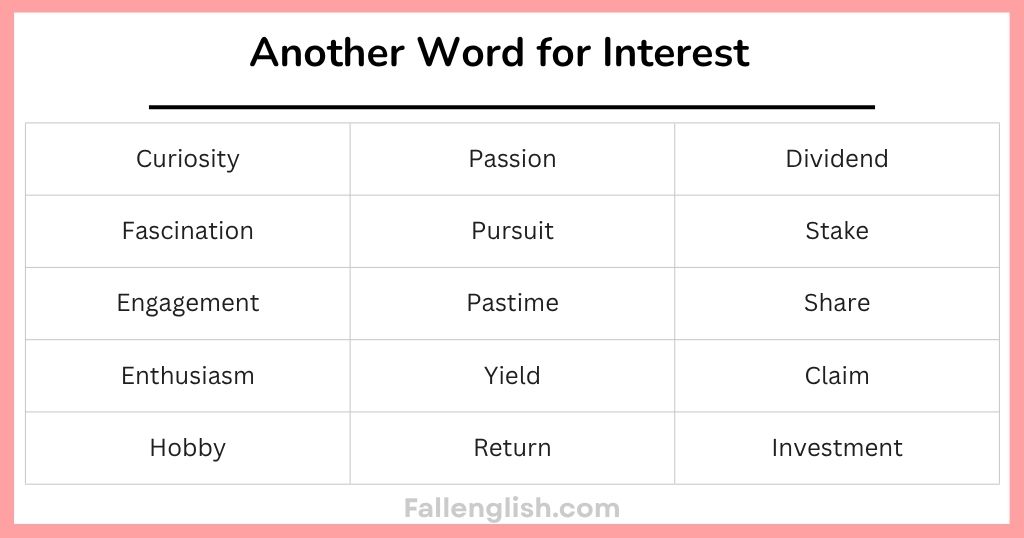
Curiosity is the most precise replacement when you want to suggest an active desire to know or discover. It implies questioning rather than passive appreciation. “Her curiosity about the case drove her to keep researching” carries a sense of searching energy that “interest” doesn’t quite capture.
Fascination is stronger. It suggests the subject has taken hold of the person, not merely caught their eye. “He had a fascination with maps” implies something closer to obsession than mild interest. Don’t use it to describe lukewarm or professional interest — it will overstate your meaning.
Engagement works especially well in professional or educational contexts where you want to describe sustained, active attention rather than general curiosity. “Student engagement” sounds more purposeful than “student interest” because it implies participation, not just willingness to look.
Enthusiasm adds energy and positive feeling. It suggests the person is ready to act, not just observe. Use it when the interest is clearly positive and motivating, not when the feeling is neutral or uncertain.
When “Interest” Means a Hobby or Pursuit
“What are your interests?” is a natural question, but in writing, it can sound vague or slightly flat.
Hobby is concrete and unpretentious. It works for informal writing and everyday conversation. “Her hobbies include painting and hiking” reads more naturally than “her interests include painting and hiking” in casual contexts.
Passion raises the emotional stakes considerably. It implies deep, enduring commitment rather than casual enjoyment. Only use it when the feeling genuinely runs deep — “his passion for jazz” suggests something central to his identity, not a weekend activity he occasionally returns to.
Pursuit sounds purposeful and slightly formal. It works well in professional profiles, résumés, and written introductions where you want to suggest that the activity involves effort and direction. “Her academic pursuits include philosophy and classical languages” positions her activities as serious and intentional.
Pastime is lighter in tone than hobby and suggests leisure and pleasure without implying a high level of skill or commitment. “Reading has always been her favourite pastime” feels warmer and less clinical than “reading has always been her main interest.”
When “Interest” Means a Financial Return
This meaning needs exact language because the alternatives are not freely interchangeable.
Yield refers to the income generated by an investment, often expressed as a percentage. It is the standard term in financial writing: “the bond has a yield of 4.5 percent.”
Return is broader — it covers overall profit, which may include yield plus appreciation in value. “The investment produced a strong return” is a natural choice when the exact financial mechanism doesn’t need specifying.
Dividend refers specifically to a payment made to shareholders from a company’s profits. It is not synonymous with interest in most cases. Do not use it unless you are writing about equity investments.
In legal and banking contexts, “interest” is often the only correct word — particularly in phrases like “interest rate” or “accrued interest.” Replacing it casually in financial documents can introduce imprecision.
When “Interest” Means a Stake or Share
“She has an interest in the business” is a legal and commercial phrase meaning ownership or entitlement. The alternatives here carry different shades of involvement.
Stake is the most natural replacement in business writing. It implies ownership and risk together. “She holds a significant stake in the company” makes her position in the organization feel concrete.
Share suggests ownership measured in formal units, typically equity. “She owns shares in the company” is more specific and implies a publicly or formally structured form of ownership.
Claim moves toward legal language and suggests a right to something, often contested or pending. “He has a legal claim on the estate” is not identical to “he has an interest in the estate” — it implies a formal dispute or process.
Investment is broader and does not necessarily suggest legal ownership. It can describe financial, emotional, or professional commitment. “She has a personal investment in the project’s success” is figurative; “she has a financial investment in the company” is literal.
Differences That Matter Most
Two pairs are frequently confused:
Curiosity vs. fascination: Both replace “interest” in the curiosity sense, but they describe different intensities. Curiosity is open and seeking — it implies the person wants to learn more. Fascination implies being drawn in without necessarily choosing it. A child might show curiosity about how a clock works; someone might feel fascination with a place they can’t fully explain.
Passion vs. interest: These are not the same strength of feeling. Describing a job applicant as having “a passion for customer service” signals something different — and riskier — than “an interest in customer service.” Passion is appropriate when the feeling is deeply held and genuine. Used casually, it can sound exaggerated or dishonest.
Choosing the Right Another Word for Interest
When replacing interest, the most useful question to ask is: how strong is the feeling, and what does it produce?
- If the feeling is mild or professional → interest may still be the best word, or try engagement or curiosity
- If the feeling is deep and motivating → passion or fascination
- If you’re describing activity rather than feeling → pursuit, hobby, or pastime
- If you’re describing financial or legal involvement → stake, return, yield, or share
The word “interest” earns its place precisely because it covers so much ground — which is also why, in precise writing, something more specific usually serves better. The right replacement narrows the meaning toward exactly what you intend, and that precision is what makes a sentence land clearly.

FallEnglish is run by a language enthusiast who explains word and text meanings in clear, simple ways. Each guide is carefully researched, original, and written to help real people understand language faster, with accuracy, context, and everyday examples you can trust.