

“In addition” is one of those phrases writers lean on so heavily it starts to lose its effect — and sometimes a different connective would actually fit the logic of the sentence better.
Quick Answer
The most useful alternatives are also, as well, besides, on top of that, plus, what’s more, and not to mention. Each one does something slightly different. Some are interchangeable with “in addition” in most sentences. Others shift the tone, imply a stronger emphasis, or work only in certain positions. The section below explains which is which.
Another Word for In Addition Comparison at a Glance
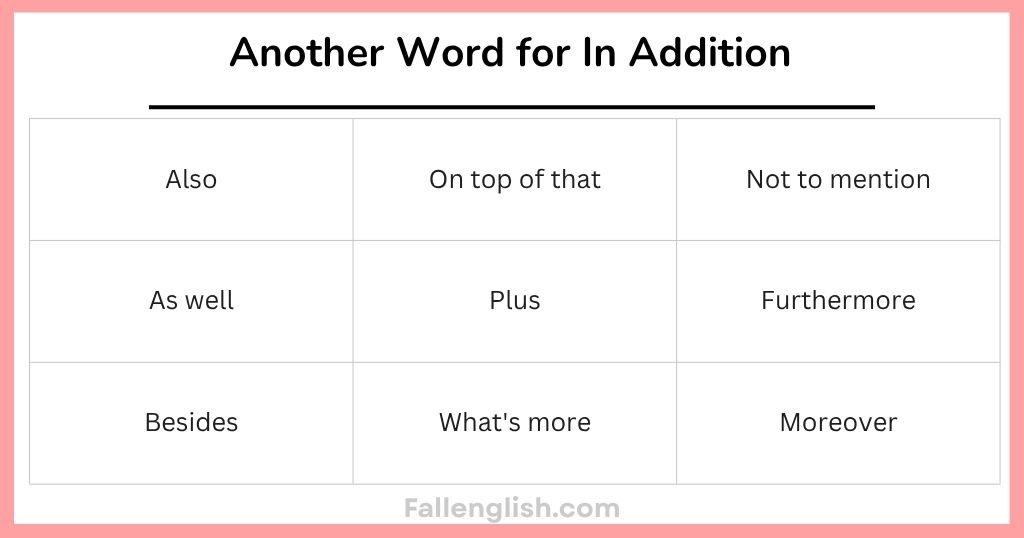
| Alternative | Works best when | Tone | Position in sentence |
| Also | Adding a related point naturally | Neutral | Mid-sentence or start |
| As well | Adding something at the end | Neutral, slightly informal | End of clause |
| Besides | Adding a point that reinforces a conclusion | Informal to neutral | Start or mid-sentence |
| On top of that | Piling on, often for emphasis or complaint | Informal, emphatic | Start of sentence |
| Plus | Quick, casual addition | Casual | Start or mid |
| What’s more | Adding a stronger or more surprising point | Emphatic, slightly formal | Start of sentence |
| Not to mention | Flagging something obvious or especially striking | Rhetorical, expressive | Mid-sentence |
| Furthermore | Formal additive logic | Formal, written | Start of sentence |
| Moreover | Stronger formal addition | Formal, academic | Start of sentence |
The Words That Are Genuinely Interchangeable
Also is the closest natural replacement in most sentences. It slots into positions “in addition” cannot always reach — including mid-sentence — without restructuring anything.
The report covers expenses. In addition, it includes a summary.
The report covers expenses. It also includes a summary.
The second version flows more easily. “Also” carries no extra emphasis, which is often exactly what a sentence needs.
As well works the same way but belongs at the end of the clause rather than the beginning or middle.
The report covers expenses and includes a summary as well.
If your sentence already ends naturally on the added item, “as well” fits cleanly. It reads slightly more conversational than “in addition.”
When You Want More Emphasis
“In addition” is neutral — it just signals that another point is coming. Sometimes you want the reader to feel the weight of what you’re adding.
What’s more signals that the next point is not just additional but stronger or more significant.
The project came in under budget. What’s more, it finished two weeks early.
That second sentence carries a “and here’s the part that really matters” quality. Use it when you mean it. If both points are roughly equal in importance, “what’s more” overstates things.
On top of that works similarly but feels more spoken and can carry a hint of exasperation or accumulation — useful in persuasive writing or storytelling, less suited to formal reports.
The shipment arrived late. On top of that, half the items were damaged.
Not to mention is rhetorical rather than straightforwardly additive. It implies the added point is so obvious it barely needs saying — which makes it persuasive but slightly loaded. Use it in writing where you want the reader to feel the added point speaks for itself.
The renovation increased the home’s value, not to mention its comfort.
Avoid it in neutral factual writing. It implies a shared assumption between writer and reader that may not always exist.
The Casual Choices
Plus and besides are the most conversational options. Both work well in everyday writing, emails, and informal speech.
I don’t want to go. Plus, I wasn’t even invited.
I don’t want to go. Besides, I wasn’t even invited.
These two are close, but “besides” carries a subtle “and if that weren’t enough” quality — it reinforces a conclusion rather than simply adding a point. “Plus” is more neutral and often just means “and also.”
Neither belongs in formal writing, technical documents, or academic papers if you want to maintain a professional register.
Formal Another Word for In Addition Options
If you’re writing an academic paper, a business report, or any structured formal document, furthermore and moreover are appropriate.
They are not identical. Furthermore simply adds a related point — roughly equivalent to “and in addition to that.” Moreover implies that the next point is stronger than or superior to the previous one.
The system is reliable. Furthermore, it requires minimal maintenance.
The system is reliable. Moreover, independent testing confirmed it outperforms all competing models.
Using “moreover” when the points are roughly equal in weight sounds slightly inflated. Using “furthermore” when the second point is clearly more significant undersells it.
Both words belong at the start of a sentence or clause. Do not try to place them mid-sentence the way you might place “also.”
Grammar Notes Worth Knowing
“In addition” can begin a sentence or appear mid-sentence with a slight restructuring (“in addition to X, Y…”). Most of its alternatives are pickier.
- Also can appear almost anywhere but sounds awkward at the very end of a clause.
- As well belongs at the end.
- What’s more, furthermore, moreover, and on top of that belong at the beginning of a new clause or sentence.
- Besides can start a sentence or appear mid-sentence but rarely works well embedded deep in a clause.
- Not to mention appears mid-sentence, connecting two parts of the same clause.
Swapping “in addition” for one of these without adjusting sentence structure is the most common mistake. The connective changes; the sentence structure sometimes has to change with it.
Choosing the Right Another Word for In Addition
The decision usually comes down to three questions:
What register are you writing in?
Formal document → furthermore, moreover.
Everyday writing or email → also, as well, besides, plus.
Rhetorical or persuasive → what’s more, not to mention.
How much emphasis does the added point need?
Equal weight → also, as well, furthermore.
Greater weight or surprise → what’s more, moreover.
Accumulated weight or frustration → on top of that.
Where does the connective need to sit in the sentence?
Beginning of a new sentence → most options work.
Mid-sentence → also, not to mention.
End of clause → as well.
The right replacement isn’t always the most sophisticated option. Often it’s simply the one that fits the sentence position, matches the tone you’ve already set, and doesn’t add emphasis you didn’t intend.
You may like to read more:
Another Word for Powerful: Alternatives That Actually Fit Your Meaning
Another Word for Interest: Choosing the Right Alternative for Every Context
Another Word for Fear: Choosing the Right Alternative for What You Mean
Another Word for Perfect: Choosing the Right Alternative

FallEnglish is run by a language enthusiast who explains word and text meanings in clear, simple ways. Each guide is carefully researched, original, and written to help real people understand language faster, with accuracy, context, and everyday examples you can trust.