

The word meaningful does a lot of work — sometimes too quietly. When a sentence calls for something more precise, more emotionally direct, or simply less worn, these are the alternatives worth knowing.
Quick Answer
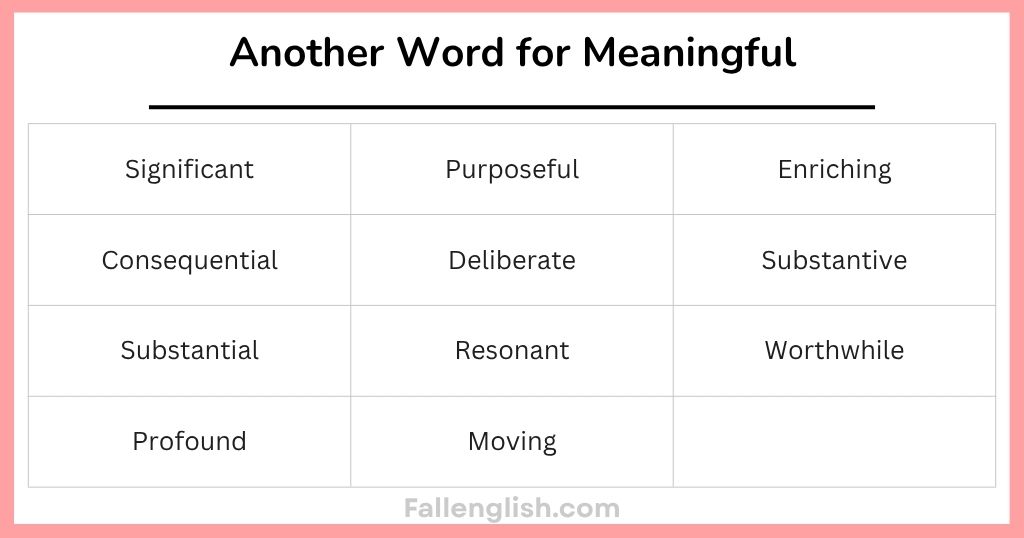
The most useful alternatives to meaningful depend on what you actually mean by it:
- Significant — when something carries weight or consequence
- Purposeful — when the focus is on intentional direction
- Profound — when the depth of impact matters
- Substantive — in professional or academic contexts, when something has real content or substance
- Valuable — when worth or benefit is the point
- Resonant — when something strikes an emotional chord
- Enriching — when experience or growth is implied
None of these are exact substitutes for each other, and none is a perfect drop-in for meaningful in every sentence. The right choice depends on what kind of meaning you are describing.
Why “Meaningful” Sometimes Isn’t Enough
Meaningful has become one of those words that sounds right while saying very little. It appears in performance reviews, mission statements, personal essays, and LinkedIn posts so often that it has started to feel weightless. A reader skims past it.
The deeper issue is that meaningful carries at least three distinct ideas depending on context:
- Significance — it matters, it has consequences
- Purpose — it was done with intention, it serves a goal
- Emotional resonance — it moved someone, it connected
Choosing a more specific alternative forces you to decide which of these you actually mean — and that decision almost always makes the sentence stronger.
Another Word for Meaningful by What You Actually Mean
When you mean “it matters” or “it carries weight”
Significant is the cleanest replacement here. It works in formal and professional writing without sounding stiff, and it points directly at consequence or importance.
We made significant progress on the project.
We made meaningful progress on the project.
Both sentences work, but significant is crisper. It makes a clearer claim.
Consequential is stronger and more specific — use it when the stakes are genuinely high. It would be out of place describing a pleasant afternoon walk, but appropriate for a decision that changes outcomes.
Substantial fits when the emphasis is on size or weight of impact rather than emotional meaning — a substantial contribution, a substantial difference.
When you mean “it had depth or serious impact”
Profound earns its place when the impact goes deep — intellectually, emotionally, or experientially. It implies that something reached a level beyond the surface.
A profound conversation suggests something that shifted understanding or feeling.
A meaningful conversation is vaguer — it simply suggests the conversation mattered in some way.
The trade-off: profound can tip into overstatement. Use it when depth is genuinely the right word, not as an intensifier.
Significant does not work here — it measures importance, not depth.
When you mean “it was purposeful or intentional”
Purposeful shifts the emphasis from the effect of something to its design. A purposeful action is one taken with clear direction.
She built a purposeful career in education.
This says something different from meaningful career — it focuses on the deliberate choices she made rather than on how the career felt or what it contributed. Use purposeful when you want to describe intention.
Deliberate is close to purposeful but carries a slightly clinical tone. It works in analytical writing but sounds detached in personal writing.
When you mean “it was emotionally moving or personally connecting”
Resonant is underused and often the best fit here. Something resonant strikes a chord — it connects with a person’s own experience or feeling.
The speech was resonant with anyone who had lost someone.
Meaningful would work in that sentence, but resonant explains why it mattered — because it activated recognition and emotion in the audience.
Moving is simpler and more direct when the emotional effect is the whole point. “A moving tribute” needs nothing more complex.
Enriching works when experience or personal growth is the result — an enriching journey, an enriching conversation. It implies that the person came away with something more than they had before.
In professional and academic writing
Substantive is valuable in formal contexts where meaningful might feel too personal or vague. A substantive discussion, substantive feedback, substantive reform — all signal that real content or change is involved, not just gesture.
We received substantive feedback from the committee.
This sounds more authoritative than meaningful feedback, which can read as either “useful” or “emotionally significant” — an ambiguity that substantive removes.
Worthwhile is plainer and more conversational, but in some professional contexts that plainness is an asset. “A worthwhile investment” makes a direct case for value without needing to explain what kind of meaning is involved.
Another Word for Meaningful Quick Comparison
| Alternative | Best when… | Tone |
| Significant | Something carries real weight or consequence | Neutral, formal-friendly |
| Profound | Depth of impact or understanding matters | Elevated, serious |
| Purposeful | Intentionality is the main idea | Direct, slightly formal |
| Substantive | Real content or substance needs emphasis | Professional, academic |
| Resonant | Emotional connection or recognition is the focus | Expressive, literary |
| Enriching | Growth or gain through experience | Warm, personal |
| Consequential | High stakes are involved | Formal, serious |
| Worthwhile | Value or benefit is the point, simply stated | Plain, direct |
Words That Look Similar but Work Differently
Meaningful vs. Significant: These overlap, but significant is almost always more precise in factual or analytical writing. Meaningful implies a human who finds something meaningful; significant implies a measurable or observable weight. In scientific or professional writing, significant is the safer, more grounded choice.
Meaningful vs. Profound: Profound claims more. Describe a conversation as meaningful and you are saying it mattered; describe it as profound and you are saying it changed something. Only reach for profound when the depth is genuinely that serious.
Purposeful vs. Meaningful: A purposeful action is intentional. A meaningful action has value or impact. A surgeon’s technique might be purposeful without feeling meaningful to the patient; a kind word might be deeply meaningful without being especially purposeful. These describe different things.
A Practical Note on Tone
Meaningful has become associated with a particular kind of earnest corporate or self-development language — “meaningful work,” “meaningful connections,” “meaningful impact.” Readers in those contexts have often stopped registering it.
If you are writing something where you actually want the reader to feel the weight of what you are describing, a more specific word does the work that meaningful promises but rarely delivers.
Making the Choice of Another Word for Meaningful
Ask what you are really trying to say:
- Does it matter in a measurable way? → Significant or substantive
- Does it run deep? → Profound
- Was it done with intention? → Purposeful
- Did it connect emotionally? → Resonant or moving
- Did it add something to the person? → Enriching
- Is the value or benefit what counts? → Worthwhile
The word meaningful often appears when a writer knows something matters but has not yet decided exactly how or why. Replacing it is less about finding a synonym and more about answering that question.
Read also:
Another Word for Powerful: Alternatives That Actually Fit Your Meaning
Another Word for Interest: Choosing the Right Alternative for Every Context
Another Word for In Addition: Choosing the Right Connective
Another Word for Journey: Choosing the Right Alternative for Your Exact Meaning

FallEnglish is run by a language enthusiast who explains word and text meanings in clear, simple ways. Each guide is carefully researched, original, and written to help real people understand language faster, with accuracy, context, and everyday examples you can trust.