

Perfect is one of those words that does too much work. It describes a flawless diamond, a perfectly timed joke, an ideal candidate, and a sunny afternoon — often in the same conversation. When you reach for a replacement, the right choice depends on which of those meanings you actually need.
Quick Answer
The most useful alternatives, depending on what you mean:
- Flawless or impeccable — when you mean without defect or error
- Ideal or optimal — when you mean best suited for the purpose
- Excellent or exemplary — when you mean of very high quality, but not necessarily without flaw
- Precise or exact — when you mean accurate to the finest detail
- Consummate — when you mean complete mastery of a skill
No single word replaces perfect in every context. The alternatives below are grouped by the meaning you’re working with.
Comparison Table on Another Word for Perfect
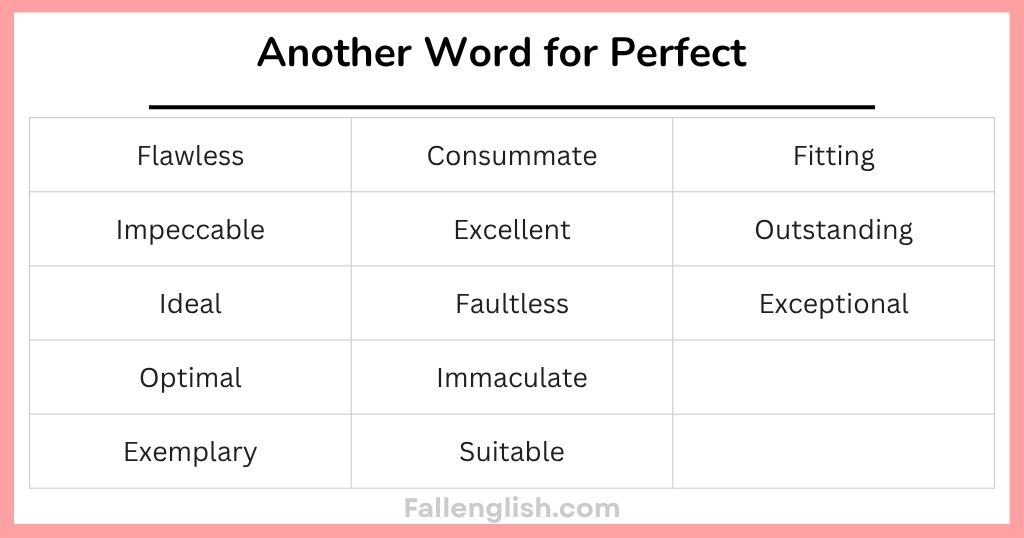
| Alternative | Best used when | Tone | Replaces perfect directly? |
| Flawless | Describing zero visible defects | Sleek, slightly elevated | Usually yes |
| Impeccable | Describing conduct, taste, or presentation | Formal, polished | Usually yes |
| Ideal | Describing the best fit for a purpose | Neutral to formal | Yes, in most cases |
| Optimal | Describing the most effective option among choices | Technical, clinical | Yes, in analytical writing |
| Exemplary | Describing something worth copying | Formal, approving | No — implies a standard |
| Consummate | Describing complete skill or expertise | Formal, literary | No — limited to skill contexts |
| Excellent | Describing very high quality | Broad, everyday | No — doesn’t mean flawless |
| Faultless | Describing absence of mistakes | Slightly formal | Usually yes |
| Immaculate | Describing cleanliness or spotless condition | Vivid, sometimes literal | Partially |
When You Mean “Without Defect”
This is the most literal sense of perfect — nothing wrong, nothing missing, nothing out of place.
Flawless is the closest match here. It works in almost every context where perfect means defect-free, and it often sounds slightly more specific and confident.
Her technique was flawless.
The diamond was flawless under magnification.
Faultless covers the same ground but reads a shade more formal. It appears more in writing than in speech.
Impeccable is strong for describing behavior, presentation, or taste — things that can be judged against a standard.
His manners were impeccable.
She has impeccable editorial judgment.
It sounds slightly odd applied to physical objects (“an impeccable stone” doesn’t quite land), which makes it narrower than flawless.
Immaculate usually refers to cleanliness or a spotless surface. You can use it figuratively, but it carries a visual image — whiteness, absence of stain — that perfect does not.
The kitchen was immaculate. ✓
Her performance was immaculate. — works, but carries a slightly unusual visual register
When You Mean “Best for the Purpose”
Perfect often doesn’t mean flawless — it means the right choice for a particular need. “This is the perfect tool for the job” doesn’t claim the tool is without defect; it claims the tool fits the situation ideally.
Ideal captures this meaning cleanly and is the most direct substitute in most sentences.
This is the ideal tool for the job.
The timing was ideal.
Optimal works well in technical, analytical, or professional writing where you’re comparing options and selecting the most effective one.
We adjusted conditions to find the optimal temperature.
This is the optimal route given current traffic.
Optimal implies a measurable best among alternatives. It doesn’t suit casual writing or emotional contexts well — “you’re the optimal person for this” sounds clinical rather than warm.
Suitable and fitting are weaker alternatives in this group. They don’t carry the sense of “the best possible” — only “acceptable” or “appropriate.” Don’t reach for them when you want to convey that something is genuinely the best match.
When You Mean “Of Very High Quality”
Sometimes perfect simply means excellent — the speaker doesn’t literally mean without flaw, only that something impressed them.
“That was a perfect meal.”
Here, excellent, outstanding, or exceptional all work, and they’re actually more honest — a meal can be outstanding without being technically flawless.
Exemplary means worthy of being used as a model or example. It’s approving and formal, more often used in professional evaluations or feedback.
Her work this quarter was exemplary.
It doesn’t replace perfect directly. It implies a comparison to a standard, which perfect does not always imply.
When You Mean Complete Mastery
Consummate is a specific and precise alternative when describing someone who has reached the highest possible level of a skill.
He is a consummate professional.
She is a consummate storyteller.
It works well in writing that calls for a slightly elevated or literary tone. In casual conversation it can sound stiff — “he’s a consummate barista” reads as deliberately ironic or playful.
The Tone Gap Between Close Alternatives
Flawless, impeccable, and perfect can all describe a high-quality result, but they don’t sound identical in a sentence.
Compare:
- “The presentation was perfect.” — warm, colloquial, natural
- “The presentation was flawless.” — sharper, more confident, slightly elevated
- “The presentation was impeccable.” — formal, best in professional contexts
If you’re writing a casual email or everyday conversation, perfect often sounds more natural than its formal replacements. The alternatives gain their value in writing where perfect is either too vague or too overused.
What Not to Substitute Directly
Absolute and complete sometimes appear in thesauruses near perfect, but they describe wholeness or totality, not quality or flawlessness. “That was a complete solution” doesn’t mean it was excellent — it means nothing was missing.
Pristine means original, unspoiled, or untouched condition. It suits physical objects and environments but doesn’t transfer smoothly to performance or character.
A pristine landscape ✓
A pristine performance — unusual; implies it was untouched rather than skillfully executed
Peerless and unrivaled mean without equal, which is a strong and specific claim. These are bigger words than perfect in most everyday uses, not safer or more precise ones.
Choosing the Right Another Word for Perfect
Use flawless when you want a direct, sharp substitute that emphasizes the absence of defect.
Use ideal when the meaning is “best suited for the purpose” rather than “without fault.”
Use optimal in analytical, technical, or professional writing where you’re selecting among measurable options.
Use impeccable for conduct, taste, presentation, or professional behavior in formal contexts.
Use excellent or outstanding when you mean very high quality — and when claiming flawlessness would be an overstatement.
Use consummate when describing someone who has reached the highest level of skill in a field.
The most common mistake is choosing a formal or sophisticated alternative when the original sentence simply calls for great or excellent. Not every replacement needs to be stronger or more elevated — sometimes a more honest word is the better one.
Read more:
Another Word for Prevention: Choosing the Right Alternative
Another Word for Powerful: Alternatives That Actually Fit Your Meaning
Another Word for Interest: Choosing the Right Alternative for Every Context

FallEnglish is run by a language enthusiast who explains word and text meanings in clear, simple ways. Each guide is carefully researched, original, and written to help real people understand language faster, with accuracy, context, and everyday examples you can trust.