

The word journey does a lot of different work — which is precisely why it can start to feel vague when you need something more precise.
Quick Answer
The most useful alternatives are trip, voyage, expedition, trek, travels, odyssey, and passage. They are not interchangeable. Trip is casual and short-range. Voyage implies water or distance. Expedition suggests purpose and planning. Trek implies physical difficulty. Odyssey carries literary weight and usually signals hardship or length. Passage is often figurative. The right choice depends on what kind of movement you are describing and what tone you want.
What Kind of Journey Are You Writing About?
Before choosing a replacement, identify which sense of journey you are using:
- Physical travel from one place to another
- A long or difficult physical experience (crossing a mountain range, surviving a long walk)
- An emotional or personal change over time
- A narrative arc in a story, speech, or essay
- A metaphorical process (a health journey, a spiritual journey)
Each meaning calls for different alternatives.
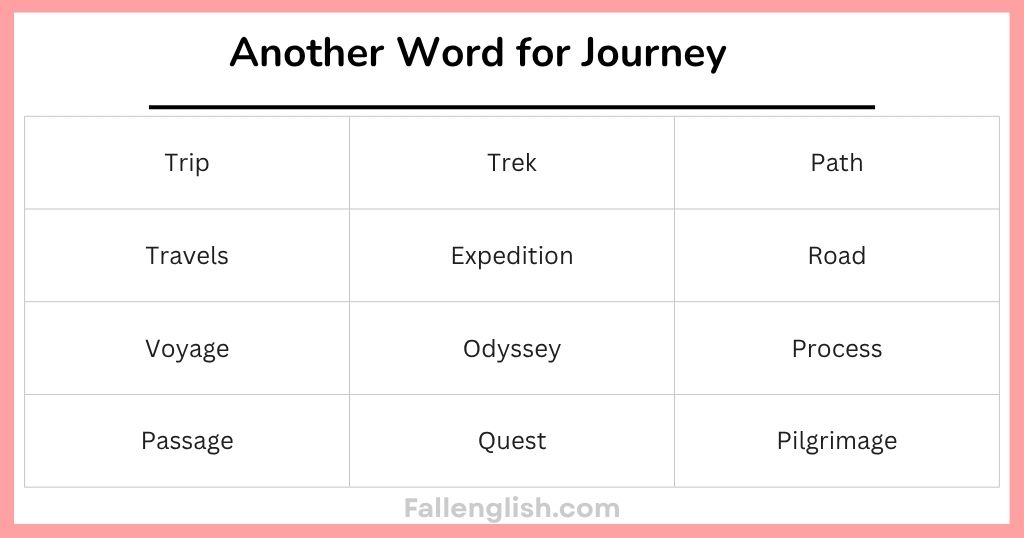
Another Word for Journey by Meaning
For ordinary physical travel
Trip is the most natural everyday replacement. It is shorter, simpler, and fits both spoken and written English without sounding forced.
The journey to the coast took four hours. → The trip to the coast took four hours.
Use trip when the travel is defined, round, and relatively short. It does not work as well for historical or epic movement — you would not describe Marco Polo’s explorations as a trip.
Travels (plural) works when the movement is extended, varied, or cumulative.
She documented her journey across Southeast Asia. → She documented her travels across Southeast Asia.
The plural form implies multiple places visited over time, not a single route.
For travel by sea or across great distance
Voyage is the natural choice when water, distance, or historic exploration is involved. It carries a sense of formality and scale.
The sailors set out on a dangerous journey. → The sailors set out on a dangerous voyage.
Voyage does not work well for land travel unless used figuratively or in a deliberately grand tone. Saying “a voyage through the countryside” sounds theatrical.
Passage overlaps with voyage in nautical contexts but is often more understated. It also carries a secondary meaning of transition — from one state or phase to another — which makes it useful in both literal and figurative writing.
For physically demanding travel
Trek implies difficulty, usually on foot, over uneven or remote terrain. It raises expectations about effort.
The journey through the mountains left them exhausted. → The trek through the mountains left them exhausted.
Trek has also moved into casual usage (“It’s a real trek to get to their new office”), where it exaggerates difficulty for effect. Context will determine whether readers take it literally.
Expedition goes further than trek. It suggests organized, purposeful travel — often scientific, geographic, or adventurous — with preparation, equipment, and a defined objective. If the journey is casual, expedition will sound overblown.
For long, difficult, or story-shaped experience
Odyssey refers to a long journey, usually marked by hardship, wandering, or unexpected obstacles. It comes from Homer’s Odyssey and still carries that literary echo. Use it when the journey genuinely involves struggle or complexity — not for a difficult commute or a tiring afternoon.
The refugee family’s journey across three countries lasted eighteen months. → The refugee family’s odyssey across three countries lasted eighteen months.
Odyssey raises the emotional stakes. That is its value, and its risk.
Quest is related but more specific: it implies travel in pursuit of something — a goal, an answer, an object. It fits narrative and metaphorical writing better than literal travel writing.
For figurative or emotional meaning
When journey describes personal change, growth, or experience over time (a grief journey, a recovery journey, a spiritual journey), the alternatives narrow considerably.
Path and road work as metaphors, but they emphasize direction and choice more than the experience of traveling itself.
Process is the plainest alternative. It strips the poetic framing entirely and focuses on steps or stages.
Her journey to sobriety took years. → Her path to sobriety took years. / Her recovery process took years.
Process is cleaner in medical, professional, or clinical writing, where journey can feel overly soft. Path works well in motivational, personal, or narrative writing.
Pilgrimage is worth noting here. It originally meant travel to a sacred site, but it now appears in both religious and secular writing to describe a journey undertaken with deep personal meaning.
Another Word for Journey Comparison at a Glance
| Alternative | Best used for | Tone |
| Trip | Everyday travel, defined and finite | Casual, neutral |
| Travels | Extended movement through multiple places | Reflective, narrative |
| Voyage | Sea travel, historic exploration, great distance | Formal, grand |
| Passage | Sea crossings; transition between phases | Understated, literary |
| Trek | Difficult travel on foot | Physical, effortful |
| Expedition | Organized purposeful travel | Serious, prepared |
| Odyssey | Long, hard, wandering experience | Literary, dramatic |
| Quest | Travel in pursuit of a specific goal | Narrative, purposeful |
| Path | Figurative: direction of change or growth | Reflective, motivational |
| Process | Figurative: structured stages of change | Neutral, clinical |
| Pilgrimage | Travel (or experience) of deep personal meaning | Reverent, meaningful |
Where Writers Go Wrong
Odyssey for small things. If the difficulty is ordinary, odyssey oversells it. A long drive through traffic is not an odyssey. A family fleeing a collapsing country arguably is.
Expedition for casual travel. Expedition implies preparation, purpose, and scale. Using it loosely makes the writing sound ironic — sometimes intentionally, often not.
Trek used literally when it is not foot travel. Trek works metaphorically (“it’s a real trek to get an appointment”), but in travel writing, readers expect actual walking.
Journey as a universal filler word. In professional and corporate writing, journey has become overused — the customer journey, the brand journey, the leadership journey. In these contexts, path, experience, or process are often plainer and more honest.
A Note on Tone
Journey itself is not a weak word. It is flexible, recognizable, and carries genuine warmth. The reason to replace it is usually one of three: it is being repeated, the context calls for more precision, or the scale or difficulty you want to describe is not captured by a word that covers everything from a half-hour drive to a life-altering experience.
Choose the alternative that narrows the meaning to exactly what you intend — not the one that sounds the most impressive.
Read more you may also like:
Another Word for Perfect: Choosing the Right Alternative
Another Word for In Addition: Choosing the Right Connective
Another Word for Interest: Choosing the Right Alternative for Every Context
Another Word for Powerful: Alternatives That Actually Fit Your Meaning

FallEnglish is run by a language enthusiast who explains word and text meanings in clear, simple ways. Each guide is carefully researched, original, and written to help real people understand language faster, with accuracy, context, and everyday examples you can trust.