


From DNA in biology class to density in physics experiments, the letter D carries a surprising amount of scientific weight. Whether you’re studying for a test, helping a child with homework, or just curious about a term you came across, this guide covers the most useful science words starting with D — across biology, chemistry, physics, earth science, and more.
Quick Reference: Common Science Words Start With D
| Word | Field | Meaning |
| Density | Physics | Mass per unit volume of a substance |
| DNA | Biology | Molecule carrying genetic instructions |
| Diffusion | Chemistry/Biology | Movement of particles from high to low concentration |
| Decomposition | Biology | Breakdown of dead matter by organisms |
| Diameter | Math/Science | Straight line through the center of a circle |
| Drought | Earth Science | Extended period of below-normal rainfall |
| Dwarf planet | Astronomy | Small planet-like body that hasn’t cleared its orbit |
| Dormant | Biology | State of reduced activity, like a sleeping volcano or seed |
| Delta | Earth Science | Fan-shaped landform at a river’s mouth |
| Deoxyribose | Chemistry | Sugar molecule that forms part of the DNA backbone |
Biology Science Words Start With D
DNA (Deoxyribonucleic Acid)
The molecule inside every cell that carries the instructions for building and running a living organism. It’s shaped like a twisted ladder — the famous double helix.
Diffusion
When particles spread out from a crowded area to a less crowded one — naturally, without any energy needed. The smell of perfume spreading across a room is diffusion in action.
Decomposition
Dead leaves, fallen trees, and animal remains don’t just sit there forever. Decomposers like bacteria and fungi break them down, returning nutrients to the soil.
Dominant (Gene)
In genetics, the trait that shows up when two different versions of a gene are present. Brown eyes are dominant over blue, for example.
Diploid
A cell with two complete sets of chromosomes. Most human body cells are diploid (written as 2n). Sperm and egg cells are not — they’re haploid.
Dormant
Not dead, just paused. Seeds stay dormant until conditions are right to sprout. Volcanoes can stay dormant for centuries before erupting again.
Dichotomous Key
A step-by-step tool scientists use to identify organisms by asking yes/no questions about their features. Commonly used in field biology.
Digestion
The process of breaking food into smaller molecules the body can absorb and use. Starts in the mouth, finishes in the small intestine.
Diaphragm
The dome-shaped muscle below the lungs that controls breathing. When it contracts, it pulls air in. When it relaxes, air flows out.
Dendrite
The branched extensions of a nerve cell (neuron) that receive incoming signals from other neurons.
Dicot
A flowering plant whose seed has two embryonic leaves (cotyledons). Roses, beans, and sunflowers are dicots. Compare with monocots like grass and corn.
Dermis
The layer of skin beneath the outer epidermis. It contains blood vessels, nerve endings, sweat glands, and hair follicles.
Diastole
The phase when the heart muscle relaxes and the chambers fill with blood — the lower number in a blood pressure reading (e.g., 80 in 120/80).
Denaturation
What happens when a protein loses its shape due to heat, acid, or other stresses. Cooking an egg is a classic example — the clear albumin turns white and solidifies as proteins denature.
Chemistry Science Words Start With D
Density
Mass divided by volume. A dense object packs more mass into less space. Gold is dense; foam is not. This is why a tiny gold ring feels heavier than a large sponge.
Decomposition Reaction
A chemical reaction where one compound breaks down into two or more simpler substances. Heating baking soda causes it to decompose into sodium carbonate, water, and carbon dioxide.
Distillation
A method for separating mixtures by heating them so one component evaporates first, then cooling the vapor to collect the purified liquid. Used to purify water and make alcohol.
Dipole
A molecule or bond with one slightly positive end and one slightly negative end. Water is a classic dipole — this uneven charge is why it dissolves so many things.
Dissociation
When a compound splits into its ions in water. Table salt (NaCl) dissociates into Na⁺ and Cl⁻ ions when dissolved.
Dioxin
A group of highly toxic chemical compounds that form as byproducts of industrial processes. They persist in the environment and accumulate in the food chain.
Deuterium
A heavier version (isotope) of hydrogen with one proton and one neutron instead of just a proton. Sometimes called “heavy hydrogen.” Used in nuclear research.
Desiccation
Extreme drying out. In chemistry and biology, desiccation refers to removing nearly all moisture from a substance or organism.
Dalton (Da)
A unit of mass used at the atomic and molecular scale. One dalton equals approximately the mass of one proton. Proteins are measured in kilodaltons (kDa).
Deliquescence
When a substance absorbs so much moisture from the air that it dissolves in it. Certain salts do this on humid days.
Physics Science Words Start With D
Decibel (dB)
The unit used to measure sound intensity. A whisper is about 30 dB. A jet engine can reach 140 dB — loud enough to cause immediate hearing damage.
Diffraction
The bending of waves — light, sound, or water — around obstacles or through openings. It’s why you can hear someone talking around a corner even when you can’t see them.
Displacement
In physics, displacement is the change in position of an object — direction matters. Walking 5 meters north and then 5 meters south gives you zero displacement, even though you moved 10 meters total.
Drag
The resistance force that opposes motion through a fluid or gas. Aerodynamic car designs and streamlined fish shapes both exist to reduce drag.
Doppler Effect
The change in observed frequency of a wave when the source or observer is moving. The rising and falling pitch of a passing ambulance siren is the Doppler effect in everyday life.
Dark Matter
A form of matter that doesn’t emit or absorb light but exerts gravitational effects. Scientists can’t observe it directly but infer its existence from how galaxies behave.
Dynamo
A device that converts mechanical energy into electrical energy using magnetic fields. The principle behind electric generators.
Ductility
The ability of a material to be stretched into a thin wire without breaking. Copper is highly ductile — that’s why electrical wires are made from it.
Decoupling
In cosmology, the moment in the early universe when photons separated from matter and traveled freely — producing what we now detect as the cosmic microwave background.
Dipole Moment
A measurement of the separation of positive and negative charges in a molecule. Useful in predicting how molecules interact with each other and with electric fields.
Earth Science Terms Starting With D
Delta
When a river slows as it meets a larger body of water, it drops sediment in a fan-shaped deposit called a delta. The Nile Delta and Mississippi Delta are two of the world’s most famous.
Deposition
The laying down of sediment carried by water, wind, or ice. Deposition builds landforms like beaches and deltas. (Not to be confused with the chemistry term for a gas turning directly into a solid.)
Drought
An extended period of significantly below-average precipitation. Droughts stress water supplies, agriculture, and ecosystems.
Dune
A hill of sand shaped by wind. Dunes move slowly over time as wind picks up grains from one side and deposits them on the other.
Dike (Geology)
A sheet of igneous rock that cuts across existing rock layers, formed when magma forces its way into a crack and solidifies.
Denudation
The long-term wearing away of rock and land by weathering and erosion. Denudation gradually lowers entire mountain ranges over millions of years.
Discharge (River)
The volume of water flowing past a point in a river per unit time. Heavy rainfall and snowmelt increase river discharge dramatically.
Read also: Science Words That Start With C: Biology, Chemistry, Physics, and More
Astronomy Science Words Start With D
Dwarf Planet
A body that orbits the Sun, has enough gravity to be roughly spherical, but hasn’t gravitationally cleared other objects from its orbital path. Pluto is the most well-known dwarf planet.
Dark Energy
A mysterious form of energy thought to make up about 68% of the universe. It’s the leading explanation for why the universe’s expansion is speeding up rather than slowing down.
Declination
The astronomical equivalent of latitude — it measures how far north or south an object sits in the sky relative to the celestial equator.
Double Star
Two stars that appear close together in the sky. True binary stars orbit each other; optical doubles just look close from Earth but are actually far apart in space.
Dust Lane
A dark band visible in galaxies where dense clouds of gas and dust block light from stars behind them. Often visible in edge-on spiral galaxies.
Medical and Human Biology Terms Starting With D
Diagnosis
The identification of a disease or condition based on signs, symptoms, and test results.
Dialysis
A medical procedure that filters waste products from the blood when the kidneys can no longer do so. Patients typically need sessions several times per week.
Dyslexia
A neurological condition that affects reading ability, making it harder to decode words accurately and fluently. It’s not related to intelligence.
Diabetes
A group of conditions where the body can’t properly regulate blood sugar. Type 1 involves an immune attack on insulin-producing cells; Type 2 involves insulin resistance.
Dementia
A syndrome involving progressive decline in memory, thinking, and other cognitive abilities. Alzheimer’s disease is the most common cause.
Disinfectant
A chemical agent that destroys or inactivates microorganisms on surfaces. Different from antiseptics, which are used on living tissue.
Environmental and Ecology Science Words Start With D
Deforestation
The large-scale removal of forest cover, usually for agriculture, logging, or urban development. It reduces biodiversity, disrupts water cycles, and releases stored carbon.
Desertification
The process by which fertile land becomes increasingly dry and desert-like, often due to climate change, drought, or poor land management.
Denitrification
Part of the nitrogen cycle — bacteria convert nitrates in soil back into nitrogen gas, which returns to the atmosphere.
DDT
A chemical pesticide once widely used that was later found to accumulate in food chains, thinning bird eggshells and threatening species like the bald eagle. Banned in many countries since the 1970s.
Dead Zone
An area in water with so little oxygen that most marine life cannot survive. Often caused by excess fertilizer runoff triggering massive algae blooms.
A Few Terms Worth Distinguishing
Diffusion vs. Osmosis
Both involve particles moving from high to low concentration — but osmosis specifically involves water moving across a semi-permeable membrane. Diffusion applies to any particle in any medium.
Dominant vs. Recessive
A dominant gene trait appears even when only one copy is present. A recessive trait only shows when both copies of the gene carry it. Neither is “better” — it’s just about expression.
Deposition (Earth Science) vs. Deposition (Chemistry)
In earth science, deposition means sediment settling. In chemistry and physics, deposition means a gas changing directly into a solid without passing through a liquid phase — like frost forming on a window.
Diameter vs. Radius
Both describe size of a circle, but diameter crosses the full width through the center; radius goes from center to edge. Diameter = 2 × radius.
Read more: Science Words That Start With F – Definitions & Examples
Complete Science Words Start With D List
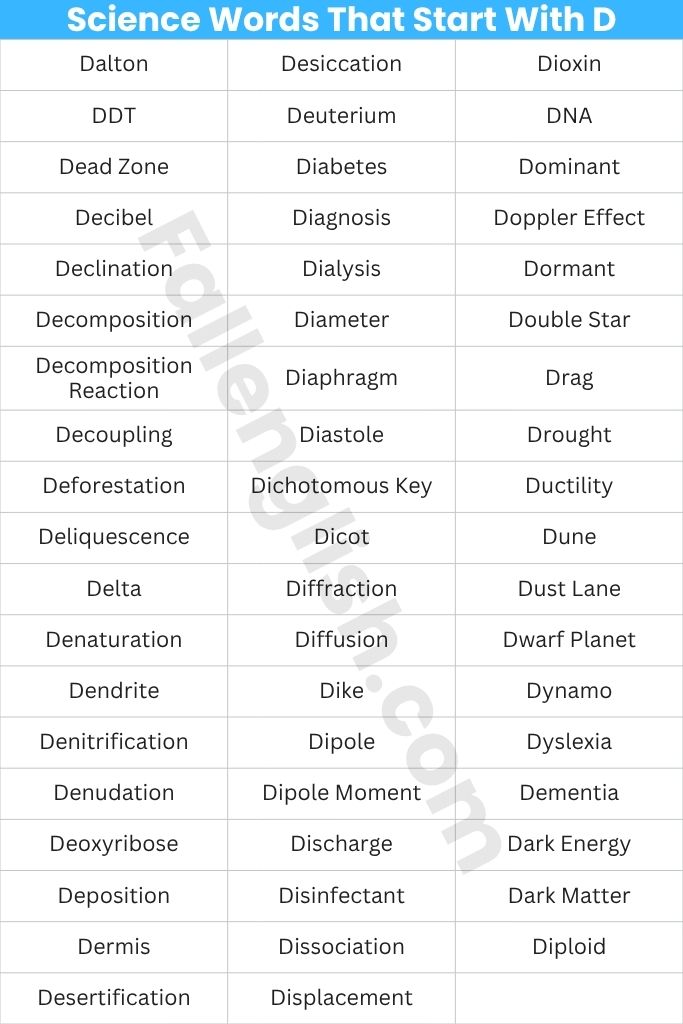
| Word | Field | Short Meaning |
| Dalton | Chemistry | Atomic mass unit |
| DDT | Environmental Science | Banned toxic pesticide |
| Dead Zone | Ecology | Oxygen-depleted water area |
| Decibel | Physics | Unit of sound intensity |
| Declination | Astronomy | Celestial coordinate (north-south) |
| Decomposition | Biology | Breakdown of dead organic matter |
| Decomposition Reaction | Chemistry | One compound breaking into simpler substances |
| Decoupling | Cosmology | Early universe photon-matter separation |
| Deforestation | Environmental Science | Large-scale forest removal |
| Deliquescence | Chemistry | Absorbing moisture until dissolved |
| Delta | Earth Science | Sediment deposit at river mouth |
| Denaturation | Biology/Chemistry | Protein losing its shape |
| Dendrite | Biology | Neuron extension that receives signals |
| Denitrification | Ecology | Conversion of nitrates to nitrogen gas |
| Denudation | Earth Science | Long-term wearing away of rock |
| Deoxyribose | Chemistry | Sugar in the DNA backbone |
| Deposition | Earth Science / Chemistry | Sediment settling; gas to solid |
| Dermis | Biology | Layer of skin beneath the epidermis |
| Desertification | Environmental Science | Fertile land becoming desert-like |
| Desiccation | Chemistry/Biology | Extreme drying |
| Deuterium | Chemistry | Heavy hydrogen isotope |
| Diabetes | Medical | Blood sugar regulation disorder |
| Diagnosis | Medical | Identifying a disease or condition |
| Dialysis | Medical | Blood filtration procedure |
| Diameter | General Science | Width of a circle through its center |
| Diaphragm | Biology | Breathing muscle below the lungs |
| Diastole | Medical | Heart’s relaxation phase |
| Dichotomous Key | Biology | Tool for identifying organisms |
| Dicot | Biology | Flowering plant with two seed leaves |
| Diffraction | Physics | Wave bending around obstacles |
| Diffusion | Biology/Chemistry | Particle movement, high to low concentration |
| Dike | Geology | Sheet of igneous rock cutting across layers |
| Dipole | Chemistry | Molecule with unequal charge distribution |
| Dipole Moment | Chemistry | Measurement of charge separation |
| Discharge | Earth Science | Volume of river water flow |
| Disinfectant | Medical | Surface microorganism-killing agent |
| Dissociation | Chemistry | Compound splitting into ions in solution |
| Displacement | Physics | Change in position with direction |
| Dioxin | Chemistry | Toxic industrial byproduct compound |
| DNA | Biology | Genetic instruction molecule |
| Dominant | Genetics | Trait expressed over a recessive one |
| Doppler Effect | Physics | Frequency shift due to motion |
| Dormant | Biology | State of reduced biological activity |
| Double Star | Astronomy | Two stars appearing close in sky |
| Drag | Physics | Resistance force through fluid/gas |
| Drought | Earth Science | Extended period of low rainfall |
| Ductility | Physics/Materials | Ability to be drawn into wire |
| Dune | Earth Science | Wind-shaped sand hill |
| Dust Lane | Astronomy | Dark band of gas/dust in a galaxy |
| Dwarf Planet | Astronomy | Orbital body not clearing its path |
| Dynamo | Physics | Mechanical-to-electrical energy converter |
| Dyslexia | Medical/Neuroscience | Reading and decoding difficulty |
| Dementia | Medical | Progressive cognitive decline |
| Dark Energy | Cosmology | Energy driving universe’s expansion |
| Dark Matter | Cosmology | Invisible gravitational matter |
| Diploid | Biology | Cell with two chromosome sets |
The letter D spans an impressive range — from the genetic code inside your cells (DNA) to the forces slowing a car down (drag), and from the dry riverbeds shaped by drought to the dark energy reshaping the entire universe. These aren’t just vocabulary words; they’re the building blocks of how scientists describe the natural world.

FallEnglish is run by a language enthusiast who explains word and text meanings in clear, simple ways. Each guide is carefully researched, original, and written to help real people understand language faster, with accuracy, context, and everyday examples you can trust.