

From fusion powering stars to fossils buried in ancient rock, the letter F covers a surprisingly wide stretch of scientific vocabulary. Whether you’re preparing for a biology quiz, helping with homework, or just curious about a word you encountered in class, this list covers the most useful F-words across the major branches of science.
Quick Reference: Common F Science Words
| Word | Field | Meaning |
| Fauna | Biology | All animal life in a particular region |
| Flora | Biology | All plant life in a particular region |
| Fossil | Earth Science | Preserved remains of ancient organisms |
| Frequency | Physics | Number of wave cycles per second |
| Friction | Physics | Resistance force between surfaces |
| Fusion | Physics/Chemistry | Combining of nuclei or substances |
| Fermentation | Chemistry/Biology | Breakdown of sugars without oxygen |
| Filament | Biology/Physics | Thin thread-like structure |
| Fission | Physics | Splitting of an atomic nucleus |
| Fungus | Biology | Organism in the kingdom Fungi |
Biology Science Words That Start With F
Fauna
All the animal life native to a specific region or time period. A rainforest’s fauna includes everything from jaguars to beetles.
Flora
The plant life of a region — the counterpart to fauna. Scientists study both together to understand an ecosystem.
Flagellum
A whip-like tail found on some bacteria and sperm cells, used for movement. Bacteria can have one or several flagella.
Filament
In plants, the stalk of a stamen that holds up the anther. In other contexts, any long, thin thread-like biological structure.
Fermentation
A metabolic process where cells break down sugars without oxygen, producing alcohol or lactic acid. Bread rising and yogurt forming are both results of fermentation.
Fetus
A developing mammal in the womb after the embryonic stage. In humans, the fetal stage begins around week 9 of pregnancy.
Follicle
A small sac or cavity in the body. Hair follicles anchor hair to the skin; ovarian follicles develop eggs.
Food Web
A diagram showing feeding relationships within an ecosystem — more complex than a simple food chain because it shows how multiple organisms interconnect.
Fungi (Fungus)
A kingdom of organisms that includes mushrooms, molds, and yeasts. Fungi break down dead matter and are essential decomposers.
Fertilization
The union of a sperm and egg to form a zygote. It’s the moment that begins the development of a new organism.
Fibula
The smaller of the two bones in the lower leg, running alongside the tibia.
Fascia
Connective tissue that wraps around muscles and organs, giving the body structure.
Foramen
An opening or hole in a bone through which nerves and blood vessels pass. The foramen magnum is the opening in the skull where the spinal cord connects to the brain.
Frond
The leaf-like structure of a fern or palm. Fern fronds uncurl as they grow.
Physics Science Words That Start With F
Force
A push or pull that can change an object’s motion. Measured in Newtons (N).
Frequency
How many wave cycles pass a point per second. Measured in Hertz (Hz). Higher frequency = higher pitch in sound, higher energy in light.
Friction
The resistance force between two surfaces in contact. Without friction, you couldn’t walk or stop a moving car.
Fission
The splitting of a heavy atomic nucleus (like uranium) into smaller nuclei, releasing large amounts of energy. Nuclear power plants use fission.
Fusion
The joining of two light nuclei (like hydrogen) to form a heavier one, releasing even more energy than fission. The sun runs on fusion.
Fluid
Any substance that flows — both liquids and gases count as fluids in physics.
Focal Point
The point where light rays converge after passing through a lens or reflecting off a mirror. Cameras and eyes both rely on focal points.
Free Fall
Motion under gravity alone, with no air resistance. Astronauts in orbit experience constant free fall.
Flux
The rate of flow of a field (like magnetic or electric flux) through a surface. Used heavily in electromagnetism.
Farad (F)
The SI unit of electrical capacitance. Named after scientist Michael Faraday.
Chemistry Science Terms Starting With F
Fluorine
Element 9 on the periodic table — the most electronegative element known. Highly reactive and found in toothpaste compounds (fluoride).
Filtration
A separation technique that uses a porous barrier to remove solid particles from a liquid or gas.
Formula
A symbolic representation of a substance. H₂O is the chemical formula for water.
Functional Group
A specific group of atoms in an organic molecule that determines its chemical behavior. The hydroxyl group (–OH) makes a molecule an alcohol.
Fission (Nuclear)
See Physics section — also a core chemistry concept when discussing nuclear reactions.
Flammability
How easily a substance catches fire. Hydrogen has very high flammability; nitrogen gas has essentially none.
Foam
A colloid in which gas bubbles are trapped within a liquid or solid. Shaving cream and sea foam are everyday examples.
Fatty Acid
A long-chain carboxylic acid that forms the building blocks of fats and oils. Saturated and unsaturated fatty acids differ by whether their carbon chains contain double bonds.
Free Radical
An atom or molecule with an unpaired electron, making it highly reactive. Free radicals play roles in both cell damage and certain chemical reactions.
Earth Science Terms Starting With F
Fossil
Preserved evidence of ancient life — bones, shells, imprints, or even footprints — found in rock. Fossils let scientists reconstruct life from millions of years ago.
Fault
A fracture in Earth’s crust where two blocks of rock have moved relative to each other. Earthquakes often occur along fault lines.
Fjord
A long, narrow inlet carved by a glacier, flanked by steep cliffs. Norway’s coastline is famous for them.
Floodplain
The flat land beside a river that gets covered with water during floods. Rich in nutrients, floodplains make excellent farmland.
Foliation
Layered or banded texture found in metamorphic rocks like slate and schist, formed under intense pressure.
Front (Weather)
The boundary between two air masses of different temperatures. A cold front brings storms; a warm front brings gradual warming.
Fracture
In mineralogy, the way a mineral breaks along irregular surfaces (as opposed to cleavage, which is smooth).
Astronomy Science Terms Starting With F
Flare (Solar Flare)
A sudden burst of radiation from the sun’s surface, sometimes strong enough to disrupt Earth’s communications.
Full Moon
The lunar phase when the entire face of the moon is illuminated by the sun as seen from Earth.
Fusion (Stellar)
The process powering stars — hydrogen atoms fuse into helium in a star’s core, releasing the light and heat we see.
Flyby
When a spacecraft travels close to a planet or moon for observation without entering orbit. NASA’s Voyager probes performed famous flybys.
Medical and Human Biology Terms Starting With F
Femur
The thigh bone — the longest and strongest bone in the human body.
Frontal Lobe
The front section of the brain’s cerebral cortex, involved in decision-making, personality, and voluntary movement.
Fibrin
A protein that forms the mesh-like structure of blood clots, helping stop bleeding after injury.
Fever
An elevated body temperature triggered by the immune system in response to infection. It’s a defense mechanism, not just a symptom.
Environmental Science Words That Start With F
Food Chain
A linear sequence showing how energy passes from one organism to another — grass → rabbit → fox, for example.
Fossil Fuel
Coal, oil, and natural gas — fuels formed from the remains of ancient organisms over millions of years. Burning them releases stored carbon.
Fragmentation (Habitat)
When continuous habitat is broken into isolated patches, usually by human activity. It’s a major driver of biodiversity loss.
Fen
A type of wetland fed by groundwater, typically with low acidity. Different from a bog, which relies on rainwater and is more acidic.
Easy to Confuse: F Words Worth Clarifying
Fission vs. Fusion
Both are nuclear reactions, but they’re opposites. Fission splits heavy atoms; fusion joins light ones. Both release energy, but fusion releases far more — and current nuclear plants use fission, not fusion.
Flora vs. Fauna
Flora = plants, fauna = animals. A simple anchor: flora shares its root with “flower.”
Frequency vs. Amplitude
Frequency is how often a wave repeats; amplitude is how large (tall) each wave is. In sound, frequency controls pitch, amplitude controls volume.
Fault vs. Fracture
In geology, a fault involves movement of rock on both sides; a fracture is simply a break in rock with no significant displacement.
Read also: Science Words That Start With C: Biology, Chemistry, Physics, and More
Complete Alphabetical Reference List of Science Words That Start With F
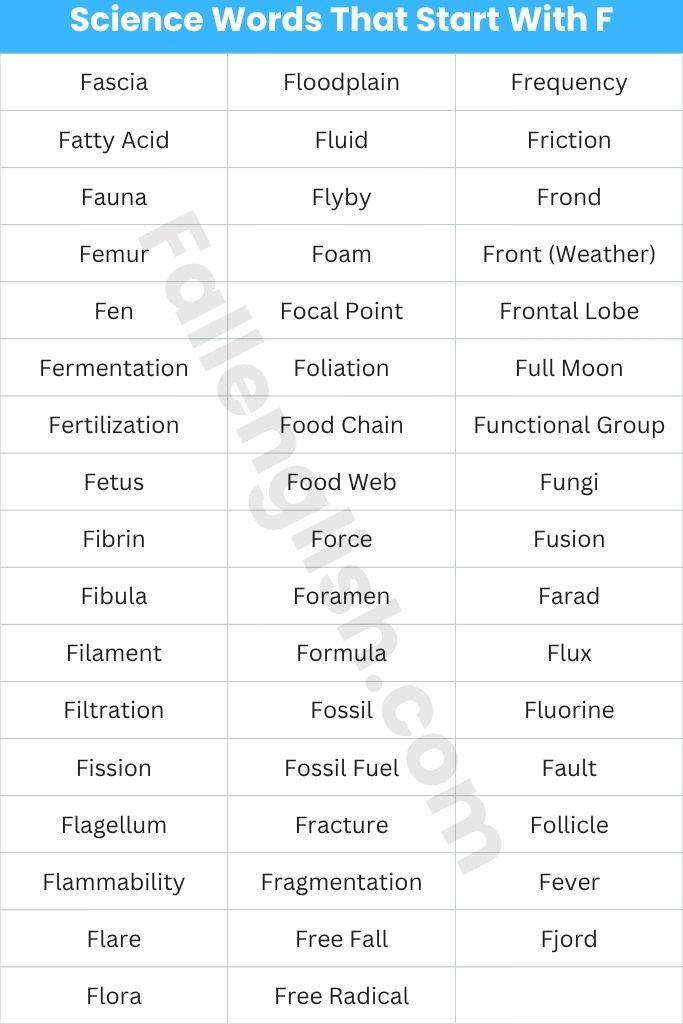
| Word | Field | Definition |
| Fascia | Biology | Connective tissue wrapping muscles and organs |
| Fatty Acid | Chemistry | Long-chain carboxylic acid; building block of fats |
| Fauna | Biology | Animal life of a region |
| Femur | Human Biology | The thigh bone |
| Fen | Environmental Science | Alkaline groundwater-fed wetland |
| Fermentation | Biology/Chemistry | Sugar breakdown without oxygen |
| Fertilization | Biology | Union of sperm and egg |
| Fetus | Biology | Developing organism after embryonic stage |
| Fibrin | Human Biology | Blood clotting protein |
| Fibula | Human Biology | Smaller lower-leg bone |
| Filament | Biology/Physics | Thin, thread-like structure |
| Filtration | Chemistry | Separation using a porous barrier |
| Fission | Physics | Splitting of an atomic nucleus |
| Flagellum | Biology | Whip-like structure used for movement |
| Flammability | Chemistry | How easily something catches fire |
| Flare | Astronomy | Sudden burst of solar radiation |
| Flora | Biology | Plant life of a region |
| Floodplain | Earth Science | Flat land beside a river prone to flooding |
| Fluid | Physics | Any substance that flows (liquid or gas) |
| Flyby | Astronomy | Close spacecraft pass of a planet |
| Foam | Chemistry | Gas-in-liquid or gas-in-solid colloid |
| Focal Point | Physics | Point where light rays converge |
| Foliation | Earth Science | Layered texture in metamorphic rocks |
| Food Chain | Environmental Science | Linear sequence of energy transfer |
| Food Web | Biology | Complex feeding relationships in an ecosystem |
| Force | Physics | Push or pull that changes motion |
| Foramen | Biology | Opening in bone for nerves/blood vessels |
| Formula | Chemistry | Symbolic representation of a substance |
| Fossil | Earth Science | Preserved remains of ancient life |
| Fossil Fuel | Environmental Science | Fuel from ancient organic remains |
| Fracture | Earth Science | Break in rock or mineral |
| Fragmentation | Environmental Science | Breakup of continuous habitat |
| Free Fall | Physics | Motion under gravity alone |
| Free Radical | Chemistry | Molecule with unpaired electron |
| Frequency | Physics | Wave cycles per second |
| Friction | Physics | Resistance between surfaces |
| Frond | Biology | Leaf structure of a fern or palm |
| Front (Weather) | Earth Science | Boundary between air masses |
| Frontal Lobe | Human Biology | Front section of the cerebral cortex |
| Full Moon | Astronomy | Fully illuminated lunar phase |
| Functional Group | Chemistry | Atom group determining molecule behavior |
| Fungi | Biology | Kingdom including mushrooms, molds, yeasts |
| Fusion | Physics/Astronomy | Joining of atomic nuclei |
| Farad | Physics | SI unit of electrical capacitance |
| Flux | Physics | Rate of field flow through a surface |
| Fluorine | Chemistry | Element 9; most electronegative element |
| Fault | Earth Science | Fracture in Earth’s crust with rock movement |
| Follicle | Biology | Small body sac or cavity |
| Fever | Human Biology | Elevated body temperature from immune response |
| Fjord | Earth Science | Glacier-carved coastal inlet |
This collection spans biology, physics, chemistry, earth science, astronomy, and environmental science — which means an F word will likely show up in almost any science class you take. The ones worth learning first: force, frequency, fusion, fission, fermentation, fossil, and food web. Those seven alone cover a meaningful chunk of school science.

FallEnglish is run by a language enthusiast who explains word and text meanings in clear, simple ways. Each guide is carefully researched, original, and written to help real people understand language faster, with accuracy, context, and everyday examples you can trust.