

Science words can feel overwhelming when you meet them for the first time, especially when they appear on homework, quizzes, or in textbooks.
This guide to Science Words That Start With J brings together the most useful terms from biology, physics, chemistry, astronomy, earth science, and medicine.
Each word includes a simple meaning so students, parents, teachers, and English learners can understand it quickly and use it with confidence in class and everyday study.
10 Most Common J Science Words
Joule — Standard unit of energy
Joint — Where two bones meet
Jupiter — Largest planet in the solar system
Jet stream — Fast high-altitude wind current
Jawbone — Lower jaw bone
Jugular — Neck vein carrying blood from brain
Juvenile — Young or early-stage organism
Jurassic — Geological period, 201–145 million years ago
Junction — Point where two things connect or meet
Jejunum — Middle section of the small intestine
20 Most-Used Science Words That Start With J
Learn these first. They appear most often across textbooks, exams, and classroom discussions.
Joule — Standard unit of energy. Lifting a book, charging a phone, running a motor — all measured in joules.
Joint — Where two bones connect. Knee, elbow, knuckles — all joints, all different types.
Jupiter — Fifth planet from the sun. Biggest in the solar system. Its Red Spot is a storm running for over 350 years.
Jet stream — A narrow band of very fast wind, 8–15 km above Earth. Shapes weather patterns and shortens flight times.
Jawbone (Mandible) — The lower jaw. Only movable bone in the human skull.
Jugular vein — Large neck vein returning blood from the brain to the heart.
Juvenile — The young stage of an organism before it reaches adult form. A tadpole is the juvenile stage of a frog.
Jurassic — Earth’s middle dinosaur era, roughly 201–145 million years ago. Continents were still splitting apart.
Junction — Where two things meet and interact. Means different things in biology, electronics, and geology — context decides which.
Jejunum — Middle third of the small intestine. Most nutrient absorption happens here.
Joule-Thomson effect — Gas cools when it expands. The science behind refrigerators and air conditioners.
Jaundice — Skin and eyes turn yellow when bilirubin builds up. Usually points to a liver issue.
Jet propulsion — Push gas backward, object moves forward. Newton’s third law driving every rocket and jet engine.
Jetting — Forcing high-pressure water into ground to break up soil or rock. Used in geology and construction.
Jamming (physics) — When a packed material suddenly stops flowing. Sand clogging a chute. Foam holding its shape.
J-wave — A distinct bump on a heart monitor reading. Doctors look for it in cold-related cardiac events.
Juxtaglomerular cells — Kidney cells that detect falling blood pressure and trigger hormone release to correct it.
J-coupling — In chemistry, atoms in a molecule influence each other through bonds. This interaction helps identify unknown compounds.
Juvenile hormone — Chemical in insects that keeps them in larval form. When it drops, they mature into adults.
Jökulhlaup — Sudden glacial flood triggered by volcanic heat melting ice from below. Iceland experiences these dramatically.
Physics Science Words That Start With J
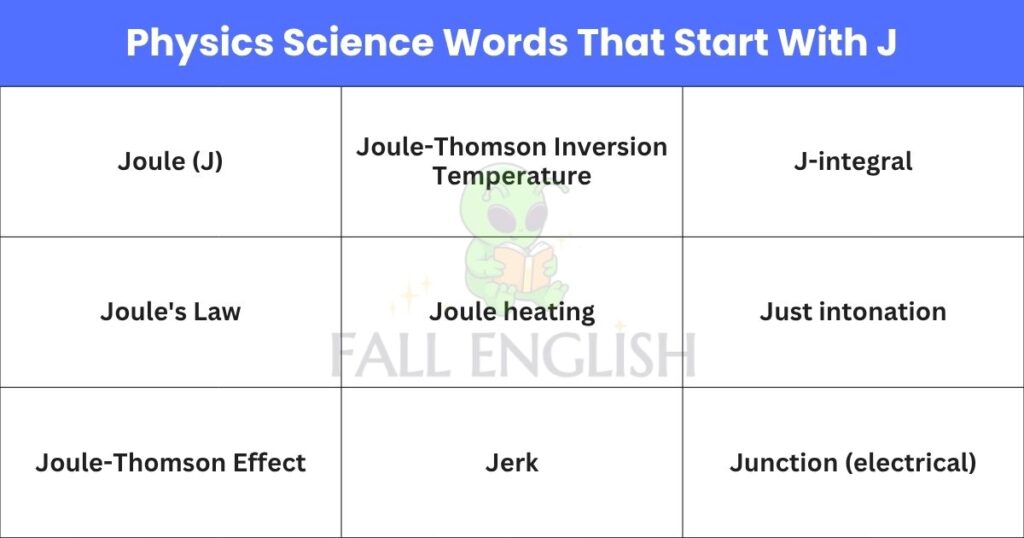
Joule (J) — Named after James Prescott Joule. The energy used applying one newton of force across one meter. Every battery, bulb, and moving object connects back to this unit.
Joule’s Law — Heat produced in a wire equals current squared multiplied by resistance. This is exactly why phone chargers get warm.
Joule-Thomson Effect — A gas expands, temperature drops — without any outside cooling involved. Refrigeration and air conditioning both depend on this.
Joule-Thomson Inversion Temperature — Above this temperature, a gas warms instead of cools when expanded. Each gas has its own value. Critical for industrial gas liquefaction.
Joule heating — Heat generated when electricity fights resistance. Toasters and electric heaters run entirely on this principle.
Jerk — Rate at which acceleration changes. A real physics measurement, not an insult. You physically feel jerk every time an elevator starts or stops.
J-integral — Mathematical tool for analyzing crack behavior in solid materials. Used in bridge and aircraft design to predict structural failure before it happens.
Just intonation — Tuning system based on pure frequency ratios. Connects physics directly to music.
Junction (electrical) — Where two semiconductor materials meet inside a chip. The core of how diodes and transistors work — meaning it’s the core of how all modern electronics work.
Chemistry Science Words That Start With J
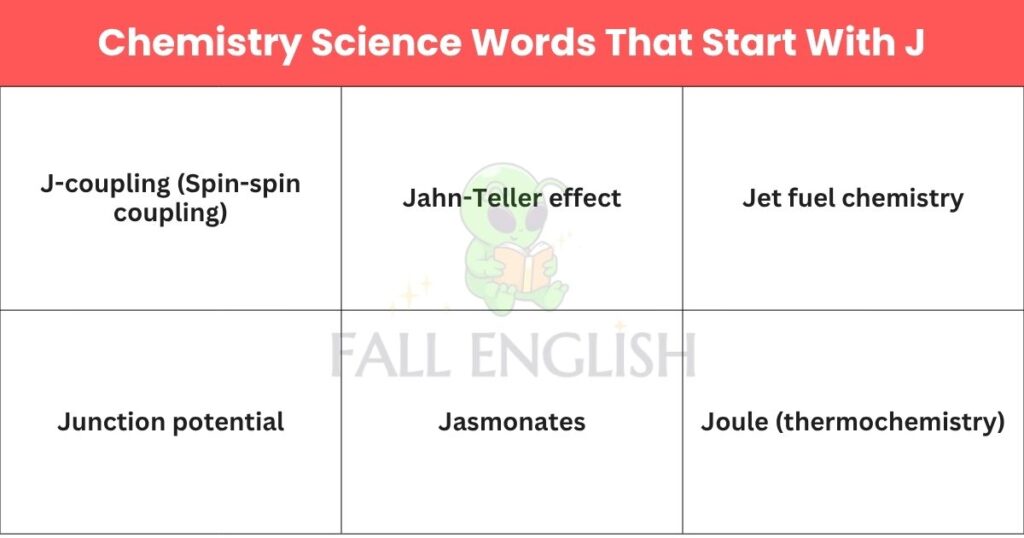
J-coupling (Spin-spin coupling) — Atoms in molecules talk to each other through chemical bonds. In NMR spectroscopy, J-coupling tells chemists exactly how atoms are connected — essential for identifying unknown substances in labs.
Junction potential — A small voltage that forms where two different liquids meet, like inside a battery. Electrochemists measure it carefully because it affects accuracy.
Jahn-Teller effect — Some molecules distort their shape to reach a more stable, lower-energy state. Matters significantly when designing transition metal compounds and certain electronic materials.
Jasmonates — Natural plant chemicals. When an insect attacks a plant, jasmonates trigger the plant’s internal defense response — essentially a chemical alarm system.
Jet fuel chemistry — Jet fuel is a precise mixture of hydrocarbons. Its chemical composition determines energy output, how low a temperature it can handle before freezing, and how safely it burns.
Joule (thermochemistry) — Energy changes in chemical reactions are always expressed in joules or kilojoules. Hand warmers releasing heat, cold packs absorbing it — both measured in joules.
Biology Science Words That Start With J
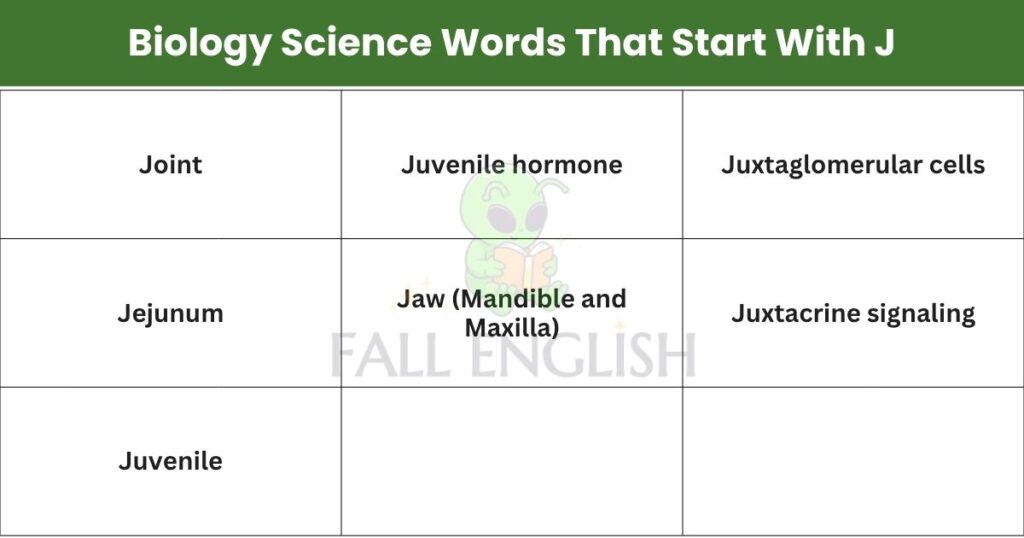
Joint — Three main types matter in biology. Ball-and-socket joints (hip, shoulder) rotate freely in all directions. Hinge joints (knee, elbow) move in one plane only. Pivot joints (top of spine, neck) allow rotation. Same word, three different mechanical designs.
Jejunum — Roughly 2.5 meters long in adults. Sits between the duodenum and ileum. The lining is covered in tiny finger-like projections called villi that dramatically increase absorption surface area.
Juvenile — Applies across all animal groups. Young deer = fawn. Young fish = fry. Young birds before adult plumage = juvenile. The term specifically means sexually immature, not just small.
Juvenile hormone — Keeps insects in their larval stage. Scientists have synthesized artificial versions used as eco-friendly pesticides — they prevent insects from maturing into reproductive adults without using toxic chemicals.
Jaw (Mandible and Maxilla) — The mandible (lower) moves. The maxilla (upper) is fixed to the skull. Together they handle chewing, airway management, and speech production. In fish, jaw evolution was one of the biggest leaps in vertebrate history.
Juxtaglomerular cells — Sit beside kidney filtering units called glomeruli. Release renin when blood pressure drops, triggering a hormone chain that tightens blood vessels and restores pressure.
Juxtacrine signaling — Cell communication that only works when two cells are physically touching. No chemical messenger travels through the blood — the signal passes only at the point of contact.
Earth Science Words That Start With J
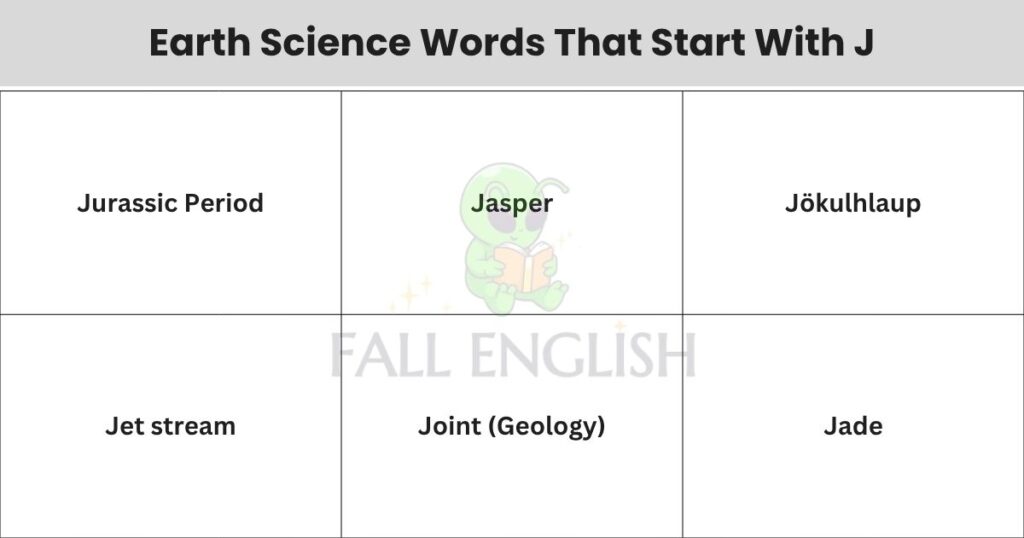
Jurassic Period — 201 to 145 million years ago. Dinosaurs dominated land. First birds appeared. The Atlantic Ocean began opening as Pangaea split. Lush fern forests covered much of the land.
Jet stream — Moves at 130–220 km/h at 8–15 km altitude. Two main jet streams exist in each hemisphere: polar and subtropical. Their position shifts seasonally and directly controls where cold or warm air masses move.
Jasper — Iron-rich quartz found in red, yellow, and brown shades. Forms in both sedimentary and volcanic rock. Color variation comes entirely from different iron compounds present during formation.
Joint (Geology) — A crack in rock with no sliding movement along it. Forms as rock cools, contracts under pressure, or is uplifted. Dominates the visible surface of cliff faces and canyon walls.
Jökulhlaup — Subglacial volcanic heat melts ice, water builds under pressure, then bursts out in a catastrophic flood. Iceland’s 1996 Gjálp eruption triggered one that discharged more water per second than the Amazon River.
Jade — Either nephrite or jadeite — two unrelated minerals that look nearly identical. Jadeite forms under extreme pressure deep in subduction zones, making it geologically rare and scientifically interesting.
Space & Astronomy Science Words That Start With J
Jupiter — 1,300+ Earths fit inside it. At least 95 confirmed moons. The Great Red Spot has been an active storm for over 350 years. No solid surface — it’s layers of compressed hydrogen and helium all the way down.
James Webb Space Telescope (JWST) — Observes infrared wavelengths invisible to human eyes, letting it see through dust clouds and detect galaxies formed shortly after the Big Bang. Its findings have already revised timelines of early galaxy formation.
Jovian planets — Jupiter, Saturn, Uranus, Neptune. Massive, gas-dominated, rich in moons and ring systems. Fundamentally different from rocky inner planets in composition and formation history.
Astrophysical jet — Narrow, high-energy particle beams shot out by black holes and neutron stars. Some stretch thousands of light-years. The energy involved is difficult to even express in ordinary numbers.
Jeans instability — Named after physicist James Jeans. A gas cloud collapses under its own gravity when mass crosses a critical threshold. This is one of the primary mechanisms behind star formation.
Julian date — A continuous count of days starting from January 1, 4713 BC. Astronomers use it to track events across centuries without calendar confusion. It’s still the standard timing system in observational astronomy.
J-type asteroid — A rare asteroid class with a mineral makeup suggesting origin deep inside a shattered parent body. Scientists study them to understand what the interiors of early planetesimals looked like.
Medical & Health Science Words That Start With J
Jaundice — Bilirubin (yellow pigment from old red blood cells) accumulates in blood and tissues. Skin and eye whites turn yellow. Newborn jaundice is common and treated with blue-light phototherapy. In adults, it signals liver, gallbladder, or blood disorders.
Jugular vein distension (JVD) — Visible bulging of the neck vein indicates elevated pressure in the heart or major vessels. Emergency physicians look for this immediately when assessing heart failure or cardiac tamponade.
Joint replacement — Diseased joint surfaces are removed and replaced with metal and plastic components. Hip and knee replacements are most common. Over one million performed annually in the US alone, with most patients regaining substantial mobility.
Jejunostomy — A surgically created opening directly into the jejunum. Patients who cannot eat by mouth receive liquid nutrition through a tube placed here, bypassing the stomach entirely.
J-pouch (ileal pouch) — Constructed from the terminal small intestine after total colon removal. Shaped like the letter J to create a reservoir. Used for patients with ulcerative colitis or familial colon cancer syndromes.
Juvenile diabetes (Type 1) — Autoimmune destruction of insulin-producing pancreatic beta cells. Distinct from Type 2, which involves insulin resistance rather than absence. Requires lifelong insulin replacement, not lifestyle modification alone.
Jumper’s knee (Patellar tendinopathy) — Overuse injury at the tendon connecting the kneecap to the shinbone. Common in basketball, volleyball, and track athletes. Diagnosed by ultrasound or MRI.
Technology & Applied Science Words That Start With J
Jet propulsion — Exhaust pushed backward drives the vehicle forward. Newton’s third law applied at scale. NASA’s Jet Propulsion Laboratory designs and operates unmanned spacecraft using these principles.
JPEG — A compression format that removes fine image detail to reduce file size. Every photo on your phone is likely JPEG. The compression is “lossy” — some data is permanently discarded to shrink the file.
Junction transistor — Two semiconductor junctions controlling current flow. Modern chips pack billions of these into a space smaller than a fingernail. Without them, no computers, no smartphones, no modern diagnostic medical equipment.
Jitter (electronics) — Small, rapid timing variations in a signal. Too much jitter causes data errors, audio glitches, or dropped packets. Engineers designing precision instruments spend significant effort minimizing it.
J-integral (engineering application) — Predicts whether an existing crack in a structure will grow under stress. Aerospace engineers run these calculations when certifying aircraft fuselage safety after damage.
Jamming signal — A deliberately broadcast signal that disrupts communications. Studied in both military technology and cybersecurity. GPS jamming is an active concern in modern warfare.
Easy Science Words That Start With J
Good starting points for younger students or anyone new to science vocabulary.
Jaw — Holds your teeth. The lower jaw moves. The upper jaw doesn’t.
Joint — Where bones meet. Bend your elbow — that movement is a joint working.
Jupiter — Biggest planet. Its stripes are cloud bands. Its storm is bigger than Earth.
Jellyfish — No brain, no heart, no bones. Moves by rhythmically squeezing its body.
Juvenile — The young form of any animal before it’s fully grown.
Jet — A focused, fast-moving stream of liquid or gas. Water jets, air jets, and rocket jets all follow the same physics.
Joule — The unit for energy. A single AA battery stores about 3,000 joules.
Jasper — A colorful rock, usually red or brown, made mostly of quartz with iron minerals giving it color.
Advanced Science Words That Start With J
Terms you’ll meet in AP courses, university science, and research literature.
Jahn-Teller distortion — Unequal electron distribution forces a molecule to physically reshape itself into a lower-energy geometry. Key concept in transition metal chemistry and crystal field theory.
J-coupling constant — Numerical value describing how strongly neighboring atoms in a molecule interact through their bonds. Used in NMR spectroscopy to determine molecular structure without destroying the sample.
Jeans mass — The minimum mass a gas cloud must reach before gravitational collapse wins over internal pressure. Below this mass, the cloud stays stable and no star forms.
Jamming transition — Dense particle systems (sand, foam, colloidal glass) shift abruptly from flowing to solid-like behavior. An active research frontier in condensed matter physics with applications in materials engineering.
Josephson effect — When two superconductors are separated by a thin barrier, electrical current tunnels through without any voltage applied. Josephson junctions are used in ultra-sensitive magnetic field detectors and quantum computers.
J-type star — A carbon-rich star with distinct spectral absorption from carbon molecules. Found in outer galactic regions. Studying them helps astronomers understand late-stage stellar evolution.
Juxtacrine signaling (advanced) — Unlike hormones traveling through blood, juxtacrine signals require physical cell-to-cell contact. Critical in embryonic development where cells need to “know” what their immediate neighbor is doing.
Science Words That Start With J — By Grade Level
| Grade Level | Words to Know |
| Grades 3–5 | Jaw, Joint, Jupiter, Jellyfish, Juvenile, Jet |
| Grades 6–8 | Joule, Jurassic, Jugular, Jejunum, Jet stream, Jasper, Jaundice, Junction |
| Grades 9–10 | Joule’s Law, Joule-Thomson effect, Juxtaglomerular cells, Juvenile hormone, Jovian planets, Jeans instability |
| Grades 11–12 / AP | Jahn-Teller effect, J-coupling, J-integral, Jamming transition, Julian date |
| College / Research | Josephson effect, Jeans mass, Jökulhlaup mechanics, J-pouch surgery, Juxtacrine signaling |
The Full List — 165+ Science Words That Start With J
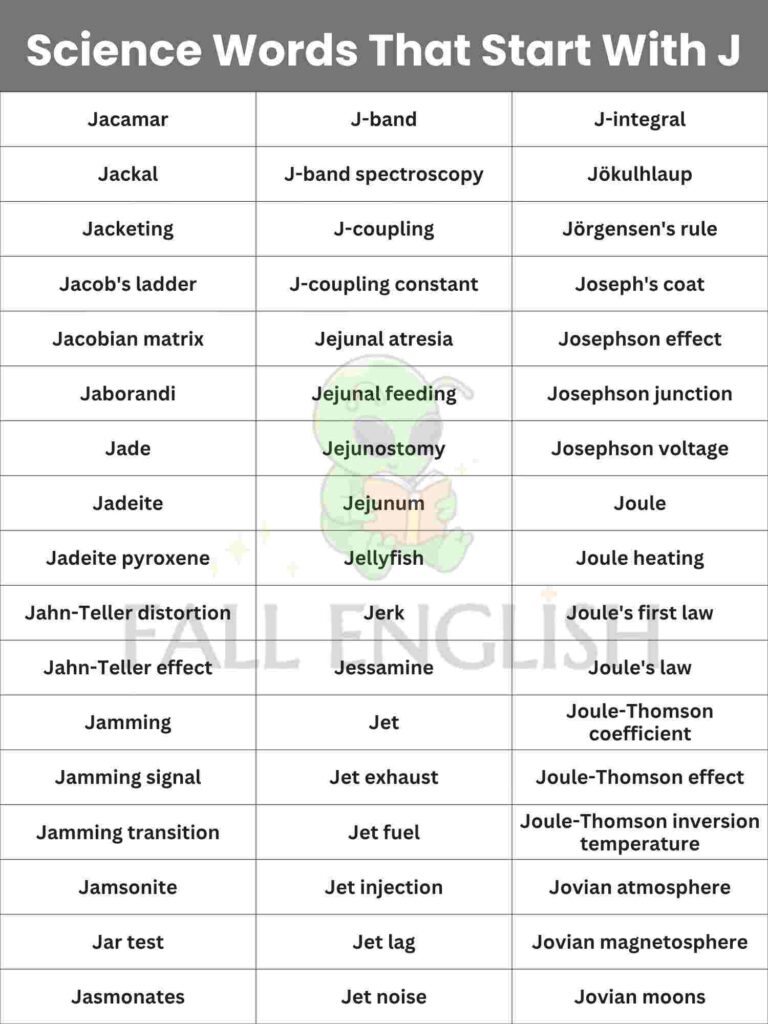
Complete alphabetical reference. Use this for quick lookups and study checks.
Jacamar
Jackal
Jacketing
Jacob’s ladder
Jacobian matrix
Jaborandi
Jade
Jadeite
Jadeite pyroxene
Jahn-Teller distortion
Jahn-Teller effect
Jamming
Jamming signal
Jamming transition
Jamsonite
Jar test
Jasmonates
Jasmonyl
Jasper
Jaundice
Jaw
Jawbone
Jaw thrust
Jaw wiring
J-band
J-band spectroscopy
J-coupling
J-coupling constant
Jejunal atresia
Jejunal feeding
Jejunostomy
Jejunum
Jellyfish
Jerk
Jessamine
Jet
Jet exhaust
Jet fuel
Jet injection
Jet lag
Jet noise
Jet propulsion
Jet stream
Jet vane
Jetting
Jettison
Jimsonweed
Jitter
Job’s tears
J-integral
Jökulhlaup
Jörgensen’s rule
Joseph’s coat
Josephson effect
Josephson junction
Josephson voltage
Joule
Joule heating
Joule’s first law
Joule’s law
Joule-Thomson coefficient
Joule-Thomson effect
Joule-Thomson inversion temperature
Jovian atmosphere
Jovian magnetosphere
Jovian moons
Jovian planets
Jovian ring system
JPEG
J-pouch
J-shaped curve
J-shaped dose-response
J-type asteroid
J-type star
J-wave
Jugal bone
Jugale
Jugular
Jugular vein
Jugular vein distension
Julian calendar
Julian date
Julian year
Julianite
Jumper’s knee
Jumping gene
Jungle fever
Jungermannia
Junction
Junction potential
Junction transistor
Junk DNA
Jupiter
Jupiter trojan
Jupiter’s Great Red Spot
Jupiter’s moons
Jurassic coast
Jurassic Period
Jurassic marine reptiles
Jurkat cells
Just intonation
Just noticeable difference
Juvenile
Juvenile diabetes
Juvenile hormone
Juvenile mortality
Juvenile onset
Juvenile plumage
Juvenile rheumatoid arthritis
Juvenile water
Juvenility
Juxtaglomerular apparatus
Juxtaglomerular cells
Juxtaglomerular index
Juxtamedullary nephron
Juxtanuclear
Juxtacrine signaling
Juxta-articular
Juxtaposition
Common Mix-Ups Worth Knowing
Joule vs. Watt — A joule is total energy stored or used. A watt is energy used per second. A 60-watt bulb burns through 60 joules every single second. Energy vs. rate of energy — that’s the real difference.
Jugular vein vs. carotid artery — Both travel the neck, causing constant confusion. Jugular carries blood down from the brain toward the heart. Carotid carries blood up from the heart toward the brain. Opposite directions, same road.
Jurassic vs. Cretaceous — T-rex lived in the Cretaceous, not the Jurassic. The movie franchise blurred this permanently. Paleontologists are strict: Jurassic = Brachiosaurus, Stegosaurus, Allosaurus. Cretaceous = T-rex, Triceratops, Velociraptor.
Jet stream vs. trade winds — Trade winds blow near the equator at low altitude, generally east to west. Jet streams blow in temperate zones at high altitude, generally west to east. Different altitude, different latitude, different direction.
Type 1 vs. Type 2 diabetes — Type 1 (often called juvenile) is autoimmune — the immune system destroys insulin-making cells. Type 2 involves those cells still working but the body ignoring their signal. Entirely different mechanisms, often confused because both affect blood sugar.
Junction: biology vs. electronics — A gap junction connects two living cells and lets them share small molecules. A semiconductor junction inside a chip controls the flow of electrons. Same word, unrelated meanings — context is everything.
Where These Words Actually Show Up
In hospitals — Doctors assess jugular distension for heart failure. Neonatal nurses treat jaundice with phototherapy. Surgeons build J-pouches after colon removal. Juxtaglomerular function is monitored in kidney disease management.
In weather forecasts — Meteorologists track jet stream position daily. When it dips south, cold air follows. When it holds north, warmth stays. Every winter forecast involves this word.
In your devices — Billions of junction transistors power every chip. JPEG compresses every photo. Jitter affects the quality of every video call on a weak connection.
In the sky tonight — Jupiter is visible to the naked eye as a bright, steady point. No telescope needed. The JWST is transmitting images right now that are rewriting our understanding of early galaxies.
On standardized tests — Joule appears in energy calculation problems. Jurassic in geological timeline questions. Juvenile hormone in AP Biology free-response. Jet stream in environmental science sections.
Memory Tricks for J Science Words
Joule → “Jules has ALL the energy” — Picture someone named Jules who never sits still. Joule = energy, always.
Jugular → “Journey Down” — Jugular vein carries blood on its journey down from the brain. J for journey, J for jugular.
Jejunum → “June is the MIDDLE of the year” — Jejunum is the middle section of the small intestine. Middle = middle.
Jeans instability → “Heavy jeans fall down” — When a gas cloud gets too massive (heavy), gravity pulls it down into a collapsing star.
Jurassic vs. Cretaceous → “J before C” — In the alphabet, J comes before C. In time, Jurassic came before Cretaceous.
Jahn-Teller → “Shape-shifter molecule” — The molecule literally changes shape to get comfortable. A molecule that can’t sit still.
Josephson effect → “Tunneling through walls” — Current sneaks through a barrier with no voltage pushing it. Like walking through a wall, which is exactly what quantum tunneling resembles.
Read more:
155+ Science Words That Start With I | Full List with Meanings
180+ Science Words That Start With H | Full List with Meanings
FAQs
What are the most important science words that start with J?
The most common and useful terms are Joule, Joint, Jupiter, Jet stream, Jurassic, and Jejunum. These appear often in school science lessons and exams.
Which J science word is used most in physics?
Joule is the most important. It is the standard unit used to measure energy in physics and chemistry.
Are there easy science words that start with J for kids?
Yes. Good beginner words include Jaw, Joint, Jet, Jellyfish, Juvenile, and Jupiter. These are simple and commonly taught in elementary and middle school.
Why do many J science words come from people’s names?
Several terms are named after scientists, such as Joule (James Joule), Josephson effect (Brian Josephson), and Jeans instability (James Jeans). Learning the story behind the word can make it easier to remember.
How can I memorize Science Words That Start With J?
Start with the most common terms, group them by subject, and use memory tricks. For example, think of Joule as “Jules has energy” and Jugular as blood traveling “down” from the brain.
Bottom line
Learning Science Words That Start With J is a practical way to build stronger science vocabulary step by step. You do not need to memorize every term at once. Focus on the words that match your current grade level or subject, and return to this list whenever you need a quick explanation. Over time, these terms will become familiar, and understanding science will feel much easier and more natural.

FallEnglish is run by a language enthusiast who explains word and text meanings in clear, simple ways. Each guide is carefully researched, original, and written to help real people understand language faster, with accuracy, context, and everyday examples you can trust.