

Science is full of useful terms, and learning them one letter at a time makes the process much easier. This guide to Science Words That Start With I brings together important words from biology, chemistry, physics, earth science, and health.
Whether you are studying for a quiz, helping your child with homework, or building your English vocabulary, this list gives clear meanings in simple language. Start with common terms like ion, inertia, and igneous, then explore more advanced words as your understanding grows.
Quick Reference: 20 Most-Used Science Words That Start With I
Inertia — Object resists any change in its motion.
Ion — Atom carrying a positive or negative charge.
Igneous — Rock formed from cooled magma or lava.
Isotope — Same element, different number of neutrons.
Infrared — Electromagnetic waves felt as heat.
Insulin — Pancreatic hormone regulating blood sugar.
Invertebrate — Animal without a backbone.
Ionic Bond — Bond formed by electron transfer between atoms.
Indicator — Chemical showing pH through color change.
Immunity — Body’s defense against specific diseases.
Inherited Trait — Characteristic passed through genes from parent.
Ignition — Process of a substance catching fire.
Incubation — Development time before symptoms or hatching appear.
Inorganic — Compound not containing carbon-hydrogen bonds.
Iridescence — Color shifting with viewing angle.
Isomer — Same chemical formula, different molecular structure.
Impermeable — Blocks liquid from passing through.
Infiltration — Water moving downward through soil.
Integrated Circuit — Miniature chip holding millions of electronic components.
Incision — Clean surgical cut made by a scalpel.
Physics Science Words That Start With I
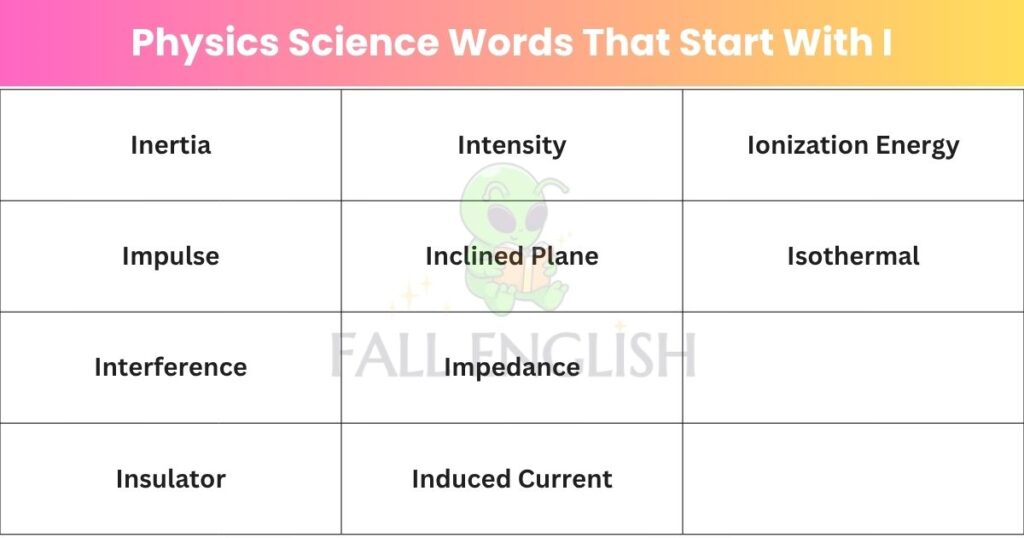
Physics explains motion, energy, waves, and forces. These words are the foundation.
Inertia — Objects resist changes to their motion. A ball sitting still wants to stay still. A moving car wants to keep moving. Newton’s First Law is entirely built on this idea.
Impulse — Force applied over a short time. When a bat hits a baseball, that brief contact transfers impulse — sending the ball in a new direction at high speed.
Interference — Two waves meeting can combine (constructive) or cancel (destructive). The rainbow shimmer on a soap bubble happens because light waves interfere with each other.
Insulator — A material blocking heat or electricity. Rubber coating on wires, foam in walls, wooden handles on metal pots — all insulators doing their job.
Intensity — How much energy a wave delivers per unit area. A whisper has low intensity. A jet engine has extremely high intensity.
Inclined Plane — A simple ramp-shaped machine that reduces the force needed to lift something by spreading effort over a longer distance.
Impedance — Total opposition to alternating current in a circuit — combining resistance, capacitance, and inductance into one measurement.
Induced Current — A changing magnetic field near a wire pushes electrons through it without any battery. Every electrical generator on Earth uses this effect.
Ionization Energy — Energy required to pull one electron away from an atom. Noble gases have the highest values — they hold electrons tightly and rarely react.
Isothermal — A process occurring at constant temperature. Useful in thermodynamics when studying how gases expand or compress under controlled conditions.
Chemistry Science Words That Start With I
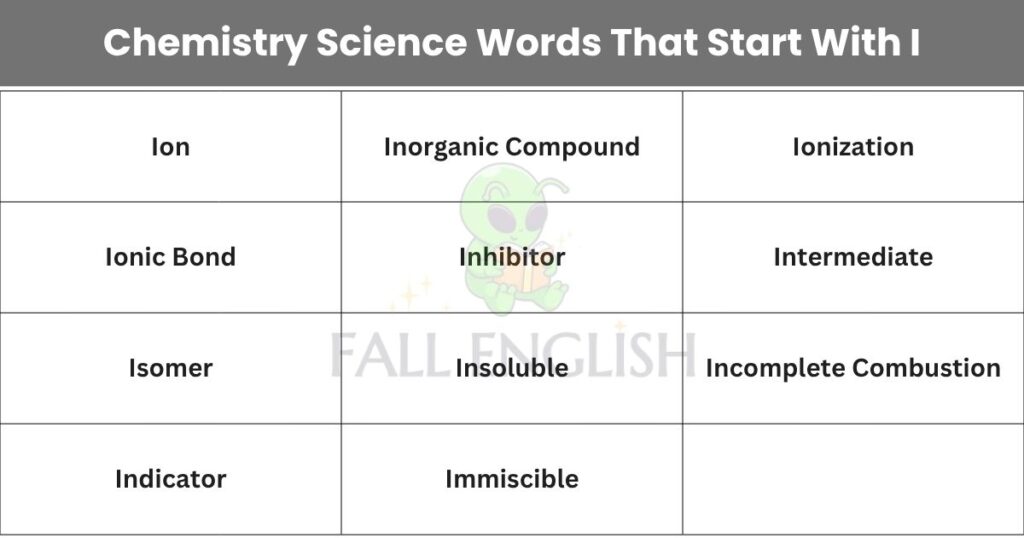
Ion — An atom that gained or lost electrons, giving it a charge. Sodium loses one electron; chlorine gains one. Together they form table salt — held by ionic attraction.
Ionic Bond — The electrostatic pull between oppositely charged ions. Most salts form this way. No sharing of electrons — one atom takes, the other gives.
Isomer — Molecules with identical formulas but different arrangements. Glucose and fructose are both C₆H₁₂O₆ but behave differently in the body and taste different on your tongue.
Indicator — A substance that changes color based on pH. Litmus paper turns red in acid, blue in base. Universal indicator shows a full spectrum from pH 1 to 14.
Inorganic Compound — Molecules without carbon-hydrogen bonds. Water, salt, and rust are inorganic. Not all inorganic things are artificial — iron ore is completely natural.
Inhibitor — A chemical that slows or stops a reaction. Food preservatives are inhibitors. Enzyme inhibitors in medicine target specific biological reactions.
Insoluble — Won’t dissolve in a given solvent. Sand stays sand in water no matter how long you stir.
Immiscible — Two liquids that refuse to mix. Oil and water are the classic example. Shake them together — they separate immediately.
Ionization — Converting neutral atoms into charged ions through heat, light, or chemical reactions. Happens constantly in stars, in lightning, and inside batteries.
Intermediate — A short-lived molecule formed mid-reaction that gets consumed before the reaction ends. Never appears in the final product.
Incomplete Combustion — Burning without enough oxygen. Produces carbon monoxide and soot instead of clean water vapor and CO₂. Common in old engines and poorly ventilated fires.
Biology Science Words That Start With I
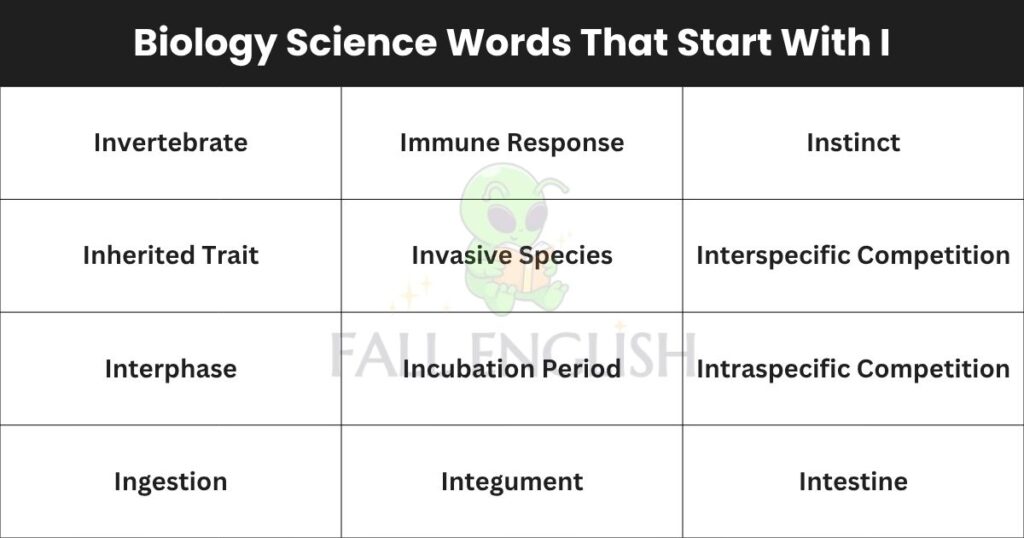
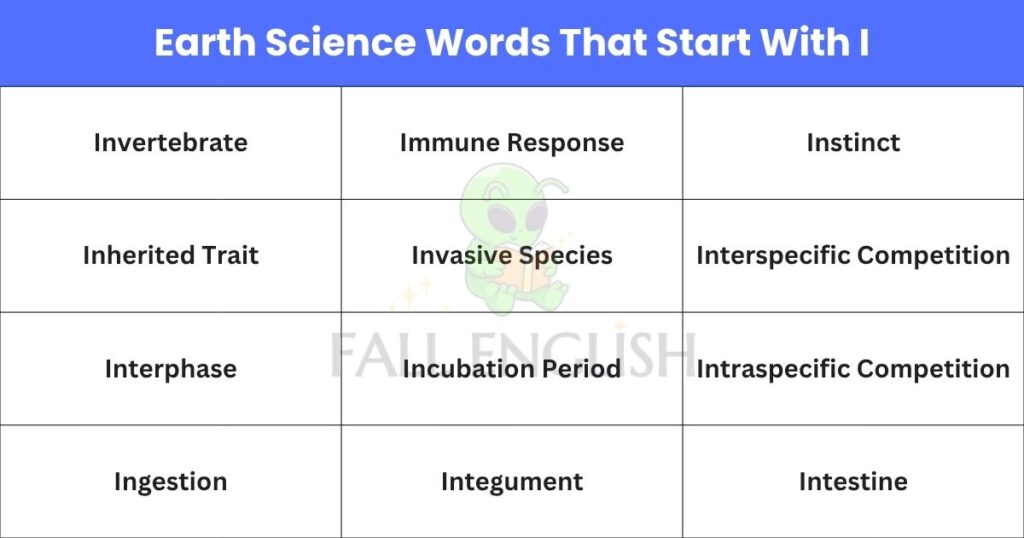
Invertebrate — No backbone, no problem. Insects, jellyfish, squid, and earthworms are all invertebrates. They represent roughly 95% of all animal species on Earth.
Inherited Trait — A characteristic coded in DNA and passed from parent to offspring. Eye color, blood type, sickle cell disease — all inherited.
Interphase — The preparatory stage before cell division. The cell spends most of its life here — growing, copying DNA, and getting ready to split.
Ingestion — Taking food into the body through the mouth. The opening step in the entire digestive process.
Immune Response — The body’s coordinated attack when it detects a foreign invader. White blood cells activate, antibodies get produced, and the threat gets neutralized.
Invasive Species — An organism introduced to a habitat where it didn’t evolve — and causes harm. Kudzu vine smothers native plants across the American South. Cane toads devastated ecosystems in Australia.
Incubation Period — Time between infection and first visible symptoms. Varies dramatically: flu shows in 1–4 days; rabies can take months.
Integument — The outer covering of an organism. Human skin, seed coats, and insect exoskeletons all count as integuments.
Instinct — Behavior present at birth, no learning required. A newborn sea turtle crawling toward the ocean has never been taught — it simply knows.
Interspecific Competition — Two different species competing for the same resource. Lions and hyenas competing over prey is a textbook example.
Intraspecific Competition — Members of the same species competing. Male deer fighting during mating season are competing intraspecifically.
Intestine — Tube-shaped digestive organ with two distinct parts. Small intestine absorbs nutrients into the bloodstream. Large intestine manages water and prepares waste for removal.
Earth Science Words That Start With I
Igneous Rock — Formed from magma or lava that cooled and hardened. Granite (slow underground cooling) and basalt (fast surface cooling) are the two most common types.
Impermeable — Doesn’t let water pass through. Clay layers underground create natural water barriers — which is why clay-lined ponds hold water effectively.
Infiltration — Rainwater seeping downward through soil into underground aquifers. Paved surfaces block infiltration, which is why flooding gets worse in heavily urbanized areas.
Isobar — A line on a weather map connecting points of equal atmospheric pressure. Closely packed isobars signal strong winds. Widely spaced ones indicate calm conditions.
Isotherm — A line connecting places with identical temperatures on a map. Meteorologists use them to visualize temperature gradients across regions.
Insolation — Solar radiation reaching Earth’s surface. Equatorial regions receive intense insolation year-round. Polar regions receive it at a low angle, spreading energy over larger areas.
Intrusive Rock — Igneous rock that forms underground when magma cools slowly over thousands of years. Granite is the most widespread example.
Isostasy — The gravitational balance between Earth’s crust and the mantle beneath it. When massive glaciers melt, the crust slowly rises — called isostatic rebound.
Ice Age — A prolonged period of global cooling where glaciers expand across continents. The most recent one ended roughly 11,700 years ago.
Iron Core — Earth’s center consists of a solid inner core and liquid outer core — both primarily iron and nickel. Movement in the liquid layer generates Earth’s magnetic field.
Space & Astronomy Science Words That Start With I
Ion Drive — A propulsion system that accelerates ions to generate thrust. Extremely fuel-efficient for deep space missions. NASA’s Dawn spacecraft traveled to the asteroid belt using one.
Infrared Telescope — Detects infrared wavelengths invisible to the human eye. Infrared light passes through dust clouds that block visible light — revealing star-forming regions hidden from ordinary telescopes.
Irregular Galaxy — A galaxy with no defined structure — not spiral, not elliptical. Often small and chaotic, sometimes shaped by gravitational collisions with neighboring galaxies.
Impact Crater — A bowl-shaped depression formed when a meteorite strikes a surface. The Moon’s cratered face shows billions of years of bombardment. Earth has craters too, mostly hidden by erosion and vegetation.
Inclination — The tilt of a planet’s axis or orbit relative to a reference plane. Earth’s 23.5° axial inclination is directly responsible for seasons.
Interstellar — The space between star systems. Voyager 1 crossed into interstellar space in 2012 — the first human-made object to do so.
Interstellar Medium — Gas and dust filling the vast gaps between stars. Mostly hydrogen and helium, but also traces of complex molecules including water and organic compounds.
Ionosphere — An atmospheric layer 60–1,000 km above Earth, rich in ions and free electrons. AM radio waves bounce off it — enabling broadcasts to travel far beyond the horizon.
Medical & Health Science Words That Start With I
Insulin — Hormone produced by pancreatic beta cells that allows cells to absorb glucose from the blood. Type 1 diabetes involves no insulin production. Type 2 involves cells that stop responding to it.
Inflammation — The body’s rapid response to injury or infection — heat, redness, swelling, and pain. Useful short-term. Chronic inflammation links to heart disease, arthritis, and cancer.
Infarction — Tissue death from blocked blood supply. A myocardial infarction is the clinical name for a heart attack. A cerebral infarction is a stroke.
Infection — Harmful microorganisms entering the body and multiplying faster than the immune system clears them. Bacterial infections respond to antibiotics. Viral ones generally do not.
Ischemia — Restricted blood flow to a tissue. Ischemia in the heart causes chest pain (angina). In the brain, it causes a stroke within minutes.
Immunoglobulin — A Y-shaped protein produced by B cells that binds to specific foreign substances. The technical name for an antibody.
Integumentary System — Skin, hair, nails, and associated glands working together as one system. Your largest organ system and first physical barrier against pathogens.
Intubation — Placing a tube into the airway to maintain breathing. Standard during surgeries requiring general anesthesia and in emergency respiratory failure.
Inoculation — Introducing a pathogen or weakened version to stimulate immune memory. The historical term that predates the word “vaccination.”
Intravenous (IV) — Delivering fluids, medication, or nutrition directly into a vein. Bypasses digestion entirely — the fastest route to get something into the bloodstream.
Technology & Applied Science Words That Start With I
Integrated Circuit — A silicon chip etched with millions of transistors and components. Every smartphone, laptop, and digital appliance depends on one.
Interface — The boundary where two systems interact. A touchscreen is a physical interface. An operating system’s desktop is a software interface.
Insulation (Technical) — Material resisting heat or electrical transfer. Building insulation reduces energy loss. Wire insulation prevents short circuits and electrocution.
Input Device — Hardware that feeds data into a computer. Keyboard, mouse, microphone, camera, touchscreen — all input devices.
Iteration — Repeating a process with improvements each cycle. Engineers iterate constantly — prototype, test, identify flaws, improve, repeat.
Internet of Things (IoT) — Physical devices embedded with sensors and internet connectivity. Smart thermostats, fitness bands, and connected appliances all belong to this category.
Image Resolution — Number of pixels forming an image. More pixels mean finer detail. A 4K display contains roughly 8.3 million pixels.
Easy Science Words That Start With I (Grades 3–5)
Perfect starting points for younger learners or anyone building foundational science vocabulary.
- Ice — Water frozen into solid form at 0°C (32°F)
- Insect — Six-legged arthropod with a three-part body: head, thorax, abdomen
- Inhale — Drawing air into the lungs during breathing
- Iron — Magnetic metal element (symbol: Fe) found in Earth’s core and human blood
- Incisor — Flat, sharp front teeth designed for biting and cutting food
- Iris — Colored ring in the eye controlling pupil size and light entry
- Island — Land mass completely surrounded by water
Advanced Science Words That Start With I (Grades 11–College)
Isomerism — The broader phenomenon where identical molecular formulas produce structurally different compounds. Includes structural, geometric, and optical isomerism — each with distinct physical and chemical properties.
Immunohistochemistry — Lab technique using labeled antibodies to detect specific proteins within tissue sections. Standard diagnostic tool in cancer pathology.
Isentropic Process — Thermodynamic process where entropy remains constant. Ideal gas expansion in a perfectly insulated container approximates this condition.
Impedance Spectroscopy — Measures how a material responds across a range of electrical frequencies. Used to analyze battery performance, corrosion, and biological tissue properties.
Interferometry — Using wave interference patterns to make extraordinarily precise measurements. The LIGO detector used interferometry to detect gravitational waves from colliding black holes.
Introgression — Genetic material from one species entering another’s gene pool through repeated hybridization over generations. Documented between wolves and coyotes in North America.
Isotopic Fractionation — Separation of isotopes during physical or chemical processes. Scientists analyze this in ancient ice cores to reconstruct Earth’s past climate conditions.
Induced Pluripotent Stem Cell (iPSC) — An adult cell reprogrammed back to a stem cell state, capable of developing into almost any cell type. Major tool in regenerative medicine research.
Science Words That Start With I — By Grade Level
Grades 3–5 Ice, Insect, Iron, Iris, Inhale, Incisor, Island, Itch, Inch, Invertebrate (basic)
Grades 6–8 Inertia, Ion, Igneous, Immunity, Isotope, Infrared, Inherited Trait, Indicator, Infiltration, Ignition, Incubation, Isobar, Invertebrate (detailed)
Grades 9–10 Ionic Bond, Ionization Energy, Interphase, Isomer, Inflammation, Integrated Circuit, Infarction, Ischemia, Insolation, Isostasy
Grades 11–College Isomerism, Interferometry, Isotopic Fractionation, Isentropic Process, Impedance Spectroscopy, Introgression, Immunohistochemistry, Induced Pluripotent Stem Cell
Full Alphabetical List — 155+ Science Words That Start With I
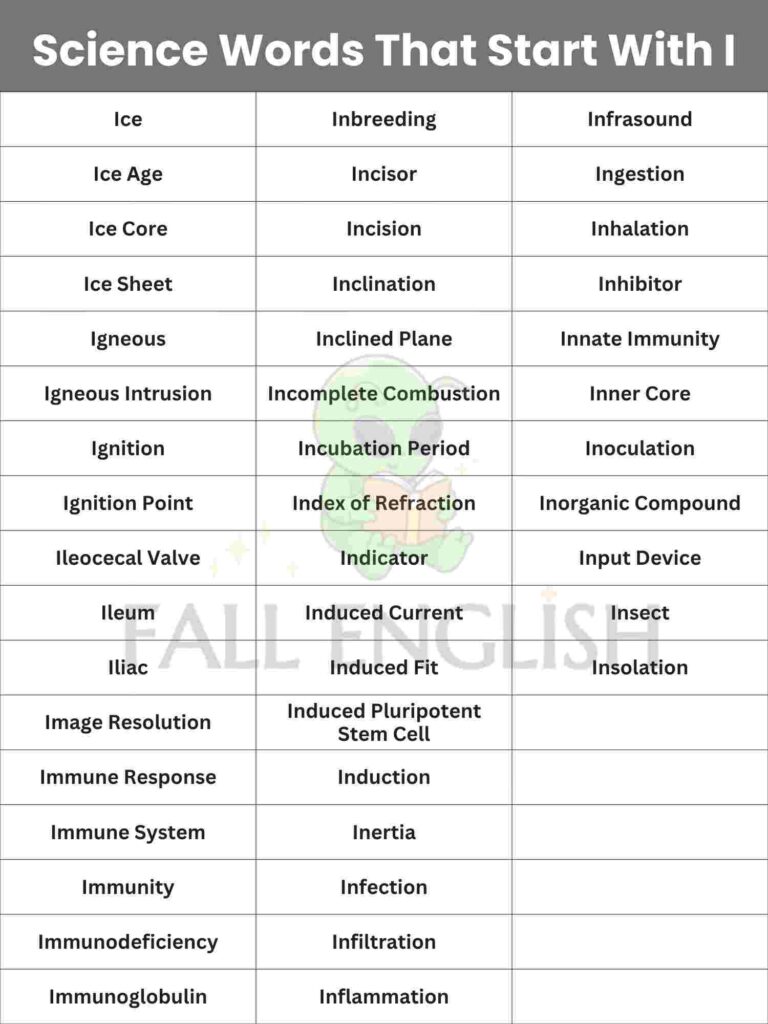
Ice
Ice Age
Ice Core
Ice Sheet
Igneous
Igneous Intrusion
Ignition
Ignition Point
Ileocecal Valve
Ileum
Iliac
Image Resolution
Immune Response
Immune System
Immunity
Immunodeficiency
Immunoglobulin
Immunohistochemistry
Impact Crater
Impedance
Impedance Matching
Impedance Spectroscopy
Impermeable
Impulse
Impulse Response
Inbreeding
Incisor
Incision
Inclination
Inclined Plane
Incomplete Combustion
Incubation Period
Index of Refraction
Indicator
Induced Current
Induced Fit
Induced Pluripotent Stem Cell
Induction
Inertia
Infection
Infiltration
Inflammation
Infraclass
Infraorder
Infrared
Infrared Radiation
Infrared Telescope
Infrasound
Ingestion
Inhalation
Inhibitor
Innate Immunity
Inner Core
Inoculation
Inorganic Compound
Input Device
Insect
Insolation
Insoluble
Instinct
Insulation
Insulator
Insulin
Insulin Resistance
Integrated Circuit
Integument
Integumentary System
Intensity
Interface
Interferon
Interference
Intermediate
Interleukin
Internet of Things
Internode
Interphase
Interspecific Competition
Interstellar
Interstellar Medium
Interstitial Fluid
Intestine
Intracellular
Intraspecific Competition
Intravenous
Intrusive Rock
Introgression
Intubation
Invasive Species
Invertebrate
Ion
Ion Channel
Ion Drive
Ionic Bond
Ionic Equilibrium
Ionic Radius
Ionization
Ionization Energy
Ionosphere
Iron
Iron Core
Iron Oxide
Iridescence
Iris
Irregular Galaxy
Ischemia
Isentropic Process
Island
Isobar
Isochore
Isocline
Isoelectric Point
Isograft
Isomer
Isomerism
Isometric Contraction
Isostasy
Isothermal
Isotherm
Isotone
Isotope
Isotopic Fractionation
Isotonic Solution
Isozyme
Iteration
Inguinal
Infarction
Common Mix-Ups Worth Knowing
Ion vs. Isotope Both involve atoms of the same element — but different things change. Ion = different number of electrons (creates charge). Isotope = different number of neutrons (creates different mass). Charge vs. mass. That’s the dividing line.
Igneous vs. Intrusive Rock All intrusive rocks are igneous — but not all igneous rocks are intrusive. Intrusive specifically means it formed underground. Extrusive igneous rock forms on the surface from lava.
Inorganic vs. Organic (Chemistry) Organic in chemistry means carbon-hydrogen bonds exist — not that something is “natural.” Plenty of organic molecules are lab-made. Plenty of inorganic things are completely natural.
Inertia vs. Impulse Inertia is a property every object has. Impulse is a calculated value (force × time). Students confuse these in physics problems — one describes what an object does, the other measures what was done to it.
Infection vs. Inflammation Infection is caused by a pathogen entering the body. Inflammation is the body’s response — which can happen with or without infection. You can have inflammation without infection (like in arthritis).
The “in-” Prefix Trick Most “in-” science words mean “not” or “into.” Insoluble = not soluble. Impermeable = not permeable. Invertebrate = without vertebrae. Learning the prefix unlocks dozens of definitions instantly.
Where These Words Actually Show Up
In a hospital Insulin, Infarction, Intravenous, Intubation, Ischemia, Incision, Inoculation, Immunoglobulin, Integumentary System
In a weather forecast Isobar, Isotherm, Insolation
In geology class Igneous, Intrusive Rock, Isostasy, Iron Core, Ice Age
On a physics test Inertia, Impulse, Interference, Insulator, Impedance, Induced Current
In a chemistry lab Ion, Ionic Bond, Indicator, Isomer, Inhibitor, Immiscible, Incomplete Combustion
In a biology textbook Invertebrate, Inherited Trait, Interphase, Instinct, Invasive Species, Integument
In space science news Ion Drive, Infrared Telescope, Ionosphere, Interstellar, Impact Crater, Irregular Galaxy
Memory Tricks for I Science Words
Inertia → Think “stubborn I” The letter I stands perfectly still. Objects with inertia resist any change. Same energy.
Igneous → Connect to “ignite” Both come from Latin ignis meaning fire. Igneous rock = fire-born rock. One word unlocks the other.
Iso- prefix → “Same” Isobar = same pressure. Isotherm = same temperature. Isotope = same element. Isotonic = same concentration. Learn the prefix once — it applies everywhere.
In- prefix → “Not” or “Without” Insoluble = not soluble. Impermeable = not permeable. Invertebrate = without vertebrae. This one prefix covers dozens of science words.
Ion → Picture a + or − floating next to an atom Every time you write the word, mentally attach a charge sign. The charge is the entire point of an ion.
Interferometry → “Interference + Measurement” The word literally contains its definition. Interference patterns are used to measure incredibly small distances.
Read also:
180+ Science Words That Start With G | Meanings, Examples & Full List
180+ Science Words That Start With H | Full List with Meanings
FAQs
What are the most important science words that start with I?
The most common and useful terms include inertia, ion, isotope, infrared, igneous, immunity, inherited trait, and ionic bond. These appear often in school science lessons and exams.
How can students remember science words more easily?
Focus on prefixes and roots. For example, iso- means “same,” and in- often means “not” or “into.” Learning these patterns helps you understand many words without memorizing each one separately.
Which science subjects use the most words starting with I?
Chemistry and biology contain many I-words, such as ion, inhibitor, insulin, and invertebrate. Physics and earth science also use important terms like inertia, impulse, and infiltration.
What is the difference between an ion and an isotope?
An ion is an atom with an electrical charge because it gained or lost electrons. An isotope is an atom of the same element with a different number of neutrons.
Are these words suitable for younger students?
Yes. Many terms such as ice, insect, iris, iron, and invertebrate are easy enough for elementary and middle school learners, while advanced terms are included for older students.
Final Words
Learning Science Words That Start With I is a practical way to build stronger science vocabulary and understand key ideas across many subjects. From everyday words like ice and insect to advanced terms like interferometry and isotopic fractionation, each word adds to your knowledge step by step.
Use this list as a study tool, a teaching resource, or a quick reference whenever you need a clear explanation. The more often you see and use these terms, the more natural science language becomes.

FallEnglish is run by a language enthusiast who explains word and text meanings in clear, simple ways. Each guide is carefully researched, original, and written to help real people understand language faster, with accuracy, context, and everyday examples you can trust.