


Science is full of useful terms, and many important ones begin with the letter A. From atom and acid to adaptation and aurora, these words appear in nearly every branch of science. This guide to Science Words That Start With A is designed to help students, teachers, and parents quickly understand each term in simple language.
Whether you are studying biology, chemistry, physics, earth science, or space, learning these words will make science easier to understand. Each term includes a clear meaning, and the list is organized so you can find the words you need without wasting time.
20 Most-Used Science Words Starting With A
Learn these first. They appear across every science subject at every grade level.
Atom — Smallest unit of any element
Acid — Substance with pH below 7
Amplitude — Height of a wave from its rest position
Adaptation — Trait helping an organism survive in its environment
Atmosphere — Layers of gas surrounding Earth
Alloy — Two or more metals combined for greater strength
Artery — Blood vessel carrying blood away from the heart
Algae — Aquatic plant-like organisms that produce oxygen
Asteroid — Rocky body orbiting the sun
Acceleration — Rate at which speed or direction changes
Antibody — Protein the immune system makes to fight invaders
Allele — One inherited version of a gene
Axon — Long fiber of a nerve cell that transmits signals
Aurora — Light display near Earth’s poles from solar particles
Aquifer — Underground rock layer storing fresh water
Aorta — Largest artery in the human body
Anatomy — Study of the physical structure of living organisms
Antibiotic — Medicine that kills or halts bacterial growth
ATP — Energy molecule powering every living cell
Apex — Highest point; an apex predator has no natural enemies
Physics Science Words That Start With A
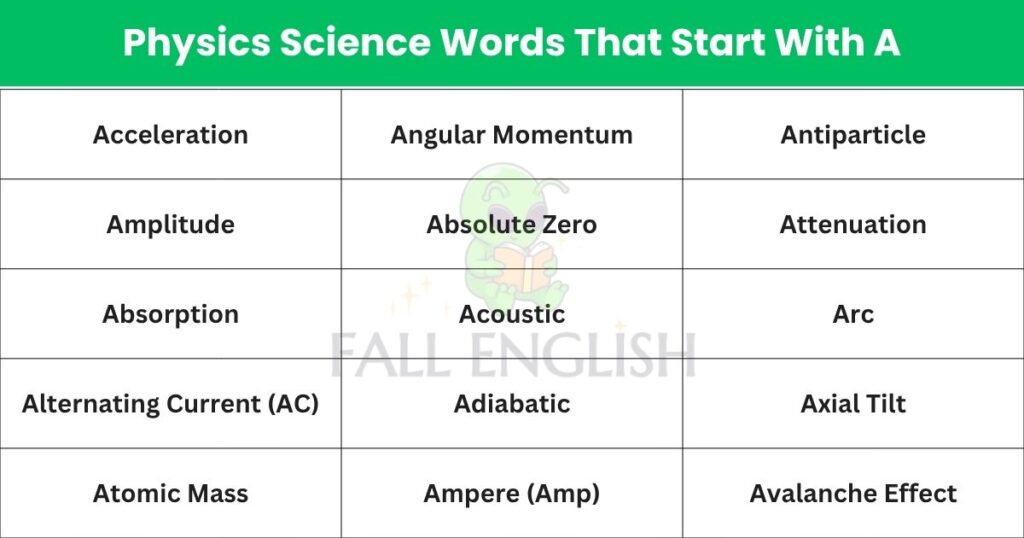
Acceleration — Rate of change in speed or direction, measured in m/s². When a car pulls away from a traffic light, that’s acceleration happening.
Amplitude — The height of a wave measured from its rest position. Louder sounds and brighter lights both carry larger amplitude waves.
Absorption — When a material takes in energy rather than reflecting it. Dark road surfaces absorb sunlight, which is why they get so hot in summer.
Alternating Current (AC) — Electrical current that reverses direction in a regular cycle. Every wall outlet in your home delivers AC.
Atomic Mass — The combined mass of protons and neutrons in an atom’s nucleus. Each element has a fixed atomic mass shown on the periodic table.
Angular Momentum — The momentum of a rotating object. A spinning top, a gyroscope, and Earth itself all carry angular momentum.
Absolute Zero — The lowest temperature physically possible: −273.15°C. At this point, particles cease all motion.
Acoustic — Relating to sound and how it travels. Acoustic energy moves as pressure waves through air, water, or solid materials.
Adiabatic — A process occurring without any heat exchange with surroundings. Weather systems and engine cycles both involve adiabatic processes.
Ampere (Amp) — Standard unit measuring electric current. A phone charger typically draws less than 2 amps.
Antiparticle — The charge-reversed counterpart of a standard particle. The antiparticle of an electron is called a positron.
Attenuation — The gradual weakening of a signal as it travels. WiFi signal dropping through thick concrete walls is attenuation at work.
Arc — A visible channel of electrical discharge jumping through air, producing intense heat and bright light.
Axial Tilt — The angle at which a planet leans on its rotational axis. Earth’s 23.5-degree tilt is the direct cause of seasons, not Earth’s distance from the sun.
Avalanche Effect — A single trigger setting off a rapidly multiplying chain of events. Relevant in electronics, nuclear physics, and materials science.
Chemistry Science Words That Start With A
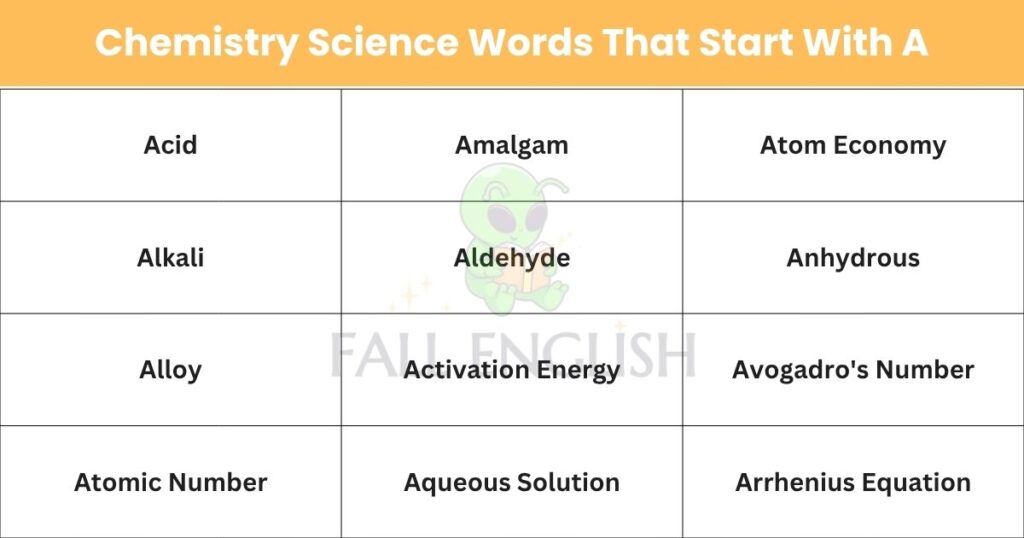
Acid — Releases hydrogen ions in solution, giving it a pH below 7. Hydrochloric acid (HCl) in your stomach breaks down food every time you eat.
Alkali — A base that dissolves in water, pushing pH above 7. Baking soda mixed in water becomes mildly alkaline.
Alloy — Metals deliberately combined to improve properties. Bronze (copper + tin) resists corrosion. Steel (iron + carbon) handles stress far better than pure iron.
Atomic Number — The count of protons in one atom of an element. This number defines the element — carbon is always 6, oxygen always 8, no exceptions.
Anion — An ion carrying negative charge, formed when an atom gains extra electrons.
Amalgam — A mercury-based alloy. Older dental fillings were made from amalgam because it’s durable and easy to shape.
Aldehyde — An organic compound containing a -CHO functional group. Found in natural fragrances and used industrially in resins and plastics.
Activation Energy — The minimum energy input required to start a chemical reaction. A match provides activation energy to ignite fuel.
Aqueous Solution — Any substance dissolved in water. Chemical equations mark these with “(aq).”
Aromatic Compound — Organic molecules built around a stable, ring-shaped carbon structure. Benzene is the foundational example.
Atom Economy — How efficiently a reaction converts reactant atoms into the desired product, rather than wasting them as byproducts.
Anhydrous — Describing a compound stripped of all water content. Anhydrous conditions are required in reactions where water would interfere.
Avogadro’s Number — 6.022 × 10²³ particles per mole of any substance. The central counting unit of all quantitative chemistry.
Arrhenius Equation — A mathematical formula predicting how reaction rates change with temperature. Higher temperature = exponentially faster reaction.
Biology Science Words That Start With A
Aerobic Respiration — Cells releasing energy by burning glucose in the presence of oxygen. Powers everything from a resting heartbeat to a full sprint — up to a point.
Anaerobic Respiration — Energy release from glucose without oxygen. Muscles switch to this during intense short bursts, producing lactic acid — the source of that burning sensation.
Angiosperm — A plant that produces flowers and encloses its seeds in fruit. Wheat, rice, apples, and oak trees are all angiosperms.
Antigen — A molecule on a pathogen’s surface that the immune system recognizes as foreign. Vaccines introduce safe antigens so the body learns to fight the real pathogen without being infected.
Asexual Reproduction — Producing offspring from one parent, with no fertilization involved. Bacteria divide this way; so do many plants and some animals like starfish.
Autotroph — An organism that manufactures its own food. Plants use photosynthesis; certain bacteria use chemical reactions. Without autotrophs, no food chain exists.
Arthropod — An invertebrate with a hard exoskeleton and jointed legs. Insects, spiders, crabs, and centipedes are all arthropods — collectively the most species-rich animal group.
Alveoli — Microscopic air sacs deep in the lungs where gas exchange occurs: oxygen enters the blood, carbon dioxide exits. An average adult has roughly 480 million of them.
Amino Acid — The molecular building blocks of proteins. Twenty standard amino acids combine in different sequences to produce every protein in the human body.
Auxin — A plant hormone directing growth toward light. When light strikes one side of a stem, auxin concentrates on the shaded side, causing faster growth there and bending the plant toward the light source.
Archaea — Single-celled microorganisms superficially similar to bacteria but genetically in a completely separate domain of life. Many survive in boiling springs, salt lakes, and acidic environments.
Amylase — A digestive enzyme present in saliva. It starts breaking down starch into sugars the moment food enters your mouth — digestion begins before you even swallow.
Anabolism — The metabolic processes that build larger molecules from smaller ones. Muscle growth, protein synthesis, and bone repair are all anabolic processes.
Abiotic — Non-living environmental factors: sunlight, temperature, rainfall, wind, and soil chemistry. Every ecosystem is shaped by the interaction of abiotic and biotic (living) factors together.
Apical Meristem — The actively dividing tissue at the tip of a plant’s root or shoot. This is where plants add new length — cutting it off stops upward or downward growth.
Earth Science Words That Start With A
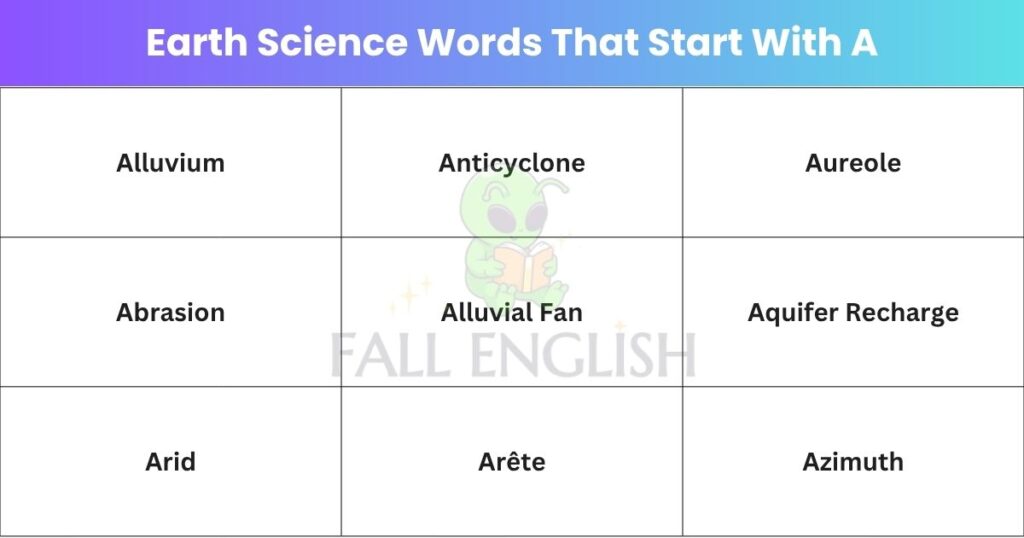
Alluvium — Sediment carried and deposited by flowing water. River deltas and floodplains built from alluvium — like the Nile Delta — are among the most fertile agricultural land on Earth.
Abrasion — Gradual wearing of rock surfaces through friction. A river carrying sand abrades its bed; wind-blown desert sand smooths rock faces over centuries.
Arid — Climate or land receiving under 250mm of annual rainfall. Roughly one-third of Earth’s land surface qualifies as arid.
Anticyclone — A high-pressure weather system rotating clockwise in the Northern Hemisphere. Associated with calm, clear, dry conditions.
Alluvial Fan — A fan-shaped wedge of sediment deposited where a fast-moving mountain stream suddenly slows on reaching flat terrain.
Arête — A narrow, knife-edged mountain ridge formed when two glaciers carve away rock from opposite sides of a peak.
Aureole — A ring of thermally altered rock surrounding a magmatic intrusion, where underground heat changed the mineral structure of surrounding rock.
Aquifer Recharge — The process of water re-entering an underground aquifer, either naturally through rainfall or artificially through injection wells. Over-pumping without recharge permanently shrinks aquifers.
Azimuth — The compass bearing to a point on the horizon, measured clockwise from true north. Used in navigation, geology, and telescope alignment.
Aphelion — Earth’s farthest point from the sun in its annual orbit, reached around July 4th. The fact that this occurs in Northern Hemisphere summer proves seasons are caused by axial tilt, not solar distance.
Space & Astronomy Science Words That Start With A
Aurora — Ribbons of colored light appearing near Earth’s poles when charged solar wind particles collide with atmospheric gases. Green is most common; red and violet appear at higher altitudes.
Accretion — The slow gravitational gathering of dust and gas into larger bodies. Stars, planets, and moons all formed through billions of years of accretion.
Albedo — The proportion of incoming sunlight a surface reflects back. Fresh snow reflects 80–90% (very high albedo). Open ocean reflects roughly 6% (low albedo).
Andromeda — The nearest large galaxy to the Milky Way, located 2.5 million light-years away and visible to the naked eye from dark locations.
Annular Eclipse — Occurs when the moon is at apogee during a solar eclipse — too far from Earth to fully cover the sun, leaving a glowing ring around the edges.
Astrophysics — The application of physics and chemistry to understand stars, galaxies, black holes, and the structure of the universe.
Apogee — The point in the moon’s orbit — or any satellite’s orbit — farthest from Earth. The moon at apogee appears measurably smaller than at perigee.
Astronomical Unit (AU) — The mean Earth-to-sun distance: approximately 150 million km. Neptune sits about 30 AU from the sun.
Angular Resolution — A telescope’s ability to distinguish fine detail and separate closely spaced objects. Larger aperture generally means sharper angular resolution.
Asteroid Belt — The region between Mars and Jupiter containing millions of rocky remnants from the solar system’s formation. Most stay there; gravitational disturbances occasionally redirect some inward.
Medical & Health Science Words That Start With A
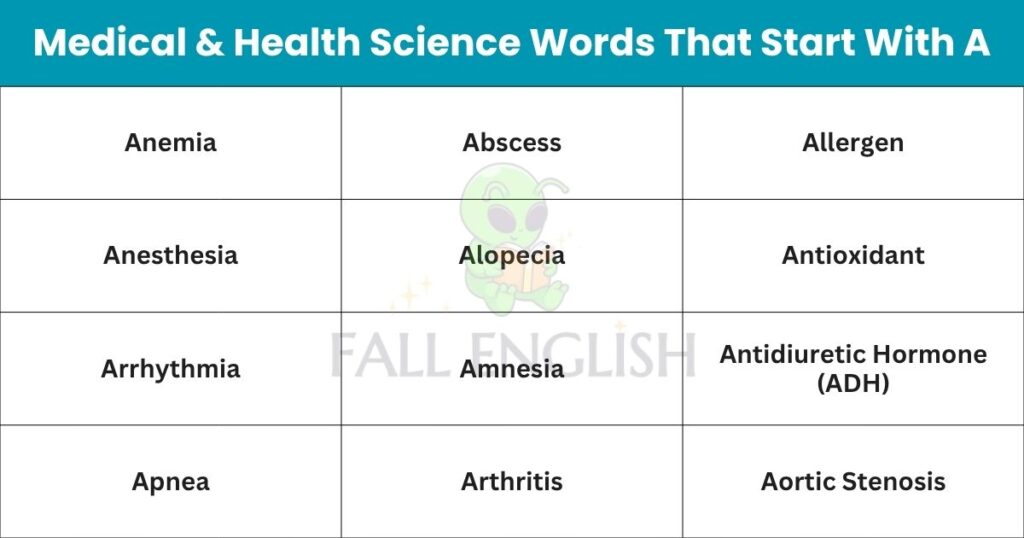
Anemia — A shortage of healthy red blood cells reducing the body’s oxygen-carrying capacity. Persistent fatigue and pale skin are the most visible signs.
Anesthesia — Medically controlled loss of sensation or consciousness during surgery. Anesthesiologists continuously monitor depth, blood pressure, and breathing throughout every procedure.
Arrhythmia — An abnormal heart rhythm — too fast, too slow, or irregular. Some are benign; others require medication, a pacemaker, or emergency intervention.
Apnea — Repeated, temporary cessation of breathing. Sleep apnea disrupts millions of people’s rest without them realizing it, raising long-term risks for heart disease.
Abscess — A walled-off pocket of pus formed by bacterial infection in body tissue. Drainage is usually required for proper healing.
Alopecia — Hair loss from the scalp or body. Causes range from genetic predisposition and hormonal changes to autoimmune conditions and certain medications.
Amnesia — Partial or total memory loss. Can follow traumatic brain injury, stroke, or severe psychological shock.
Arthritis — Chronic joint inflammation causing pain, swelling, and stiffness. Osteoarthritis results from cartilage wear over time; rheumatoid arthritis is an autoimmune attack on joint tissue.
Allergen — The specific substance provoking an allergic immune response. Pollen, peanuts, shellfish, and latex are among the most common.
Antioxidant — A molecule that neutralizes free radicals — unstable particles that damage cell structures. Found in many fruits and vegetables; also produced naturally by the body.
Antidiuretic Hormone (ADH) — A hormone signaling kidneys to retain water when the body is dehydrated. It’s why urine becomes more concentrated when you haven’t drunk enough.
Aortic Stenosis — Narrowing of the aortic valve that restricts blood flow leaving the heart. Often develops silently over decades before causing symptoms.
Technology & Applied Science Words That Start With A
Algorithm — A defined sequence of instructions for solving a problem or completing a task. Search engines, recommendation systems, and navigation apps are all built on algorithms.
Artificial Intelligence (AI) — Computer systems performing tasks that typically need human reasoning — recognizing speech, translating languages, diagnosing images.
Automation — Using machines or software to handle tasks without human involvement. Widespread in manufacturing, logistics, and data processing.
Analog Signal — A continuously varying signal with no discrete steps. Vinyl records and FM radio both carry information as analog signals.
API (Application Programming Interface) — The rules and protocols allowing different software systems to communicate. When a weather app shows your local forecast, it’s pulling data through an API.
Aerodynamics — The science of how air moves around solid objects. Car bodies, aircraft wings, and cycling helmets are all shaped using aerodynamic principles.
Arc Welding — A metal-joining technique using the concentrated heat of an electric arc to melt and fuse materials.
Autonomous Vehicle — A vehicle that navigates without human control using sensors, cameras, radar, and onboard AI systems.
Antenna — A device that transmits or receives electromagnetic waves. Present in smartphones, satellites, WiFi routers, and broadcasting towers.
Attenuation (Engineering) — Reduction in signal power as it travels through a medium or cable. Engineers minimize attenuation to maintain signal quality over distance.
Easy Science Words That Start With A (Grades 3–5)
Air — The invisible mixture of gases we breathe, mostly nitrogen (78%) and oxygen (21%).
Animal — A living organism that consumes food for energy and can generally move around.
Absorb — To take something in. A sponge absorbs water; dark surfaces absorb sunlight.
Amphibian — An animal completing part of its life in water and part on land. Frogs, toads, and salamanders.
Arachnid — An eight-legged invertebrate. Spiders, scorpions, and ticks are arachnids — not insects, which have six legs.
Autumn — The season between summer and winter, when daylight shortens and deciduous trees shed leaves.
Axis — The imaginary line through an object’s center around which it rotates. Earth completes one rotation on its axis every 24 hours.
Ash — Fine powdery residue remaining after combustion. Volcanic ash can travel thousands of kilometers carried by upper atmospheric winds.
Advanced Science Words That Start With A (Grades 10–12)
Anisotropy — A material’s properties varying depending on the direction of measurement. Crystal lattices are anisotropic — they conduct heat, light, and electricity differently along different axes.
Aneuploid — A cell with an incorrect chromosome count. Down syndrome results from trisomy 21 — three copies of chromosome 21 instead of two.
Anthropic Principle — The cosmological observation that the universe’s physical constants appear precisely calibrated to permit complex life. Extensively debated in physics and philosophy.
Abiogenesis — Scientific study of how life first arose from non-living chemistry on early Earth. Still an active and unresolved area of research.
Allometric Scaling — The mathematical relationship between body size and biological traits like metabolic rate, lifespan, or brain mass across species.
Asymptote — A line that a curve approaches indefinitely without ever reaching it. Appears in physics equations, population growth models, and engineering curves.
Afferent Nerve — A nerve fiber carrying sensory signals toward the central nervous system. Pain, temperature, and touch signals travel via afferent pathways to the brain.
Anaphase — The mitosis stage when duplicated chromosomes are pulled to opposite ends of the dividing cell by spindle fibers.
Apoptosis — Genetically programmed cell self-destruction. Cells dismantle themselves in a controlled sequence to prevent tissue damage. During embryonic development, apoptosis is how individual fingers form by eliminating the tissue between them.
Autocatalysis — A chemical reaction that generates its own catalyst as a product, causing the reaction to accelerate as it proceeds.
Science Words That Start With A By Grade Level
| Grade | Priority Words |
| 3–5 | Air, Animal, Absorb, Amphibian, Arachnid, Ash, Axis, Autumn |
| 6–7 | Acid, Adaptation, Atmosphere, Artery, Antibiotic, Amplitude, Alloy, Algae |
| 8–9 | Acceleration, Aerobic, Anaerobic, Allele, Antibody, Aquifer, Astronomical Unit, Atom |
| 10–12 | Activation Energy, Apoptosis, Adiabatic, Avogadro’s Number, Astrophysics, Aneuploidy, Autocatalysis, Abiogenesis |
Complete List: 250+ Science Words That Start With A
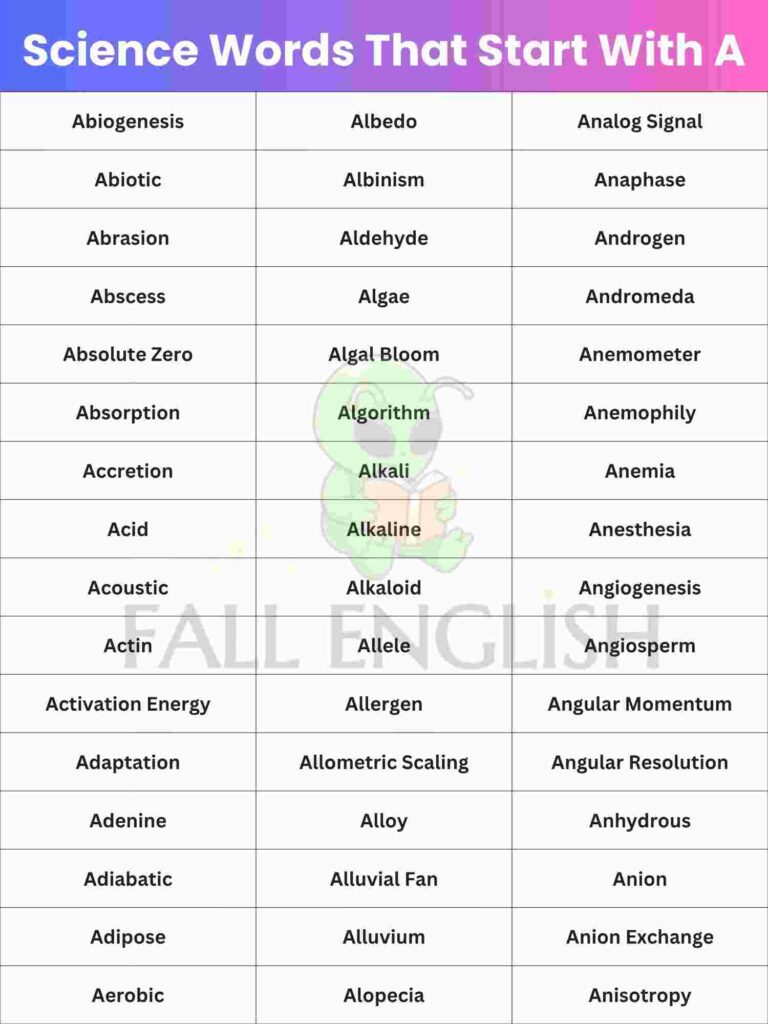
Abiogenesis
Abiotic
Abrasion
Abscess
Absolute Zero
Absorption
Accretion
Acid
Acoustic
Actin
Activation Energy
Adaptation
Adenine
Adiabatic
Adipose
Aerobic
Aerodynamics
Aerosol
Afferent Nerve
Agonist
Agroecology
Air
Air Pressure
Air Resistance
Albedo
Albinism
Aldehyde
Algae
Algal Bloom
Algorithm
Alkali
Alkaline
Alkaloid
Allele
Allergen
Allometric Scaling
Alloy
Alluvial Fan
Alluvium
Alopecia
Alternating Current
Alveoli
Amalgam
Amino Acid
Amnesia
Ampere
Amphibian
Amphipathic
Amplitude
Amplitude Modulation
Anabolism
Anaerobe
Anaerobic
Analog Signal
Anaphase
Androgen
Andromeda
Anemometer
Anemophily
Anemia
Anesthesia
Angiogenesis
Angiosperm
Angular Momentum
Angular Resolution
Anhydrous
Anion
Anion Exchange
Anisotropy
Annelid
Annular Eclipse
Anode
Aneuploid
Antagonist
Antenna
Anterior
Anthropic Principle
Antibiotic
Anticoagulant
Antidiuretic Hormone
Antigen
Antimatter
Antioxidant
Antiparticle
Anticyclone
Anovulation
Aorta
Aortic Arch
Aortic Stenosis
API
Aphelion
Apical Meristem
Apnea
Apogee
Apex
Apoptosis
Aqueous Solution
Aquifer
Aquifer Recharge
Aquatic
Arachnid
Arc
Arc Welding
Archaea
Archimedes’ Principle
Arête
Arid
Arrhythmia
Arrhenius Equation
Arterial
Arteriole
Arteriosclerosis
Artery
Arthritis
Arthropod
Artificial Intelligence
Ascending Colon
Ascomycete
Asepsis
Asexual Reproduction
Ash
Assimilation
Asteroid
Asteroid Belt
Astronomical Unit
Astronomy
Astrophysics
Asymptote
Atmosphere
Atmospheric Pressure
Atom
Atom Economy
Atomic Mass
Atomic Number
ATP
Attenuation
Atrium
Atrophy
Auditory
Aurora
Aureole
Autism Spectrum
Autotroph
Autonomous Vehicle
Automation
Autumn
Auxin
Avascular
Avifauna
Avogadro’s Number
Axial Skeleton
Axial Tilt
Axillary
Axis
Axon
Azimuth
Achromatic
Abyssal Zone
Angstrom
Animal Cell
Common Mix-Ups Worth Knowing
Artery vs. Vein Arteries carry blood away from the heart. Veins return it. Memory hook: Artery = Away.
Aerobic vs. Anaerobic Aerobic needs oxygen; anaerobic doesn’t. Long-distance running is aerobic. A 10-second sprint briefly turns anaerobic.
Atom vs. Element An element is the category — all carbon atoms belong to one element. An atom is a single unit of it.
Allele vs. Gene A gene is the instruction set. An allele is which version you inherited. Blue eyes and brown eyes are different alleles of the same gene.
Asteroid vs. Meteor vs. Meteorite Asteroid = orbiting in space. Meteor = the streak of light entering atmosphere. Meteorite = the piece that survives and lands.
Acid vs. Alkaline pH below 7 = acid. pH above 7 = alkaline. Pure water = neutral at exactly 7.
Adaptation vs. Evolution Adaptation is one specific inherited trait. Evolution is the broader generational process that produces and refines adaptations over time.
Aerobic Respiration vs. Photosynthesis Both involve oxygen and glucose — but oppositely. Respiration consumes glucose and oxygen to release energy. Photosynthesis uses light energy to produce glucose and oxygen.
Where These Words Actually Show Up
| Real-World Setting | A-Words Found There |
| Hospital ward | Arrhythmia, Anemia, Anesthesia, Apnea, Abscess, Allergen |
| Chemistry lab | Acid, Aqueous Solution, Activation Energy, Anhydrous, Arrhenius Equation |
| Inside your body | ATP, Axon, Aorta, Alveoli, Amino Acid, Amylase, ADH |
| Night sky observation | Aurora, Andromeda, Apogee, Annular Eclipse, Astronomical Unit |
| Underground geology | Aquifer, Aquifer Recharge, Alluvium, Abrasion, Arête |
| Tech and software | Algorithm, API, AI, Antenna, Automation, Analog Signal |
| Biology classroom | Aerobic, Anaerobic, Autotroph, Arthropod, Auxin, Archaea |
| Physics classroom | Acceleration, Amplitude, Absolute Zero, AC, Angular Momentum |
| Weather forecasting | Anticyclone, Atmospheric Pressure, Arid, Aphelion |
Memory Tricks for A Science Words
Amplitude → “Amply tall.” A bigger wave is taller. Taller = more energy.
Artery → A for Away. Arteries carry blood away from the heart.
Autotroph → “Auto” = self. It feeds itself without hunting or grazing.
Apogee → Think “gone away from Earth” — it’s the farthest orbital point.
Anaerobic → The prefix “an-” means without. Anaerobic = without oxygen.
Avogadro’s Number → 6.022 × 10²³. Think of it as chemistry’s giant dozen — the unit chemists use to count particles the way a baker counts in dozens.
Asteroid vs. Meteorite → Only earns the name “meteorite” after it hits the ground. “Ite” = it made impact.
Albedo → High albedo = bounces light away. Snow and mirrors are high-albedo surfaces. Charcoal and ocean water are low.
Apoptosis → Cells “opting out” on purpose — controlled self-removal for the organism’s benefit.
Adiabatic → “A-dia-batic” — no heat crosses the boundary. Sealed from thermal exchange.
Read also:
130+ Science Words That Start With S | Full List with Meanings
150+ Science Words That Start With R (With Meanings and Examples)
FAQs on Science Words That Start With A
What are the most important Science Words That Start With A for students?
Some of the most common terms are atom, acid, adaptation, atmosphere, acceleration, antibody, artery, algae, asteroid, and ATP. These words appear often in school science lessons and exams.
Why should students learn science vocabulary by letter?
Learning words alphabetically makes them easier to remember and review. It also helps students build a strong vocabulary step by step instead of trying to memorize random terms.
Which branches of science use words that start with A?
The letter A appears across all major science subjects, including biology, chemistry, physics, astronomy, earth science, medicine, and technology.
What is the easiest science word starting with A?
Simple words like air, animal, ash, axis, and autumn are great for younger students because they are familiar and easy to understand.
Are these science words useful in real life?
Yes. Doctors use words like anemia and arrhythmia, engineers use algorithm and automation, and scientists use terms like acid and atom every day.

FallEnglish is run by a language enthusiast who explains word and text meanings in clear, simple ways. Each guide is carefully researched, original, and written to help real people understand language faster, with accuracy, context, and everyday examples you can trust.