

Science is full of useful terms that help explain how the world works. This guide to Science Words That Start With R brings together important vocabulary from biology, chemistry, physics, Earth science, and space.
Whether you’re studying for a test, helping with homework, or building your English vocabulary, this list makes complex terms easier to understand. Each word is explained in simple language so you can learn faster and remember more.
The 20 Most-Used Science Words That Start With R
Radiation — Energy traveling as waves or particles
Reaction — A chemical change between substances
Refraction — Bending of light as it passes through materials
Reproduction — Process of producing offspring
Respiration — How living things release energy from food
Resistance — How much a material opposes electric current
Reflection — Light bouncing off a surface
RNA — Molecule that carries genetic instructions
Receptor — Cell structure that detects chemical signals
Renewable — Energy source that naturally replenishes
Retina — Light-sensitive layer inside the eye
Replication — Copying of DNA before cell division
Revolution — One complete orbit around a celestial body
Rotation — Spinning on an axis
Runoff — Water flowing over land into rivers
Reef — Underwater structure made of coral
Reagent — Substance used to cause a chemical reaction
Reflex — Automatic body response to a stimulus
Rudimentary — Basic or leftover structure in an organism
Radioactive — Having unstable atoms that emit energy
Physics Science Words That Start With R
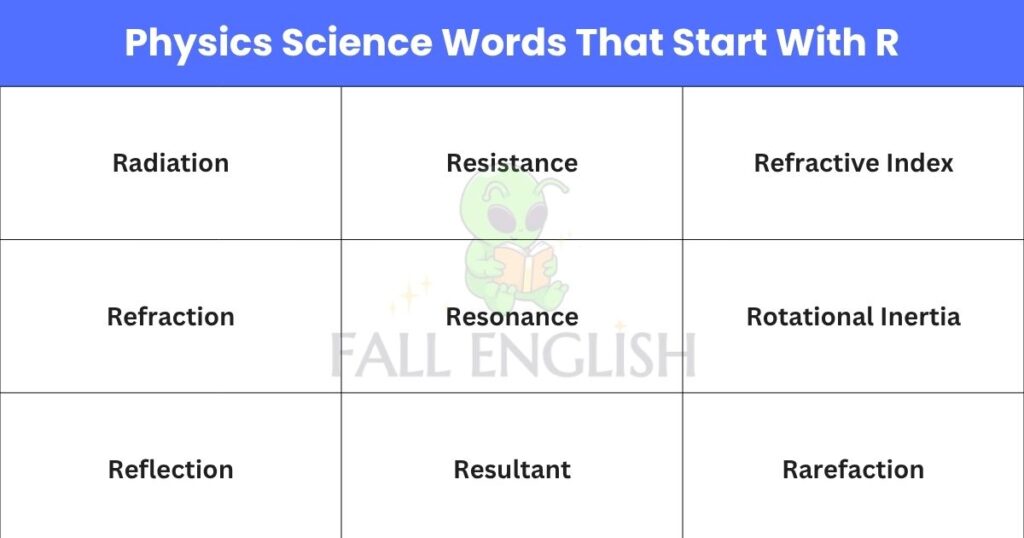
Physics covers energy, forces, and motion. These R words are central to that story.
Radiation — Energy moving through space as waves or particles. Sunlight is radiation. So is the heat from a campfire.
Refraction — Light bending as it moves from one material into another. That’s why a straw looks snapped in a glass of water — light slows down and changes direction in water.
Reflection — Light bouncing off a surface. Mirrors reflect almost everything. Dark surfaces absorb most of it.
Resistance — How strongly a material fights the flow of electric current. Rubber resists well. Copper doesn’t — which is why electrical wires are made from it.
Resonance — When an object vibrates powerfully at just the right frequency. Opera singers can shatter glass using resonance — no joke.
Resultant — The single force representing the combined effect of multiple forces acting on one object.
Refractive Index — A number showing how much light slows inside a material compared to a vacuum.
Rotational Inertia — A spinning object’s resistance to changes in its spin. When a figure skater pulls their arms in, they spin faster because of this.
Rarefaction — The zone in a sound wave where air particles spread apart. The opposite of compression.
Rectification — Converting alternating current (AC) into direct current (DC). Every phone charger does this silently.
Chemistry Science Words That Start With R
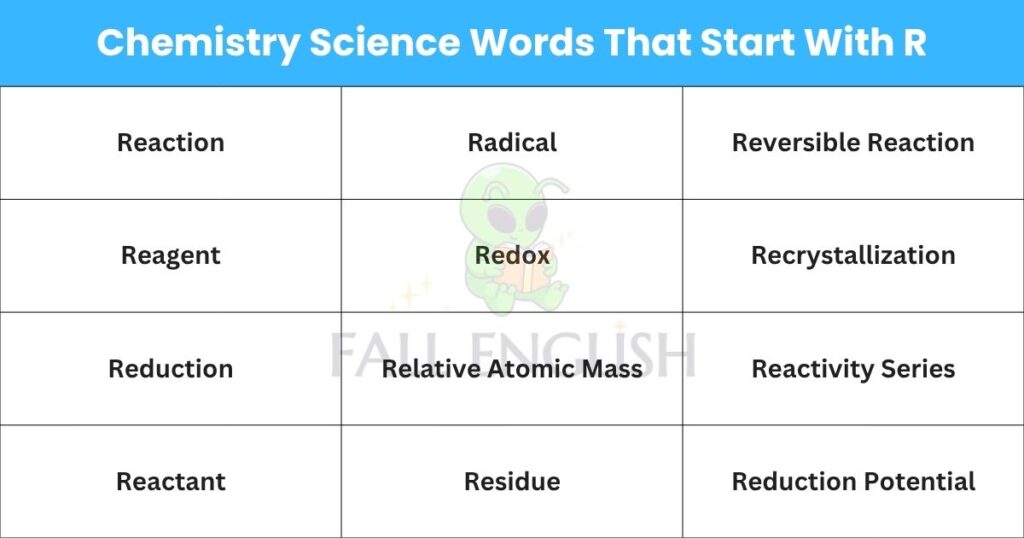
Reaction — When substances interact and form something new. Burning wood, rusting iron, baking bread — all chemical reactions.
Reagent — A substance added to trigger or test a reaction. Labs use reagents to detect specific compounds in a sample.
Reduction — A process where a substance gains electrons. Removing rust from iron involves reduction.
Reactant — The starting material in a reaction. Before bread bakes, flour and yeast are the reactants.
Radical — An atom or molecule with an unpaired electron. Extremely reactive and short-lived.
Redox — Short for reduction-oxidation. Describes any reaction involving electron transfer between substances.
Relative Atomic Mass — The average mass of an element’s atoms compared to carbon-12. It’s the number printed on a periodic table.
Residue — What remains after a chemical reaction or filtration.
Reversible Reaction — A reaction that can run both forward and backward depending on conditions.
Recrystallization — A purification method where a substance dissolves and then cools into pure crystals. Common in pharmaceutical production.
Reactivity Series — A ranking of metals from most to least reactive. Potassium sits near the top. Gold sits near the bottom — which is exactly why gold doesn’t corrode.
Reduction Potential — Measures how readily a substance gains electrons in a reaction.
Biology Science Words That Start With R
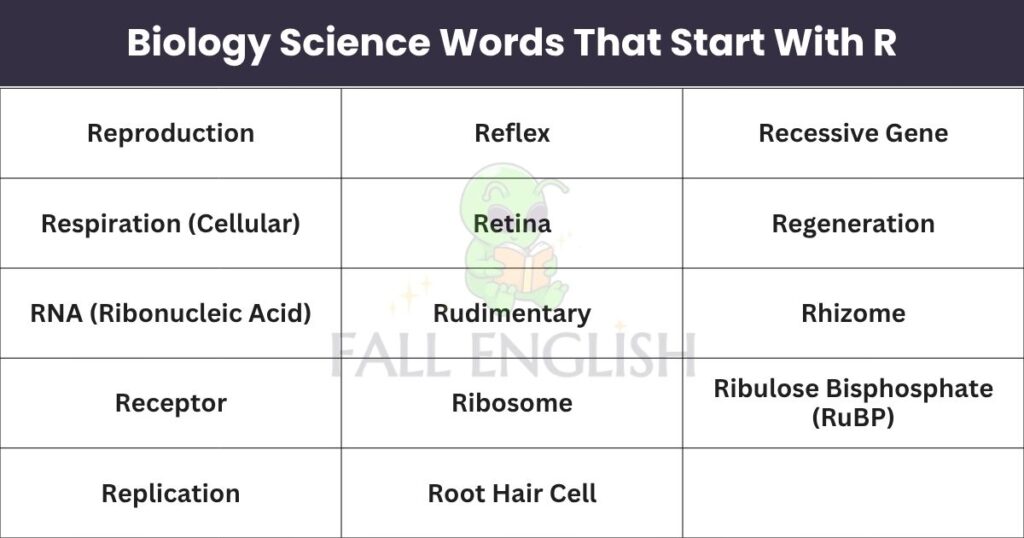
Reproduction — How living things create offspring. Sexual reproduction needs two parents. Asexual reproduction — like a starfish regrowing — needs just one.
Respiration (Cellular) — The process cells use to convert glucose into usable energy. Every living cell does this constantly, whether you’re asleep or running.
RNA (Ribonucleic Acid) — A molecule that reads DNA instructions and uses them to build proteins. Think of it as the cell’s working copy of the blueprint.
Receptor — A protein on a cell’s surface that picks up chemical signals. Pain receptors tell your brain when something is wrong. Hormone receptors respond to adrenaline, insulin, and more. In medicine, most drugs work by blocking or activating specific receptors.
Replication — DNA copying itself before a cell divides, so both new cells get a full set of instructions.
Reflex — An automatic response that skips conscious thought entirely. You pull your hand from something hot before your brain decides to.
Retina — The light-sensitive layer at the back of the eye. It converts incoming light into nerve signals sent to the brain. In medicine, retinal damage — as in diabetic retinopathy — is a leading cause of vision loss.
Rudimentary — A body part that’s underdeveloped or no longer functional. Whale pelvis bones are rudimentary — leftovers from when their ancestors walked on land.
Ribosome — Tiny structures inside cells that read RNA and assemble proteins. If a cell is a factory, ribosomes are the assembly line.
Root Hair Cell — A specialized plant cell designed to absorb water and minerals from soil. Its shape — long and thin — maximizes surface contact.
Recessive Gene — A gene that only shows its effect when two copies are inherited. Blue eyes often involve recessive genes.
Regeneration — Regrowing lost body parts. Salamanders can regrow entire limbs. Humans can regrow liver tissue.
Rhizome — An underground stem that sends out both roots and shoots. Ginger is actually a rhizome, not a root.
Ribulose Bisphosphate (RuBP) — A molecule in plant cells that captures carbon dioxide during photosynthesis.
Earth Science Words That Start With R
Runoff — Rainwater flowing over land instead of soaking into the ground. Excess runoff causes flooding and carries pollutants into rivers.
Reef — An underwater ridge — usually coral — forming one of Earth’s most biodiverse habitats.
Rock Cycle — The continuous process by which rocks shift between igneous, sedimentary, and metamorphic forms through heat, pressure, and erosion.
Rift Valley — A lowland formed when Earth’s crust pulls apart. East Africa’s Great Rift Valley formed this way over millions of years.
Richter Scale — Measures earthquake intensity. Each step up represents ten times more energy than the one before.
Rain Shadow — The dry region on a mountain’s sheltered side, blocked from rain-carrying winds.
Relative Humidity — The percentage of water vapor in the air compared to its maximum capacity at that temperature.
Rift Zone — An area where tectonic plates pull apart, often triggering volcanic activity.
Rock Strata — Layered rock formed over time. Geologists read these layers like chapters in Earth’s history.
Regolith — Loose rock, dust, and debris sitting above solid bedrock. Found on Earth, the Moon, and Mars.
Residual Soil — Soil formed directly from the breakdown of underlying rock.
Runoff Erosion — Soil loss caused by flowing surface water — especially damaging on bare, unprotected ground.
Space & Astronomy Science Words That Start With R
Revolution — One complete orbit around another body. Earth’s revolution around the Sun = one year.
Rotation — Spinning on an axis. Earth’s rotation = one day (24 hours).
Red Dwarf — The most common star type in the galaxy. Smaller and cooler than our Sun, but lives trillions of years.
Red Giant — What a star like the Sun becomes near the end of its life — expanding enormously before collapsing.
Redshift — Light from an object moving away gets stretched toward longer, redder wavelengths. It’s the main evidence that the universe is expanding.
Retrograde Motion — A planet appearing to move backward in the sky — an optical illusion created as faster inner planets overtake slower outer ones.
Radiation Belt — Zones of charged particles held around a planet by its magnetic field. Earth’s are called the Van Allen Belts.
Roche Limit — The closest distance a moon can orbit without being ripped apart by gravitational tidal forces. Saturn’s rings may be material that crossed this limit.
Radio Telescope — Detects radio waves from space rather than visible light. Used to study galaxies, pulsars, and the cosmic microwave background.
Rocket Propulsion — Based on Newton’s third law: exhaust pushed downward drives the rocket upward.
Medical & Health Science Words That Start With R
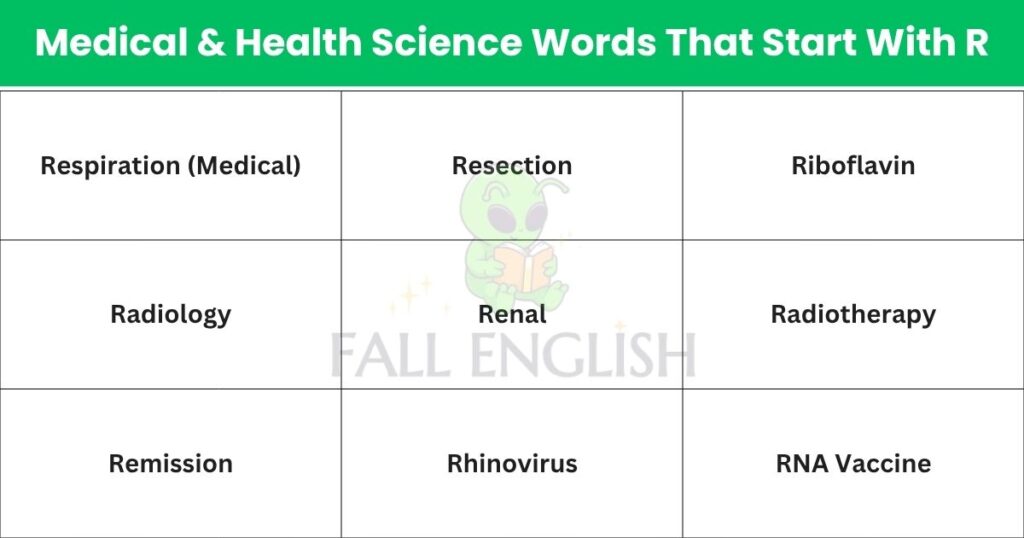
Respiration (Medical) — In clinical terms, this specifically means the mechanical act of breathing — measuring how many times per minute a patient inhales and exhales.
Radiology — The medical field using imaging — X-rays, MRIs, CT scans — to diagnose disease without surgery.
Remission — When signs of a disease, especially cancer, significantly decrease or disappear. Not always a permanent cure.
Resection — Surgical removal of part of an organ. A liver resection removes a damaged section while preserving function.
Renal — Relating to the kidneys. Renal failure means the kidneys can no longer filter waste from the blood effectively.
Rhinovirus — The virus responsible for most common colds.
Riboflavin — Vitamin B2. Converts food into energy at the cellular level. Found in eggs, dairy, and leafy greens.
Radiotherapy — Using targeted radiation to destroy cancer cells while minimizing damage to surrounding tissue.
RNA Vaccine — Uses messenger RNA to teach the immune system to recognize a specific pathogen. The COVID-19 vaccines made this approach widely known.
Technology & Applied Science Words That Start With R
Robot — A machine that performs tasks automatically, guided by programming or sensors.
RAM (Random Access Memory) — A computer’s short-term working memory. It clears when the device powers off.
Resolution — The level of detail in an image or display, measured in pixels.
Renewable Energy — Power from sources that naturally replenish: solar, wind, hydro, geothermal.
Radar — Uses radio waves to detect objects’ location, distance, and speed. Found in airports, weather stations, and speed cameras.
Router — Directs internet traffic between devices and networks. The box that runs your home Wi-Fi is a router.
Resistor — A circuit component that limits current flow. Found inside nearly every electronic device ever made.
Remote Sensing — Collecting data about an object without physical contact. Satellites use it to track forests, storms, and ocean temperatures.
Rectifier — Converts alternating current (AC) to direct current (DC) inside electronic devices.
Robotics — The science of designing, building, and programming robots.
Easy Science Words That Start With R (Grades 3–5)
These are visual, simple, and a great starting point.
Rain — Water falling from clouds when droplets grow heavy enough.
Rock — A solid natural material formed from minerals.
Root — The underground part of a plant that absorbs water and anchors it.
Rust — The reddish coating formed when iron reacts with water and oxygen.
River — A large body of flowing freshwater moving toward a lake or ocean.
Rainbow — An arc of colors formed when sunlight passes through water droplets.
Reptile — A cold-blooded, scaly animal like a snake, lizard, or crocodile.
Reproduce — To create offspring. Every living thing does it — differently.
Rotate — To spin on an axis. Earth rotates once every 24 hours.
Reef — An underwater structure, often coral, that shelters thousands of sea species.
Advanced Science Words That Start With R
These appear in high school, university, or professional science.
Ribonucleoprotein — A complex of RNA and protein that carries out gene expression tasks inside cells.
Rheology — The study of how materials flow and deform under force. Used in designing everything from toothpaste to concrete.
Radiometric Dating — Determining the age of rocks or fossils using the known decay rates of radioactive isotopes.
Recombinant DNA — DNA artificially combined from multiple sources. The foundation of genetic engineering and most modern biotech.
Renormalization — A mathematical method in quantum physics that removes infinite values from equations to produce usable results.
Retroviruses — Viruses that convert their RNA into DNA and insert it permanently into the host’s genome. HIV is a retrovirus.
Raman Spectroscopy — A technique using laser light to identify molecules by how they scatter that light. Used in forensics, pharmaceuticals, and material science.
Ribozyme — An RNA molecule that can catalyze chemical reactions — previously thought to be only a protein ability.
Resonance (Chemistry) — When a molecule’s true structure is a blend of multiple possible arrangements, none of which alone is accurate.
Redox Potential — A value predicting the direction of electron transfer in a chemical reaction.
Science Words That Start With R — By Grade Level
| Grade Level | Words |
| Grades 3–5 | Rain, Rock, Root, Rust, River, Rainbow, Reptile, Rotate, Reef, Reproduce |
| Grades 6–7 | Radiation, Reaction, Refraction, Reflection, Respiration, Resistance, Runoff, Rotation, Revolution, Reef |
| Grade 8–High School | RNA, Receptor, Replication, Redox, Reagent, Ribosome, Rift Valley, Radiotherapy, Recessive Gene, Retrograde |
| Advanced/College | Radiometric Dating, Recombinant DNA, Renormalization, Ribozyme, Raman Spectroscopy, Retroviruses, Ribonucleoprotein, Rheology |
The Full List — 150+ Science Words That Start With R
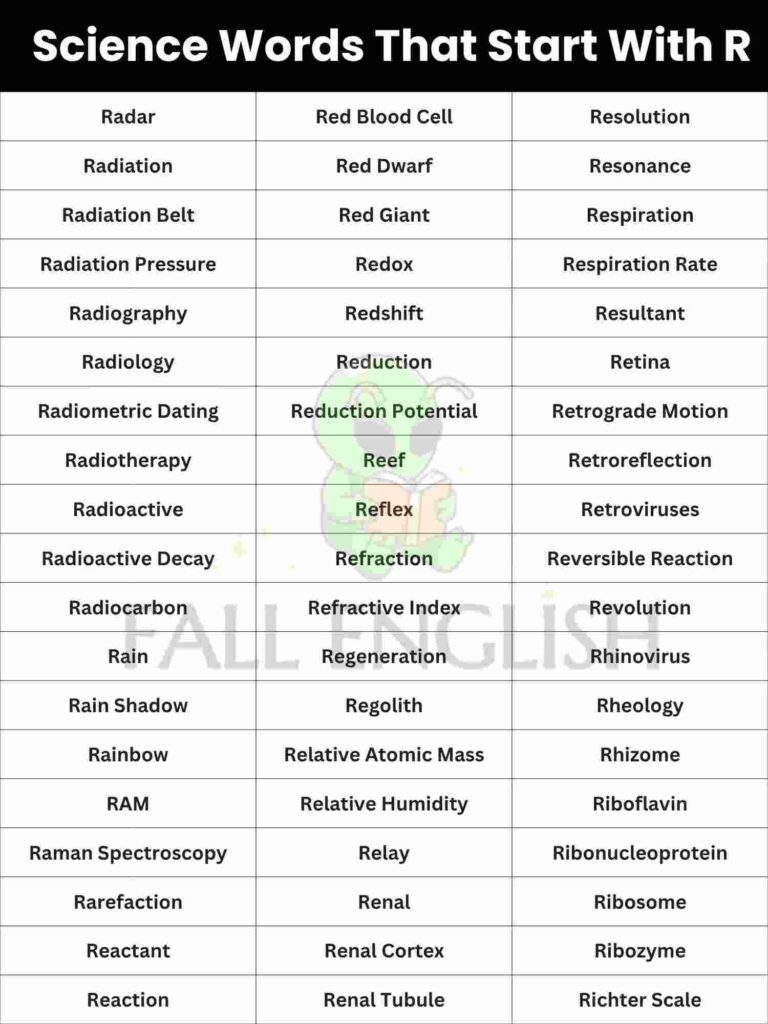
Radar
Radiation
Radiation Belt
Radiation Pressure
Radiography
Radiology
Radiometric Dating
Radiotherapy
Radioactive
Radioactive Decay
Radiocarbon
Rain
Rain Shadow
Rainbow
RAM
Raman Spectroscopy
Rarefaction
Reactant
Reaction
Reaction Rate
Reactivity
Reactivity Series
Receptor
Receptor Agonist
Recessive Gene
Recrystallization
Rectification
Rectifier
Red Blood Cell
Red Dwarf
Red Giant
Redox
Redshift
Reduction
Reduction Potential
Reef
Reflex
Refraction
Refractive Index
Regeneration
Regolith
Relative Atomic Mass
Relative Humidity
Relay
Renal
Renal Cortex
Renal Tubule
Remote Sensing
Renewable
Renewable Energy
Renormalization
Replication
Reproduction
Reproductive System
Resection
Residual Soil
Residue
Resistance
Resistor
Resolution
Resonance
Respiration
Respiration Rate
Resultant
Retina
Retrograde Motion
Retroreflection
Retroviruses
Reversible Reaction
Revolution
Rhinovirus
Rheology
Rhizome
Riboflavin
Ribonucleoprotein
Ribosome
Ribozyme
Richter Scale
Rift Valley
Rift Zone
River
RNA
RNA Polymerase
RNA Vaccine
Robot
Robotics
Roche Limit
Rock
Rock Cycle
Rock Salt
Rock Strata
Rocket Propulsion
Root
Root Hair Cell
Rotation
Rotational Inertia
Router
Rudimentary
Runoff
Runoff Erosion
Rust
Rupture
Ray
Ramp
Common Mix-Ups Worth Knowing
Rotation vs. Revolution Rotation is spinning in place — Earth rotating creates day and night. Revolution is traveling around something else — Earth revolving around the Sun creates a year. Same planet, two completely different motions.
Respiration vs. Breathing Breathing moves air in and out of your lungs. Cellular respiration is what happens next — your cells extracting energy from oxygen. One is mechanical. The other is chemical.
Radiation vs. Radioactive Radioactive materials emit radiation — but radiation itself comes from many non-radioactive sources too. Sunlight is radiation. Microwaves are radiation. Neither source is radioactive.
Reactant vs. Reagent A reactant is anything entering a chemical reaction. A reagent is more specific — a controlled substance used to test for or trigger a particular reaction in a lab setting.
Recessive vs. Dominant Gene A recessive gene only expresses itself when inherited from both parents. A dominant gene shows up with just one copy. This distinction explains why two brown-eyed parents can have a blue-eyed child.
Refraction vs. Reflection Reflection is light bouncing back. Refraction is light bending as it enters a new material. A mirror reflects. A swimming pool refracts — making it look shallower than it is.
Where These Words Actually Show Up
In hospitals Radiology, renal, receptor, remission, RNA vaccine, radiotherapy, respiration, resection
In nature Runoff, reef, rock cycle, rift valley, rain shadow, regolith, river, relative humidity
In electronics and tech RAM, resistor, rectifier, router, resolution, radar, remote sensing, robotics
In space news Redshift, red dwarf, retrograde motion, radiation belt, Roche limit
In biology class right now RNA, ribosomes, replication, receptor, respiration, recessive gene, regeneration
On your body right now Your retina is processing light. Your ribosomes are building proteins. Your renal system is filtering blood. Science isn’t just in textbooks.
Memory Tricks for R Science Words
Rotation = spinning in place. Think: Round and Round on your own axis.
Refraction bends, Reflection bounces. Refraction shares a root with “fracture” — it breaks the straight path of light.
Redshift = retreating. Something moving away from you fast stretches its light toward red. Red = running away.
Recessive = hiding. It needs two copies to show up — it stays hidden in your DNA until then.
Reactant → enters the Reaction. They share the same root word. The reactant is what goes in.
Ribosomes = protein assembly line. They read RNA like a recipe and build proteins piece by piece.
Read more:
150+ Science Words That Start With T | Meanings, Examples & Full List
130+ Science Words That Start With S | Full List with Meanings
FAQs
What are the most common science words that start with R?
Some of the most common terms are radiation, reaction, refraction, reproduction, respiration, resistance, reflection, RNA, receptor, and rotation. These appear often in school science lessons and exams.
Which Science Words That Start With R are easiest for younger students?
Words like rain, rock, root, river, rainbow, reptile, and rust are easy to understand because children can see them in everyday life.
Why do many science terms begin with R?
Many scientific words come from Latin roots. For example, “respiration” comes from a Latin word meaning “to breathe,” and “replication” means “to copy.”
Which R science words are important for biology?
Key biology terms include RNA, ribosome, receptor, reproduction, regeneration, reflex, and retina.
How can I remember difficult science vocabulary?
Group words by subject, connect them to real-life examples, and review them regularly. Learning one word in context is easier than memorizing long lists.
Bottom line
This guide covered 150+ science words starting with R — from rain and root all the way to ribozyme and renormalization. Every word is sorted by subject, grade level, and real-world context so you can find exactly what you need without reading the whole thing.
Use the grade-level table to know where to start. Use the subject sections when a specific class has you stuck. Use the mix-ups section before a test — that’s where easy marks get lost.
Science vocabulary isn’t about memorizing a list. It’s about building a language for understanding how the world actually works.

FallEnglish is run by a language enthusiast who explains word and text meanings in clear, simple ways. Each guide is carefully researched, original, and written to help real people understand language faster, with accuracy, context, and everyday examples you can trust.