

Proud is one of those words that can mean several different things at once — and swapping it out without thinking about which meaning you intend is how writers end up saying something slightly off.
Quick Answer
The most useful alternatives depend on what kind of pride you’re describing:
- For a quiet, personal sense of satisfaction: gratified, fulfilled, pleased
- For justified pride in achievement: accomplished, honored, vindicated
- For warm pride in someone else: admiring, delighted, moved
- For excessive or arrogant pride: conceited, self-satisfied, smug, vain, arrogant
The word proud sits in the middle of this range. It can tilt toward warmth or toward arrogance depending on context, and most of its alternatives live at one end or the other.
The Two Very Different Meanings of “Proud”
Before choosing a replacement, decide which sense of proud you actually mean.
Sense 1 — Earned, positive pride:
“She was proud of what her team accomplished.”
This is pride that feels deserved. It carries warmth, satisfaction, and a sense of meaning.
Sense 2 — Excessive, self-regarding pride:
“He was too proud to ask for help.”
This is pride that gets in the way. It overlaps with arrogance, stubbornness, or vanity.
Many alternatives only work in one of these senses. Using smug where you meant honored — or fulfilled where you meant conceited — will change the tone of your sentence entirely.
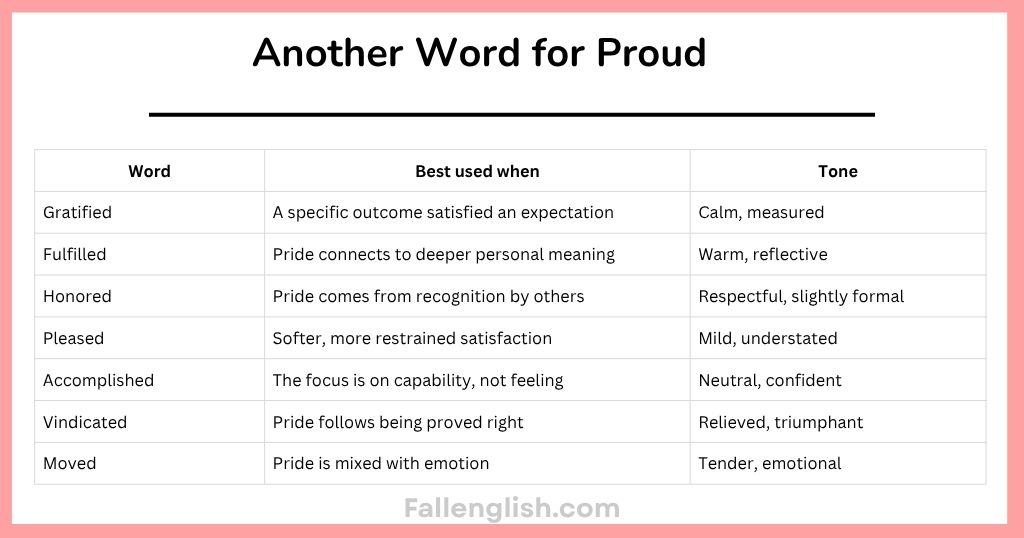
Another Word for Proud with Meaning
| Word | Best used when | Tone |
| Gratified | A specific outcome satisfied an expectation | Calm, measured |
| Fulfilled | Pride connects to deeper personal meaning | Warm, reflective |
| Honored | Pride comes from recognition by others | Respectful, slightly formal |
| Pleased | Softer, more restrained satisfaction | Mild, understated |
| Accomplished | The focus is on capability, not feeling | Neutral, confident |
| Vindicated | Pride follows being proved right | Relieved, triumphant |
| Moved | Pride is mixed with emotion | Tender, emotional |
Gratified suits moments where something went the way you hoped. “She was gratified by the response” signals that expectations were met — it sounds measured, even professional. It works well in formal writing.
Fulfilled goes deeper. It suggests that the pride connects to something meaningful about who you are or what you value. “He felt fulfilled by the work he had done” implies this mattered personally, not just professionally. It doesn’t work as a direct replacement for proud in every sentence — you can’t usually say “I’m so fulfilled of you” — but as a standalone emotional word, it carries more weight.
Honored redirects the pride outward. When you say “I’m honored to be here,” you’re not claiming a personal achievement — you’re acknowledging that someone else recognized you. Honored is slightly more formal and a little more humble than proud. Use it in speeches, formal letters, or any context where you want to express that the recognition matters.
Pleased is the quietest of the group. It fits when the tone calls for restraint — a thank-you note, a professional message, a moment where expressing full pride might seem excessive. “We are pleased to announce” is standard in formal communications precisely because it signals satisfaction without enthusiasm that might seem out of place.
Vindicated is more specific. It belongs in situations where the pride comes after being doubted or challenged. “She felt vindicated when the results proved her theory correct.” It has an edge that proud doesn’t — a faint sense of “I told you so” that can sound either triumphant or petty depending on how it’s used.
Alternatives for Negative or Excessive Pride
| Word | What it adds | Example register |
| Arrogant | Claims superiority over others | Critical, direct |
| Conceited | Excessive self-admiration, often over appearance or talent | Critical, slightly informal |
| Smug | Satisfaction at others’ expense or in an irritating way | Critical, colloquial |
| Vain | Pride focused on appearance or public image | Critical, literary |
| Self-satisfied | Contentment that ignores room for improvement | Critical, understated |
| Haughty | Contempt for others expressed through manner or attitude | Formal, literary |
| Pompous | Excessive self-importance in speech or behavior | Critical, informal |
These words all carry a negative charge. The important distinction is what kind of excessive pride each one describes.
Arrogant is the broadest. It means someone behaves as though they are better than others — in ability, status, or judgment. “His arrogant refusal to listen cost the team the project.” It’s direct and clearly critical.
Smug is more specific and often more irritating to read about. It describes a self-satisfied attitude that comes partly at someone else’s expense — the quiet pleasure of being right while someone else is wrong, expressed a little too visibly. “She gave a smug smile when her prediction came true.” Smug is colloquial and sharp.
Conceited focuses on a specific kind of excessive self-regard — usually around talent, appearance, or ability. It’s the pride that refuses feedback because it can’t accept that improvement is possible. “He was too conceited to take the director’s notes seriously.”
Vain overlaps with conceited but tilts more toward appearance and public image. It’s also a word with a longer literary history — vanity appears throughout classic literature as one of the more destructive human qualities. In contemporary usage, vain still carries that weight.
Haughty is a word for formal or literary contexts. It means pride expressed through condescension — looking down on others as inferior. It’s not a word you’d use in casual conversation, but in literary fiction or historical writing, it works with precision.
When “Proud” Is About Someone Else
A common use of proud that gets overlooked: “I’m so proud of you.”
Here the word isn’t really about the speaker’s own pride in themselves — it’s about admiration for someone else’s achievement. The alternatives shift accordingly.
- “I admire what you’ve done” — more measured and less emotional
- “I’m so pleased for you” — warm but restrained
- “You should be incredibly proud” — redirects the pride back to the achiever
- “I’m moved by what you’ve accomplished” — emotional, sincere, warmer than proud
In close personal relationships, proud is natural and expected. In professional contexts, some people feel that expressing pride in a colleague or employee can sound slightly parental — as if you’re grading them. “I’m impressed by what you’ve done” or “This is genuinely outstanding work” can communicate the same feeling without that implication.
Mistakes Worth Avoiding
Using “smug” or “self-satisfied” when you mean fulfilled. These words look like they belong on the same spectrum, but they don’t. Smug implies irritating or unearned satisfaction. Fulfilled implies deep personal meaning. Confusing them reverses the tone of a sentence.
Using “honored” to describe internal pride. “She felt honored of her own performance” doesn’t work. Honored requires someone else to be doing the recognizing. When the pride is purely internal, satisfied, gratified, or fulfilled fit better.
Using “vain” for harmless confidence. Vain is a criticism, not a neutral descriptor. A character described as vain is being judged. If you mean confident or self-assured, use those words instead.
Treating “proud” as permanently arrogant. In everyday speech, proud reads as positive unless the context signals otherwise. Replacing it with arrogant or pompous when you simply meant self-confident is a significant escalation.
Read more:
Another Word for Saddest: Alternatives That Capture What You Mean
Another Word for Chaos: Alternatives That Actually Fit Your Meaning
Choosing the Right Word
The core question with proud is whether the pride you’re describing is earned or excessive, and whether it’s directed inward or outward.
For pride that deserves respect: gratified, honored, fulfilled, moved.
For pride that has become a problem: arrogant, smug, conceited, haughty.
For pride in someone else’s achievement: admiring, pleased, moved, impressed.
For restrained or professional contexts: pleased, gratified, satisfied.
The most common mistake is picking an alternative that lives too far along one of these axes — reaching for a word that sounds slightly stronger or more interesting without noticing that it carries a judgment the original sentence didn’t intend. Proud is a relatively neutral word. Most of its alternatives are not.

FallEnglish is run by a language enthusiast who explains word and text meanings in clear, simple ways. Each guide is carefully researched, original, and written to help real people understand language faster, with accuracy, context, and everyday examples you can trust.