

When “saddest” feels too plain or too vague for what you’re trying to express, the right alternative depends on what kind of sadness you mean — and how deeply you want to land it.
Quick Answer
The most useful alternatives to saddest include most heartbreaking, most tragic, most sorrowful, most devastating, most melancholy, and most forlorn. None of these are simple swaps — each carries a different emotional weight, a different kind of pain, and a different implied cause.
Why “Saddest” Sometimes Falls Short
Sad is a broad word. It covers everything from mild disappointment to profound grief. When you reach for saddest — the superlative — you’re usually trying to describe something at an emotional extreme. The problem is that “saddest” doesn’t tell the reader what kind of sadness, or why it hurts.
Compare:
- “The saddest moment in the film” — functional, but flat
- “The most heartbreaking moment in the film” — implies something tender was lost
- “The most devastating moment in the film” — implies impact, shock, collapse
The difference isn’t intensity alone. It’s the shape of the emotion.
Another Word for Saddest by Meaning
When something causes grief or loss
Most heartbreaking — the best general replacement for saddest when the sadness comes from something tender being lost or destroyed. It works for relationships, farewells, deaths, and disappointments that touch something personal.
“It was the most heartbreaking scene I had ever watched.”
Most sorrowful — more formal and literary. It implies deep, quiet grief rather than sudden pain. Works well in eulogies, elegies, or serious writing.
“She left with the most sorrowful expression on her face.”
Most mournful — close to sorrowful, but carries an almost audible quality — the kind of sadness expressed outwardly, through a look, a sound, or a posture.
“The violin played the most mournful melody as the ceremony ended.”
When something is painful by its nature or outcome
Most tragic — not simply sad, but sad because something went wrong that shouldn’t have. Tragedy implies a story with an avoidable or ironic end. Don’t use this for ordinary disappointments.
“His death was the most tragic loss the team had suffered.”
Most devastating — emphasizes the force of the sadness, not just the feeling. Use this when the sadness leaves something ruined or when the blow is sudden and severe.
“The diagnosis was the most devastating news they had ever received.”
When the sadness is quiet, internal, or persistent
Most melancholy — a gentler word. The sadness here is reflective, often beautiful in a subdued way. Think of autumn evenings, old photographs, faded things. It doesn’t imply crisis — it implies a mood.
“The most melancholy part of the trip was the train ride home alone.”
Most forlorn — suggests sadness combined with abandonment or hopelessness. A forlorn person or place feels left behind. It’s a more poetic choice.
“The old house looked the most forlorn in winter.”
Most despairing — intense and inward. This goes beyond sadness into a loss of hope. Use carefully — it implies someone has stopped believing things can improve.
“His most despairing letter arrived three weeks before the news.”
When the sadness affects others deeply
Most pitiful — describes something that causes pity in the observer. Be careful: in some contexts it can sound condescending, as if looking down on the subject rather than empathizing.
Most wretched — stronger than pitiful. Implies a state of deep misery, often with an element of degradation or suffering. More at home in literary or historical writing.
Another Word for Saddest Comparison at a Glance
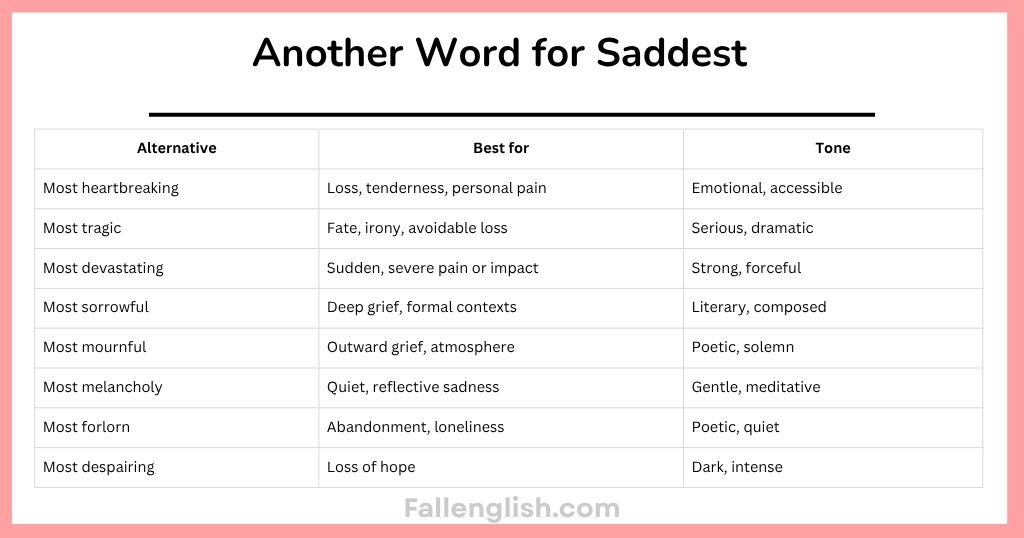
| Alternative | Best for | Tone |
| Most heartbreaking | Loss, tenderness, personal pain | Emotional, accessible |
| Most tragic | Fate, irony, avoidable loss | Serious, dramatic |
| Most devastating | Sudden, severe pain or impact | Strong, forceful |
| Most sorrowful | Deep grief, formal contexts | Literary, composed |
| Most mournful | Outward grief, atmosphere | Poetic, solemn |
| Most melancholy | Quiet, reflective sadness | Gentle, meditative |
| Most forlorn | Abandonment, loneliness | Poetic, quiet |
| Most despairing | Loss of hope | Dark, intense |
Mistakes Worth Avoiding
Don’t treat these as interchangeable with “saddest” in every sentence. Most tragic implies a narrative cause — something went wrong. Calling a rainy afternoon “the most tragic moment of my week” misuses the word’s weight.
“Most devastating” is about impact, not just feeling. A devastating event doesn’t just make you sad — it changes something. If you only mean “very sad,” most heartbreaking or most sorrowful is more accurate.
“Most melancholy” is a mood, not a crisis. It would be strange to describe a terminal diagnosis as “the most melancholy news.” The word is too gentle for acute pain.
Superlative form matters. All of these follow the most + adjective pattern rather than adding -est. You would not write “heartbreakingest” or “melancoliest.” This is worth noting if English is not your first language.
Read also:
Another Word for Get Rid Of: The Right Word for Every Situation
Another Word for Faced: The Right Word Depends on What You Mean
Choosing the Right One
If you’re describing a scene, a story, or a piece of art — most heartbreaking or most tragic will usually feel the most natural to a reader.
If you’re writing about atmosphere, memory, or place — most melancholy or most forlorn fit without overstating.
If the sadness is about impact and severity — reach for most devastating.
If you want formality or solemnity — most sorrowful or most mournful carry that register without sounding melodramatic.
The best replacement for saddest is the word that names the specific kind of pain — not just how much of it there is.

FallEnglish is run by a language enthusiast who explains word and text meanings in clear, simple ways. Each guide is carefully researched, original, and written to help real people understand language faster, with accuracy, context, and everyday examples you can trust.