

You’re mid-sentence. The word “in which” is sitting there, and something feels off. Not wrong, exactly. Just heavy. A little stiff. Like you put on a suit to write a text message.
That’s the “in which” problem. It works grammatically, but it often adds weight where the writing needs to breathe. The good news? There are more than 41 ways to replace it, and each one changes your sentence’s tone in a slightly different way.
This guide shows you which alternative fits which situation, so you stop guessing and start writing with more control.
What “In Which” Is Actually Doing
“In which” connects a noun to extra information about it. It describes a place, a time, a condition, or a situation. That’s its job.
The phrase itself isn’t wrong. It’s just formal by nature. When used too often, it makes writing sound stiff or academic even when that’s not the goal.
Understanding what it does helps you choose a replacement that keeps the meaning intact while fitting the tone better.
41+ Full Another Word for “In Which” Table
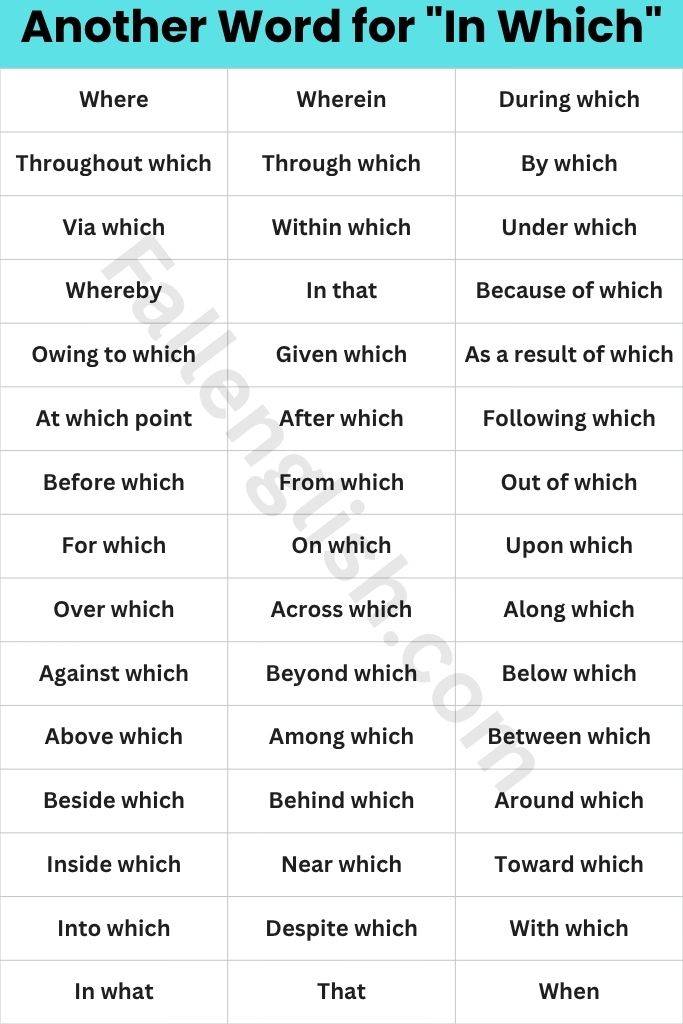
Organized by function so you can find the right one fast.
| Alternative | Tone | Best Used When |
| Where | Casual/Neutral | Place or general situation |
| Wherein | Formal | Legal, academic, official documents |
| During which | Neutral | A time period or event span |
| Throughout which | Formal | Something lasting the full duration |
| Through which | Formal/Neutral | Process, channel, or method |
| By which | Formal/Neutral | Mechanism or means |
| Via which | Formal | Route or delivery channel |
| Within which | Formal | Inside a limit or boundary |
| Under which | Formal | Rules, conditions, authority |
| Whereby | Formal | Systems, procedures, arrangements |
| In that | Neutral | Explaining a reason or feature |
| Because of which | Neutral | Cause and effect link |
| Owing to which | Formal | Formal cause or reason |
| Given which | Formal | Condition-based explanation |
| As a result of which | Formal | Outcome or consequence |
| At which point | Neutral | A moment in a sequence |
| After which | Neutral | What comes next in order |
| Following which | Formal | Formal sequence or timeline |
| Before which | Formal | Prior condition or event |
| From which | Neutral | Source or origin |
| Out of which | Casual | Material, source, or result |
| For which | Neutral | Purpose or reason |
| On which | Neutral | An event, date, or occasion |
| Upon which | Formal | Formal event or surface |
| Over which | Neutral | Span, authority, or control |
| Across which | Neutral | Range or extent |
| Along which | Neutral | Path or direction |
| Against which | Formal | Contrast, measure, or resistance |
| Beyond which | Formal | Exceeding a limit |
| Below which | Formal | Beneath a threshold |
| Above which | Formal | Exceeding a level or amount |
| Among which | Neutral | Selection within a group |
| Between which | Neutral | Comparing two specific options |
| Beside which | Neutral | Comparison or proximity |
| Behind which | Neutral | Hidden reason or position |
| Around which | Casual | Surrounding idea or concept |
| Inside which | Casual | Container or enclosed space |
| Near which | Casual | Proximity or closeness |
| Toward which | Neutral | Direction or goal |
| Into which | Neutral | Entry or transition |
| Despite which | Formal | Contradiction or contrast |
| With which | Neutral | Tool, instrument, or means |
| In what | Casual | Informal explanation |
| That | Casual | Simple, direct connection |
| When | Casual/Neutral | Time-based situations |
In Which Synonym Meaning Clusters: Choosing by Function
The table above shows you what to use. This section shows you why.
In Which synonym For Place and Setting
“Where” is almost always the cleanest swap when “in which” refers to a physical or situational location.
The lab in which the samples were tested reads more naturally as the lab where the samples were tested.
“Wherein” works too, but it carries an older, more formal feel. Save it for contracts and legal documents.
“Inside which” works for enclosed spaces in casual writing. “Around which” suits abstract ideas that surround a topic rather than contain it physically.
In Which synonym For Time
“During which” is precise. It signals something happened inside a specific time window, not just near it.
“Throughout which” goes further, implying something lasted the entire period without interruption.
“When” is the most casual option and works well in everyday writing. “At which point” fits sequences, when you need to mark a specific moment in a timeline.
In Which synonym For Process and Method
“Through which,” “by which,” and “via which” all handle this space, but they’re not identical.
“Through which” pictures a channel or path something travels. “By which” focuses on the mechanism itself. “Via which” is the most technical-sounding of the three.
The system through which payments are processed focuses on the flow. The method by which votes are counted focuses on the technique. The difference is small but real.
In Which synonym For Rules, Conditions, and Authority
“Under which,” “within which,” and “whereby” belong here.
“Under which” implies operating beneath a rule or authority. “Within which” suggests a defined boundary or limit. “Whereby” introduces a formal system or arrangement, common in legal writing and policy documents.
In Which synonym For Cause and Explanation
“In that” is unique. It doesn’t just connect, it explains. It signals that what follows is why something is true or useful.
The approach was helpful in that it reduced guesswork. You cannot replace “in that” with “where” or “during which” in that sentence. It’s doing a different job.
“Because of which,” “owing to which,” and “as a result of which” all handle causation too, but they’re heavier. Use them when you want to be very explicit about the cause.
Another Word for “In Which” in Sentence Rewrites: Same Idea, Different Feel
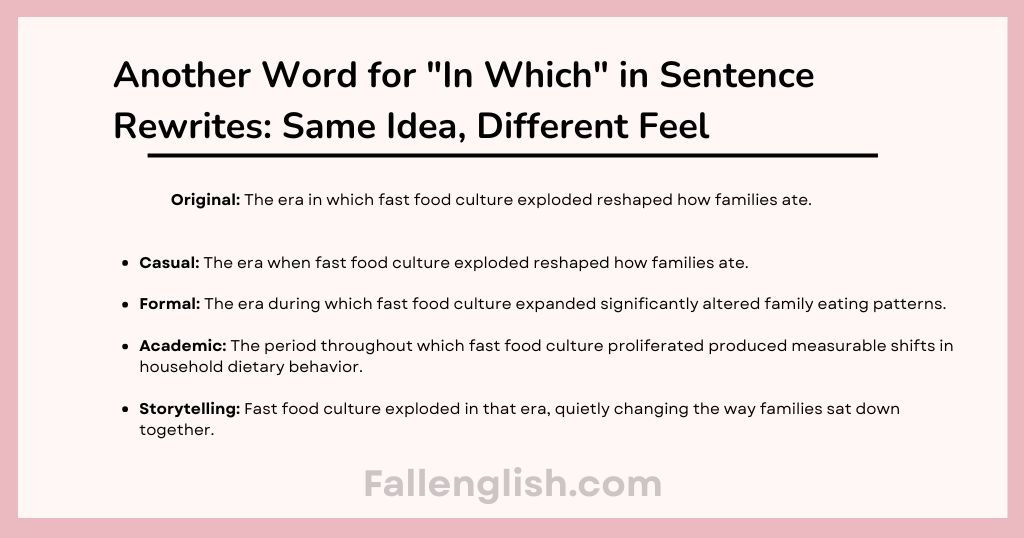
This is where alternatives stop being abstract and start being practical.
Original: The era in which fast food culture exploded reshaped how families ate.
- Casual: The era when fast food culture exploded reshaped how families ate.
- Formal: The era during which fast food culture expanded significantly altered family eating patterns.
- Academic: The period throughout which fast food culture proliferated produced measurable shifts in household dietary behavior.
- Storytelling: Fast food culture exploded in that era, quietly changing the way families sat down together.
Notice how each version signals a different kind of writing. The storytelling version drops the relative phrase entirely and rebuilds the sentence around action.
Original: The contract in which the terms were agreed upon was signed in April.
- Neutral: The contract under which the terms were agreed was signed in April.
- Formal: The agreement wherein the terms were established was executed in April.
- Simpler: The contract, signed in April, outlined the agreed terms.
- Direct: They signed the contract in April, finalizing all terms.
“Under which” fits better than “in which” here because terms operate under contracts. Small detail. Big difference to a careful reader.
Original: The workshop in which she learned photography changed her career.
- Casual: The workshop where she learned photography changed her career.
- Academic: The instructional workshop during which she developed her photographic skills proved professionally transformative.
- Creative: She walked into that workshop not knowing it would change everything.
The creative version doesn’t need any relative phrase at all. Sometimes cutting is the best edit.
Another Word for “In Which” Formal vs. Casual: What Fits Where
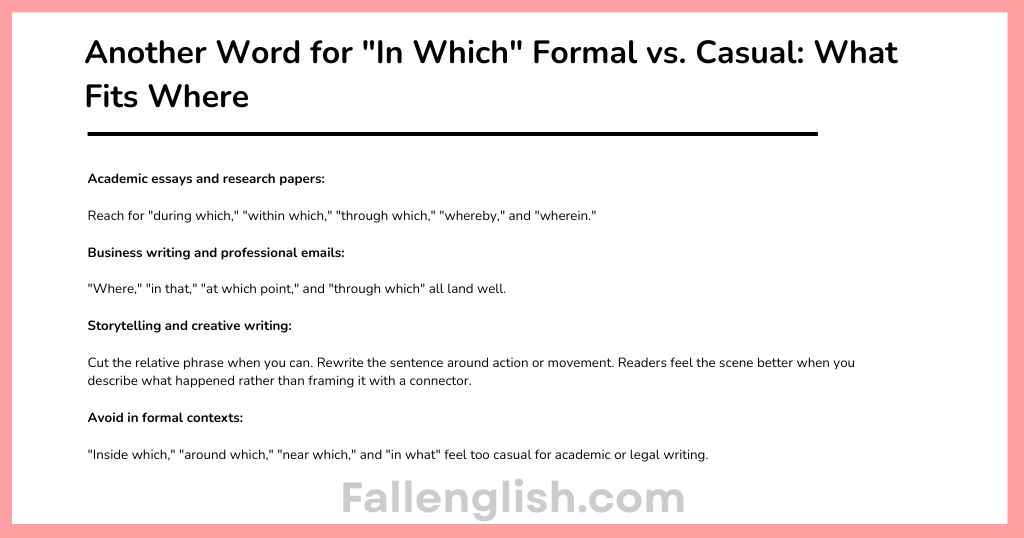
Academic essays and research papers:
Reach for “during which,” “within which,” “through which,” “whereby,” and “wherein.” These match the precision and register that formal writing expects.
Business writing and professional emails:
“Where,” “in that,” “at which point,” and “through which” all land well. They stay clear without sounding stiff.
Storytelling and creative writing:
Cut the relative phrase when you can. Rewrite the sentence around action or movement. Readers feel the scene better when you describe what happened rather than framing it with a connector.
Avoid in formal contexts:
“Inside which,” “around which,” “near which,” and “in what” feel too casual for academic or legal writing. They work in conversation or informal content, but not in a research paper or legal brief.
In Which synonym Common Mistakes That Quietly Hurt Writing
Replacing “in which” with “where” for abstract nouns.
“Where” works for concrete places and situations, but sounds imprecise when attached to abstract nouns. “A condition where stress builds” is widely used but technically loose. In academic writing, “a condition in which stress builds” or “a condition under which stress accumulates” is sharper.
Misusing “wherein.”
It’s a legitimate word but feels archaic in modern writing. Using it in a blog post or email makes the writing feel stiff in a different way than “in which” does. Match the word to the context.
Treating “in that” and “in which” as interchangeable.
They are not. “In which” describes. “In that” explains. The plan succeeded in that it met every deadline. Swap in “in which” and the sentence breaks. The function is different.
Stacking two relative phrases in one sentence.
The framework within which the system through which data flows operates is technically correct and practically unreadable. If you have two relative connectors in one sentence, split it into two sentences.
Forgetting that cutting is an option.
“The year in which she graduated” can become “the year she graduated.” Dropping the relative phrase entirely often makes the sentence faster and cleaner. Try cutting it first. If the meaning holds, keep the shorter version.
Using “whereby” outside formal contexts.
“Whereby” belongs in systems, procedures, and formal descriptions. Dropping it into casual writing sounds odd. “A game whereby players collect points” reads like a rulebook. “A game where players collect points” reads like a person talking.
In Which synonym Related Words That Often Get Confused
These aren’t replacements for “in which,” but they live nearby and sometimes get tangled up.
Wherein is the compressed, older version of “in which.” Same meaning, much stiffer tone. Use only in formal or legal contexts.
Whereas shows contrast between two things. It is not a substitute for “in which” and means something entirely different. Writers sometimes reach for it by mistake.
Whereby introduces a system or method. Don’t use it where “in which” is describing a place, time, or general situation.
Such that explains a result or degree. A different function entirely. “Such that” answers “to what extent,” not “inside what.”
So that shows purpose or intention. Another different job. Don’t mix it up with “in which,” which describes a container or setting.
Read also:
Another Word for Garbage: 56+ Better Synonyms for Every Situation
69+ Another Word for Audit: Smarter Alternatives for Every Context
FAQs about Another Word for “In Which”
Is “in which” too formal for everyday writing?
It depends on the context. In academic papers and formal reports, it’s perfectly appropriate. In blog posts, emails, and casual writing, it often makes sentences feel heavier than they need to be. If you notice your writing sounds stiff, “in which” is usually one of the first things worth checking.
Can “where” replace “in which” in an essay?
In many cases, yes, especially when you’re describing a physical place or a general situation. But in academic essays, “where” attached to abstract nouns can feel imprecise. “A model within which several variables interact” is more exact than “a model where several variables interact” in a research context.
What’s the difference between “through which” and “by which”?
“Through which” emphasizes a path or channel something travels along. “By which” focuses on the method or mechanism used. Both are formal. The choice depends on whether your sentence is describing movement through something or the means of doing something.
When should I just cut “in which” rather than replace it?
Whenever the sentence stays clear without it. “The decade in which everything shifted” works fine as “the decade everything shifted.” If removing the phrase doesn’t change the meaning and the sentence still flows, cutting it is usually the better edit. Shorter is often stronger.
What to Take Away
“In which” is not a writing problem. Overusing it without checking if something better fits, that’s the problem.
For time, try “during which” or “when.” For place, use “where.” For process and method, reach for “through which” or “by which.” For conditions and rules, “under which” or “within which” is more precise. For explanations, “in that” does a job none of the others can.
And sometimes, the right move is to drop the phrase entirely and rewrite the sentence so it doesn’t need a connector at all.
That’s not just finding another word. That’s writing with more intention.

FallEnglish is run by a language enthusiast who explains word and text meanings in clear, simple ways. Each guide is carefully researched, original, and written to help real people understand language faster, with accuracy, context, and everyday examples you can trust.