


You’re not just tired of the word “garbage.” You’re tired of sounding like you only know one word. Whether you’re cleaning up an essay, writing dialogue, or just texting someone about the mess in the kitchen, the word you pick changes how your sentence lands.
This guide gives you 56+ Another Word for Garbage, sorted by tone, meaning, and use, so you can choose with confidence instead of guessing.
What “Garbage” Really Means (Two Ways)
Garbage works in two directions. Literally, it’s unwanted physical waste. Figuratively, it describes anything worthless, low quality, or not worth your time.
That split matters. Some synonyms only work for one meaning, not both. Mixing them up is where most writers go wrong.
Quick-Reference: 56+ Another Word for Garbage

🗑️ Another Word for Garbage Literal Waste (Physical, Everyday)
| Word | Tone | Best Used When |
| Trash | Casual, American | Everyday US speech or writing |
| Rubbish | Casual, British/Australian | UK, AU context or dismissive use |
| Refuse | Formal | Technical, official, environmental writing |
| Waste | Neutral | Professional, sustainability content |
| Litter | Neutral | Outdoor spaces, public areas |
| Debris | Neutral | Broken fragments, post-damage scenes |
| Scraps | Mild | Kitchen leftovers, craft offcuts |
| Junk | Informal | Old cluttered objects, unused items |
| Muck | Earthy, British | Muddy or organic mess |
| Filth | Strong | Emphasizes disgust or extreme dirtiness |
| Slop | Informal | Messy, wet, or liquid waste |
| Offal | Technical | Animal byproducts, butchery waste |
| Swill | Strong | Low-quality liquid waste or food scraps |
| Dross | Literary | Inferior leftover material |
| Clutter | Mild | Disorganized but possibly still useful items |
| Sludge | Technical | Thick, wet industrial or organic waste |
| Effluent | Formal/Technical | Liquid waste, especially from factories |
| Sewage | Technical | Wastewater, drainage systems |
| Compost | Neutral/Positive | Organic waste being recycled |
| Scrap | Neutral | Leftover material, metal or fabric |
| Residue | Neutral | What remains after use or processing |
| Castoffs | Mild | Things discarded but still intact |
| Discards | Neutral | Items deliberately thrown away |
| Leftovers | Mild | Remaining food or material |
| Byproduct | Neutral | Secondary output, often unwanted |
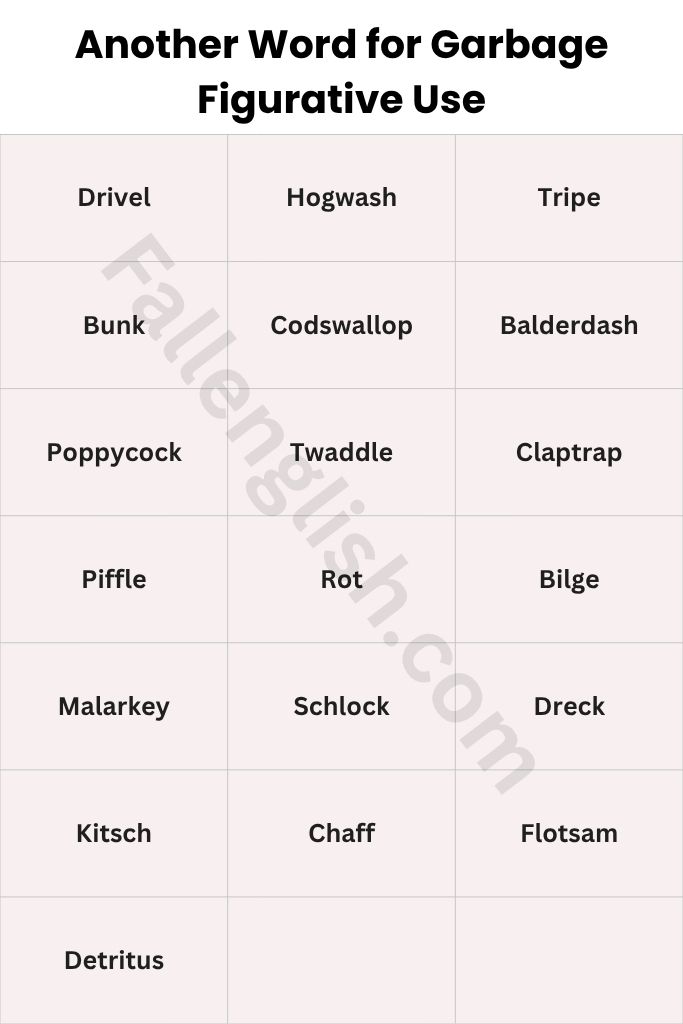
💬 Another Word for Garbage Figurative Use (Bad Quality, Worthless Ideas)
| Word | Tone | Best Used When |
| Drivel | Cutting | Pointless speech or writing |
| Hogwash | Casual | Ridiculous or untrue claims |
| Tripe | British informal | Nonsense, low-quality content |
| Bunk | Sharp, punchy | Dismissing something quickly |
| Codswallop | Playful, British | Absurd statements |
| Balderdash | Old-fashioned | Formal-sounding nonsense |
| Poppycock | Mild, humorous | Outdated but colorful dismissal |
| Twaddle | British | Weak, silly, meaningless talk |
| Claptrap | Informal | Showy but hollow speech |
| Piffle | Light, British | Mild dismissal of a weak idea |
| Rot | British casual | Short, sharp rejection |
| Bilge | Nautical origin | Worthless or offensive talk |
| Malarkey | American casual | Nonsense, exaggerated claims |
| Schlock | Yiddish-origin | Cheaply made, low-quality goods |
| Dreck | Yiddish-origin | Inferior content or products |
| Kitsch | Art/culture context | Tacky, low-taste items or ideas |
| Chaff | Literary | Worthless leftovers after value is removed |
| Flotsam | Literary | Odds and ends without real value |
| Detritus | Literary/formal | Accumulated worthless remains |
🗣️ Another Word for Garbage Slang and Regional Terms
| Word | Origin/Region | Example Use |
| Garbo | Australian/American informal | “Take the garbo out before dark.” |
| Basura | Spanish-origin, US cities | Common in bilingual urban settings |
| Skank | Some regional dialects | Filthy or low-quality material |
| Rubbish | Also UK slang | “That film was absolute rubbish.” |
| Crud | American casual | “Clean that crud off the counter.” |
| Gunk | American informal | Sticky, messy, unidentified waste |
| Grime | Urban, informal | Built-up dirt or filth on surfaces |
| Swill | Also figurative slang | “They’re serving swill at that place.” |
| Scuzz | Casual American | Dirty, unappealing mess or person |
| Grunge | Informal | Grimy buildup or low-quality material |
⬆️ Antonyms (Opposite of Garbage)
| Word | Meaning |
| Treasure | Rare, highly valued item |
| Asset | Useful, worth keeping |
| Gem | Small but excellent thing |
| Keepsake | Preserved for sentimental value |
| Commodity | Tradeable, valuable material |
| Prize | Something earned or exceptional |
Meaning Clusters: Synonyms for Garbage Nuance That Matters
Getting the right word isn’t just about finding a synonym. It’s about understanding what each word actually points to.
Debris vs. Litter: Debris comes from destruction. A collapsed wall leaves debris. A careless picnicker leaves litter. They’re both scattered waste, but the cause is completely different.
Refuse vs. Waste: Refuse is solid discarded material. Waste is broader and includes liquids, gases, and heat. In environmental writing, using them interchangeably can create real confusion.
Junk vs. Clutter: Junk has no value left. Clutter might still be useful but is just disorganized. One belongs in the bin; the other needs a shelf.
Drivel vs. Tripe vs. Bunk: All three dismiss quality, but differently. Drivel attacks the effort put into something, suggesting it was always pointless. Tripe suggests it’s offensive or stomach-turning bad. Bunk is the fastest, flattest rejection of all three.
Dross vs. Schlock vs. Dreck: These cluster around poor craftsmanship. Dross is literary and elegant in its dismissal. Schlock and dreck both come from Yiddish and carry a kind of weary, seen-it-all contempt. Schlock tends toward cheap goods; dreck leans toward content or media.
Another Word for Garbage Sentence Rewrites: Watch the Tone Shift

Original: “There was garbage all over the street.”
- Formal: “Refuse had accumulated along the street, prompting sanitation complaints.”
- Journalistic: “Waste littered the road following the weekend’s events.”
- Creative: “Detritus spread across the pavement like the street had given up.”
- Casual: “The whole street was just covered in crud.”
Original: “That report was garbage.”
- Professional: “The report lacked credibility and showed little research depth.”
- Informal: “Honestly, that report was pure drivel.”
- British casual: “The whole thing was rubbish from the first page.”
- Sharp and fast: “That report? Total bunk.”
Original: “He just threw garbage everywhere.”
- Environmental tone: “He scattered refuse without any regard for disposal.”
- Storytelling: “Filth trailed behind him wherever he went.”
- Casual dialogue: “He was just tossing junk around like it was nothing.”
Each version says the same thing. Each version creates a different reaction.
Another Word for Garbage Formal vs. Informal: The Quick Decision Guide

Formal writing, reports, official documents: Use refuse, waste, debris, effluent, residue, byproduct
News writing, general audience: Use waste, litter, debris, trash (for US publications)
Casual writing, blogs, dialogue, social media: Use trash, rubbish, junk, crud, muck, garbo
Figurative dismissal in any informal context: Use drivel, bunk, hogwash, tripe, malarkey
Literary or creative writing: Use dross, detritus, flotsam, chaff, swill
Technical or scientific writing: Use effluent, sludge, sewage, offal, residue
Common Mistakes Writers Make Garbage Synonyms
Using “debris” for household waste. It doesn’t work. Debris describes structural or environmental fragments, not kitchen scraps or everyday rubbish.
Using “litter” indoors. Litter belongs in outdoor public contexts. Saying someone “left litter in the kitchen” sounds unnatural to most readers.
Reaching for “filth” when you mean clutter. Filth implies serious dirtiness and often disgust. Clutter is just messiness. They’re not even close in emotional weight.
Overusing “drivel” for everything bad. Drivel specifically attacks the value of speech or text. Calling a product or a place “drivel” sounds odd. Save it for words, ideas, or writing.
Treating “refuse” and “rubbish” as equal. Refuse is formal and technical. Rubbish is casual British English. Dropping “refuse” into casual conversation sounds stiff. Dropping “rubbish” into a government report sounds unprofessional.
Another Word for Garbage Related Vocabulary Worth Knowing
These aren’t direct synonyms but come up in the same searches and conversations.
Landfill / garbage dump: Where waste ends up. “Landfill” is formal and preferred in professional writing. “Dump” is informal but widely understood.
Sanitation worker: The respectful professional term for a garbage collector. Use it in formal or public-facing writing.
Waste bin / rubbish bin / trash can / garbage can: The container varies by region. “Bin” works in UK and Australian English. “Can” is American.
Recyclables: Not all waste is garbage. If you’re writing about waste management or sustainability, distinguishing recyclables from garbage adds precision and shows awareness.
Read also: 165+ Science Words That Start With J | Full List with Meanings
FAQs
Why does “rubbish” sound strange in American writing?
Americans do use it, but often with a slightly theatrical quality, like they’re imitating British speech. For natural-sounding American English, stick with trash or garbage. Use rubbish when you want a hint of that British directness or when your audience is British or Australian.
Which word works best in global English content?
“Waste” travels the best. It fits formal and informal writing, doesn’t sound regional, and covers both literal and some figurative uses without confusion.
Is there a polite, professional term for a garbage dump?
Yes: “landfill.” For facilities that sort or move waste before disposal, “transfer station” or “materials recovery facility” are the accurate terms. In professional writing, avoid “dump” entirely.
When should I use “detritus” instead of “debris”?
Use detritus when you mean accumulated waste over time, often with a literary or figurative flavor. Use debris for sudden, specific physical fragments. Detritus feels slower and more layered; debris feels immediate.
Pick the Right Word, Every Time
Here’s the short version when you’re in a hurry.
- Writing for a US audience, casual tone: trash
- Writing for UK or Australian readers: rubbish
- Formal or technical document: refuse or waste
- Describing scattered fragments: debris
- Dismissing a bad idea or poor writing: drivel or bunk
- Literary or creative writing: dross or detritus
- Outdoor mess in public places: litter
- Old useless stuff piling up: junk
The right word is already in this list. Now you just have to match it to your sentence.

FallEnglish is run by a language enthusiast who explains word and text meanings in clear, simple ways. Each guide is carefully researched, original, and written to help real people understand language faster, with accuracy, context, and everyday examples you can trust.