

Impact pulls a lot of weight in modern English — sometimes too much. When the same word appears three times in a paragraph, or when it feels vague where you need something precise, the problem usually isn’t the word itself but how broadly it’s being used.
Quick Answer
The best alternatives depend on which sense of impact you mean:
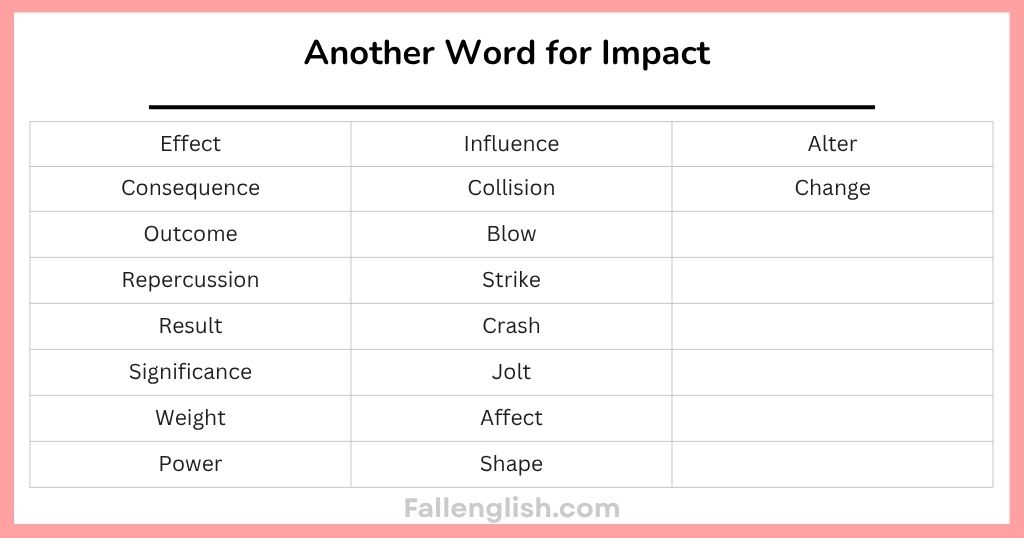
- Effect or result → effect, consequence, outcome, influence
- Strong impression or force → force, weight, power, significance
- Physical collision → collision, blow, strike, crash
- Verb use → affect, shape, alter, influence
No single word replaces impact in every situation. The right choice depends on whether you’re describing a cause-and-effect relationship, a physical event, or the felt importance of something.
The Core Problem with Impact
Impact became overused precisely because it can mean almost anything. A policy has an impact. A speech has an impact. A meteor has an impact. That flexibility is useful, but it also means the word often tells the reader very little.
When you replace impact with a more specific word, you usually gain clarity. Saying a policy had consequences tells the reader something happened afterward. Saying it had influence suggests an ongoing, shaping force. Saying it had weight emphasizes how seriously it was felt. Each of these does something impact doesn’t.
Another Word for Impact by Meaning
When you mean “result” or “effect”
| Word | What it adds | Works best when |
| effect | Direct, neutral cause-and-result link | Describing what a cause produced |
| consequence | Suggests the result matters or carries weight | The outcome is serious or hard to reverse |
| outcome | Focuses on the end state | Evaluating success or failure |
| repercussion | Implies a negative or unexpected ripple | Something went wrong or spread outward |
| result | Straightforward, factual | Plain factual statements |
Effect is the cleanest substitution in most cases. It’s precise, neutral, and grammatically parallel: “the effect of the policy” works wherever “the impact of the policy” would have.
Consequence raises the stakes. It implies the result carries weight, and often implies someone is accountable for it. Use it when the outcome is serious, not when you’re describing minor or neutral results.
Repercussion almost always implies something spread in an unwanted direction: the repercussions of the decision. Don’t use it to describe a positive outcome.
When you mean “force” or “importance”
These alternatives describe how strongly something registers — not what it caused, but how much it mattered.
- significance — focuses on meaning and importance, especially in analysis or argument
- weight — suggests seriousness or felt importance; works well in professional and written contexts
- power — emphasizes strength or capacity to change things; can sound forceful or dramatic
- influence — suggests a shaping effect, especially one that develops over time rather than all at once
“The speech had real weight” feels measured and serious.
“The speech had real power” emphasizes force and emotion.
“The speech had real significance” is analytical, better suited to an academic or evaluative sentence.
These are not interchangeable. Choosing the wrong one shifts the reader’s sense of what you’re describing.
When you mean a physical collision
Here impact is often used correctly, but alternatives can be more precise:
- collision — two things meeting with force, usually by movement
- blow — a single striking force, often intentional
- strike — a clean, direct hit
- crash — violent, sudden, usually involving noise or damage
- jolt — a sudden sharp movement or shock, often smaller in scale
In scientific or engineering writing, impact is the standard technical term for a force applied on contact, so replacing it there may reduce precision rather than increase it. Stick with impact in that context.
When impact is used as a verb
This is where the word earns the most criticism. Many style guides and editors recommend avoiding impact as a verb (“this will impact our results”) in favor of more precise choices:
- affect — the most natural, direct substitution in most sentences
- shape — suggests gradual forming or influence over time
- alter — implies a specific change took place
- influence — suggests a softer, ongoing effect rather than a sudden one
- change — plain, clear, and often more honest about what you mean
“This will affect our results” is cleaner and less prone to misreading than “this will impact our results.”
“The experience shaped her thinking” implies something formative, not just a momentary effect.
“The new rule altered the outcome” pinpoints that a specific change occurred.
If you’re writing for a formal or edited publication, replacing verbal impact with one of these is almost always the right call.
When Impact Is Actually the Right Word
Not every instance needs a replacement. Impact earns its place when:
- You need to convey both the force and the significance of something at once, and no other word does both
- The context is scientific or technical writing where impact has precise meaning
- You’re using it in a set phrase where alternatives sound stilted (impact assessment, high-impact, on impact)
The goal is not to eliminate impact from your writing but to use it deliberately — not as a default filler for “something important happened here.”
Read also:
Another Word for Liberation: Alternatives That Actually Fit Your Meaning
Another Word for Variety: Alternatives That Actually Fit Your Meaning
Choosing the Right Another Word for Impact
Use effect when you want a clean, neutral description of what something caused.
Use consequence when the result is serious, lasting, or carries accountability.
Use influence when something shaped another thing gradually rather than all at once.
Use weight or significance when you’re describing how important something felt or why it matters.
Use affect (verb) when you want to say something changed or touched another thing.
Use repercussion only when the outcome spread outward, often negatively.
The strongest writing usually picks the word that matches the specific shape of what happened — not the word that sounds the most forceful. Consequence is not stronger than effect; it’s just different. Knowing that difference is what makes the right choice clear.

FallEnglish is run by a language enthusiast who explains word and text meanings in clear, simple ways. Each guide is carefully researched, original, and written to help real people understand language faster, with accuracy, context, and everyday examples you can trust.