

Liberation carries a lot of weight. It can describe the end of political oppression, a personal emotional breakthrough, the freeing of prisoners, or a philosophical concept of self-determination. That range is exactly why a single replacement rarely works across every context.
Quick Answer
The most useful alternatives are freedom, release, emancipation, deliverance, and independence — but they are not interchangeable. Freedom names a state; liberation describes arriving at it. Emancipation fits legal or historical contexts. Release works for more immediate, personal situations. Deliverance carries a strong moral or spiritual charge. Independence focuses on self-governance rather than escape from oppression.
The Core Distinction Worth Understanding First
Most people reach for a synonym because liberation feels too grand, too political, or too abstract for what they’re writing. But before choosing a replacement, it helps to identify which sense you’re using:
- Political or collective — a people freed from occupation, dictatorship, or colonial rule
- Legal or institutional — formal release from bondage, slavery, or captivity
- Personal or emotional — an individual freed from guilt, fear, expectation, or constraint
- Philosophical or spiritual — the concept of ultimate freedom in religious or existential thought
Each sense pulls toward different alternatives.
Another Word for Liberation by Meaning
When liberation means political or collective freedom
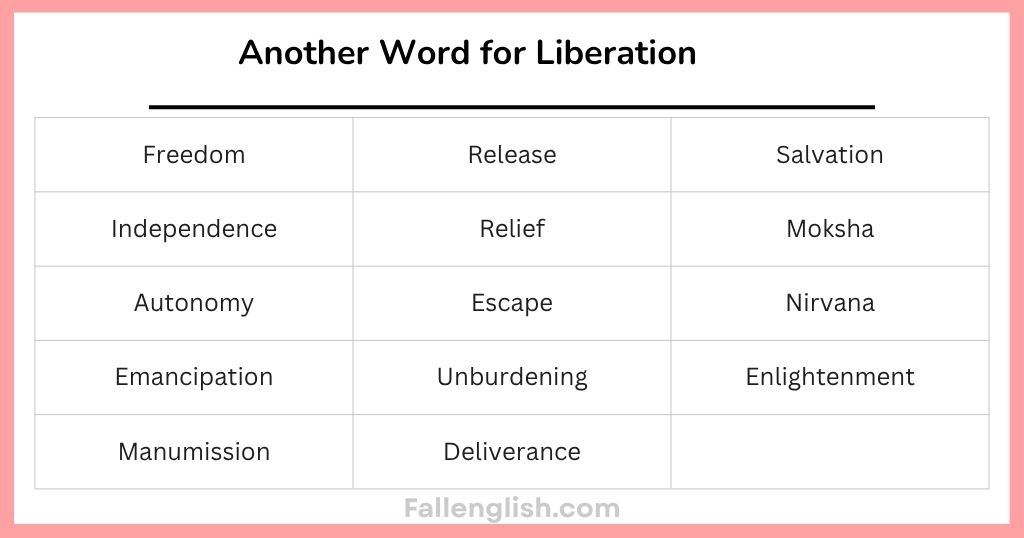
Freedom is the natural, broadest choice. It names the condition that liberation produces. You can often swap one for the other in a sentence, but there’s a subtle difference in emphasis: liberation implies a struggle or transition; freedom describes the result.
The country’s liberation came after years of resistance. → The sentence focuses on the act of becoming free.
The country finally had its freedom. → The sentence rests on the state itself.
Independence narrows the focus to self-rule. It fits when the point is not just freedom from oppression but the capacity to govern without outside control. A country can win its liberation and still not have full independence if another power shapes its decisions. Use independence when that distinction matters.
Autonomy works in similar territory but tends to appear in institutional, organizational, or philosophical writing rather than political history. A region might seek autonomy within a larger state; a person might seek autonomy within a relationship or workplace. It rarely carries the dramatic weight of liberation.
When liberation means legal or historical emancipation
Emancipation is the most precise alternative here. It carries a specific legal and historical meaning — freedom granted formally, particularly from slavery or legal subordination. In American historical writing, the word is almost inseparable from that context. Use it when the freeing is formal, documented, and rooted in an institutional act.
The emancipation of enslaved people required not just a proclamation but enforcement.
Avoid using emancipation casually for emotional or everyday situations. It will sound incongruous.
Manumission is more technically precise — referring specifically to the formal freeing of an enslaved person by their enslaver — but it belongs in historical scholarship rather than general writing.
When liberation means personal or emotional release
Release is the most natural word in personal contexts. It feels immediate and physical rather than ideological.
Telling the truth gave her a sense of release she hadn’t expected.
Liberation in this sentence would work, but it would elevate the moment toward the dramatic. Release keeps it grounded and human.
Relief overlaps with release but focuses more on the lifting of pressure than on the act of becoming free. It implies something was weighing on the person.
Handing in her resignation brought enormous relief.
Escape suggests breaking away from something confining, but it has a slightly desperate or urgent edge. Liberation implies something was conquered; escape implies something was fled.
Unburdening works in emotional and confessional contexts — it describes the specific experience of putting down a weight rather than being freed in a broader sense.
When liberation is philosophical or spiritual
Deliverance is the strongest alternative here. It implies rescue by an outside force — divine, moral, or providential. Unlike liberation, which often implies active struggle, deliverance implies being saved. That distinction changes the tone of a sentence entirely.
Liberation from suffering — the person or group actively overcomes it.
Deliverance from suffering — something or someone else intervenes.
Salvation occupies similar spiritual ground but is even more specifically theological in most readers’ minds. Use it where religious register is appropriate and intentional.
Moksha, nirvana, and enlightenment all represent liberation in specific religious traditions — Hindu, Buddhist, and broadly spiritual respectively. They are not synonyms but names for related concepts. Use them only when writing about those traditions directly.
Read more: Another Word for Risk: Alternatives That Actually Fit Your Meaning
Words That Look Similar but Create Different Impressions
| Word | What it actually implies | Where it can mislead |
| Freedom | A condition or right | Doesn’t convey the struggle of arriving there |
| Release | Immediate, personal, physical | Too small for collective or political contexts |
| Emancipation | Formal, legal, historical | Sounds incongruous in emotional or casual use |
| Deliverance | Rescue from outside | Implies passivity, not active struggle |
| Independence | Self-governance | Doesn’t cover emotional or spiritual liberation |
| Escape | Fleeing constraint | Implies urgency and possibly failure to fully resolve |
How Context Changes the Best Choice
In historical writing: Emancipation and liberation are both appropriate. Choose based on whether the freeing was formal-legal (emancipation) or the result of a broader political or military struggle (liberation).
In personal essays or memoir: Release or relief usually fits better than liberation, which can make an individual experience sound like a political manifesto unless that effect is intentional.
In fiction: Liberation carries narrative weight and works well at a climactic moment. Freedom is quieter and more reflective. Deliverance has a moral or even ominous resonance — suitable when a character is saved by something beyond themselves.
In academic or philosophical writing: Autonomy, self-determination, and emancipation (especially in the tradition of critical theory, where Habermas and others use it technically) all have specific uses. Liberation also has a specific meaning in liberation theology and liberation philosophy. None of these are casually interchangeable.
In everyday speech: Freedom is almost always the most natural word. Liberation in casual conversation tends to sound either dramatic or ironic.
Read more: Another Word for Eye-Opening: Better Choices for What You Actually Mean
A Practical Selection Guide
Use freedom when you’re naming the condition itself — what someone has, or what they’re fighting for.
Use emancipation when the freeing is legal, formal, or tied to historical bondage.
Use release when the context is personal, immediate, and emotional — a feeling, not an ideology.
Use deliverance when an outside force does the rescuing, especially in moral or spiritual writing.
Use independence when the emphasis is on self-rule and the ability to act without external control.
Use autonomy in professional, institutional, or philosophical contexts where the focus is decision-making freedom rather than escape from oppression.
Keep liberation when the word needs to carry the weight of active struggle, collective identity, or ideological significance — because none of the alternatives quite do that.
The difference between these words is rarely about dictionary definitions. It’s about what the sentence implies about how freedom arrived, who brought it about, and what kind of constraint it overcame. Getting that right is what turns a synonym into the right word.

FallEnglish is run by a language enthusiast who explains word and text meanings in clear, simple ways. Each guide is carefully researched, original, and written to help real people understand language faster, with accuracy, context, and everyday examples you can trust.