

Freedom is one of those words that carries enormous weight — political, emotional, philosophical — and that weight can sometimes work against you as a writer. When the word feels too grand, too vague, or simply overused in context, the right alternative depends entirely on what kind of freedom you mean.
Quick Answer
The most useful alternatives are liberty, independence, autonomy, free rein, and latitude. They are not interchangeable. Liberty and freedom are closest in meaning but differ in connotation. Autonomy is more specific — self-governance, usually of a person or institution. Independent signals the absence of control rather than the presence of rights. Free rein and latitude are informal and situational, best for contexts involving permission rather than principle.
The Central Problem With “Freedom”
Freedom covers too much ground. A political scientist, a parent, a novelist, and a prisoner all use the word differently. Before choosing a replacement, identify which sense you actually mean:
- Freedom as a political or civil right — the liberty to speak, assemble, vote
- Freedom as personal independence — living without another person’s control
- Freedom as self-direction — making your own decisions about your own life
- Freedom as permission or latitude — being allowed to act without restriction in a specific situation
- Freedom as release — escaping confinement, obligation, or constraint
Each sense has its own stronger alternatives.
Another Word for Freedom Comparison at a Glance
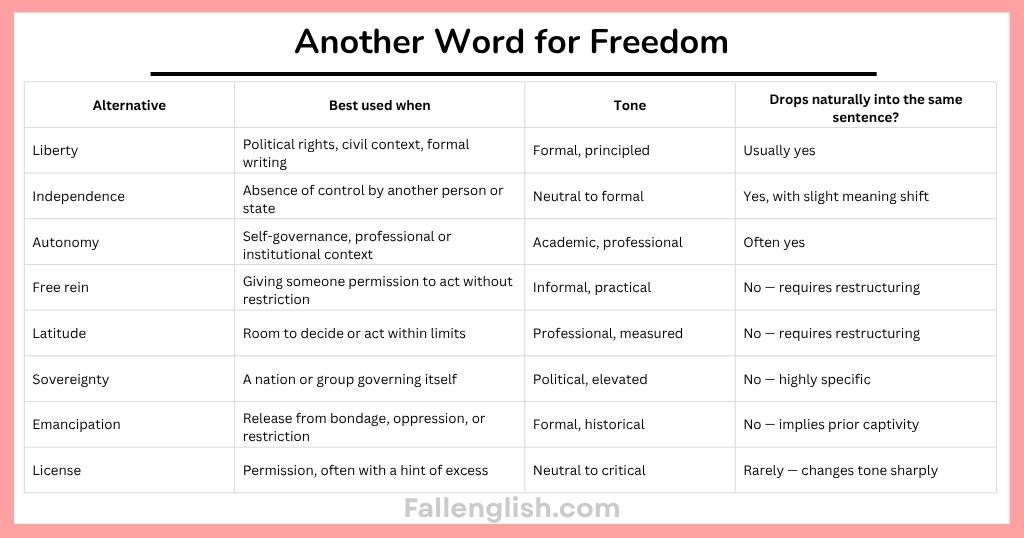
| Alternative | Best used when | Tone | Drops naturally into the same sentence? |
| Liberty | Political rights, civil context, formal writing | Formal, principled | Usually yes |
| Independence | Absence of control by another person or state | Neutral to formal | Yes, with slight meaning shift |
| Autonomy | Self-governance, professional or institutional context | Academic, professional | Often yes |
| Free rein | Giving someone permission to act without restriction | Informal, practical | No — requires restructuring |
| Latitude | Room to decide or act within limits | Professional, measured | No — requires restructuring |
| Sovereignty | A nation or group governing itself | Political, elevated | No — highly specific |
| Emancipation | Release from bondage, oppression, or restriction | Formal, historical | No — implies prior captivity |
| License | Permission, often with a hint of excess | Neutral to critical | Rarely — changes tone sharply |
Another Word for Freedom by Meaning
When you mean a political or civil right
Liberty is the closest alternative, and in many formal or political sentences the two words are nearly interchangeable. The difference is one of register and emphasis. Freedom can feel personal and emotional; liberty tends to feel institutional and principled — the kind of word that appears in constitutions and court rulings.
The protesters marched in defense of their freedom. → natural, emotional
The ruling upheld the liberty of citizens to assemble. → more formal, legal in feeling
Sovereignty works when the freedom belongs to a nation or collective rather than an individual. It implies the right to self-rule and is not interchangeable with personal freedom.
When you mean independence from another person or system
Independence focuses on what is absent — outside control — rather than what is present. It suits contexts where a person, country, or organization is no longer subject to another’s authority.
She finally had the freedom she had always wanted. — emotional, personal
She finally had the independence she had always wanted. — practical, suggests control was previously held by someone else
The shift is subtle but real. Independence asks: free from what? Freedom doesn’t require that question.
When you mean self-directed decision-making
Autonomy is the right word when the point is that someone controls their own choices, especially in a professional, medical, or institutional setting. It carries an academic and technical flavor that makes it natural in workplace writing, ethics discussions, and policy documents — but slightly stiff in casual speech or fiction.
Patients have the right to make their own decisions.
Patient autonomy must be respected.
The second sentence is more at home in a medical or legal document. In a personal essay or story, freedom to choose will usually sound more natural than autonomy.
Agency is worth mentioning here. It doesn’t mean freedom directly, but it captures the sense that someone has the power to act and choose. In academic writing, particularly in social sciences and literary criticism, agency has largely replaced freedom in discussions of personal self-determination.
When you mean permission or room to act
Free rein and latitude both describe a situation where someone is allowed to act without close direction. Neither substitutes directly into a sentence built around the noun freedom — they require different constructions.
The designer was given freedom to experiment.
The designer was given free rein to experiment.
The designer was given considerable latitude.
All three work, but they create slightly different impressions. Free rein suggests total permission. Latitude suggests room within limits — it implies that some boundaries exist, even if they are generous. Freedom in this context sits between the two.
License can work here too, but be careful: it often implies permission that goes slightly too far. Artistic license, poetic license — the word carries a whiff of excess or deviation. If you want a neutral word for permission, latitude is safer.
When you mean release from captivity or oppression
Emancipation is powerful and specific. It implies that freedom was formally granted after a period of bondage or severe restriction. The word carries historical weight, particularly in the context of slavery, and that weight should be respected. Using it casually — the emancipation of my lunch hour — will read as either ironic or tone-deaf.
Liberation is slightly broader, covering release from oppression, occupation, or constraint. It suits both personal and political contexts and carries an active sense — someone was liberated, which implies an agent of change.
Freedom came slowly. — neutral, general
Liberation came slowly. — implies a struggle, an oppressor, a moment of change
Words That Look Right But Shift the Meaning
Liberties (plural) does not mean the same thing as freedom. Taking liberties means acting with too much familiarity or presumption. Civil liberties are specific legal rights. The plural form creates entirely different sentences.
License can mean freedom, but it suggests that the freedom may be excessive or unearned. Calling someone’s behavior license rather than freedom is often critical.
Privilege sometimes appears in discussions of freedom but implies something granted rather than owed — a meaningful distinction in political and ethical arguments.
How Context Changes the Best Choice
In political or academic writing: Liberty and autonomy carry weight without sounding overblown. Freedom is not wrong, but it can feel less precise.
In fiction or personal narrative: Freedom usually sounds more natural than its formal alternatives. The word carries emotional charge that autonomy cannot replicate.
In professional settings (performance reviews, workplace policy, project briefs): Latitude and autonomy fit cleanly. Saying a colleague was given latitude to make decisions sounds professional. Saying they were given freedom sounds slightly too large.
In historical writing: Match the register of the period. Emancipation and liberty suit historical documents and formal discussions. Autonomy is largely a modern academic term.
Read more:
Another Word for Access: Choosing the Right Alternative for Your Context
Another Word for Resistance: Finding the Right Word for Your Meaning
Choosing the Right Another Word for Freedom
The question is not which alternative is strongest — it is which one names what you actually mean.
- If you mean a formal right: liberty
- If you mean absence of outside control: independence
- If you mean self-governance or personal decision-making: autonomy
- If you mean permission to act without restriction: free rein or latitude
- If you mean release from oppression: liberation or emancipation
- If you mean the full emotional and philosophical weight of the idea: freedom may still be the right word
That last point matters. Freedom earned its place in serious writing because it carries breadth and feeling that its alternatives often trade away for precision. A replacement is only better when the precision serves the sentence.

FallEnglish is run by a language enthusiast who explains word and text meanings in clear, simple ways. Each guide is carefully researched, original, and written to help real people understand language faster, with accuracy, context, and everyday examples you can trust.