

Resistance is one of those words that shifts meaning quietly depending on what you’re writing about — political struggle, physical force, personal willpower, or narrative conflict — which makes finding the right alternative more complicated than it first appears.
Quick Answer
The best alternative depends on what kind of resistance you mean:
- Opposition fits political, institutional, or social pushback
- Defiance works when the resistance is bold, deliberate, and personal
- Friction suits mechanical, interpersonal, or organizational contexts
- Pushback sounds natural in workplace and conversational writing
- Reluctance captures internal resistance — hesitation rather than active opposition
- Resilience is related but describes a different thing: the capacity to withstand, not the act of resisting
Don’t treat these as interchangeable. Choosing the wrong one can quietly change your meaning.
The Core Problem With “Resistance”
The word carries at least four distinct senses:
- Physical — friction, drag, opposing force (electrical resistance, air resistance)
- Political or collective — organized opposition to power, authority, or change (the French Resistance, resistance movements)
- Interpersonal or organizational — pushback, reluctance, foot-dragging in response to an idea or decision
- Internal or psychological — the inner force that makes a person avoid, delay, or refuse
Picking an alternative without sorting out which sense you need is the most common mistake. A word that fits sense 3 perfectly may sound wrong in sense 1, and vice versa.
Another Word for Resistance by Meaning
When you mean organized or political opposition
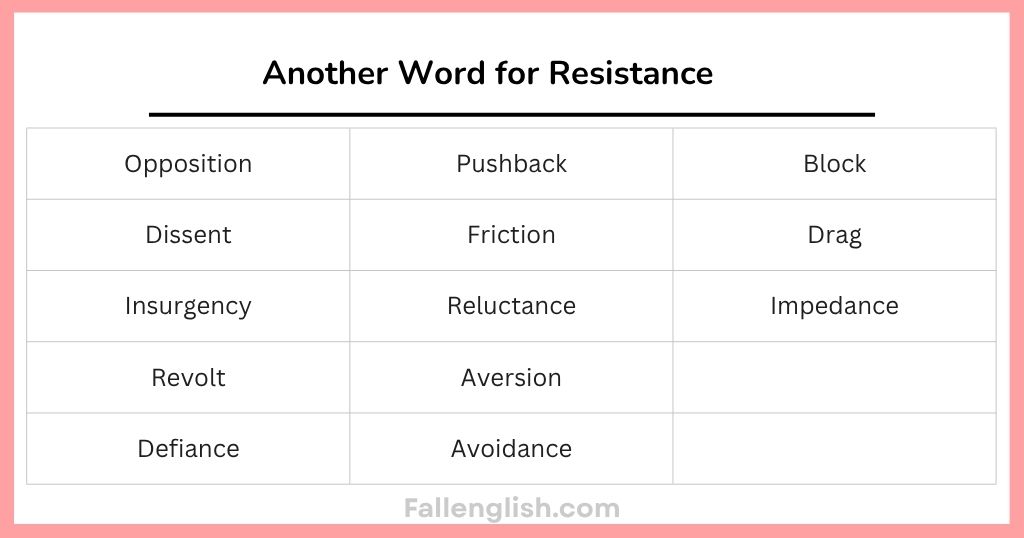
Opposition is the cleanest substitute here. It’s broad enough to cover both formal and informal forms of collective pushback without carrying the dramatic or heroic weight that resistance sometimes implies.
Dissent narrows the meaning to disagreement — usually expressed through voice or vote rather than action. It fits political writing, journalism, and academic contexts well, but it doesn’t capture physical defiance.
Insurgency and revolt escalate the stakes considerably. Use them when the opposition involves active disruption or confrontation, not merely disagreement.
| Word | Best used when | Tone |
| Opposition | Describing organized or institutional pushback | Neutral to formal |
| Dissent | Describing disagreement, especially within a group | Measured, intellectual |
| Insurgency | Armed or forceful challenge to authority | Serious, high-stakes |
| Revolt | Open, often sudden, rejection of authority | Dramatic |
| Defiance | A deliberate, personal refusal to comply | Bold, confrontational |
When you mean interpersonal or organizational pushback
Pushback is the most natural choice in workplace or conversational writing. It’s direct, slightly informal, and widely understood.
The proposal met with immediate pushback from the finance team.
Friction works well when the resistance is ongoing and produces slowing or difficulty rather than outright refusal.
There’s been friction between the departments since the restructuring.
Reluctance shifts the tone. It implies hesitation or unwillingness — softer than opposition, and more passive. It’s useful when the resistance isn’t confrontational but shows up as delay or disengagement.
Despite her reluctance, she agreed to join the project.
Reluctance and pushback are not interchangeable. Reluctance describes a feeling; pushback describes a response. Someone can feel reluctance without expressing pushback, and can push back without feeling reluctant.
When you mean internal or psychological resistance
Reluctance works here too, but several other words are more precise depending on the situation:
Aversion suggests a stronger internal pull away from something — closer to discomfort or distaste than simple hesitation.
Avoidance focuses on behavior: the person actively steers away rather than merely feeling unwilling.
Block appears frequently in creative and psychological writing — “a creative block,” “an emotional block” — to describe the felt experience of internal resistance.
In psychological and self-help writing, resistance itself is often kept because it’s a recognized term. If you’re writing in that domain, replacing it may reduce clarity rather than improve it.
When you mean physical or mechanical resistance
Here, most of the alternatives above don’t work. The options are narrower:
Friction is the most versatile — used in physics, engineering, and figurative contexts alike.
Drag fits aerodynamic or fluid contexts.
Impedance is specific to electrical engineering.
Opposition works in formal or descriptive writing when the idea of two forces working against each other needs to be expressed plainly.
Don’t use defiance or pushback in a technical context. They import human intention into a physical description, which is usually wrong unless the tone is deliberately figurative.
The Defiance Distinction
Defiance deserves attention because writers often reach for it as a more dramatic form of resistance — and sometimes that’s exactly right, but sometimes it’s too much.
Resistance can be passive: a material resists force, a person resists change without doing anything overtly. Defiance, by contrast, always involves a visible, often willful act of refusing or challenging.
The community’s resistance to the development plan was quiet but firm.
The activist’s defiance of the court order drew national attention.
In the first sentence, defiance would overstate things. In the second, resistance would understate them.
Resilience Is Not a Synonym
This confusion appears often. Resilience describes the capacity to recover from difficulty — not the act of opposing it. A person who shows resilience bounces back; a person who shows resistance pushes against.
Using resilience when you mean resistance changes the story from one of opposition to one of recovery. These are genuinely different ideas.
Read more:
Another Word for Access: Choosing the Right Alternative for Your Context
Another Word for Changeover: Alternatives That Actually Fit
Choosing the Right Another Word for Resistance
Use opposition when the resistance is organized, public, or institutional.
Use defiance when a person or group is deliberately and visibly refusing to comply.
Use pushback in workplace, conversational, or journalistic writing when the resistance is reactive and informal.
Use friction when resistance is ongoing, produces difficulty or slowness, and isn’t necessarily confrontational.
Use reluctance when the resistance is internal and shows up as hesitation rather than action.
Keep resistance when you’re writing in a domain — physics, psychology, political history — where it functions as a recognized term with a specific meaning. Replacing it there can blur precision rather than sharpen it.
The strongest replacement isn’t always the most dramatic one. The right word is the one that matches not just the meaning but the degree of force, the presence or absence of intention, and the register of the writing around it.

FallEnglish is run by a language enthusiast who explains word and text meanings in clear, simple ways. Each guide is carefully researched, original, and written to help real people understand language faster, with accuracy, context, and everyday examples you can trust.