
You typed “craziest” and something felt off. Maybe it was too casual. Maybe you’d already used it twice. Maybe you were describing a real person and realized the word carried more baggage than you intended.
That hesitation is your instinct working correctly.
“Craziest” blurs meaning. It can describe a shocking event, a strange personality, a terrible plan, or a chaotic situation, and it handles none of them with much precision. The alternatives below don’t just swap one word for another. They sharpen what you actually mean.
What “Craziest” Really Means (And Why That Matters)
It’s the superlative of “crazy,” but that covers a lot of ground. Surprising. Strange. Illogical. Chaotic. Reckless. Sometimes, carelessly, it gets applied to people in ways that touch on mental health without the writer even realizing it.
Before picking a replacement, ask yourself one question: what am I actually trying to say? The answer points you directly to the right word.
46+ Another Word for Craziest Organized by Meaning
This is the core of what you came for. Every word here is grouped by the meaning it actually carries, not just listed alphabetically like a thesaurus dump.
Another Word for Craziest Wild, Extreme, or Hard to Believe
(Use when something is shocking, intense, or beyond expectation)
- Wildest
- Most extreme
- Most unbelievable
- Most outrageous
- Most staggering
- Most astonishing
- Most jaw-dropping
- Most overwhelming
- Most mind-bending
- Most over-the-top
Another Word for Craziest Strange, Odd, or Quirky
(Use when something feels unusual, funny-strange, or hard to categorize)
- Strangest
- Oddest
- Most bizarre
- Zaniest
- Most peculiar
- Most offbeat
- Most outlandish
- Most whimsical
- Most unconventional
- Most unexpected
Another Word for Illogical, Senseless, or Poorly Reasoned Craziest
(Use when a plan, argument, or decision makes no sense)
- Most absurd
- Most irrational
- Most preposterous
- Most illogical
- Most nonsensical
- Most half-baked
- Most far-fetched
- Most unreasonable
- Most misguided
- Most ill-conceived
Another Word for Chaotic, Erratic, or Out of Control Craziest
(Use when describing behavior, situations, or events with no order)
- Most chaotic
- Most erratic
- Most turbulent
- Most disorderly
- Most unpredictable
- Most volatile
- Most frenzied
- Most frenetic
- Most unruly
- Most reckless
Eccentric or Unconventional (for people)
(Use when describing a person’s style, personality, or habits)
- Most eccentric
- Most unconventional
- Most idiosyncratic
- Most free-spirited
- Most unorthodox
- Most individualistic
- Most colorful (as in, a colorful personality)
Quick-Access Another Word for Craziest Table: Pick by Tone and Context
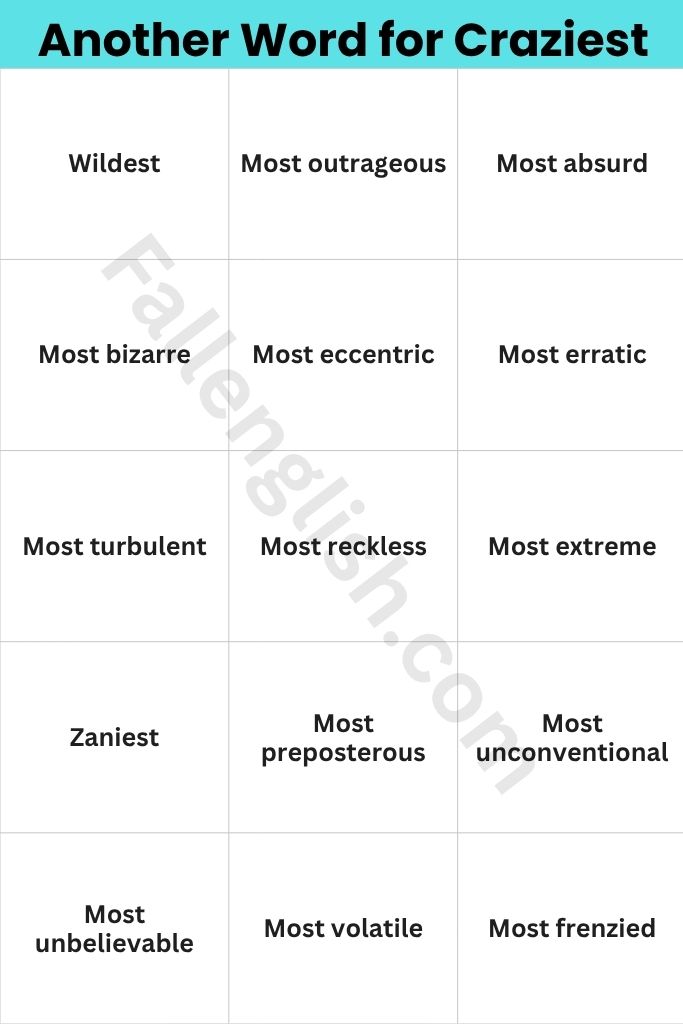
| Word | Tone | Best For |
| Wildest | Casual, energetic | Events, stories, moments |
| Most outrageous | Bold | Behavior, shocking claims |
| Most absurd | Dry, slightly formal | Arguments, flawed plans |
| Most bizarre | Neutral | Unusual situations |
| Most eccentric | Warm | Personality, personal style |
| Most erratic | Observational | Behavior patterns |
| Most turbulent | Literary | Time periods, emotional phases |
| Most reckless | Serious | Actions with real consequences |
| Most extreme | Versatile | Measures, reactions, conditions |
| Zaniest | Playful | Humor, lighthearted content |
| Most preposterous | Elevated | Arguments you want to dismiss |
| Most unconventional | Professional | Approaches, methods, ideas |
| Most unbelievable | Conversational | Stories, coincidences |
| Most volatile | Tense | Situations, relationships |
| Most frenzied | Intense | Crowds, activity, energy |
Another Word for Craziest in Sentence Rewrites: Watching the Meaning Shift
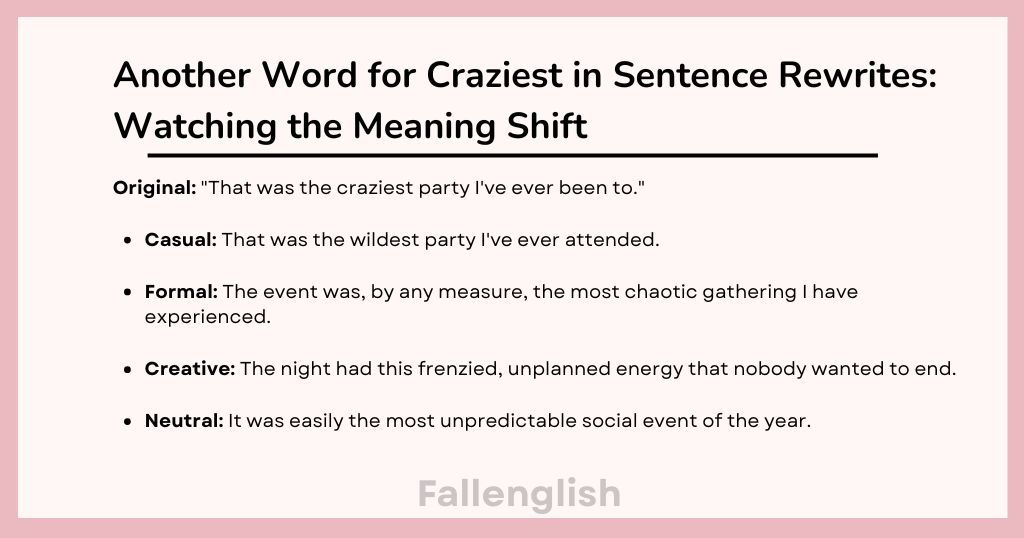
This is where word choice gets real. Same sentence, different word, completely different impression.
Original: “That was the craziest party I’ve ever been to.”
- Casual: That was the wildest party I’ve ever attended.
- Formal: The event was, by any measure, the most chaotic gathering I have experienced.
- Creative: The night had this frenzied, unplanned energy that nobody wanted to end.
- Neutral: It was easily the most unpredictable social event of the year.
Each version signals something different. “Wildest” suggests excitement. “Chaotic” implies disorder. “Frenzied” puts the reader inside the energy. “Unpredictable” stays factual.
Original: “She made the craziest decision of her career.”
- Formal: She made the most irrational professional decision of her career.
- Critical: It was widely considered her most reckless move yet.
- Neutral: No one had expected a choice so far removed from conventional thinking.
- Casual: Honestly, it was the most out-there call she had ever made.
Notice how “reckless” implies danger or harm. “Irrational” targets the logic. “Unconventional” removes judgment entirely. Your word shapes how the reader feels about the person, not just the decision.
Original: “He’s the craziest person in the office.”
This one needs care. Applying “craziest” to a real person can land badly without intending to.
- Better: He’s the most eccentric personality on the team.
- Better still: His energy is genuinely unlike anyone else in the building.
- Professional: He approaches problems in the most unconventional way I’ve seen.
“Eccentric” is warm. “Unconventional” respects the person. Describing the behavior rather than labeling the person is always the cleanest move.
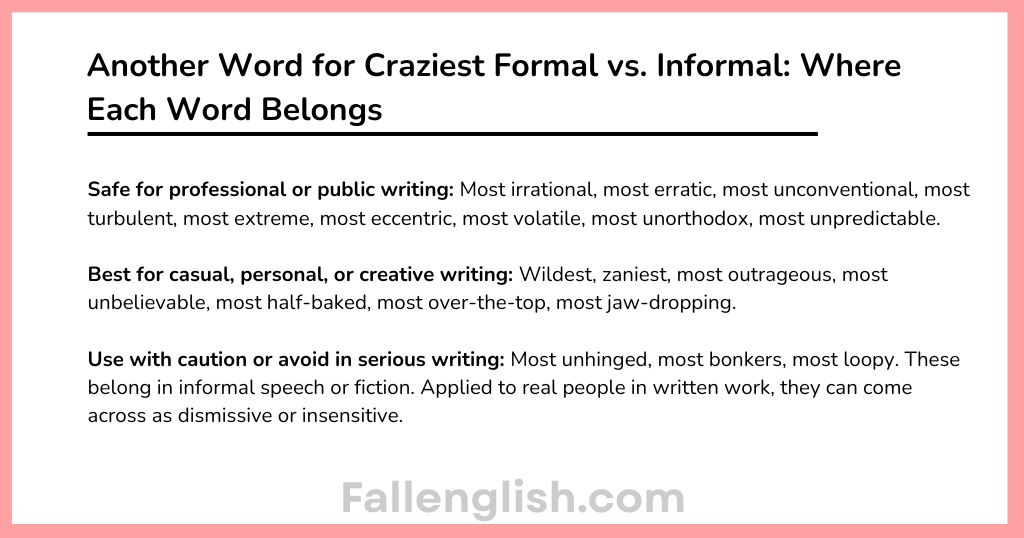
Another Word for Craziest Formal vs. Informal: Where Each Word Belongs
Some of these 46+ words are flexible. Others belong only in casual speech.
Safe for professional or public writing: Most irrational, most erratic, most unconventional, most turbulent, most extreme, most eccentric, most volatile, most unorthodox, most unpredictable.
These hold up under scrutiny. They don’t read as slang and carry no risk of sounding careless.
Best for casual, personal, or creative writing: Wildest, zaniest, most outrageous, most unbelievable, most half-baked, most over-the-top, most jaw-dropping.
These carry personality and energy. In the right piece they’re exactly right. In a formal report, they undermine your credibility.
Use with caution or avoid in serious writing: Most unhinged, most bonkers, most loopy. These belong in informal speech or fiction. Applied to real people in written work, they can come across as dismissive or insensitive.
Common Mistakes to Avoid
Picking intensity over accuracy. “Wildest” is energetic, but if the plan was genuinely flawed, “most ill-conceived” is more precise. Match the word to the meaning, not just the feeling.
Using “unhinged” for real people. In casual writing it reads as harsh. In anything serious, it risks trivializing mental health. Reserve it for fictional characters or clearly exaggerated contexts.
Assuming all these words mean the same thing. They don’t. “Bizarre” signals strangeness. “Reckless” signals danger. “Absurd” signals logical failure. Using the wrong one shifts your meaning in ways you might not catch until a reader points it out.
Repeating the same replacement throughout a piece. If you swap “craziest” for “wildest” seven times, you’ve traded one repetition for another. Vary across the groups above.
Craziest synonym Related Words Worth Keeping Nearby
Erratic is more specific than most synonyms here. It describes something that changes without pattern, useful for behavior or performance that’s inconsistent over time.
Turbulent carries a slightly literary quality. It works for time periods, emotional phases, and relationships in ways that “chaotic” doesn’t quite match.
Absurd has roots in philosophy and theater. It implies something that defies reason at a structural level, not just something that seems odd. Useful in opinion and analytical writing.
Outlandish sits between bizarre and absurd. It suggests something so far outside normal that it almost feels theatrical. Good for describing ideas or proposals that stretch belief.
Eccentric is arguably the most human-friendly word on this entire list. It describes someone who operates differently without framing that as a problem. If you’re writing about a real person, this is usually the right place to land.
Volatile adds a layer of instability and potential danger that words like “chaotic” don’t fully capture. Useful when the unpredictability carries risk.
Read more:
34+ Another Word for Superstition: Synonyms, Tone Guide & Smart Usage
30+ Another Word for Upbringing: Synonyms and When to Use Each
FAQ’s about Craziest synonym
What is the most versatile single replacement for “craziest” in everyday writing?
“Wildest” covers the most ground in casual and semi-formal writing without sounding forced. For anything more analytical or professional, “most irrational” or “most extreme” tends to be the cleaner fit depending on context.
Is it ever fine to use “craziest” as-is?
In natural conversation, text messages, and highly casual personal writing, yes. The issue arises in published content, professional writing, or any piece where precision and tone matter. There it often reads as vague or careless.
What’s the actual difference between “bizarre” and “absurd”?
“Bizarre” describes something that looks or feels deeply strange. It’s about appearance and atmosphere. “Absurd” is about logic. An absurd argument collapses under reason. A bizarre situation just feels wrong in a hard-to-explain way. They’re not interchangeable.
When describing a person, which words are safest?
“Eccentric,” “unconventional,” “unorthodox,” and “most unpredictable” are the safest across most writing contexts. They describe behavior or personality without labeling the person or implying anything about their mental health.
The Practical Takeaway
You now have 46+ alternatives, grouped by meaning, sorted by tone, and shown in real sentences. The job isn’t to find a fancier word. It’s to find the accurate one.
If you mean surprising, use “wildest” or “most unbelievable.” If you mean illogical, use “most absurd” or “most irrational.” If you mean strange in a harmless way, use “eccentric” or “most offbeat.” If you mean genuinely dangerous or out of control, use “most reckless” or “most volatile.”
That’s the difference between a word that fills space and one that does actual work.

FallEnglish is run by a language enthusiast who explains word and text meanings in clear, simple ways. Each guide is carefully researched, original, and written to help real people understand language faster, with accuracy, context, and everyday examples you can trust.