

Most writers don’t struggle to find a synonym. They struggle to find the right one.
“Rearing” sounds stiff. “Background” feels too wide. “Nurturing” only captures part of the picture. The word you pick changes how your sentence reads, how formal it feels, and what it quietly says about the person being described.
This guide gives you 30+ alternatives, explains the real differences between them, and shows you exactly where each one fits.
What “Upbringing” Really Means
It’s the full experience of being raised. Values taught, environment lived in, care received, habits formed. It’s personal, it carries emotional weight, and it covers both what was done and how it felt.
That’s why no single synonym replaces it perfectly in every situation. You have to pick based on what part of that experience you’re highlighting.
Pronunciation: UP-bring-ing (stress lands on the first syllable).
The Complete Another Word for Upbringing Table
| Word | Tone | Best Used When |
| Rearing | Neutral, slightly formal | Describing the practical act of raising a child |
| Raising | Casual, natural | Everyday conversation, general storytelling |
| Nurturing | Warm, emotional | Emotional support and love are the focus |
| Cultivation | Formal, literary | Deliberate character or skill development |
| Formation | Academic, philosophical | Identity, values, or moral development |
| Grounding | Warm, stable | A secure, steady emotional foundation |
| Shaping | Figurative, creative | Influences that molded personality |
| Molding | Figurative, intentional | Strong, deliberate external influence |
| Conditioning | Psychological, clinical | Behavioral patterns formed through repetition |
| Schooling | Educational focus | When learning and instruction are central |
| Instruction | Formal, structured | Rules, discipline, or specific teaching |
| Teaching | Active, direct | Passing down knowledge or values |
| Discipline | Specific, structured | When rules and boundaries define the raising |
| Mentorship | Warm, personal | One significant person’s lasting influence |
| Guidance | Gentle, directional | Direction and wisdom given over time |
| Care | Simple, tender | Minimalist or emotionally gentle writing |
| Guardianship | Legal, formal | Foster care, custody, or legal writing |
| Stewardship | Responsible, serious | A sense of duty driving the child-raising |
| Socialization | Academic, clinical | Sociology or psychology contexts |
| Development | Broad, clinical | Academic writing, developmental research |
| Home life | Informal, relatable | Casual essays, personal narratives |
| Early life | Neutral, biographical | Journalism, profiles, introductions |
| Childhood experience | Broad, reflective | Memoirs, personal writing |
| Family environment | Descriptive | Sociological writing, character backstory |
| Parental guidance | Formal-ish | When a parent’s specific role is the focus |
| Roots | Warm, cultural | Heritage, family identity, belonging |
| Heritage | Cultural, proud | Tradition and ethnic or family identity |
| Lineage | Formal, ancestral | Historical, genealogical, or literary writing |
| Tradition | Cultural, communal | Shared family or community practices |
| Moral foundation | Values-driven | Ethics, religion, or character writing |
| Cultural shaping | Identity-focused | Community and culture as formative forces |
| Breeding | Archaic, class-based | Historical fiction or deliberate social commentary |
| Background | Broad, sociological | When family history and context both matter |
Upbringing Synonyms Meaning Clusters: What Each Group Actually Covers
This is where most synonym guides fall short. Listing words is easy. Understanding which category of meaning they belong to is what actually helps you write better.
Practical Care Upbringing Synonym Words
Rearing, raising, care, guardianship, stewardship
These describe what was done. The physical, daily act of looking after a child. No emotional coloring, just action.
“Her rearing was handled almost entirely by her aunt” reads factually and cleanly. It doesn’t imply warmth or coldness. It simply states what happened.
Use these when you want precision without sentiment.
Emotional Support Upbringing Synonym Words
Nurturing, grounding, guidance, mentorship
These imply that love or emotional investment was present. They suggest the child was supported, not just managed.
“The grounding she received at home stayed with her for decades.” That sentence creates a feeling. It implies safety, consistency, and care without spelling any of it out.
Character and Values Upbringing Synonym Words
Formation, cultivation, molding, shaping, moral foundation, conditioning
These focus on what kind of person the upbringing produced. They suggest the raising was intentional, even deliberate.
“His moral formation happened more at the dinner table than in any classroom.” This goes beyond care and into the territory of identity. Who did this process build?
Conditioning is in this group but sits apart. It carries a slightly clinical edge, implying the person was shaped through repeated experience, sometimes without full awareness. Use it carefully.
Cultural Identity Upbringing Synonym Words
Roots, heritage, lineage, tradition, cultural shaping, background
These zoom out. The shaping force wasn’t just parents. It was a community, a religion, a cultural history.
“Her roots gave her a language for things most people couldn’t name.” That’s about more than parenting. It’s about belonging to something larger.
Background is the broadest word here. It covers upbringing but also adds socioeconomic circumstances, family history, and geography. Swapping “upbringing” for “background” quietly expands your meaning.
Learning and Structure Upbringing Synonym Words
Schooling, instruction, teaching, discipline
These narrow in on one specific part of the upbringing: what was formally taught and how.
“Strict instruction in her faith began before she could read.” This doesn’t describe the whole childhood. It describes one deliberate thread running through it.
Use these when education, rules, or structured transmission of knowledge is the point you’re making.
Another Word for Upbringing in Sentence Rewrites: The Same Idea, Four Different Tones
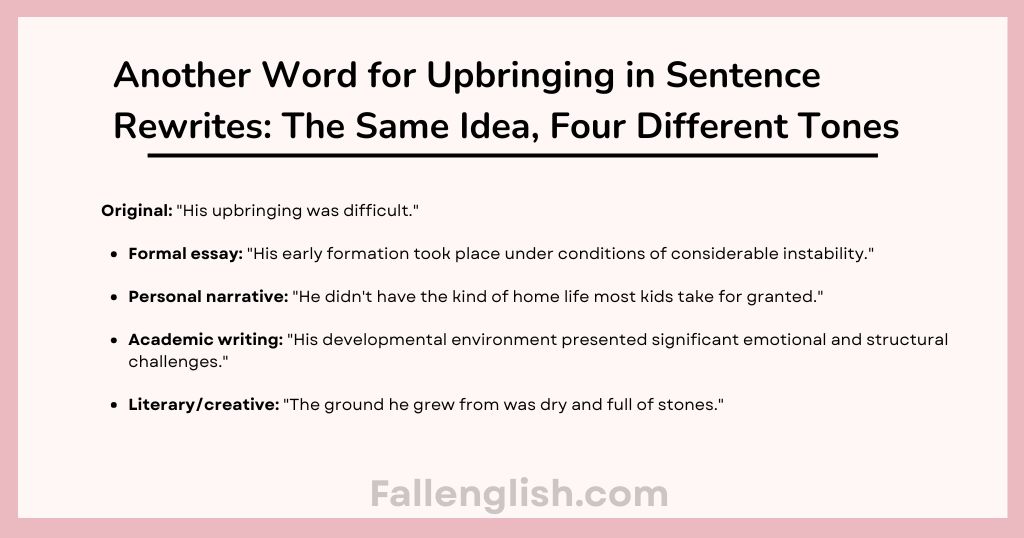
Original: “His upbringing was difficult.”
- Formal essay: “His early formation took place under conditions of considerable instability.”
- Personal narrative: “He didn’t have the kind of home life most kids take for granted.”
- Academic writing: “His developmental environment presented significant emotional and structural challenges.”
- Literary/creative: “The ground he grew from was dry and full of stones.”
None of these are wrong. Each one is right for a different kind of writing. The literary version doesn’t even name the difficulty. It makes you feel it.
Original: “She had a traditional upbringing.”
- Formal: “She was raised within a framework of closely held family traditions and clear expectations.”
- Memoir tone: “Her childhood moved on a rhythm: prayers before meals, Sunday visits to her grandmother, silence after nine.”
- Cultural essay: “Her heritage shaped her sense of self long before she had words to describe it.”
The memoir version shows the upbringing instead of naming it. Often that’s the stronger move.
Upbringing Synonym Where Each Word Belongs: Format and Context Guide
Academic papers and research writing:
Formation, socialization, conditioning, development, cultivation. These signal that you’re thinking analytically, not personally.
College applications and personal statements:
Roots, grounding, home life, early life, childhood experience. Genuine without being dramatic. Personal without oversharing.
Memoirs and creative nonfiction:
Shaping, nurturing, tradition, roots, moral foundation. These carry texture. They let the emotional register breathe.
Professional or formal contexts:
Early life, background, family environment, parental guidance. Neutral, clean, no unnecessary intimacy.
Historical fiction or social commentary:
Breeding, lineage, heritage. These words carry period-appropriate weight. In modern casual writing, they can land oddly.
Upbringing Synonym Mistakes That Cost Writers Clarity
Replacing “upbringing” with “background” without noticing the shift. Background is wider. It includes upbringing but also pulls in class, geography, and family history. If you only mean how someone was raised, background quietly adds information you didn’t intend.
Using “conditioning” when you mean “raising.” Conditioning implies something was done to the person, often repeatedly and without full awareness. It belongs in psychological writing. In a personal essay, it can make a loving home sound like an experiment.
Treating “nurturing” as purely positive and all-purpose. You can’t write “his nurturing was cold and withholding” without it feeling contradictory. Nurturing already implies care was present. For neutral or negative contexts, rearing or raising work much better.
Using “breeding” in modern, neutral writing. Unless you’re writing about a specific historical era or making a deliberate social point, this word carries class-based and archaic weight that tends to distract.
Choosing “socialization” in emotional writing. It’s a textbook word. “Her socialization shaped her relationship patterns” sounds clinical. It drains warmth from any personal narrative.
Upbringing Antonyms: When the Opposite Is What You Need
Sometimes the point isn’t what someone received. It’s what they lacked.
- Neglect – absence of necessary care, physical or emotional
- Abandonment – complete removal of parental presence or responsibility
- Deprivation – lack of basic needs, warmth, or connection
- Dysfunction – a chaotic, unstable, or harmful family environment
- Exposure – being placed in the path of harm rather than protected from it
These words carry serious weight. Pair them with context. A sentence that uses “abandonment” or “deprivation” owes the reader some grounding in specifics.
Upbringing Synonym Related Words That Orbit This Topic
These aren’t synonyms for upbringing, but they frequently appear alongside it and are worth distinguishing.
Attachment – the emotional bond formed between child and caregiver. Closely connected to the quality of upbringing but describes the relationship, not the process.
Environment – the physical and social setting. More external than upbringing. The environment is where the upbringing happened.
Influence – what the upbringing produced. Upbringing is the cause. Influence is often the effect. “His upbringing had a lasting influence on how he handled conflict.”
Character – frequently the outcome being described. The upbringing shaped the character.
Values – what was transmitted. Upbringing is the vehicle. Values are what it carried.
Read also –
34+ Another Word for “Faced”: Pick the Word That Actually Fits
34+ Another Word for Superstition: Synonyms, Tone Guide & Smart Usage
FAQ’s about Upbringing Synonyms
What is the best another word for upbringing in everyday writing?
“Raising” is often the most natural choice in everyday conversations and casual writing. It is simple, familiar, and easy for most readers to understand.
Which synonym for upbringing sounds most professional?
For formal or professional writing, words like “early life,” “formation,” “development,” or “family environment” usually work best because they sound neutral and clear.
Is “background” the same as upbringing?
Not exactly. Upbringing focuses on how a person was raised, while background includes a wider range of factors such as family history, education, culture, and social circumstances.
When should I use “nurturing” instead of “upbringing”?
Use “nurturing” when you want to emphasize emotional support, care, encouragement, and positive relationships rather than the entire experience of being raised.
The Practical Takeaway
The right synonym isn’t the most impressive one. It’s the one that carries the right amount of warmth, formality, and precision for your specific sentence.
Warm and personal? Reach for nurturing, roots, or home life. Analytical and formal? Formation, development, or socialization. Showing rather than telling? Skip the synonym entirely and describe what the upbringing looked like in practice.
Every word on this list has a job. Know the job before you pick the word.

FallEnglish is run by a language enthusiast who explains word and text meanings in clear, simple ways. Each guide is carefully researched, original, and written to help real people understand language faster, with accuracy, context, and everyday examples you can trust.