

You’ve written “get rid of” twice in the same paragraph and you know it. You try a replacement, but it either sounds stiff, dramatic, or just slightly off. The sentence doesn’t feel right.
That’s the actual problem most writers face. It’s not finding any synonym. It’s knowing which one fits your exact tone, context, and meaning without making the sentence feel forced.
“Get rid of” does a lot of different jobs. It handles physical removal, emotional release, legal endings, and system-level changes all at once. When you replace it without thinking, the meaning often shifts in ways you didn’t plan.
This guide gives you 31+ real alternatives, explained honestly, so you can choose with confidence.
What “Get rid of” Phrase Actually Carries
“Get rid of” means to remove something so completely that it no longer affects your space, work, or life. The target can be physical, emotional, digital, or institutional.
The phrase itself is neutral in meaning but informal in tone. It works perfectly in everyday speech and casual writing. In formal, academic, or professional writing, a more precise word almost always does a sharper job.
The Full Another Word for Get Rid Of Table: 31+ Alternatives by Tone
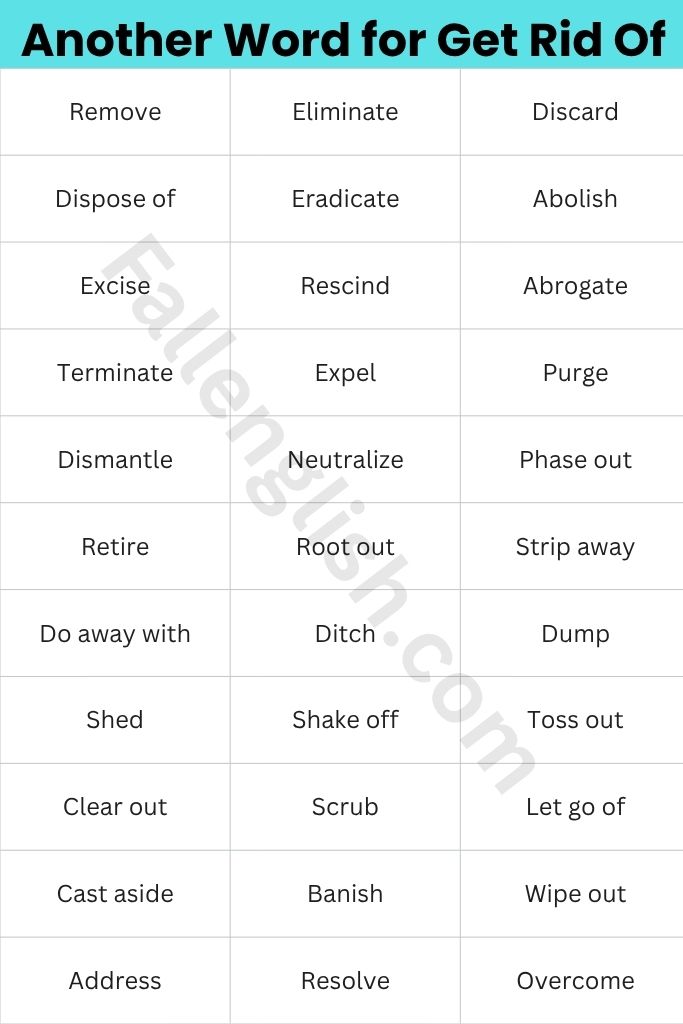
| Word / Phrase | Tone | Best Situation |
| Remove | Neutral | General physical or abstract removal |
| Eliminate | Formal | Errors, variables, problems in reports |
| Discard | Neutral | Objects, ideas, options no longer needed |
| Dispose of | Formal/Neutral | Waste, documents, materials |
| Eradicate | Strong/Formal | Deep, systemic, or long-standing issues |
| Abolish | Formal | Laws, policies, institutions |
| Excise | Precise | Cutting a specific part from a larger whole |
| Rescind | Legal | Reversing an offer, contract, or decision |
| Abrogate | Legal/Formal | Formally ending a law or treaty |
| Terminate | Formal/Cold | Contracts, roles, processes |
| Expel | Formal | Removing a person from a group or space |
| Purge | Strong/Technical | Files, systems, or deeply held feelings |
| Dismantle | Formal | Systems, structures, arguments |
| Neutralize | Technical | Threats, risks, dangers |
| Phase out | Business | Products, roles, outdated practices |
| Retire | Professional/Soft | Old tools, methods, or policies |
| Root out | Figurative | Hidden problems, corruption, bad habits |
| Strip away | Figurative | Layers, pretense, false assumptions |
| Do away with | Mixed | Traditions, steps, outdated processes |
| Ditch | Casual | Plans, habits, old belongings |
| Dump | Casual/Blunt | Objects, bad plans, burdensome things |
| Shed | Soft | Habits, weight, old identity or ways |
| Shake off | Casual | Negative feelings, lingering habits |
| Toss out | Casual | Physical clutter, rejected ideas |
| Clear out | Casual | Rooms, mental clutter, teams |
| Scrub | Casual/Technical | Data, missions, plans (cancel or delete) |
| Let go of | Emotional | Feelings, relationships, the past |
| Cast aside | Literary | Old beliefs, emotional burdens |
| Banish | Dramatic/Literary | Thoughts, fears, unwanted people |
| Wipe out | Strong/Informal | Something destroyed or ended totally |
| Address | Soft | Issues or problems needing attention |
| Resolve | Soft | Tension, conflict, manageable problems |
| Overcome | Positive | Challenges, obstacles, personal struggles |
Another Word for Get Rid Of Meaning Clusters: The Differences That Actually Matter
These words don’t all mean the same thing. They point in different directions. Grouping them by what they actually signal helps you pick more accurately.
Mild Letting Go vs. Complete Destruction
Some words feel like a calm exit. Shed, retire, phase out — something leaves naturally or by plan. There’s no force. No finality implied.
Others signal total removal. Eradicate, wipe out, banish — nothing remains. The action is final.
Write “the company phased out its print catalog” and it sounds like a calm business decision.
Write “the company eradicated its print catalog” and it sounds like something went wrong.
Same event, very different impression.
Get rid of Synonym Formal vs. Everyday Register
Abolish, rescind, abrogate, expel, and terminate carry institutional or legal weight. They belong in essays, formal reports, policy documents, and academic writing.
Ditch, dump, toss out, and shake off belong in conversation, personal essays, or casual content. Drop one of these into a business proposal and the register collapses.
Remove, discard, and dispose of are reliable middle-ground options. They work across most contexts without sounding either too stiff or too loose.
Get rid of Synonym Emotional vs. Operational
This gap causes more awkward sentences than writers realize.
Let go of, shed, and cast aside carry emotional meaning. Use them when someone is releasing something that once mattered — a habit, a relationship, a past version of themselves.
Delete, purge, scrub, and discard are operational. They work on objects, files, data, and processes. There’s no feeling attached, which is exactly what makes them appropriate in technical or business writing.
Mixing these up creates subtle wrongness. “The system let go of corrupted files” sounds odd because let go of implies attachment. “The system purged corrupted files” is clean and correct.
Get rid of Synonym in Problem-Solving Language
When writing about getting rid of a problem specifically, your word choice signals how serious the situation is.
Address and resolve are soft. They suggest the problem is manageable and being handled.
Eliminate and eradicate are harder. They signal the problem needs to be finished completely.
Root out suggests something hidden and entrenched — often used for corruption, systemic bias, or deep organizational issues.
Neutralize is clinical and precise. It appears often in risk management, security writing, and crisis communication.
Match the word to the actual scale of the problem. Using eradicate for a minor formatting issue sounds unintentionally dramatic. Using address for a serious safety risk sounds like you’re downplaying it.
Another Word for Get Rid Of in Sentence Rewrites: Same Idea, Different Words
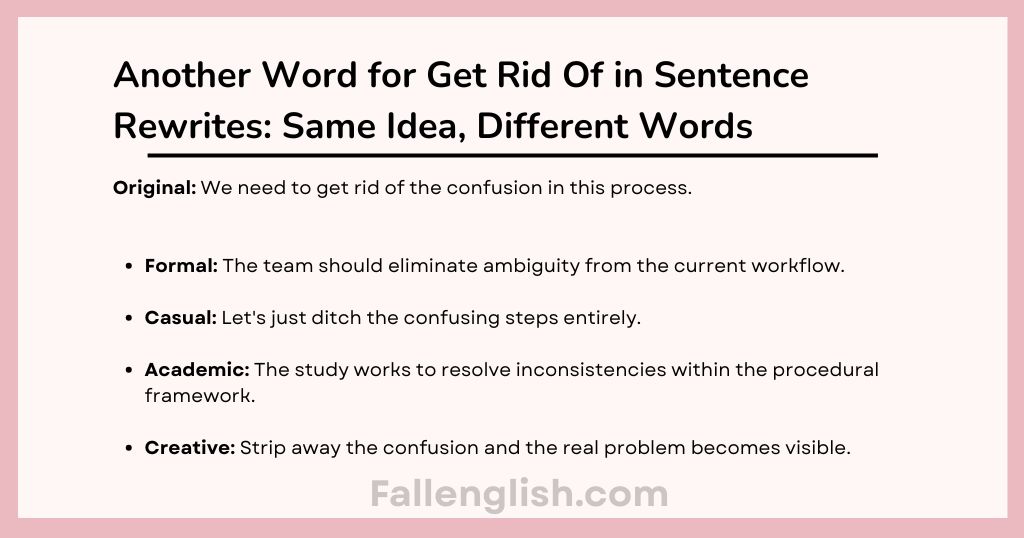
Seeing these alternatives in real sentences shows you what actually changes.
Original: We need to get rid of the confusion in this process.
- Formal: The team should eliminate ambiguity from the current workflow.
- Casual: Let’s just ditch the confusing steps entirely.
- Academic: The study works to resolve inconsistencies within the procedural framework.
- Creative: Strip away the confusion and the real problem becomes visible.
Original: She needed to get rid of old habits.
- Soft/Personal: She was finally ready to shed habits that no longer served her.
- Neutral: She worked to discard patterns that were holding her back.
- Literary: She cast aside the ways she had carried for years without question.
Original: The organization must get rid of this outdated policy.
- Formal: The organization must abolish this outdated policy immediately.
- Business: Leadership should phase out the policy before the next quarter.
- Legal: The board voted to rescind the policy effective immediately.
In each case, the replacement doesn’t just swap a word. It shifts the weight, the tone, and the implied urgency of the whole sentence.
Another Word for Get Rid Of in Formal Writing: What to Use in Essays and Reports
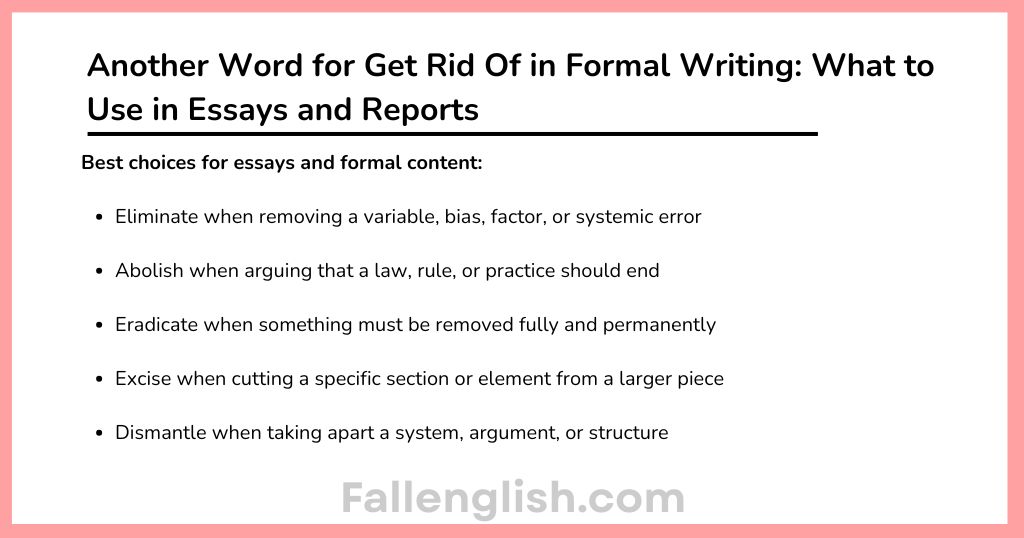
“Get rid of” almost never belongs in academic or formal writing. It reads as too loose for the register.
Best choices for essays and formal content:
- Eliminate when removing a variable, bias, factor, or systemic error
- Abolish when arguing that a law, rule, or practice should end
- Eradicate when something must be removed fully and permanently
- Excise when cutting a specific section or element from a larger piece
- Dismantle when taking apart a system, argument, or structure
Avoid ditch, dump, toss out, or wipe out in formal writing. Even when the idea is right, the word undermines the tone around it.
Writing About Getting Rid of a Person
This is worth handling carefully because word choice here sends a very different signal depending on the situation.
- Dismiss fits professional settings, such as an employer ending a role
- Expel fits institutional settings like schools, clubs, or organizations
- Remove from works in process or policy writing (“removed from the committee”)
- Distance oneself from works in personal or relational writing
Using eliminate or purge when referring to people in most everyday contexts raises red flags. These words carry cold or historically dark connotations that most writers don’t intend, but readers will notice and feel.
Common Mistakes With Get Rid Of synonym
Using “eradicate” for minor problems. Eradicate suggests something deeply rooted and hard to kill. Using it for small issues like typos or scheduling errors sounds unintentionally absurd.
Swapping “rescind” and “abolish.” Rescind reverses a specific decision: a job offer, a policy, an order. Abolish permanently ends a practice or institution. They are not interchangeable.
Overusing “eliminate.” It’s the most common grab when writers want something formal. In long documents, it becomes repetitive fast. Rotate with remove, discard, and phase out.
Putting emotional words into operational sentences. “The system let go of the old data” sounds strange. “The system purged the old data” is correct. Emotional words need emotional contexts.
Using “purge” carelessly. It has clean technical and therapeutic uses. It also carries heavy political history. In writing about people or groups, the connotation needs to be considered before using it.
Get Rid Of synonym Related Words That Belong Nearby
These aren’t direct synonyms but they live in the same neighborhood and often come up in the same situations:
Reduce means lessen, not fully remove. Useful when total elimination isn’t the goal or isn’t possible.
Minimize means bring something to its smallest possible presence. Common in design, risk writing, and productivity content.
Prevent means stop something before it exists. Sometimes the best way to get rid of a problem is to keep it from arriving at all. Related in spirit to obviate.
Replace sometimes getting rid of something means substituting it with something better. This word captures that full move rather than just the removal.
Suppress means hold something down or stop it from surfacing. It has both technical uses (suppress a signal, suppress output) and social ones (suppress dissent, suppress evidence). Use with awareness of context.
Read also:
30+ Another Word for Upbringing: Synonyms and When to Use Each
46+ Another Word for Craziest: The Only Guide Writers Need
FAQ’s about Get Rid Of synonym
What is the best another word for “get rid of”?
There isn’t one perfect replacement. Remove is the safest all-around choice. For formal writing, eliminate or discard often work better. In casual speech, ditch or toss out sound more natural.
Is “get rid of” wrong to use?
No. It’s a common and correct phrase in everyday English. However, in essays, reports, or business writing, a more specific word usually makes your meaning clearer.
Which synonym is best for formal writing?
Words like eliminate, abolish, eradicate, excise, terminate, and dismantle fit formal and professional writing because they are more precise than “get rid of.”
What’s the difference between “remove” and “eliminate”?
Remove means taking something away from its place. Eliminate means ending it completely so it is no longer present or relevant. The second word usually sounds stronger.
Can I use “ditch” instead of “get rid of”?
Yes, but only in informal situations. Ditch works well in conversations, blogs, and personal writing. It is usually too casual for academic or business documents.
Final Word on Choosing
Two questions cut through the confusion every time.
First: how formal is the piece? If it’s an essay, report, or professional document, reach for eliminate, abolish, eradicate, or dismantle. If it’s casual, ditch, shed, or toss out feel natural and honest.
Second: how final is the action? A soft removal (phase out, retire, shed) versus a hard one (eradicate, wipe out, purge) sends completely different signals about what actually happened.
The phrase “get rid of” isn’t broken. It’s just doing too much work alone. Give each situation the word it actually deserves.

FallEnglish is run by a language enthusiast who explains word and text meanings in clear, simple ways. Each guide is carefully researched, original, and written to help real people understand language faster, with accuracy, context, and everyday examples you can trust.