

Toxic has done a lot of heavy lifting in recent years. It now covers everything from poisonous chemicals to dysfunctional relationships to harmful social environments — and that overuse is exactly why writers reach for alternatives. The problem is that its replacements are not all equal, and choosing the wrong one can weaken your meaning, shift your tone, or describe something slightly different from what you intended.
Quick Answer
The best replacement depends on which sense of toxic you mean:
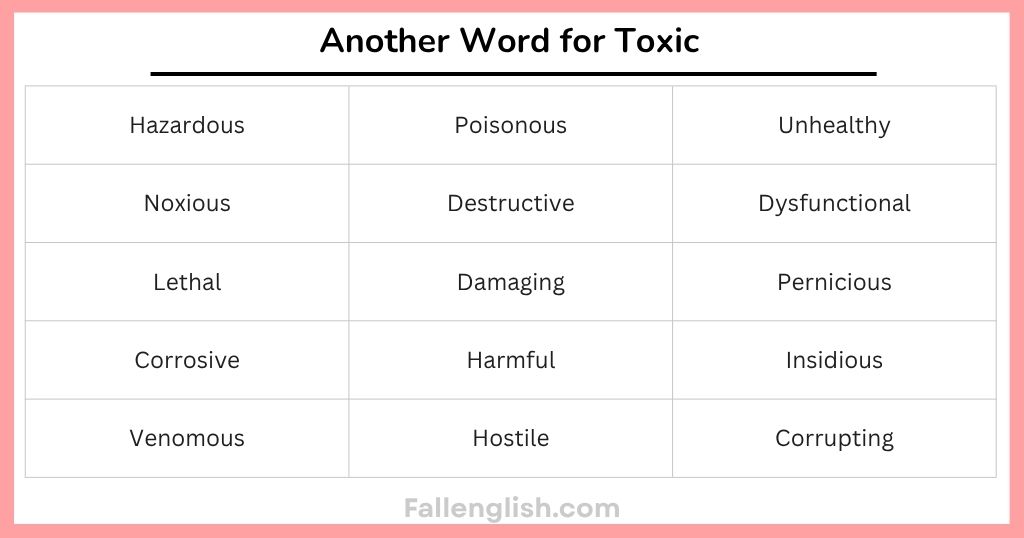
- Poisonous / chemically harmful → hazardous, noxious, lethal, corrosive
- Harmful to people or relationships → destructive, damaging, harmful, corrosive
- Hostile social environment → hostile, corrosive, poisonous, unhealthy
- Morally corrupting → corrupting, pernicious, insidious
No single word covers all four senses. The first thing to decide is which one you mean.
What You’re Actually Dealing With
The word toxic started in chemistry and medicine, where it means “capable of causing harm through chemical action.” That meaning is precise and still useful. But over the past decade, the word migrated into everyday speech and now describes bad bosses, unhealthy friendships, social media culture, and political climates.
That migration created two problems for writers:
- The word has become vague through overuse.
- Many alternatives only cover one of its meanings, not all of them.
This is why picking a replacement requires knowing your meaning first.
Another Word for Toxic by Meaning
When you mean physically or chemically harmful
| Word | What it emphasizes | Example |
| Hazardous | General danger, often regulatory | hazardous waste, hazardous materials |
| Noxious | Harmful through fumes, smell, or exposure | noxious gases, noxious fumes |
| Lethal | Capable of causing death | lethal dose, lethal concentration |
| Corrosive | Destroys on contact; chemical or figurative | corrosive acid, corrosive influence |
| Venomous | Specific to animal or biological origin | venomous snake, venomous bite |
| Poisonous | Causes harm if ingested or absorbed | poisonous berries, poisonous substance |
Noxious is the closest substitute for toxic in a scientific or environmental context. Toxic fumes and noxious fumes are nearly interchangeable, though noxious can also cover things that are merely offensive to the senses without being medically dangerous, so context matters.
Lethal and venomous are narrower. Lethal focuses on death as the outcome; venomous is specifically biological. Swapping toxic for either of these sharpens the meaning but also raises the stakes — only use them when that precision is accurate.
When you mean harmful to people, relationships, or groups
This is where toxic gets used most often in modern writing, and where the alternatives differ most meaningfully.
Destructive emphasizes what happens as a result — something breaks down. It describes a behavior, relationship, or pattern that dismantles rather than corrupts.
His destructive anger drove people away.
Damaging is close to destructive but slightly softer in implication. It often suggests harm that may be repairable or partial, not total.
Her damaging remarks stayed with him for years.
Harmful is the most neutral of the three. It states that something causes harm without dramatizing it. Useful in formal or clinical writing.
The study identified several harmful behaviors.
Corrosive is worth using more than it is. It carries the original chemical meaning (slow, relentless breakdown) and transfers perfectly to relationships and institutions. It suggests that the damage happens gradually, which is often more accurate than toxic‘s implications of sudden contamination.
A corrosive culture of blame had settled into the organization.
Poisonous works here too, and it stays closer to the original metaphor than corrosive does. The difference is that poisonous tends to suggest active infection or intent, while corrosive suggests process.
When you mean a hostile or unhealthy environment
This is the context where toxic appears most often in headlines and commentary — toxic workplace, toxic culture, toxic environment.
The best alternatives here are:
Hostile — direct, unambiguous, often the most honest word. If a workplace is hostile, people feel unwelcome, threatened, or undermined. It doesn’t suggest contamination; it describes the experience.
Unhealthy — softer, often appropriate in HR, therapy, or parenting contexts where judgment is being kept deliberate and measured.
Dysfunctional — points to the structure breaking down rather than the atmosphere being dangerous. A dysfunctional team may not feel hostile, but its processes or relationships don’t work.
Corrosive works here too, especially in journalism and longer-form writing, and often sounds less worn than toxic while conveying the same slow damage.
One to avoid in this context: Negative. Calling a workplace culture “negative” drains almost all the meaning. It is technically accurate but tells the reader almost nothing.
When you mean morally or socially corrupting
This is where the alternatives shift most noticeably in register. These words belong to more formal or literary writing.
Pernicious — means causing harm in a hidden or subtle way. It is the right word when the danger is not obvious at first.
The pernicious effects of misinformation spread slowly through communities.
Insidious — suggests something that advances quietly and is hard to detect. Often slightly darker in tone than pernicious, and slightly more focused on the method of harm than the result.
The insidious logic of the ideology went unchallenged for years.
Corrupting — describes something that degrades character, judgment, or institutions. It implies a process of moral degradation.
The corrupting influence of unchecked power was well documented.
These three are not casual replacements. They carry a more serious tone and work best in journalism, academic writing, and formal commentary. Dropping one of them into a conversational sentence can feel unexpectedly heavy.
Where Alternatives Fail
A few words appear in thesaurus results for toxic but break down under pressure.
Virulent is sometimes listed as a synonym. In a medical context, it describes disease agents that are particularly aggressive and fast-spreading. In figurative use, it usually describes speech or attitudes — virulent racism, virulent criticism. It does not transfer cleanly to workplace culture or personal relationships.
Malignant belongs to medicine and oncology, where it describes cells or growths. In figurative writing, it works occasionally — a malignant influence — but it reads as quite formal and carries connotations of cancer that may not suit your context.
Vicious overlaps with hostile but usually implies active aggression rather than a damaging environment. A vicious attack differs from a vicious workplace — the second one works, but the word is less precise than hostile or corrosive for describing long-term harm.
The Overuse Problem
Part of why writers search for alternatives is that toxic has become a cliché in specific domains — HR writing, self-help, social criticism, and political commentary. Editors at major publications have flagged it as overused.
If the original word in your draft is toxic and you’re reaching for a replacement, ask whether the issue is the word itself or the vagueness behind it. Sometimes the better fix is not a synonym but a more specific description:
A culture where reporting misconduct was punished — more specific than a toxic culture
A relationship in which one person consistently undermined the other — more specific than a toxic relationship
The most useful alternative is sometimes a clause, not a single word.
Read also:
Another Word for Resistance: Finding the Right Word for Your Meaning
Another Word for Freedom: Alternatives That Fit What You Mean
Choosing Quickly Another Word for Toxic
- Writing about chemicals, waste, or pollution → noxious or hazardous
- Writing about a damaging relationship → destructive or corrosive
- Writing about workplace culture → hostile or corrosive
- Writing about subtle moral harm → pernicious or insidious
- Writing in a clinical or neutral register → harmful
- Writing in a formal or journalistic register → corrosive, pernicious, or damaging
The word you want is usually the one that captures how the harm happens — sudden and lethal, slow and corrosive, subtle and insidious, or openly hostile. Toxic collapses all of those into one word. A replacement that forces you to be more specific is almost always an improvement.

FallEnglish is run by a language enthusiast who explains word and text meanings in clear, simple ways. Each guide is carefully researched, original, and written to help real people understand language faster, with accuracy, context, and everyday examples you can trust.