

Science is full of useful words, and many important ones begin with the letter B. From bacteria and blood to black holes and buoyancy, these terms appear in school lessons, exams, and everyday life. This guide to Science Words That Start With B explains each word in clear, simple language so students can understand what it means and where it is used.
Whether you’re studying biology, chemistry, physics, or earth science, learning these terms will make science easier to follow. Instead of memorizing hard definitions, you’ll see practical meanings and real examples that help each word make sense.
20 Most-Used Science Words That Start With B
These appear constantly — in textbooks, exams, labs, and everyday science conversations. Start here.
Bacteria — Microscopic single-celled organisms found everywhere.
Base — A substance that neutralizes acids; pH above 7.
Biodiversity — Variety of living species in one ecosystem.
Biology — The scientific study of living organisms.
Boiling point — Temperature at which a liquid turns to gas.
Bond (chemical) — Force holding atoms together in a molecule.
Brain — Organ controlling thought and body functions.
Buoyancy — Upward force a fluid exerts on an object.
Biome — Large ecological zone with its own climate and species.
Blood — Fluid transporting oxygen through the body.
Botany — Scientific study of plants.
Black hole — Space region where gravity traps everything, even light.
Boron — Chemical element used in glass and nuclear reactors.
Biomass — Total mass of living material in an area.
Bronchi — Airways connecting the windpipe to the lungs.
Binary — System using only two values: 0 and 1.
Barometer — Device measuring atmospheric air pressure.
Beta particle — Electron released during radioactive decay.
Biosphere — All living things on Earth plus their environments.
Brittle — Breaks easily without bending.
Physics Science Words That Start With B
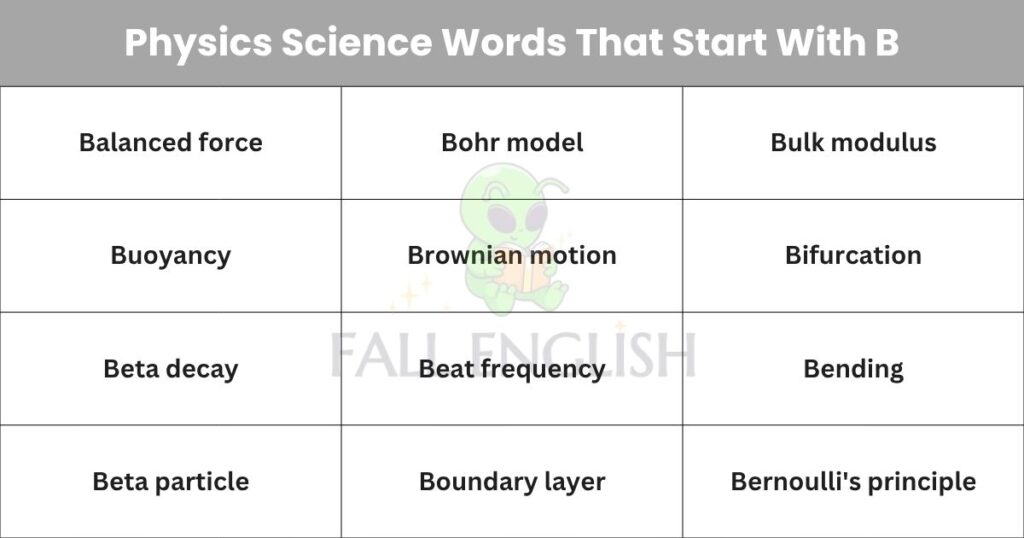
Balanced force — Two forces cancel each other out. A book sitting still on a desk is proof.
Buoyancy — The upward push water gives any object placed in it. A wooden boat floats; a coin sinks. Archimedes figured this out in a bathtub.
Beta decay — A radioactive process where a nucleus releases a beta particle and transforms into a different element entirely.
Beta particle — A fast-moving electron released during radioactive decay. Travels farther than an alpha particle but stopped by thin metal.
Blackbody radiation — Energy an object emits purely because of its temperature. Stars behave like near-perfect blackbodies.
Bohr model — Niels Bohr’s picture of the atom: electrons orbit the nucleus in fixed rings, like planets around a sun. Simplified, but still taught because it works for basics.
Brownian motion — The random jiggling of tiny particles in a fluid, caused by invisible molecules bumping into them. Einstein wrote about this in 1905.
Beat frequency — The pulsing sound you hear when two slightly different sound waves overlap. Instrument tuners use it to match notes perfectly.
Boundary layer — The thin zone of fluid right next to a surface where speed shifts dramatically. Critical in airplane wing design.
Band gap — The energy difference deciding whether a material conducts electricity or blocks it. Your phone’s semiconductors depend on this.
Bulk modulus — Measures how resistant a material is to compression. Useful for understanding rock or liquid behavior under pressure.
Bifurcation — A point where one system splits into two possible behaviors. Shows up in chaos theory and fluid dynamics.
Bending — A force that deforms an object by pushing from different points simultaneously. Engineers calculate this when designing bridges.
Bernoulli’s principle — Faster-moving fluid has lower pressure. Part of why airplane wings generate lift. Blow across a sheet of paper — the top rises. Try it.
Chemistry Science Words That Start With B
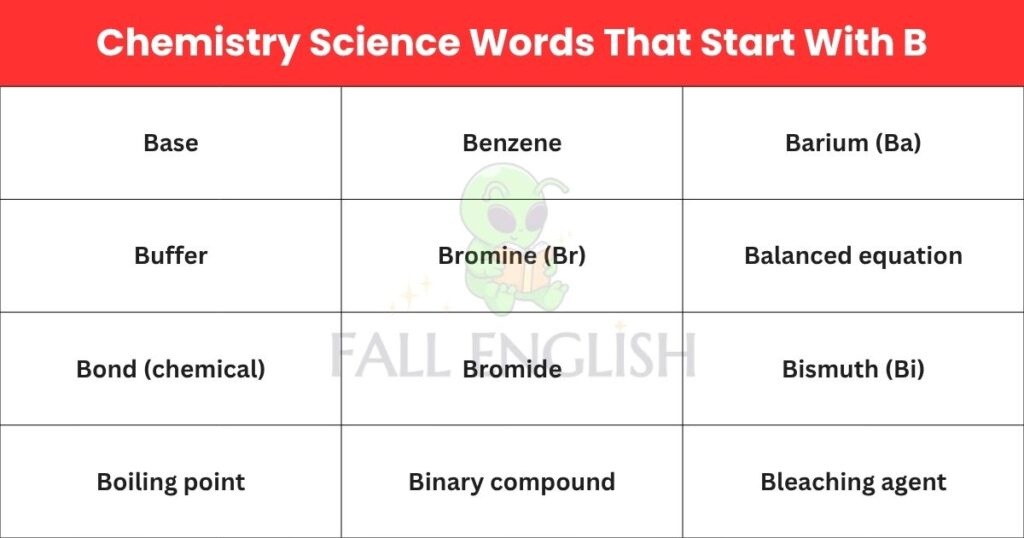
Base — pH above 7. Bases feel slippery and neutralize acids. Baking soda is a base — that’s why it fizzes with vinegar.
Buffer — A solution resisting pH change even when acid or base is added. Your blood uses a buffer system to stay at the right pH.
Bond (chemical) — The force holding atoms together. Ionic, covalent, and metallic bonds each work differently and determine a substance’s properties.
Boiling point — Temperature at which liquid becomes gas at normal air pressure. Water boils at 100°C. Add salt and it shifts — slightly.
Boron (B) — Element 5 on the periodic table. Found in borax, fiberglass, and some cancer treatments.
Benzene — A ring-shaped molecule of six carbon atoms. A common industrial solvent and building block for many medicines, but toxic with long exposure.
Bromine (Br) — One of only two elements liquid at room temperature. Reddish-brown, used in flame retardants.
Bromide — A compound containing bromine. Once used widely in photography; digital cameras made that nearly obsolete.
Binary compound — Made of exactly two elements. Table salt (sodium chloride) is the textbook example.
Boyle’s Law — At fixed temperature, increase pressure on gas and volume decreases. Squeeze a balloon — you just ran the experiment.
Barium (Ba) — A soft silvery metal. “Barium swallow” is a medical imaging test using barium compounds to make the digestive tract visible on X-rays.
Balanced equation — A chemical equation where atoms are equal on both sides. Chemistry cannot create or destroy atoms.
Bismuth (Bi) — Pinkish metallic element, one of the least toxic heavy metals. The active ingredient in Pepto-Bismol.
Bleaching agent — Breaks the molecules causing color or staining. Chlorine-based bleaches work this way.
Bond energy — Energy needed to break a chemical bond. Higher bond energy means a stronger, more stable connection.
Combustion (Burning) — A rapid reaction with oxygen releasing heat and light. Fire is combustion in action.
Biology Science Words That Start With B
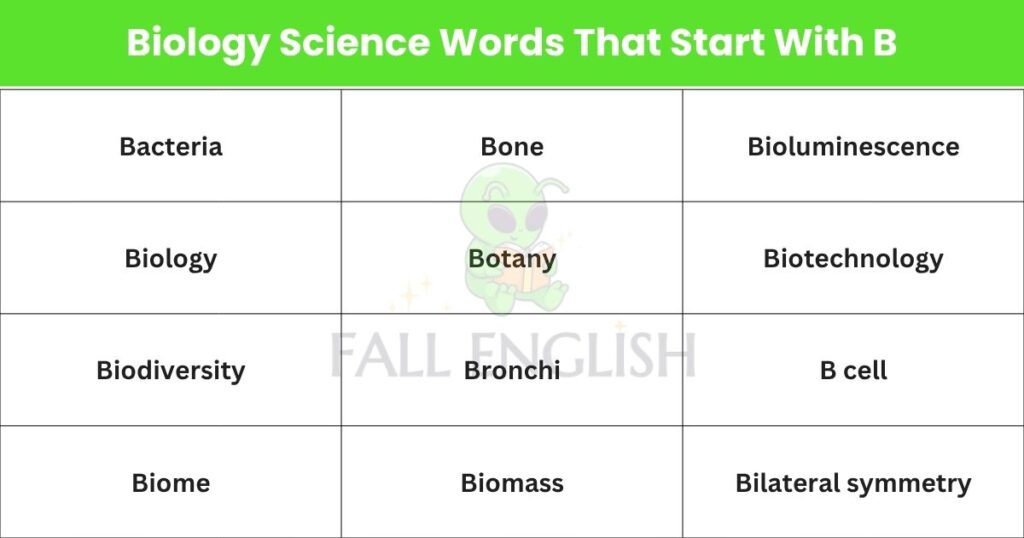
Bacteria — Single-celled organisms without a nucleus. Some cause disease; others make yogurt, fix nitrogen in soil, or live usefully in your gut.
Biology — The scientific study of all living things. It branches into zoology, microbiology, ecology, genetics, and many more fields.
Biodiversity — The variety of life in a given place. A rainforest has high biodiversity; a concrete parking lot has almost none.
Biome — A large zone defined by climate, vegetation, and animal life. The Sahara is a desert biome; the Amazon is a tropical rainforest biome.
Biosphere — Every layer of Earth where life exists — deep ocean vents to mountain peaks — including air, water, and land zones.
Blood — The liquid tissue circulating through your body, carrying oxygen, nutrients, waste, hormones, and immune cells.
Brain — The control center of the nervous system. About 1.4 kg in adults, using roughly 20% of your body’s total energy.
Bone — Living tissue — not dead material. It constantly rebuilds itself, stores calcium, and produces blood cells in the marrow.
Botany — Scientific study of plants, from algae to giant sequoias.
Bronchi — Two main airways branching from the trachea into the lungs. Each divides further into smaller bronchioles.
Biomass — The total dry weight of living organisms in an ecosystem. Ecologists use it to measure how productive a habitat is.
Binary fission — How bacteria reproduce: one cell copies its DNA and splits into two identical cells. Fast, simple, no partner needed.
Blood type — Determined by proteins on red blood cells. Four main types: A, B, AB, and O — each with a positive or negative Rh factor, making 8 combinations.
Bioluminescence — The ability of some organisms to produce their own light through chemical reactions. Fireflies, certain deep-sea fish, and some fungi do this.
Biotechnology — Using living organisms or their biological systems to create products. Ranges from insulin-producing bacteria to CRISPR gene editing.
B cell — A white blood cell producing antibodies. A central player in your immune system’s response to infection.
Bilateral symmetry — A body plan where left and right sides mirror each other. Humans, dogs, and butterflies all share this.
Biotic factor — Any living component of an ecosystem — trees, insects, fungi. Rocks and water are abiotic (nonliving).
Budding — Reproduction where a new organism grows directly from the parent’s body. Yeast, coral, and hydra all reproduce this way.
Basophil — A white blood cell involved in allergic reactions. Releases histamine during immune responses.
Biofilm — A colony of bacteria stuck to a surface under a protective slimy layer. Dental plaque is a biofilm you encounter daily.
Earth Science Words That Start With B
Basalt — Dark, fine-grained volcanic rock. Most of the ocean floor is basalt, formed when lava cools rapidly.
Bedrock — Solid rock beneath all surface soil and loose material. Skyscraper foundations must anchor into bedrock.
Biodegradable — A material microorganisms can break down naturally over time. Paper is; most plastics are not.
Basin — A low area where water collects, or a region where rock layers dip toward a center point. River basins and ocean basins are both called this.
Barometer — Measures atmospheric pressure. A pressure drop often signals rain coming — sailors have relied on this for centuries.
Biogeochemical cycle — The movement of elements like carbon, nitrogen, and water through living things, soil, water, and air. Nothing in nature is wasted.
Brackish water — Saltier than freshwater, less salty than seawater. Found in estuaries and mangrove swamps.
Breccia — Rock made of sharp, angular fragments cemented together. Signals violent geological events — impacts, landslides, faults.
Butte — An isolated hill with steep sides and a flat top. What remains after a larger plateau erodes away. Common in the American Southwest.
Bog — A wetland where dead plant matter builds up as peat. Acidic, low in nutrients, but home to highly specialized life.
Blizzard — A severe snowstorm combining high winds, heavy snow, and near-zero visibility lasting several hours.
Bathymetry — Measurement of ocean floor depth. Essentially topography, but underwater.
Beach — A loose deposit of sand, gravel, or shells along a shoreline, constantly reshaped by waves.
Space & Astronomy Science Words That Start With B
Black hole — A region where gravity is so extreme that nothing — not even light — escapes past the event horizon. Forms when massive stars collapse.
Big Bang — The leading explanation for the universe’s origin. About 13.8 billion years ago, all matter and energy expanded from an unimaginably dense point. Space itself grew — it wasn’t an explosion into space.
Binary star — Two stars gravitationally bound, orbiting a shared center of mass. More than half the stars in our galaxy may be in binary systems.
Brown dwarf — Larger than a planet but too small to sustain nuclear fusion like a true star. Often called a “failed star.”
Blue shift — When a light source moves toward you, wavelengths compress toward the blue end of the spectrum. Opposite of red shift.
Bolide — A very bright meteor that explodes in the atmosphere, sometimes producing visible fireballs and ground-felt shockwaves.
Baryonic matter — Ordinary matter made of protons, neutrons, and electrons — everything you can see and touch. Makes up only about 5% of the universe’s total content.
Asteroid Belt — The region between Mars and Jupiter packed with rocky bodies ranging from dust to dwarf-planet-sized Ceres.
Bow shock — The boundary where Earth’s magnetic field pushes back against the solar wind. It’s what shields us from being blasted by charged particles.
Blue giant — A massive, extremely hot star burning bright but dying fast in cosmic terms. Can be 10–100 times the sun’s mass.
Medical & Health Science Words That Start With B
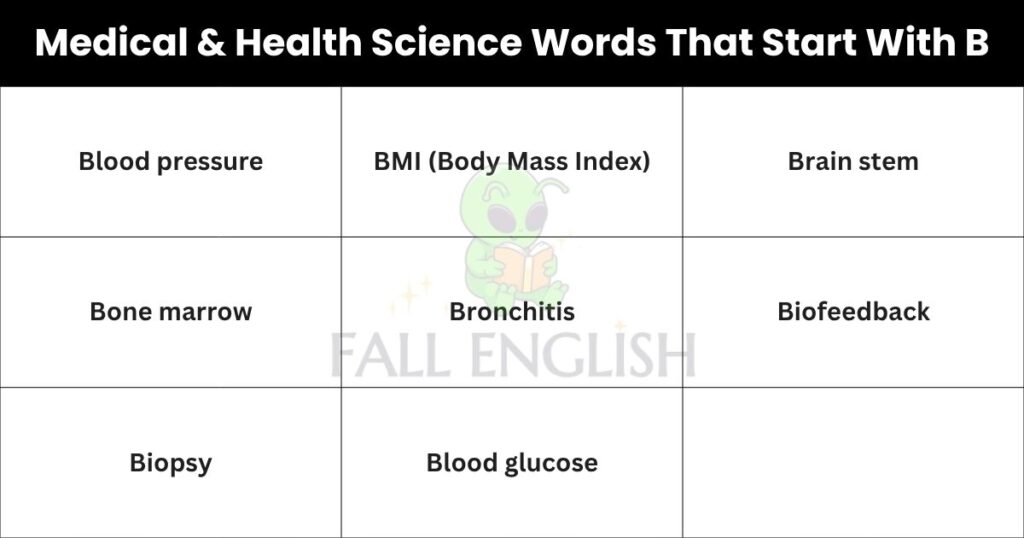
Blood pressure — The force blood exerts against artery walls. Measured as systolic over diastolic. Normal sits around 120/80 mmHg.
Bone marrow — Soft tissue inside bones producing red blood cells, white blood cells, and platelets. Marrow transplants treat certain blood cancers.
Biopsy — Removing a small tissue sample to check for disease. A pathologist examines it under a microscope, often to detect cancer.
BMI (Body Mass Index) — Calculated from height and weight. A rough indicator of body fatness used in health screenings — useful but not perfect.
Bronchitis — Inflammation of the bronchi, usually from infection or smoking, causing persistent cough.
Blood glucose — Sugar concentration in the blood, regulated by insulin. Chronically high levels lead to diabetes complications.
Blood clot — Hardened blood that stops bleeding at a wound. Clots forming inside blood vessels — thrombosis — can cause heart attacks or strokes.
Bradycardia — Heart rate below 60 beats per minute. Normal in trained athletes; a potential warning sign in others.
Brain stem — The lower brain section connecting to the spinal cord. Governs breathing, heart rate, and core survival functions.
Biofeedback — A technique using real-time sensors to show you your own body data — heart rate, muscle tension — so you can learn to consciously influence them.
Technology & Applied Science Words That Start With B
Binary code — The base language of computers. Every image, text, and video is stored as combinations of 0s and 1s.
Bandwidth — Data a connection can carry per second. Higher bandwidth = faster internet.
Battery — Stores chemical energy and converts it to electrical energy. Powers everything from TV remotes to electric vehicles.
Biotechnology — Applying biological systems to solve real-world problems — growing medicines inside bacteria, engineering drought-resistant crops, developing gene therapies.
Boolean — A value that is either true or false. Named after mathematician George Boole. The foundation of nearly all programming logic.
Bluetooth — Short-range wireless data technology. Named after 10th-century Danish king Harald Bluetooth, who united rival tribes — the technology unites devices.
Bridge circuit — An electrical circuit measuring unknown resistance with high precision. Found in sensitive scientific instruments and sensors.
Byte — Eight bits of digital data. One letter in a text file takes roughly one byte.
Bus (computing) — The internal pathway through which data travels between a computer’s components.
Bioreactor — A controlled vessel for biological reactions — growing vaccine cells, fermenting beverages, or producing biofuels.
Science Words That Start With B — By Grade Level
Grades 4–6
Bird, Blood, Bone, Breathe, Bud, Bubble, Bacteria, Biology, Brain, Body, Breeze, Burrow, Branch, Burning
Grades 7–8
Boiling point, Base, Biodiversity, Biome, Bronchi, Buoyancy, Barometer, Binary fission, Biomass, Botany, Basalt, Blood pressure
Grades 9–10
Boyle’s Law, Benzene, Black hole, Beta particle, Bernoulli’s principle, Bioluminescence, B cell, Biotechnology, Biogeochemical cycle, Blood clot
Grade 11–College
Boltzmann constant, Bose-Einstein condensate, Bioinformatics, Band theory, Baryon, Biosynthesis, Bifurcation, Blackbody radiation, Baryonic matter, Biofilm
Advanced Science Words That Start With B
Bose-Einstein condensate — A state of matter formed when certain particles cool to near absolute zero. They merge into one shared quantum state — behaving like one giant atom. First created in a lab in 1995.
Bioinformatics — Using computers and statistics to analyze biological data, especially DNA sequences. Essential in genomics and modern drug discovery.
Baryon — A subatomic particle built from three quarks. Protons and neutrons are baryons — and therefore so is everything you’ve ever touched.
Band theory — Explains how electrons behave in solids, determining whether a material conducts electricity, blocks it, or sits somewhere in between.
Boltzmann constant — A fundamental constant linking temperature to particle energy. Appears throughout thermodynamics and statistical physics.
Biosynthesis — How living cells build complex molecules from simpler ones. Proteins, DNA, and fats are all assembled through biosynthesis.
Buckling — When a structure fails under compression by bending sideways instead of crushing straight down. Engineers account for this in tall, thin columns.
Bifurcation theory — Studies how tiny changes in a system can suddenly produce completely different behavior. Relevant in physics, biology, and economics alike.
The Full List — 190+ Science Words That Start With B
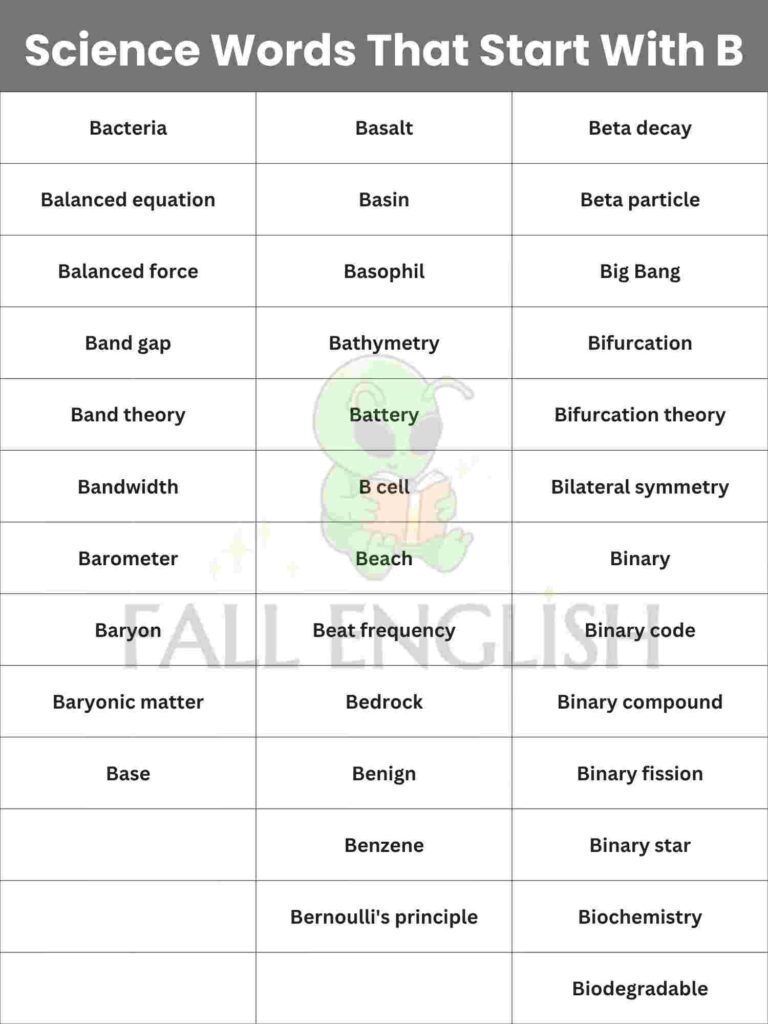
Bacteria
Balanced equation
Balanced force
Band gap
Band theory
Bandwidth
Barometer
Baryon
Baryonic matter
Base
Basalt
Basin
Basophil
Bathymetry
Battery
B cell
Beach
Beat frequency
Bedrock
Benign
Benzene
Bernoulli’s principle
Beta decay
Beta particle
Big Bang
Bifurcation
Bifurcation theory
Bilateral symmetry
Binary
Binary code
Binary compound
Binary fission
Binary star
Biochemistry
Biodegradable
Biodegradation
Biodiversity
Biofilm
Biofeedback
Biogeochemical cycle
Bioinformatics
Bioluminescence
Biomass
Biome
Bioreactor
Biosphere
Biosynthesis
Biotechnology
Biotic factor
Bismuth
Blizzard
Blood
Blood clot
Blood glucose
Blood pressure
Blood type
Blood vessel
Blue giant
Blue shift
BMI
Bog
Bohr model
Boiling point
Bolide
Boltzmann constant
Bond energy
Boolean
Bose-Einstein condensate
Boron
Boron trifluoride
Botany
Bow shock
Brackish water
Bradycardia
Brain
Brain stem
Breccia
Bridge circuit
Brittle
Bromide
Bromine
Bronchi
Bronchiole
Bronchitis
Brownian motion
Buckling
Budding
Buffer
Bulk modulus
Buoyancy
Buoyant force
Bus
Butte
Byte
Barium
Bending
Bleaching agent
Body cavity
Body plan
Body temperature
Bomb calorimeter
Bone
Bone density
Bone marrow
Boyle’s Law
Breed
Brine
Brittleness
Broadband
Bronchodilator
Brown dwarf
Bulb
Burning
Burst pressure
Bile
Bile duct
Bioaccumulation
Bioavailability
Biochemical oxygen demand
Biochar
Biodiversity hotspot
Bioenergy
Biofuel
Biogenic
Biological clock
Biological control
Biomagnification
Biomarker
Biorhythm
Biosecurity
Biotope
Bleaching (coral)
Blood bank
Blue light
Borax
Boric acid
Bottleneck effect
Boundary layer
Biostimulant
Biosensor
Biopolymer
Biomechanics
Biophysics
Biocide
Bioethics
Biogas
Biohazard
Common Mix-Ups Worth Knowing
Bacteria vs. Virus Both cause infections but work completely differently. Bacteria are living cells — antibiotics kill them. Viruses aren’t truly alive; they hijack host cells to replicate. Antibiotics do nothing against viruses. This confusion leads to real harm when people demand antibiotics for a cold.
Base vs. Alkali Every alkali is a base, but not every base is an alkali. An alkali specifically dissolves in water. Sodium hydroxide is both. Some bases don’t dissolve in water at all — so they can’t be called alkalis.
Biome vs. Ecosystem A biome is a large climate-defined region — all tropical rainforests everywhere. An ecosystem is a specific, bounded community of living and nonliving things. One biome holds many different ecosystems inside it.
Boiling Point vs. Melting Point Boiling = liquid becomes gas. Melting = solid becomes liquid. Water melts at 0°C and boils at 100°C. Two completely separate events, two separate temperatures.
Brown Dwarf vs. Black Hole A brown dwarf is a failed star — never massive enough to fuse hydrogen. A black hole forms when a massive star collapses violently at the end of its life. Completely different origins, sizes, and behaviors.
Benign vs. Malignant Both involve abnormal cell growth. Benign tumors stay put. Malignant ones spread to other tissues — that spreading is what makes cancer life-threatening.
Where These Words Actually Show Up
In hospitals: Blood pressure, biopsy, bradycardia, bone marrow, blood glucose, blood clot, bronchitis
In school science labs: Boiling point, base, buffer, balanced equation, Brownian motion, Boyle’s Law, barometer
In nature and outdoors: Basalt, bog, brackish water, bioluminescence, biodegradable, biome, biodiversity
In tech and computing: Binary, boolean, bandwidth, Bluetooth, byte, bus, battery, bioreactor
In space documentaries: Black hole, Big Bang, binary star, brown dwarf, blue shift, bow shock, bolide
In environmental news: Biodegradable, biomass, biogeochemical cycle, bioaccumulation, biofuel, coral bleaching
Memory Tricks for B Science Words
Black hole — Black = no light escapes. The name describes exactly what it does.
Buoyancy — “Bi = two directions.” Gravity pulls down; buoyancy pushes up.
Binary — Bicycle has two wheels. Binary has two values. Bi always means two.
Buffer — A traffic buffer stops crashes. A chemical buffer stops pH from crashing in either direction.
Bioluminescence — Bio = life. Lumen = light. Living light. Two roots, one word.
Bernoulli’s principle — Blow across a sheet of paper right now. The top lifts. Faster air above = lower pressure = paper rises. You just felt physics.
Boyle’s Law — Squeeze a balloon. Pressure goes up; size goes down. Your hands ran the experiment.
Big Bang — Not an explosion into space. Space itself stretched and grew. The “bang” part misleads almost everyone the first time.
Related Posts:
250+ Science Words That Start With A | Full List with Meanings
150+ Science Words That Start With R (With Meanings and Examples)
FAQs
What are the most common Science Words That Start With B?
Some of the most familiar terms are bacteria, base, biology, blood, brain, boiling point, buoyancy, biome, biodiversity, and black hole. These appear often in textbooks and classroom discussions.
How can students remember science words more easily?
The best method is to connect each word to a real example. For instance, think of boats for buoyancy, vinegar and baking soda for bases, and fireflies for bioluminescence. Real images help words stick.
Why do so many science terms start with “bio”?
The prefix “bio” means life. That is why words such as biology, biodiversity, biotechnology, and biosphere all relate to living organisms or life processes.
Are these words useful for school exams?
Yes. Many of these terms appear in science quizzes, worksheets, and board exams. Understanding them clearly can improve both vocabulary and subject knowledge.
Which science subjects use words starting with B?
These words appear across biology, chemistry, physics, medicine, astronomy, environmental science, and computer technology.

FallEnglish is run by a language enthusiast who explains word and text meanings in clear, simple ways. Each guide is carefully researched, original, and written to help real people understand language faster, with accuracy, context, and everyday examples you can trust.