


Suegro means “father-in-law” in Spanish. Your spouse’s dad. That’s the clean answer. But stick around, because how this word actually lives in real conversations is a different story entirely.
Imagine you’re at a family gathering. Someone leans over and whispers, “cuidado, llega el suegro” — careful, the father-in-law’s coming. The room shifts a little. Everyone sits up straighter. That one word just communicated a whole social dynamic without explaining a single thing.
That’s suegro. Simple on paper. Heavy in practice.
So What Exactly Does Suegro Mean
Suegro (pronounced SWEH-groh) is the Spanish word for your spouse’s father. It’s a standard family term, not slang, not informal — just the normal word people use every day across every Spanish-speaking country.
The matching pair works like this:
- Suegro — father-in-law (masculine)
- Suegra — mother-in-law (feminine)
- Los suegros — both in-laws together
That last one catches people off guard. In Spanish, the masculine plural covers both. So mis suegros vinieron doesn’t mean just the dads showed up — it means both in-laws did.
One letter difference between suegro and suegra. Completely different person.
How Suegro Sounds in Real Conversations
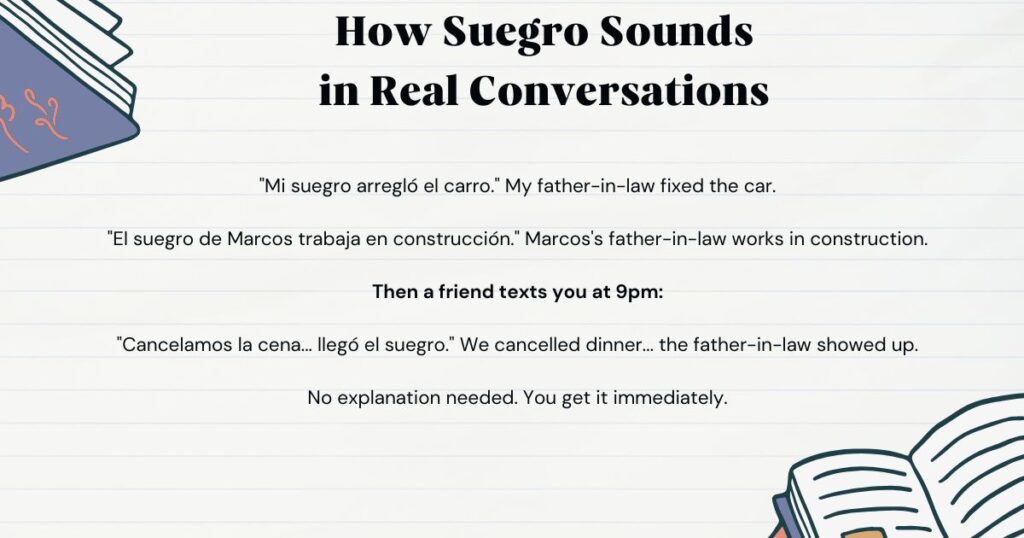
Not every use of suegro is loaded. Most of the time it’s completely ordinary.
“Mi suegro arregló el carro.” My father-in-law fixed the car.
“El suegro de Marcos trabaja en construcción.” Marcos’s father-in-law works in construction.
Then a friend texts you at 9pm:
“Cancelamos la cena… llegó el suegro.” We cancelled dinner… the father-in-law showed up.
No explanation needed. You get it immediately.
That’s the thing about suegro — native speakers don’t over-explain it. They drop it and trust you to understand the situation. Which means if you’re learning Spanish, picking up on the tone around the word matters just as much as knowing the definition.
Is Suegro Disrespectful to Say
Not even slightly. It’s a neutral family title, the same way “father-in-law” is in English. You can say it warmly, you can say it with a tired laugh, you can say it in an argument — the word itself doesn’t change. The feeling around it does.
Where people sometimes get confused is with suegra, the feminine version. Some learners wonder if calling someone your suegra to their face sounds cold or rude. It doesn’t. Plenty of people address their mother-in-law directly as suegra in an affectionate way, the same way someone might call their aunt tía instead of using her name.
Context, tone, relationship. Those three things decide everything.
Read also: Papacito Meaning — What This Actually Tells You About the Moment
The Cultural Weight Behind the Suegro
Here’s what dictionaries won’t tell you.
In a lot of Latin families, the suegro is a figure you have to earn. Especially if you’re the one marrying his child. There’s an unspoken expectation — show respect, prove you’re reliable, don’t embarrass his family. Some suegros make that easy. Others make it a years-long project.
Latin comedy leans into this hard. The strict suegro who interrogates the boyfriend, the suegro who never thinks anyone is good enough for his daughter — these are recurring characters in telenovelas, movies, and everyday humor because they reflect something real that a lot of families recognize.
But the flip side exists too, and it doesn’t get talked about as much. Plenty of people describe their suegro as someone who became a genuine father figure. Someone who taught them a skill, backed them up in tough moments, or quietly made them feel part of the family without any big announcement. That version of the suegro is just as common — it just doesn’t make for as funny a story.
Suegro vs. Suegra — Where People Get Confused
Since both words come up in searches together, worth being direct about the difference:
Suegra meaning in English = mother-in-law. Spouse’s mother. Feminine form.
Suegro meaning in English = father-in-law. Spouse’s father. Masculine form.
If you’ve landed on Urban Dictionary entries for suegra — those are joke definitions built on the classic difficult-mother-in-law stereotype. Entertaining maybe, but not what the word actually means. Real dictionaries are straightforward: suegra is mother-in-law, nothing more.
Suegra in Spanish Songs and What the Lyrics Actually Mean
Latin music references suegros and suegras more than you’d expect, mostly because family pressure and relationship dynamics are constant themes in reggaeton, bachata, and even older boleros.
When a lyric brings up the suegra or suegro, it’s usually shorthand for outside interference in a relationship — the parent who has opinions, who shows up uninvited, who the singer has to deal with to be with the person they love. Listeners immediately understand the stakes. No translation required if you know the culture.
Some searches come in as suegra lyrics in English — usually people trying to decode a specific song where the word appears and they want to know if it’s being used as a compliment or a complaint. Almost always it’s the latter, but delivered with the kind of humor that keeps it from being mean-spirited.
A Detail Most Giudes Skip
In some regions — parts of Mexico, Central America, parts of South America — people use suegro or suegra even before there’s a marriage. Long-term relationship, serious couple, met the parents — and suddenly the girlfriend’s dad is el suegro in casual conversation. No ring required.
It signals seriousness. It says: this relationship is real enough that we’re already using family titles for each other’s parents.
That usage won’t show up in a dictionary. But it shows up constantly in real life.
Read also: Oye Como Va Meaning: Lyrics, Translation & Real Song Context
Suegra Food — Yes, That’s a Real Thing
Completely different context, worth mentioning briefly.
In some Spanish-speaking regions, suegra also refers to the hard end crust of a bread loaf — the tough outer piece that not everyone wants. The nickname makes a certain kind of sense if you’ve ever heard anyone joke about a difficult mother-in-law. It’s dry humor baked into the language, literally.
Lengua de suegra (mother-in-law’s tongue) shows up as both a plant name — the spiky Sansevieria — and a type of elongated sponge cake in parts of Central America. None of this connects to suegro specifically, but since suegra searches often lead people here, it’s worth knowing these food and plant references exist and mean something completely different from the family term.
The Short Version
Suegro = father-in-law. Spanish. Neutral word. No disrespect built in. Pronounced SWEH-groh. Paired with suegra (mother-in-law). Together they’re los suegros. Used across all Spanish-speaking countries the same way. Carries cultural weight in Latin family dynamics but nothing negative on its own.
If someone used it in a message to you and you weren’t sure — now you are.

FallEnglish is run by a language enthusiast who explains word and text meanings in clear, simple ways. Each guide is carefully researched, original, and written to help real people understand language faster, with accuracy, context, and everyday examples you can trust.