


Science becomes much easier when you understand the meaning behind unfamiliar terms. This guide to Science Words That Start With D brings together important vocabulary from biology, chemistry, physics, Earth science, medicine, and astronomy in one organized place.
Whether you are studying for a test, helping with homework, or building your scientific vocabulary, these words and explanations will help you understand what they mean and where they are used in real life.
20 Most-Used Science Words Starting With D
These appear most frequently across science textbooks and exams. Learn these first.
Density — Mass packed into a given volume
Diffusion — Particles spreading from high to low concentration
DNA — Molecule carrying genetic instructions in living things
Decomposition — Breakdown of dead matter by bacteria or fungi
Displacement — Net straight-line change in position, including direction
Drought — Abnormal extended period of below-normal rainfall
Digestion — Breaking food into nutrients cells can absorb
Doppler Effect — Wave frequency shifts when source or observer moves
Delta — Fan-shaped sediment deposit where a river meets the sea
Dominant Gene — Gene that masks the effect of a paired recessive gene
Diode — Device allowing current to flow in one direction only
Diploid — Cell containing two complete sets of chromosomes
Dwarf Planet — Orbital body too small to clear its path around the Sun
Dark Matter — Invisible mass accounting for most of the universe’s matter
Diameter — Line passing straight through the center of a sphere or circle
Dichotomous Key — Identification tool using paired yes/no questions
Dew Point — Temperature at which air becomes saturated and droplets form
Decay — Gradual breakdown of an organism or substance
Dynamo — Machine converting mechanical energy into electrical energy
Dormancy — Reduced biological activity during unfavorable conditions
Physics Science Words That Start With D
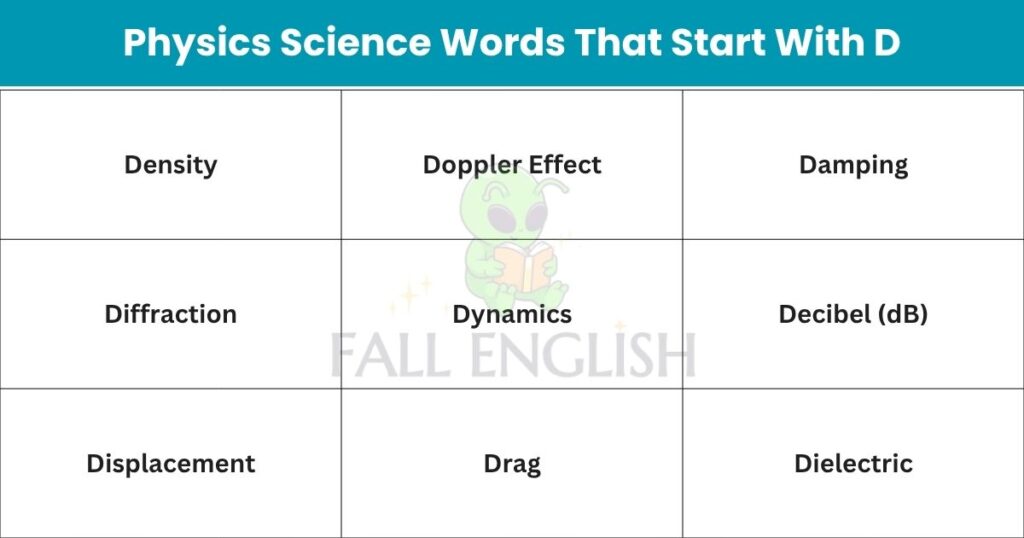
Density Tightly packed matter has high density. A rock and foam block can be identical in size — the rock feels heavier because its mass is compressed into the same space. Formula: mass ÷ volume.
Diffraction Waves bend around corners or edges instead of traveling in a perfectly straight line. Light passing through a narrow slit fans outward — that spreading is diffraction.
Displacement The straight-line gap between where something started and where it stopped — direction matters. Walk in a full circle and your displacement is zero; your distance walked is not.
Doppler Effect A sound source moving toward you compresses its waves — pitch rises. Moving away, waves stretch — pitch drops. Astronomers apply the same principle to light waves to calculate how fast stars move toward or away from Earth.
Dynamics The physics branch studying how forces produce and change motion. Rolling balls, falling objects, spinning wheels — all governed by dynamics.
Drag Resistance force acting against an object moving through air or water. It’s why skydivers reach a terminal velocity instead of accelerating endlessly.
Damping Gradual reduction of vibration in a system. Car shock absorbers damp road vibrations so passengers don’t feel every bump.
Decibel (dB) Unit measuring sound intensity. Normal conversation sits around 60 dB. A jet engine reaches approximately 140 dB.
Dielectric A non-conducting material placed between capacitor plates to store electrical energy more effectively. Glass, rubber, and plastic are common dielectrics.
Dyne A CGS unit of force. One dyne accelerates one gram of mass at one centimeter per second squared.
Diffuse Reflection When light hits a rough surface and scatters in multiple directions rather than reflecting at one clean angle. Matte paint produces diffuse reflection; mirrors do not.
Chemistry Science Words That Start With D
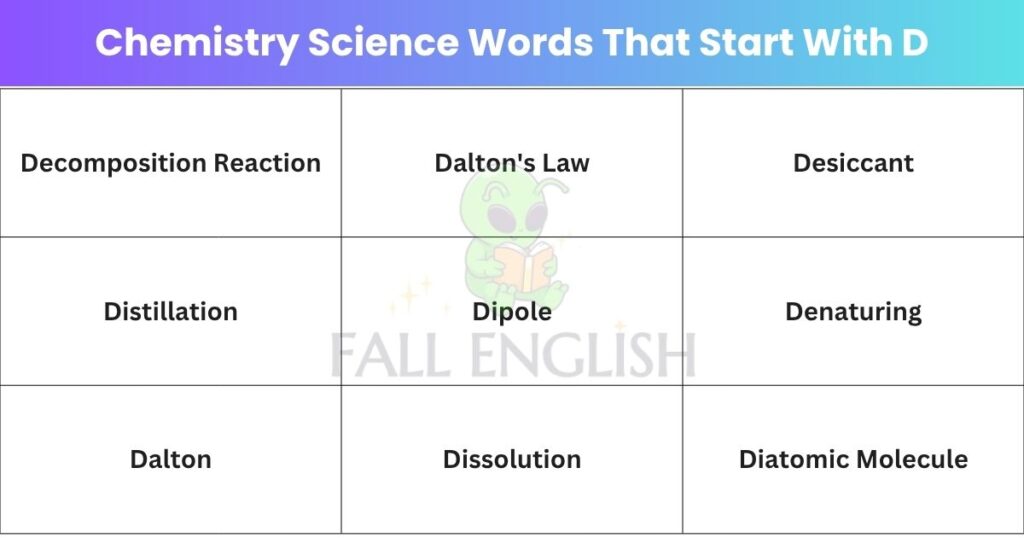
Decomposition Reaction A single compound breaks into two or more simpler substances. Heating calcium carbonate produces calcium oxide and carbon dioxide.
Distillation Purification through controlled boiling and condensing. Saltwater distillation removes impurities — one technique used in producing clean drinking water.
Dalton Unit of atomic mass. John Dalton also proposed the atomic theory — that all matter consists of indivisible atoms.
Dalton’s Law The total pressure of a gas mixture equals the sum of each individual gas’s pressure. Relevant in respiratory physiology and industrial gas mixing.
Dipole A molecule carrying positive charge on one end and negative on the other. Water (H₂O) is the most studied dipole molecule.
Dissolution A solute dissolving uniformly into a solvent. Sugar disappearing into hot tea is dissolution at the kitchen scale.
Ductility A metal’s capacity to be drawn into thin wire without fracturing. Gold and copper rank among the most ductile metals.
Desiccant A substance that continuously absorbs surrounding moisture. The silica gel packets sealed inside new shoe boxes serve exactly this purpose.
Denaturing Heat, acid, or pH change destroys a protein’s three-dimensional structure — permanently altering its function. Frying an egg denatures its proteins, changing them from transparent to opaque white.
Diatomic Molecule A molecule composed of exactly two atoms. Oxygen (O₂), nitrogen (N₂), and hydrogen (H₂) are all diatomic at room temperature.
Dispersion Tiny particles of one substance distributed evenly through another without dissolving. Milk is a dispersion of fat droplets in water.
Disaccharide A sugar formed by joining two simple sugar molecules. Sucrose (table sugar) and lactose (milk sugar) are both disaccharides.
Desiccation Complete removal of moisture from a substance. Desiccation is used in food preservation — dried fruit and jerky are everyday examples.
Biology Science Words That Start With D
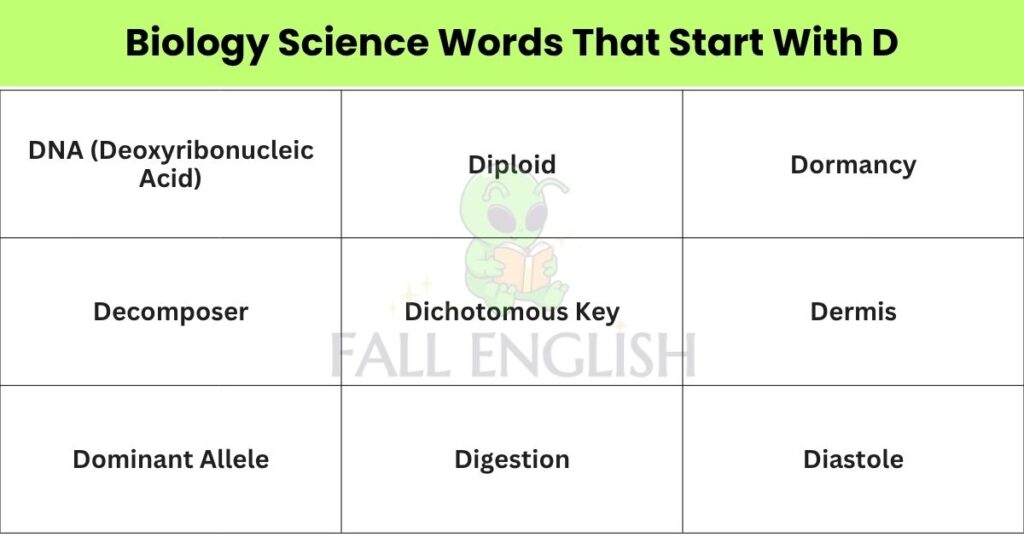
DNA (Deoxyribonucleic Acid) A twisted-ladder molecule holding the genetic blueprint for every living organism. It instructs cells to build proteins, grow, reproduce, and repair themselves.
Decomposer Bacteria and fungi that break down dead organisms, cycling nutrients back into soil. Without decomposers, dead organic material would accumulate indefinitely.
Dominant Allele Expresses itself in an organism’s appearance even when only one copy is present. Brown eye color is dominant — one copy is enough to show it.
Diploid A cell carrying two sets of chromosomes — one from each parent. Human body cells are diploid, holding 46 chromosomes total.
Dichotomous Key A biological identification guide built on paired yes/no choices. Used in labs to identify unknown plants, insects, or fungi step by step.
Digestion Mechanical and chemical breakdown of food into molecules small enough for cells to absorb. Stomach acid, digestive enzymes, and intestinal absorption all play roles.
Dormancy A temporary state of reduced biological activity during unfavorable conditions. Seeds wait dormant through winter; bears hibernate in a comparable state.
Dermis The middle skin layer beneath the epidermis, containing nerve endings, sweat glands, and hair follicles.
Diastole The phase when heart muscle relaxes and chambers refill with blood. The lower number in a blood pressure reading reflects diastolic pressure.
Dendritic Cell An immune cell that detects foreign invaders and signals the broader immune response — functioning as the body’s early-warning scout.
Domestication Humans selectively bred wild species over generations to produce useful traits. Dogs descend from wolves; wheat from wild grass.
Diploblastic Describes animals with body walls built from only two cell layers. Jellyfish and sea anemones are diploblastic organisms.
Detritivore An organism that feeds on dead organic material. Earthworms, millipedes, and dung beetles are detritivores — distinct from decomposers, which break matter down chemically.
Deoxyribose The five-carbon sugar forming the structural backbone of DNA. RNA uses ribose instead — one oxygen atom’s difference that changes everything about how each molecule behaves.
Dermal Tissue The outer protective layer of a plant, equivalent in function to skin. It controls water loss and blocks pathogens.
Earth Science Words That Start With D
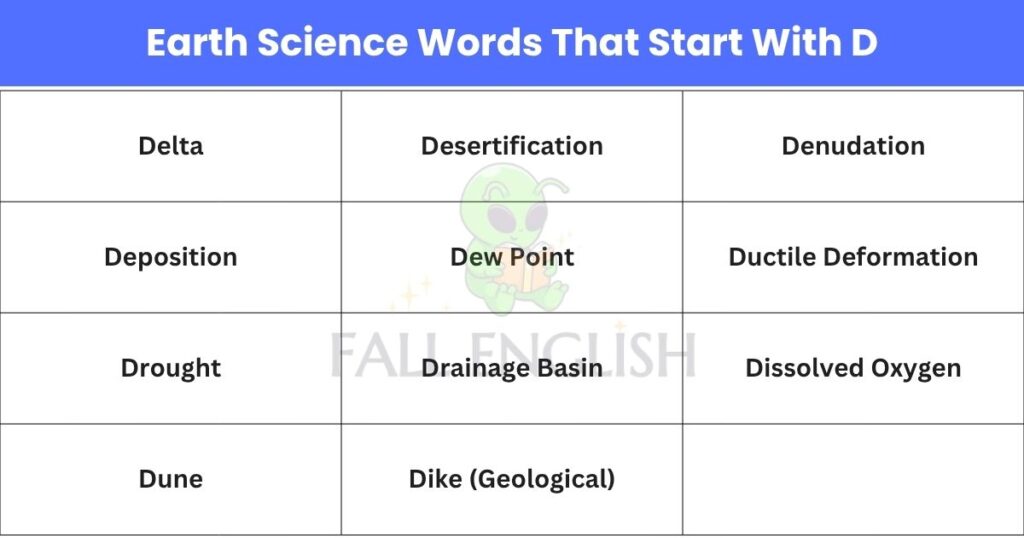
Delta A fan-shaped landform built where a river slows and deposits its sediment load upon reaching the sea. The Nile Delta is among the most recognizable on Earth.
Deposition The process by which wind, water, or ice drops transported sediment. Wind deposition builds dunes; water deposition builds deltas and floodplains.
Drought An abnormal rainfall shortage extending beyond what is typical for a region. Unlike a predictable dry season, a drought signals a departure from normal conditions.
Dune A hill of sand shaped and constantly repositioned by wind. Coastal and desert dunes follow the same formation mechanics.
Desertification Productive land degrading into desert through overfarming, deforestation, or long-term climate shifts. Sub-Saharan Africa is among the regions most affected.
Dew Point The precise temperature at which air can no longer hold its water vapor, triggering condensation into fog, dew, or rain.
Drainage Basin All land area draining rainfall into a single river system. The Amazon River’s drainage basin is one of the largest on Earth.
Dike (Geological) A sheet of igneous rock cutting across existing rock layers, formed when magma forced its way through cracks and solidified.
Denudation The long-term stripping of Earth’s surface through combined weathering, erosion, and mass movement.
Ductile Deformation Rocks deep underground bending and flowing slowly under extreme pressure rather than fracturing — the opposite of brittle failure.
Dissolved Oxygen The amount of oxygen dissolved in water. Fish and aquatic organisms depend on it to breathe. Warmer water holds less dissolved oxygen, making temperature a critical factor in aquatic health.
Divergent Boundary A tectonic boundary where two plates move apart. New crust forms here as magma rises to fill the gap — the Mid-Atlantic Ridge is a prime example.
Downwelling The sinking of surface ocean water, driven by temperature or salinity changes. It plays a key role in ocean circulation and climate regulation.
Space & Astronomy Science Words That Start With D
Dark Matter Makes up roughly 27% of the universe but emits, absorbs, and reflects no light. Its existence is inferred because galaxies rotate faster than visible mass alone could produce.
Dark Energy The force driving the universe’s accelerating expansion. It accounts for approximately 68% of the universe’s total energy content and remains one of science’s largest open questions.
Dwarf Planet Large enough to be roughly spherical but hasn’t gravitationally cleared its orbital path. Pluto is the most well-known dwarf planet; Eris, Makemake, and Haumea are others.
Doppler Shift Light from a star moving away shifts toward red (redshift). Light from an approaching star shifts toward blue (blueshift). Astronomers use this to measure how fast cosmic objects move.
Declination The celestial equivalent of geographic latitude — measuring how far north or south an object sits in the sky from the celestial equator.
Dark Nebula A dense cloud of gas and dust blocking light from objects behind it. The Horsehead Nebula in Orion is a famous dark nebula.
Dust Disk A rotating disk of gas and dust surrounding a young star. Planets gradually coalesce from material inside these disks.
Double Star Two stars appearing close together in the sky. True binary systems orbit each other; optical doubles only appear close from Earth’s viewing angle.
Dwarf Star A relatively small, low-luminosity star. Our Sun is classified as a yellow dwarf — mid-sized in the full stellar spectrum.
Dysnomia The only known moon of the dwarf planet Eris — one of the most distant objects in the solar system.
Medical & Health Science Words That Start With D
Diagnosis Identifying a condition based on symptoms, physical examination, and test results.
Dialysis A mechanical process filtering waste products from blood when the kidneys can no longer perform this function. Many patients with kidney failure require sessions several times per week.
Deoxygenated Blood Blood that has delivered its oxygen to body tissues and is returning to the heart and lungs to collect a fresh supply.
Dermatitis Skin inflammation causing redness, itching, or rash. Contact dermatitis occurs when the skin reacts to a specific allergen or irritant.
Diabetes A metabolic condition where the body cannot properly regulate blood sugar levels — either because insulin isn’t produced or cells don’t respond to it.
Deficiency A shortage of something the body requires for normal function. Vitamin D deficiency weakens bones; iron deficiency causes fatigue and reduced oxygen transport.
Diuretic Any substance stimulating increased urine output. Several blood pressure medications work through this mechanism.
Dilation The widening of an opening or vessel. Pupils dilate in low light to admit more; cervical dilation occurs during childbirth.
Dyslexia A neurological condition affecting reading and written language processing. Not connected to intelligence — many highly successful people are dyslexic.
Dementia A group of progressive symptoms — memory loss, impaired reasoning, social difficulty — severe enough to interfere with independent daily life. Alzheimer’s disease is the most common underlying cause.
Dopaminergic Relating to neurons or pathways that use dopamine as their chemical messenger. Parkinson’s disease involves the degeneration of dopaminergic neurons.
Technology & Applied Science Words That Start With D
Digital Signal Data transmitted as discrete values — typically 0s and 1s. Digital signals maintain quality over long distances far better than analog signals.
Diode An electronic component permitting current flow in one direction only. Present in virtually every electronic device, from phone chargers to radio transmitters.
Data Compression Reducing file size by encoding information more efficiently without losing essential content. MP3 audio and JPEG images both use compression algorithms.
Drag Coefficient A numerical value representing how aerodynamically clean an object’s shape is. Automotive engineers minimize it to reduce fuel consumption at highway speeds.
Drone An unmanned aerial vehicle operated by remote control or onboard programming. Applications span photography, precision agriculture, package delivery, and defense.
Decryption Converting encrypted data back into readable form. The counterpart to encryption and the foundation of digital security systems.
Dynamic RAM (DRAM) A type of volatile computer memory that stores data temporarily and requires constant electrical refreshing to retain information.
Desalination Removing salt and minerals from seawater to produce fresh drinking water. Widely used in water-scarce regions like the Middle East.
Easy Science Words That Start With D (Grades 3–5)
Good entry points for younger learners or anyone new to science vocabulary.
- Day — Time for Earth to complete one full rotation (24 hours)
- Dark — Absence of light
- Dirt — Loose soil containing minerals, organic matter, and tiny organisms
- Dew — Water droplets condensing on cool surfaces overnight
- Decay — Slow breakdown of once-living material over time
- Dinosaur — Extinct reptiles that dominated Earth millions of years ago
- Droplet — A tiny sphere of liquid
- Dry Ice — Solid carbon dioxide that converts directly to gas without melting
- Dawn — The moment light first appears before sunrise
- Duct — A channel or tube carrying air, fluid, or other substances
Advanced Science Words That Start With D (Grades 11–12 & Beyond)
Dipole Moment Measures the degree of charge separation within a molecule. Central to spectroscopy, molecular modeling, and quantum chemistry.
Darcy’s Law Describes fluid movement through porous materials like soil or sandstone. Essential in groundwater hydrology and petroleum reservoir engineering.
Dendritic Growth The branching, tree-like pattern appearing in snowflake crystals, metal solidification, and neuron development — driven by the physics of diffusion-limited growth.
Deconvolution A mathematical process reversing image blurring to recover sharp signals. Used in astronomical imaging and MRI analysis.
Dimensional Analysis A problem-solving method tracking and canceling physical units to verify equations and convert between measurement systems.
Diastereomers Stereoisomers that are not mirror images of each other. In pharmaceutical development, different diastereomers of the same compound can produce completely different biological effects.
Dysregulation When a biological control system — hormonal, immune, or neurological — loses its normal regulated function, often contributing to disease.
Dynamic Equilibrium A state where forward and reverse reactions occur at equal rates, so overall concentrations stay constant even though reactions continue.
Science Words That Start With D — By Grade Level
| Grade | Priority Words |
| 3–4 | Dew, Decay, Dirt, Day, Dawn, Droplet, Dinosaur, Duct |
| 5–6 | Density, Delta, Drought, DNA, Digestion, Dormancy, Decomposer |
| 7–8 | Dominant Allele, Diploid, Doppler Effect, Dew Point, Dialysis, Diastole |
| 9–10 | Denaturing, Diode, Desiccant, Drag Coefficient, Desertification, Divergent Boundary |
| 11–12 | Dark Matter, Dark Energy, Diastereomers, Dipole Moment, Darcy’s Law, Dynamic Equilibrium |
The Complete List: 140+ Science Words Starts With D
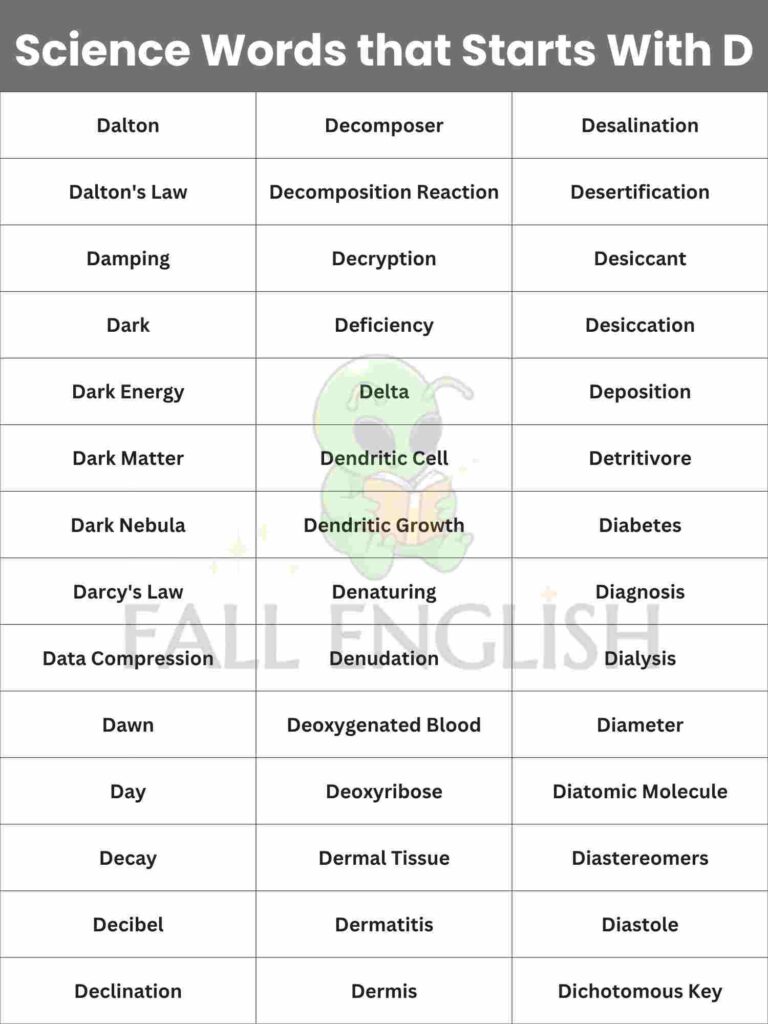
- Dalton
- Dalton’s Law
- Damping
- Dark
- Dark Energy
- Dark Matter
- Dark Nebula
- Darcy’s Law
- Data Compression
- Dawn
- Day
- Decay
- Decibel
- Declination
- Deconvolution
- Decomposer
- Decomposition Reaction
- Decryption
- Deficiency
- Delta
- Dendritic Cell
- Dendritic Growth
- Denaturing
- Denudation
- Deoxygenated Blood
- Deoxyribose
- Dermal Tissue
- Dermatitis
- Dermis
- Desalination
- Desertification
- Desiccant
- Desiccation
- Deposition
- Detritivore
- Diabetes
- Diagnosis
- Dialysis
- Diameter
- Diatomic Molecule
- Diastereomers
- Diastole
- Dichotomous Key
- Dielectric
- Diffraction
- Diffuse Reflection
- Digestion
- Digital Signal
- Dike
- Dilation
- Dimensional Analysis
- Diode
- Diploblastic
- Diploid
- Dipole
- Dipole Moment
- Dirt
- Disaccharide
- Dispersion
- Dissolution
- Dissolved Oxygen
- Distillation
- Diuretic
- Divergent Boundary
- DNA
- DNA Replication
- Domestication
- Dominant Allele
- Dominant Gene
- Dopaminergic
- Doppler Effect
- Doppler Shift
- Dormancy
- Dormant Volcano
- Double Star
- Downwelling
- Drag
- Drag Coefficient
- Drag Force
- Drainage Basin
- DRAM
- Droplet
- Drone
- Drought
- Dry Ice
- Duct
- Ductile Deformation
- Ductility
- Ductless Gland
- Ductwork
- Dune
- Dust Disk
- Dwarf Planet
- Dwarf Star
- Dynamic Equilibrium
- Dynamic RAM
- Dynamics
- Dynamo
- Dyne
- Dyslexia
- Dysregulation
- Dysnomia
- Dysphasia
- Dew
- Dew Point
- Dementia
- Dinosaur
Common Mix-Ups Worth Knowing
Diffusion vs. Osmosis Diffusion covers any substance spreading from concentrated to less concentrated areas. Osmosis is specific — it refers only to water crossing a semi-permeable membrane.
Distance vs. Displacement Distance measures total path traveled. Displacement measures the net straight-line change in position, with direction. Running a lap around a 400m track: distance = 400m, displacement = 0.
Dominant vs. Recessive Dominant alleles express with just one copy. Recessive alleles require two copies to show. A person can carry a recessive allele their entire life without ever displaying it.
Drought vs. Dry Season A dry season is a regular, predictable weather pattern tied to climate cycles. A drought is an unexpected shortage — rainfall significantly below what that region normally receives.
Deoxyribose vs. Ribose DNA uses deoxyribose; RNA uses ribose. One missing oxygen atom separates them structurally — yet that difference produces two molecules with entirely different functions in the cell.
Detritivore vs. Decomposer Both process dead material, but differently. Detritivores physically eat and fragment dead organic matter. Decomposers — bacteria and fungi — break it down chemically through enzyme secretion.
Where These Words Actually Show Up
| Setting | Words You’ll Encounter |
| Hospital | Diagnosis, Dialysis, Diastole, Dilation, Dermatitis, Diabetes, Dementia |
| Biology lab | DNA, Diploid, Dichotomous Key, Decomposer, Dominant Allele, Denaturing |
| Weather reports | Dew Point, Drought, Deposition, Downwelling |
| Physics class | Density, Drag, Displacement, Doppler Effect, Damping, Decibel |
| Space science | Dark Matter, Dark Energy, Dwarf Planet, Doppler Shift, Dark Nebula |
| Electronics | Diode, DRAM, Digital Signal, Decryption, Data Compression |
| Everyday life | Decay (aging fruit), Dissolution (sugar in tea), Dew (wet grass at dawn), Desiccant (packaging packets) |
Memory Tricks for Key D Words
DNA → “Do Not Alter” It carries exact instructions. Any change is a mutation.
Density → Heavy for size High density means mass compressed tightly. Stone sinks; cork floats — same principle.
Diffusion → Crowd leaving a stadium People (particles) spread out from the packed area toward open space — always from concentrated to less concentrated.
Doppler Effect → The ambulance test Approaching siren sounds higher. Departing siren sounds lower. Frequency compresses when source moves toward you, stretches when it moves away.
Dominant vs. Recessive → The microphone rule Dominant speaks even in a pair. Recessive only gets heard when dominant is completely absent.
Detritivore vs. Decomposer → Shredder vs. dissolver Detritivores physically shred dead material. Decomposers chemically dissolve it.
Related Posts:
190+ Science Words That Start With B | Full List with Meanings
160+ Science Words That Start With C | Full List with Meanings
FAQs
What are the most important science words that start with D for students?
Some of the most common and useful terms are DNA, density, diffusion, decomposition, displacement, drought, digestion, dew point, dominant allele, and dwarf planet. These appear often in school science books and exams.
How can I remember difficult science vocabulary more easily?
Connect each word to a real-life example. For instance, think of sugar dissolving in tea for dissolution, or an ambulance siren changing pitch for the Doppler Effect. Simple examples make terms easier to understand and recall.
Which branch of science has the most words that start with D?
Biology includes the largest number of D-words because it covers genetics, anatomy, ecology, and health. Terms like DNA, diploid, decomposer, and dormancy are widely used in life science.
What is the difference between distance and displacement?
Distance is the total path traveled. Displacement is the straight-line change from start to finish and includes direction. If you walk in a circle and return to your starting point, your displacement is zero.
Why do so many scientific terms begin with D?
Many scientific words come from Greek and Latin roots such as “de,” “di,” and “dys.” These prefixes are used across physics, chemistry, biology, and medicine to form precise technical terms.
Bottom line
Learning Science Words That Start With D helps you read textbooks with more confidence and understand how science explains everyday life. From DNA and density to dark matter and drought, each word adds to your knowledge of the world around you. Use this list as a study guide, classroom reference, or quick review whenever you encounter a new scientific term. The more words you understand, the easier science becomes.

FallEnglish is run by a language enthusiast who explains word and text meanings in clear, simple ways. Each guide is carefully researched, original, and written to help real people understand language faster, with accuracy, context, and everyday examples you can trust.