

You’re writing about someone who crosses their fingers before a big game, avoids the number 13, or throws salt over their shoulder after spilling it. You know “superstition” is the obvious word, but it might feel too clinical, too dismissive, or just overused in your piece.
The tricky part is that the alternatives aren’t all equal. Some sound academic, some sound mocking, and some only cover part of what “superstition” means. Picking the wrong one can shift the whole tone of your sentence without you realizing it.
The Best Another Word for Superstition, and When to Use Each
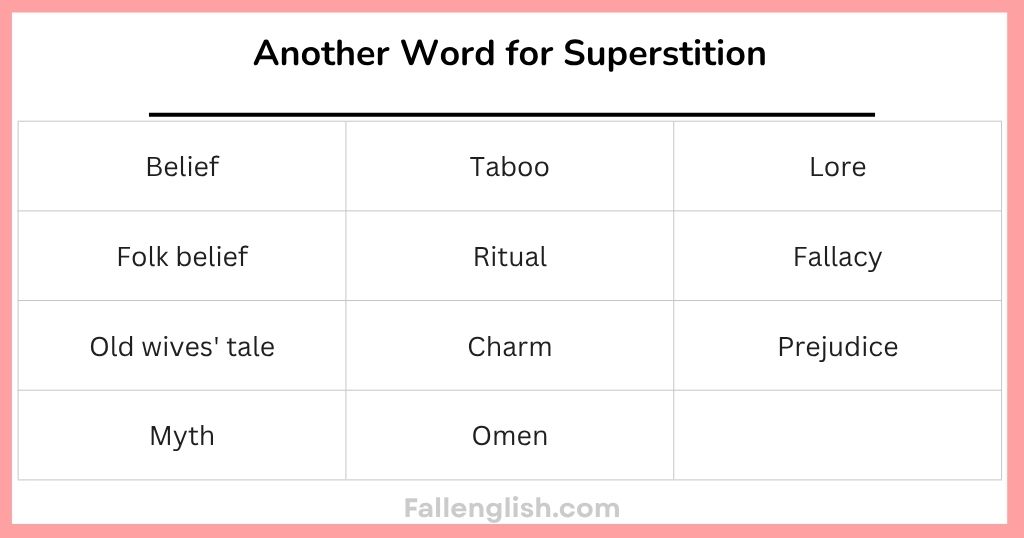
Belief — The most neutral swap. Use it when you want to describe the practice without judging it. “The belief that breaking a mirror brings bad luck has survived for centuries.” It doesn’t carry any negative weight, which is its strength and its limitation.
Folk belief — Slightly more specific. It signals that the idea comes from popular tradition rather than formal religion or science. Good for cultural writing or anthropology. “The folk belief around owls as omens of death varies widely across cultures.”
Old wives’ tale — Casual and slightly dismissive. Best for conversational writing when you want to flag that something has been passed down without much evidence. “My grandmother swore by it, but it’s really just an old wives’ tale.” Avoid it in formal or academic writing.
Myth — Works when the superstition involves a widely held false idea. “The myth that you lose most body heat through your head persists despite the science.” Be careful: myth has many other uses (origin stories, folklore narratives), so it can create confusion if the context isn’t clear.
Taboo — Use this specifically when the superstition involves something forbidden or avoided. “In many households, opening an umbrella indoors is a taboo.” It doesn’t cover superstitions that involve positive rituals or lucky charms.
Ritual — Works when the superstition is an action someone performs, not just a belief they hold. “Before every free throw, he went through the same ritual: bounce the ball three times, take a breath, shoot.” Ritual is neutral and even slightly respectful. It fits sports, religion, and personal habits.
Charm — Refers to a lucky object or practice, not the belief system itself. “She kept a rabbit’s foot as a charm.” Too narrow to replace “superstition” in most sentences, but perfect when you’re talking about a specific lucky item or act.
Omen — Focuses on signs and portents rather than the belief itself. “A black cat crossing your path was once considered an omen.” Use it when the superstition is specifically about reading signs.
Lore — Broad term covering traditional knowledge and stories. “According to local lore, the well grants wishes to those who toss a coin at midnight.” Works well in storytelling and cultural writing. It’s warmer than “superstition” and doesn’t carry any skepticism.
Fallacy — Formal, and clearly signals that something is wrong or illogical. “The idea that cold weather causes illness is a common fallacy.” Only fits when you want to explicitly argue against the belief. It’s too strong for neutral description.
Prejudice — In older English, “prejudice” sometimes meant a belief held without evidence, close to superstition. This usage is now rare and could confuse readers. Avoid it unless you’re quoting historical texts.
Where These Words Actually Differ
The biggest split is between neutral and skeptical alternatives.
Words like belief, folk belief, lore, and ritual let you describe the practice without taking a side. They’re useful when you’re writing about culture, history, or someone else’s traditions with respect.
Words like old wives’ tale, fallacy, and myth carry built-in doubt. They tell the reader you think the belief is probably wrong. That works in skeptical essays, science writing, and casual conversation, but it can come across as dismissive or culturally insensitive if you’re writing about someone else’s traditions.
Taboo and omen are the narrowest. They cover specific types of superstition: something avoided versus something interpreted as a sign. Neither can replace “superstition” across the board.
Ritual is interesting because it has almost no negative connotation. Athletes, performers, and religious practitioners all use rituals, and the word carries a sense of intention and meaning. If you use it, readers may assume the person takes the practice seriously, which might or might not match what you want to say.
Superstition Synonym in Sentences That Show the Difference
She was raised with a strong superstition about Fridays.
→ Replace with belief to sound neutral: She was raised with a strong belief about Fridays.
→ Replace with fear if the emotional angle matters more: She was raised with a deep fear of Fridays.
The team had several superstitions before match day.
→ Rituals works perfectly here and sounds more sympathetic: The team had several rituals before match day.
→ Habits also works if you want to strip away any mystical feeling entirely.
He dismissed it as superstition.
→ Nonsense is blunter but casual: He dismissed it as nonsense.
→ Myth stays cleaner: He dismissed it as myth.
Words That Look Right but Can Misfire
Paranoia — Sounds tempting when someone is excessively fearful, but paranoia is a clinical term describing a mental state, not a cultural belief. Using it to mean superstition can come across as insulting or medically inaccurate.
Phobia — Same problem. A phobia is a recognized anxiety disorder. Calling someone’s superstition a phobia changes the meaning entirely.
Delusion — Strong and clinical. It implies the person is out of touch with reality. Unless that’s exactly your meaning, it’s too harsh a replacement.
Fantasy — Suggests something imaginary and pleasant, like a dream. It doesn’t capture the fear or seriousness that many superstitions carry.
Tradition — Close in some cases, but tradition is broader and usually positive. Not all superstitions are traditions, and many traditions have nothing to do with superstition.
Quick Decision Guide for Another Word for Superstition
If you want to stay neutral → use belief or folk belief
If you’re describing a lucky object or action → use charm or ritual
If you’re describing something people avoid → use taboo
If you’re describing a warning sign → use omen
If you’re writing about cultural heritage warmly → use lore
If you want to signal the belief is probably wrong → use myth or old wives’ tale
If you’re writing formally and arguing against the belief → use fallacy
A Note on Tone
“Superstition” itself isn’t neutral. It came into English partly through religious and philosophical traditions that wanted to distinguish “proper” belief from “improper” belief. When you call something a superstition, you’re subtly saying it doesn’t belong in the category of rational or legitimate thinking. That’s fine when it’s your intention, but worth noticing when it isn’t.
If you’re writing about another culture’s practices, folk belief or traditional practice often shows more care than reaching for “superstition” by default.
The word you choose shapes how your reader feels about the belief and the person who holds it. Ritual earns respect. Old wives’ tale earns an eye-roll. Lore earns curiosity. Pick based on the tone your writing actually needs, not just on which word sounds most like a synonym.

FallEnglish is run by a language enthusiast who explains word and text meanings in clear, simple ways. Each guide is carefully researched, original, and written to help real people understand language faster, with accuracy, context, and everyday examples you can trust.