

Humility is one of those words that writers reach for when they want to describe a particular quality of character — but it carries its own quiet complexity, and not every synonym captures the same shade of meaning.
Quick Answer
The most useful alternatives, depending on what you mean:
- Modesty — the most natural everyday replacement, especially for understated behavior
- Humbleness — a slightly softer, more personal-feeling version of humility itself
- Meekness — similar in spirit but carries a passive, even self-effacing tone that humility does not always imply
- Unpretentiousness — best when you want to emphasize the absence of arrogance rather than the presence of a virtue
- Diffidence — useful when the humility shades into hesitancy or self-doubt
- Deference — right when the humility is directed toward another person or authority
None of these are fully interchangeable with humility. Which one fits depends on whether you mean a character trait, a behavior, a social attitude, or something closer to self-deprecation.
What Kind of Humility Do You Mean?
Before reaching for a synonym, it helps to ask what humility is actually doing in your sentence. The word carries at least three distinct senses:
1. A character virtue — a genuine, internal absence of ego; the quality of not thinking more highly of yourself than is warranted. This is the theological and philosophical sense.
2. A social behavior — not boasting, not pushing yourself forward, deferring to others in conversation or rank.
3. A tone of self-presentation — speaking about yourself in modest terms, downplaying achievements, qualifying opinions.
The alternatives below are sorted by which sense they serve best.
Another Word for Humility Grouped by Meaning
When you mean an internal virtue or strength of character
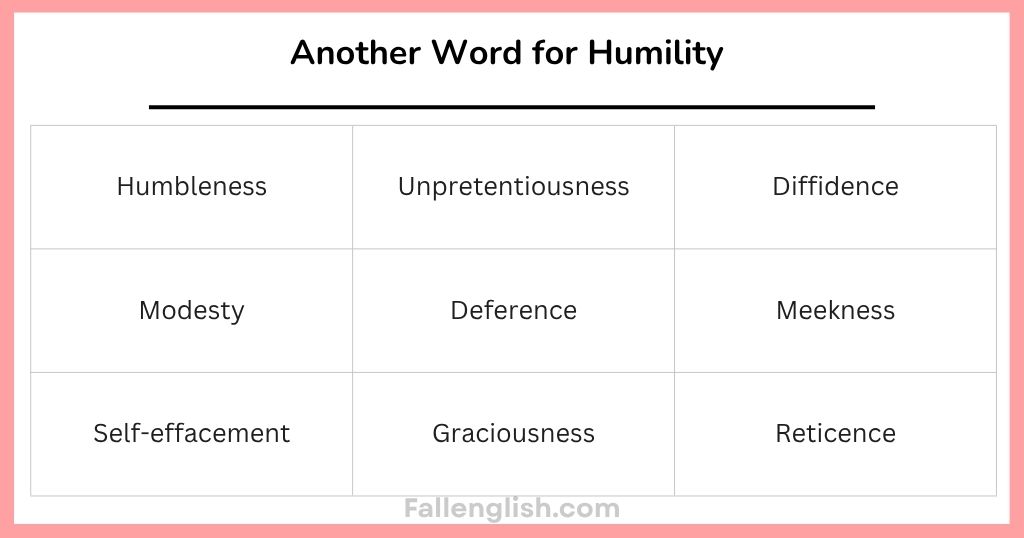
Humbleness is the closest parallel to humility in this sense, though it tends to feel slightly warmer and less formal. His humbleness after the championship surprised reporters. It works well in spoken and personal writing; in philosophical or formal contexts, humility usually reads better.
Modesty overlaps significantly here but tilts toward behavior rather than inner character. A modest person does not show off. A humble person does not think too highly of themselves. The difference is subtle but real: you can act modestly without being humble at heart, and a genuinely humble person might not even think of their behavior as modest.
Self-effacement captures the active side of this virtue — deliberately keeping yourself out of the spotlight. It implies a choice more than a trait, and can sometimes suggest excessive self-erasure rather than healthy humility.
When you mean social behavior or manner
Unpretentiousness works well when you want to say someone does not perform superiority — no airs, no posturing. It describes the absence of pride rather than the presence of a virtue, which makes it slightly more neutral. A useful choice in everyday and professional writing: Her unpretentiousness made her immediately likeable.
Deference is the right word when humility is being expressed toward someone else specifically — a senior colleague, a tradition, an expert. It implies respectful yielding. You would not use it for general humility, only for directed humility: He spoke with deference to the older architects in the room.
Graciousness sometimes serves as a near-synonym in social contexts, particularly when someone accepts praise or criticism without self-promotion. It adds warmth that humility does not always carry.
When you mean self-doubt or hesitancy
Diffidence describes someone who holds back, underestimates themselves, or lacks confidence in expressing opinions. It shares surface features with humility but the emotional territory is different: a diffident person may wish they could speak up, while a humble person may simply choose not to. Using diffidence as a synonym for humility risks implying weakness where the original word did not.
Meekness sits close to humility in religious and ethical writing, but in everyday use it has softened (or weakened, depending on your view) to suggest passivity or timidity. The meek shall inherit the earth uses it as a virtue; She accepted the criticism meekly can read as slightly sad. Worth using carefully.
Reticence describes a reluctance to speak or draw attention, which overlaps with humble behavior but comes from a different root — it is about verbal restraint, not character.
Alternatives That Look Similar But Can Mislead
Self-deprecation is often confused with humility, but it is specifically the habit of putting yourself down, sometimes humorously. Genuine humility does not require self-criticism; it simply does not require self-promotion. Calling someone self-deprecating when you mean humble can imply they talk themselves down, which is a different thing.
Submissiveness is not a synonym for humility. It describes yielding to external pressure or authority, often without the voluntary, virtuous quality that humility implies. Using it as a replacement can unintentionally suggest a person lacks agency.
Servility is further still — it implies an almost compulsive deference that has nothing in common with the positive qualities humility describes. Avoid it as a replacement.
How Context Changes the Best Choice
| Situation | Best Alternative | Why |
| Academic or philosophical writing | Humility itself, or humbleness | These carry the right weight and precision |
| Describing someone’s social manner | Modesty or unpretentiousness | More natural; focused on behavior |
| Religious or spiritual writing | Meekness or lowliness | Appropriate register; traditional usage |
| Workplace or professional context | Deference, modesty | Clear, non-charged language |
| Describing hesitancy or underconfidence | Diffidence | More accurate than misusing humility |
| Creative or character writing | Humbleness, self-effacement | Emotionally richer; more personal |
Collocations Worth Checking
Not every alternative slots naturally into the same phrases humility does:
- intellectual humility → intellectual modesty works; intellectual meekness does not
- a show of humility → a show of modesty or a show of deference both work well
- humility before God → meekness, reverence, or deference fit better here
- genuine humility → genuine modesty works; genuine diffidence changes the meaning
- false humility → false modesty is the natural phrase; false humbleness sounds slightly unnatural
Read more:
Another Word for Loud: Choosing the Right Word for Noise, Voice, and Volume
Another Word for Family: Alternatives That Actually Fit What You Mean
A Practical Note on Tone
Humility carries a quiet dignity. Most of its alternatives tilt the sentence in some direction — either softer (meekness, diffidence), more behavioral (modesty, unpretentiousness), or more relational (deference, graciousness). If you want to preserve humility’s sense of internal strength without self-congratulation, modesty or humbleness will serve you best in most general writing. If the humility is directed outward — toward a person, a tradition, or an authority — deference is probably the sharper word.
The goal is not to find a word that sounds similar. It is to find the one that keeps the meaning intact while giving you the tone or emphasis you actually want.

FallEnglish is run by a language enthusiast who explains word and text meanings in clear, simple ways. Each guide is carefully researched, original, and written to help real people understand language faster, with accuracy, context, and everyday examples you can trust.