

The word deeper does a lot of work in English — it describes physical distance, emotional intensity, intellectual complexity, and more — which is exactly why a single replacement rarely fits every situation.
Quick Answer
The most useful alternatives depend on what deeper is modifying:
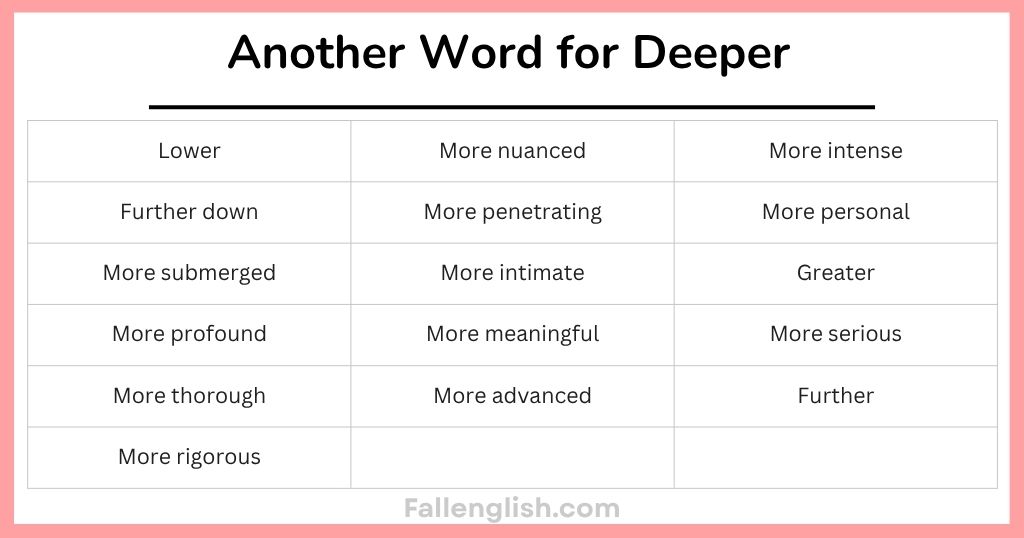
- For physical or spatial depth: lower, further down, more submerged
- For intellectual or analytical depth: more profound, more rigorous, more thorough
- For emotional or relational depth: more intimate, more meaningful, more intense
- For degree or extent: greater, more advanced, more serious
None of these are interchangeable across all contexts. The sections below explain which fits where.
What Makes Deeper Tricky to Replace
Deeper is the comparative form of deep, and deep carries at least four distinct senses. Before choosing a replacement, identify which sense you’re working with:
| Sense | Example | What you’re really saying |
| Physical | deeper water | greater vertical distance downward |
| Intellectual | deeper analysis | more thorough, more penetrating thinking |
| Emotional | deeper connection | greater emotional closeness or intensity |
| Degree/severity | deeper trouble | a more serious or advanced state |
Choosing the wrong alternative often happens when writers borrow from one sense and apply it to another.
Another Word for Deeper by Sense
Physical or Spatial
When deeper describes literal downward distance or submersion, your options are limited but precise.
Lower works when the emphasis is on vertical position rather than the distance itself. The pipe runs lower than we expected focuses on where it sits; the pipe runs deeper than we expected emphasizes the extent of distance.
Further down is natural in spoken or informal writing and avoids ambiguity when the direction matters. Further down the shaft, further down the channel.
More submerged works specifically for objects in liquid or buried in a surface. It would sound wrong in most other physical contexts.
Intellectual or Analytical Another Word for Deeper
This is where writers most often reach for a replacement — and where the most meaningful distinctions exist.
More profound raises the stakes. It implies the analysis touches on something fundamental or important, not just that it is more detailed. A more profound examination of the data suggests the insight is significant, not merely thorough. Overusing it makes writing feel inflated.
More thorough is the safest, clearest replacement for deeper when you mean more careful and complete. It makes no claims about importance — only about completeness. Useful in academic, professional, and instructional writing.
More rigorous emphasizes method and discipline. It suits scientific writing, policy analysis, and academic contexts where the standard of evidence or process matters. A more rigorous approach tells the reader that assumptions are tested, not just that more was covered.
More nuanced shifts the focus from quantity of detail to quality of distinction-making. A deeper reading of a poem could mean many things; a more nuanced reading means the writer is catching subtleties that a surface reading misses.
More penetrating is slightly formal and works well for describing analysis, criticism, or questioning. A more penetrating question is one that gets past the obvious. It carries a mild sense of sharpness or incision.
Quick comparison:
| Word | Best for | Tone |
| More thorough | Complete, careful coverage | Neutral, professional |
| More rigorous | Methodical, evidence-based | Academic, formal |
| More profound | Significant insight | Elevated, sometimes literary |
| More nuanced | Subtle distinction-making | Intellectual, careful |
| More penetrating | Sharp, incisive questioning or criticism | Formal, slightly literary |
Emotional or Relational Another Word for Deeper
More intimate works when deeper describes closeness between people. A deeper relationship and a more intimate relationship are close, but intimate adds a sense of personal disclosure or closeness that deep does not necessarily carry.
More meaningful shifts the focus to significance rather than intensity. You might have a brief but meaningful conversation, whereas deep often implies sustained engagement.
More intense describes emotional force rather than emotional closeness. A deeper feeling could be quiet and settled; a more intense feeling is active and heightened. These are not the same thing.
More personal works when deeper describes disclosure — sharing more of yourself, moving past formality. The conversation became more personal is often a natural substitute for the conversation went deeper.
Degree or Severity
When deeper describes how far into trouble, complexity, or difficulty something has gone, these alternatives work:
Greater is often the cleanest substitution. Deeper understanding → greater understanding. Deeper concern → greater concern. It avoids the spatial metaphor entirely and suits formal prose.
More serious fits when deeper describes a worsening situation. Deeper debt, deeper crisis → more serious debt, more serious crisis. This is clearer in plain-language writing.
More advanced works in progressive contexts — stages of learning, disease, skill, or process. Deeper into the course → further into the course or at a more advanced stage.
Further (not farther) is often the most natural replacement when deeper suggests progress along a path or process. Deeper into the research → further into the research. Deeper into the conversation → further into the conversation. This works in both formal and informal registers.
A Difference Worth Knowing: Deeper vs. Further
In many sentences, further and deeper compete for the same slot.
We need to go deeper into this question.
We need to go further into this question.
Both work, but they imply different things. Deeper uses a vertical spatial metaphor — it suggests layers beneath the surface. Further uses a horizontal one — it suggests more ground to cover. In intellectual and analytical writing, deeper often sounds more penetrating; further sounds more expansive. The choice is subtle, but it is real.
Deeper Synonyms in Sentences That Show the Difference
The study required a deeper analysis of the survey results.
→ Suggests getting beneath the obvious patterns.
The study required a more thorough analysis of the survey results.
→ Suggests covering more of the data carefully.
The study required a more rigorous analysis of the survey results.
→ Suggests tighter methodology and testing of assumptions.
These three sentences are not interchangeable. Each makes a different claim about what was missing from the original analysis.
One Common Mistake
Writers sometimes replace deeper with more in-depth to avoid repetition, but in-depth is an adjective, not a comparative. A more in-depth look is grammatically fine, but it is wordier than it needs to be, and more thorough or more detailed usually says the same thing more cleanly.
Read more:
Another Word for Toxic: Choosing the Right Alternative for What You Mean
Another Word for Division: Alternatives for Every Meaning
Choosing the Right Word
If you are describing physical distance, use lower, further down, or more submerged — not more profound.
If you are writing analytically, the choice between thorough, rigorous, nuanced, and penetrating depends on what specifically was insufficient: coverage, method, subtlety, or sharpness.
If you are writing about relationships or emotion, the choice between intimate, meaningful, personal, and intense depends on whether you mean closeness, significance, disclosure, or force.
If you mean degree or progression, further, greater, or more serious will almost always read more clearly than trying to carry the spatial metaphor of deeper into an abstract sentence.
The replacement that works is not the most impressive-sounding one. It is the one that preserves exactly what you meant — and nothing extra.

FallEnglish is run by a language enthusiast who explains word and text meanings in clear, simple ways. Each guide is carefully researched, original, and written to help real people understand language faster, with accuracy, context, and everyday examples you can trust.