

Seamless does a lot of work in modern writing — sometimes too much. If it’s starting to feel vague, overused, or slightly hollow in your sentence, here’s how to replace it well.
Quick Answer
The right alternative depends on what seamless is actually doing in your sentence. The word carries at least three distinct meanings:
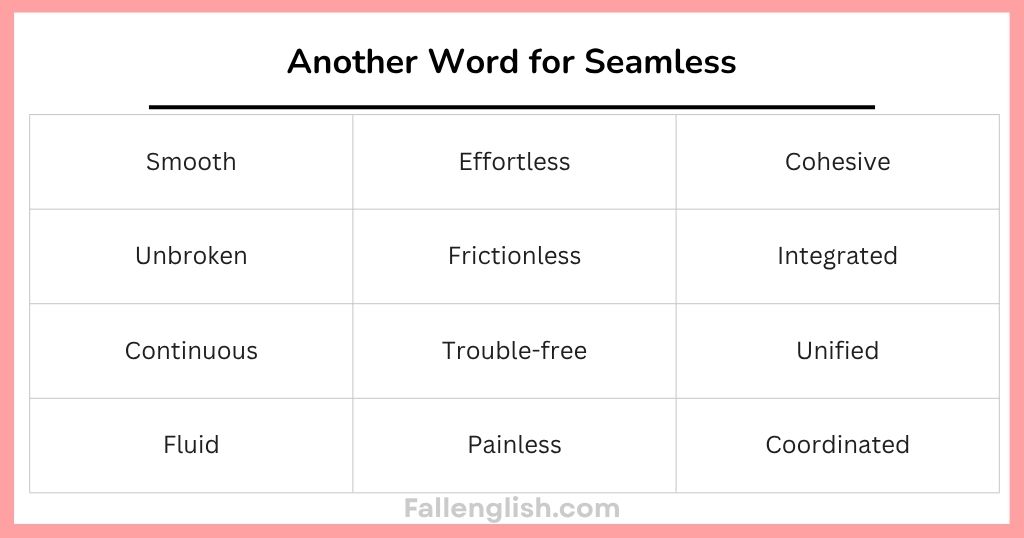
- No visible joins or interruptions → smooth, unbroken, continuous, fluid
- No friction or difficulty → effortless, frictionless, trouble-free
- Well-coordinated, no gaps between parts → cohesive, integrated, unified, coordinated
None of these are pure synonyms. Each pulls in a slightly different direction.
The Problem with “Seamless”
Seamless originally described fabric with no stitched seams. Its figurative life has been so successful that it now appears in tech writing, marketing, business communication, UX copy, and everyday conversation — often without doing precise work. When a reader sees seamless experience, seamless integration, or seamless transition, they understand the general intention but may not feel the meaning.
That vagueness is usually why a writer looks for an alternative: not because the word is wrong, but because it has been worn smooth by repetition.
Another Word for Seamless by Meaning
When you mean: no interruptions, no breaks
| Word | What it adds | Works naturally with |
| smooth | Easy progress, no rough patches | transition, process, journey, ride |
| unbroken | Continuous, nothing missing | line, sequence, record, silence |
| continuous | No pauses or gaps | flow, coverage, supply, effort |
| fluid | Natural movement, adapts easily | motion, style, conversation, shift |
Smooth is the closest all-purpose replacement for seamless in most sentences. It works in both literal and figurative contexts and sounds natural in professional and casual writing alike.
Fluid implies something more adaptive — not just uninterrupted, but responsive. A fluid conversation adjusts to its participants; a seamless conversation simply has no awkward breaks. The difference is subtle but real.
Unbroken tends toward the literal or the emphatic. It works well when the continuity itself is the point: an unbroken chain of custody, an unbroken run of victories.
When you mean: no effort, no friction
| Word | What it adds | Works naturally with |
| effortless | Looks natural, requires no strain | performance, grace, style, delivery |
| frictionless | No resistance or obstacles | checkout, process, onboarding |
| trouble-free | Practical, no problems | installation, journey, operation |
| painless | Slight informality; removal of what was expected to hurt | process, procedure, switch |
Effortless describes the impression something creates — it looks easy, whether or not it was. A seamless performance describes continuity; an effortless performance describes grace. Writers who want to compliment a speaker or athlete often want effortless rather than seamless.
Frictionless is the preferred term in product design, UX, and fintech. If seamless has become a cliché in your industry, frictionless is the current preferred term — though it is following a similar trajectory.
Painless is informal and slightly self-aware. It works when the writer wants to acknowledge that a process could have been difficult: a surprisingly painless migration.
When you mean: well-coordinated, no gaps between parts
| Word | What it adds | Works naturally with |
| cohesive | Parts feel like they belong together | design, team, narrative, strategy |
| integrated | Systems or parts are connected and working together | platform, system, approach, solution |
| unified | Single, consistent direction or identity | front, message, vision, experience |
| coordinated | Parts are aligned in timing or action | response, effort, rollout, campaign |
These alternatives work when seamless describes how multiple components relate rather than how something feels in motion.
Cohesive is the strongest choice for creative work — design, writing, branding — where the goal is that parts feel like they belong together aesthetically. Integrated fits technical and business contexts where systems or teams are linked. Unified stresses shared purpose or identity. Coordinated emphasizes timing and deliberate alignment.
Another Word for Seamless That Look Similar But Aren’t
Seamless ≠ perfect
Seamless describes continuity or the absence of friction, not flawlessness. A process can be seamless and still produce an imperfect result. Don’t use seamless when you mean flawless, polished, or precise — and don’t replace seamless with those words if continuity is what you actually mean.
Seamless ≠ invisible
In UX writing, seamless often implies that the technology disappears from the user’s awareness. Invisible or transparent (in its technical sense) makes that meaning more direct: a transparent handoff between systems or invisible to the end user.
Seamless ≠ automatic
A seamless process may still require human action. Automated or automatic should only replace seamless when the process genuinely runs without intervention.
How Context Changes the Right Choice
In business writing: The transition to the new system was seamless → The transition to the new system was smooth or trouble-free reads more plainly. Cohesive or integrated works better when describing how departments or platforms connect.
In UX and product copy: Seamless has become filler. Frictionless, intuitive, or a concrete description (complete checkout in two taps) often communicates more than the abstraction.
In design or creative writing: Cohesive earns its place when describing visual or narrative unity. Fluid works for transitions in storytelling or choreography. Smooth handles most other needs.
In everyday speech: Seamless rarely sounds natural spoken aloud. Easy, smooth, no hassle, or went without a hitch tend to sound more natural in conversation.
Read also:
Another Word for Impact: Choosing the Right Alternative for Every Context
Another Word for Ideology: Alternatives That Actually Fit
A Practical Test
Before replacing seamless, ask what it is actually doing in the sentence:
- If it means the process moved without interruption → smooth or continuous
- If it means parts fit together well → cohesive or integrated
- If it means something required no effort → effortless or frictionless
- If it means no problems occurred → trouble-free or without a hitch
- If it means the technology or mechanism disappeared → invisible or transparent
The best replacement will be the word that names what you actually observed — not what you hoped the reader would feel.

FallEnglish is run by a language enthusiast who explains word and text meanings in clear, simple ways. Each guide is carefully researched, original, and written to help real people understand language faster, with accuracy, context, and everyday examples you can trust.