

The word ideology carries a lot of weight — political, philosophical, and sometimes dismissive — and writers often need an alternative that fits a narrower or less loaded meaning.
Quick Answer
The most useful alternatives depend on what you mean:
- Belief system — the clearest general replacement for most writing
- Worldview — personal or philosophical perspective
- Doctrine — organized, authoritative set of principles
- Creed — core convictions, often moral or religious in character
- Framework — preferred in academic, analytical, or neutral contexts
- Philosophy — broader personal or intellectual outlook
- Set of values — informal, plain-language alternative
No single word replaces ideology in every context. The right choice depends on whether you mean organized political beliefs, a personal perspective, a formal doctrine, or simply the lens through which someone sees the world.
What “Ideology” Actually Means (And Why It Matters Here)
Ideology has at least three distinct senses in common use:
1. A political or social belief system — “left-wing ideology,” “the ideology of nationalism”
2. A guiding philosophy held by a group or organization — “the company’s ideology of growth at all costs”
3. A rigid or distorted set of beliefs (often used critically) — “blinded by ideology”
The third sense is the problem. When you write ideology, some readers hear criticism — a suggestion that the beliefs are rigid, extreme, or disconnected from reality. If that isn’t what you intend, a different word prevents the misreading.
Another Word for Ideology by Meaning
When you mean a personal or philosophical outlook
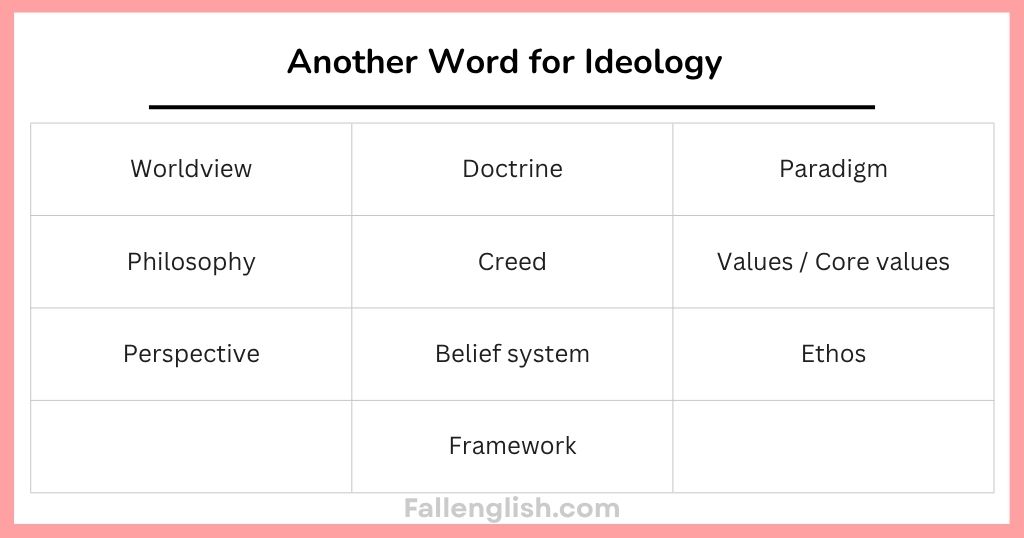
Worldview fits when the focus is on how an individual or group interprets reality — their assumptions about human nature, society, or meaning. It sounds neither clinical nor political.
Her worldview was shaped more by loss than by any political theory.
Philosophy works when the emphasis is on reasoned thinking rather than organized doctrine. It suggests reflection rather than allegiance.
The team operated on a philosophy of radical transparency.
Perspective is lighter still — useful when you want to acknowledge a point of view without implying a structured belief system at all.
When you mean organized principles held by a group
Doctrine is the right word when a set of beliefs has been formally stated and is expected to guide behavior. It is common in religious, military, and political contexts.
The party’s doctrine made compromise difficult.
Doctrine carries an air of authority and inflexibility. That is sometimes exactly what you want — but avoid it when you mean something more open-ended.
Creed emphasizes the core convictions a person or group holds most deeply. It has religious origins but works in secular contexts when you want to convey genuine personal commitment.
Their creed was simple: work hard, waste nothing, trust no one who hasn’t earned it.
Belief system is the safest general replacement. It is neutral, clear, and readable. When in doubt, this phrase works.
When you mean a conceptual lens or analytical framework
Framework is useful in academic writing, journalism, and analysis when you mean the structure of assumptions through which someone interprets events.
She examined the data through a Marxist framework.
Framework is more clinical than ideology — it describes a tool for thinking rather than a set of convictions. That neutrality is often an advantage.
Paradigm belongs in academic and intellectual writing. It refers to the dominant model or pattern of thinking within a discipline or era. Use it when you mean a widespread, foundational way of seeing things — not a personal stance.
The scientific paradigm shifted dramatically in the early twentieth century.
Avoid paradigm in casual writing. Outside academic or intellectual contexts, it often reads as jargon.
When you mean values or principles in a business or organizational context
Values or core values has become the standard in organizational writing. It is warmer and less politically charged than ideology.
The company’s values placed sustainability above short-term profit.
Ethos suits contexts where you want to capture the overall character and spirit of an organization or culture, not just its stated principles.
The startup had an ethos of irreverence that attracted unconventional thinkers.
The Tone Problem With “Ideology”
In political and journalistic writing, ideology is often used to draw a contrast — implying that the other side follows a fixed script while “we” respond to facts. Phrases like ideological rigidity and driven by ideology are almost always critical.
If you are writing analytically and want to stay neutral, belief system, framework, or worldview removes the implied criticism. If you intend the critical tone — if you mean that someone’s thinking is inflexible or detached from evidence — ideology may actually be the most honest word.
Another Word for Ideology That Look Similar but Behave Differently
Dogma — Similar in feel to doctrine, but stronger. It implies beliefs that are accepted without question and cannot be challenged. Use it when you mean intellectual rigidity, not organized belief in general.
Agenda — Sometimes used loosely to mean ideology, but agenda implies a plan or goal, not a belief system. “They have an agenda” suggests strategic intent; “they have an ideology” suggests a worldview. These are different accusations.
Narrative — Popular in political commentary, but it refers to the story used to explain or justify events, not the underlying beliefs themselves. The ideology comes first; the narrative serves it.
Read more:
Another Word for Variety: Alternatives That Actually Fit Your Meaning
Another Word for Impact: Choosing the Right Alternative for Every Context
Choosing Another Word for Ideology in Practice
| You’re writing about… | Better choice |
| Someone’s personal view of the world | worldview, perspective |
| An organized religion or political party’s formal beliefs | doctrine, creed |
| Academic or analytical writing | framework, paradigm |
| Business or organizational culture | ethos, values |
| General, neutral use | belief system |
| Intellectual inflexibility (critical tone intended) | dogma, or keep ideology |
The most useful test: ask whether you mean what someone believes or how rigidly they believe it. That distinction usually points to the right word. Ideology is not wrong — it is often precise — but when it imports a tone you did not intend, the alternatives above let you say exactly what you mean.

FallEnglish is run by a language enthusiast who explains word and text meanings in clear, simple ways. Each guide is carefully researched, original, and written to help real people understand language faster, with accuracy, context, and everyday examples you can trust.