

You write the sentence. You read it back. “Faced” sits there looking perfectly fine, and yet something feels off. Not wrong exactly. Just… empty. Like the word showed up but didn’t bring anything with it.
That’s the real problem with overusing “faced.” It works in almost every situation, which means it adds almost nothing to any of them. It doesn’t tell the reader whether your subject resisted, endured, chose to engage, or simply stumbled into something. The reader gets the bare fact. Nothing more.
One word swap can change all of that. This guide gives you 34+ vetted alternatives, grouped by what they actually mean, with real examples and honest guidance on when each one earns its place.
What “Faced” Is Really Doing in Your Sentence
“Faced” covers four very different situations, and that’s exactly why it gets overused:
- Simply coming across something (a problem, a person, a moment)
- Actively opposing or resisting something with effort
- Enduring or suffering something over time
- Physically turning toward a direction or space
Swapping the word without knowing which meaning you’re working with is how writers end up with replacements that technically fit but feel wrong. So before you reach for a synonym, pin down which of these four you actually mean.
The Full Another Word for “Faced” Table: 34+ Alternatives
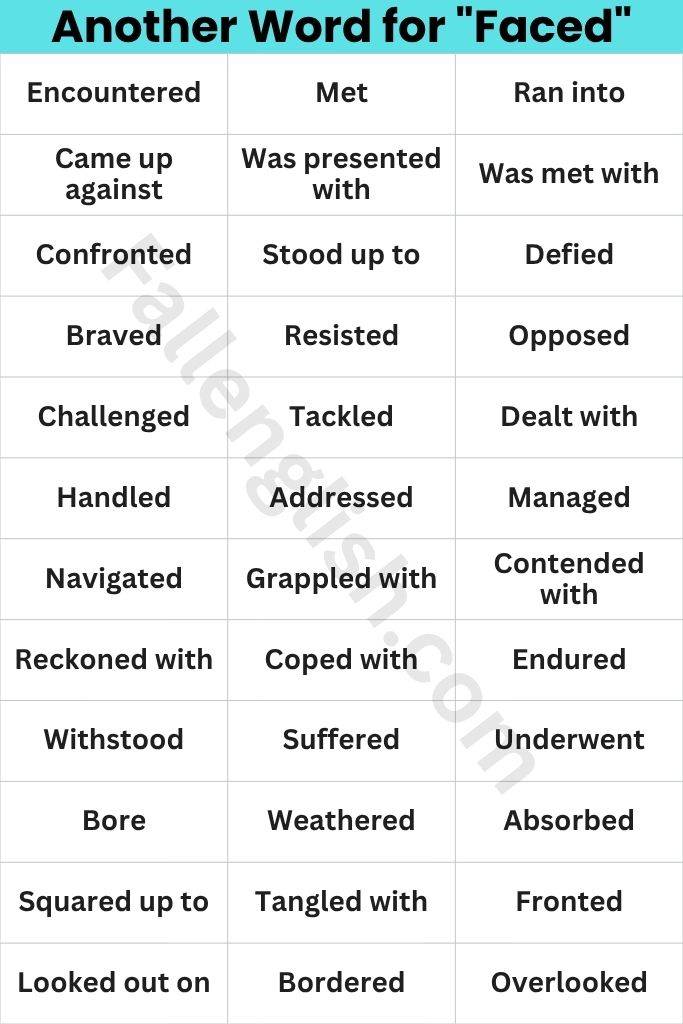
| Met | Simple, neutral | Basic meetings or discoveries |
| Ran into | Casual | Something unexpected, unplanned |
| Came up against | Slightly tense | Hitting a wall or barrier |
| Was presented with | Formal, passive | A situation arrived without being chosen |
| Was met with | Passive, neutral | The reaction or situation came toward the person |
| Confronted | Sharp, direct | Actively opposing something or someone |
| Stood up to | Assertive | Refusing to back down under pressure |
| Defied | Bold | Breaking expectations or resisting force |
| Braved | Courageous | Moving forward despite real fear or danger |
| Resisted | Oppositional | Pushing back against external force |
| Opposed | Firm, formal | Taking a clear position against something |
| Challenged | Two-sided | Either questioned something, or was questioned |
| Tackled | Active, energetic | Going at a problem with visible effort |
| Dealt with | Practical | Managing something step by step |
| Handled | Competent, calm | Resolving something efficiently |
| Addressed | Formal | Giving deliberate attention to an issue |
| Managed | Neutral-formal | Maintaining control through difficulty |
| Navigated | Skillful | Moving through something complex or layered |
| Grappled with | Raw, honest | Struggling without an easy answer |
| Contended with | Formal | Dealing with sustained difficulty over time |
| Reckoned with | Serious | Acknowledging something unavoidable |
| Coped with | Personal, emotional | Managing mentally or emotionally |
| Endured | Heavy, formal | Surviving something long and painful |
| Withstood | Resistant, strong | Holding firm against external pressure |
| Suffered | Emotional | Felt the real negative weight of something |
| Underwent | Passive, formal | Went through a process or change |
| Bore | Literary | Carried a burden with quiet strength |
| Weathered | Resilient | Survived without breaking under strain |
| Absorbed | Controlled, internal | Took the impact without visible reaction |
| Squared up to | Informal | Preparing mentally to take something on |
| Tangled with | Casual, vivid | Got involved in conflict or difficulty |
| Fronted | Physical, formal | Literally positioned in front of something |
| Looked out on | Descriptive | Facing a landscape or view |
| Bordered | Structural | Located next to or alongside something |
| Overlooked | Directional | Positioned above and facing outward |
Faced Synonym Meaning Clusters: The Grouping That Actually Helps
Coming Across Something Without Drama
When nothing dramatic happened, and you just want to report the moment clearly, reach for one of these: encountered, met, ran into, came up against, was presented with, was met with.
These are clean and emotionally neutral. No blame, no heroism, no judgment.
“The research team encountered a gap in the existing data.” That’s it. Simple and honest.
“She was met with silence when she walked into the room.” Here the situation came to her. The passive form shifts the weight naturally.
Use these in journalism, reports, summaries, or anywhere you want the reader to draw their own conclusions.
Actively Opposing or Resisting Faced Synonym
These words carry intention. The person didn’t just experience something. They pushed back.
Confronted, stood up to, defied, braved, resisted, opposed, challenged, tackled
“He confronted the committee about the missing records.” That word tells you he walked in ready. There was purpose behind it.
“She defied the pressure to stay quiet.” Bold. Clean. The resistance is built right into the word.
“The crew braved deteriorating conditions to complete the mission.” “Braved” carries both fear and courage at once. It’s doing double work in one syllable.
These are not interchangeable. “Tackled” has rolling-up-your-sleeves energy. “Opposed” has boardroom formality. “Stood up to” has a personal, emotional backbone. Pick based on who your subject is and what they were actually doing.
Enduring Something Over Time Faced Synonym
Some things are not chosen. They happen. These words respect that difference.
Endured, withstood, suffered, underwent, bore, weathered, absorbed
“The villagers endured weeks of flooding before relief arrived.” The word holds length and weight at the same time.
“She bore the criticism quietly and kept working.” Literary, controlled. There is dignity in that word.
“The old structure withstood every storm that season.” Resistance is the core meaning here. Something pushed and nothing broke.
A quick note on “suffered”: it signals real harm or loss. Use it carefully. “The project suffered a delay” is acceptable in business writing. “He suffered a mild email error” reads as overreach.
Taking Responsibility and Acting Faced Synonym
These words move toward resolution, not just survival.
Addressed, dealt with, handled, managed, navigated, grappled with, contended with, coped with, reckoned with
“The director addressed the concerns raised by staff directly.” Formal. Action-oriented. The word implies nothing was swept aside.
“She navigated the tension between both teams without taking sides.” Intelligence is embedded in that word. It’s not just managing. It’s moving through something with skill.
“He grappled with the decision for days before committing.” This one doesn’t pretend the answer was easy. That honesty lands with readers.
“Reckoned with” carries particular weight. It means something could no longer be avoided or dismissed. “A challenge she had long reckoned with” tells you this wasn’t new, and it wasn’t light.
Physical Direction and Location Faced Synonym
When “faced” is literal, meaning a building, room, or window pointing toward something, the replacements are more specific and more visual.
Fronted, looked out on, bordered, overlooked
“The farmhouse looked out on open fields that stretched to the treeline.” Far more visual than “faced the fields.”
“The hotel overlooked the harbor from the third floor.” Directional, precise, grounded.
Use these in travel writing, architecture descriptions, real estate copy, or any scene-setting moment where geography matters.
Another Word for “Faced” in Sentence Rewrites That Show the Difference
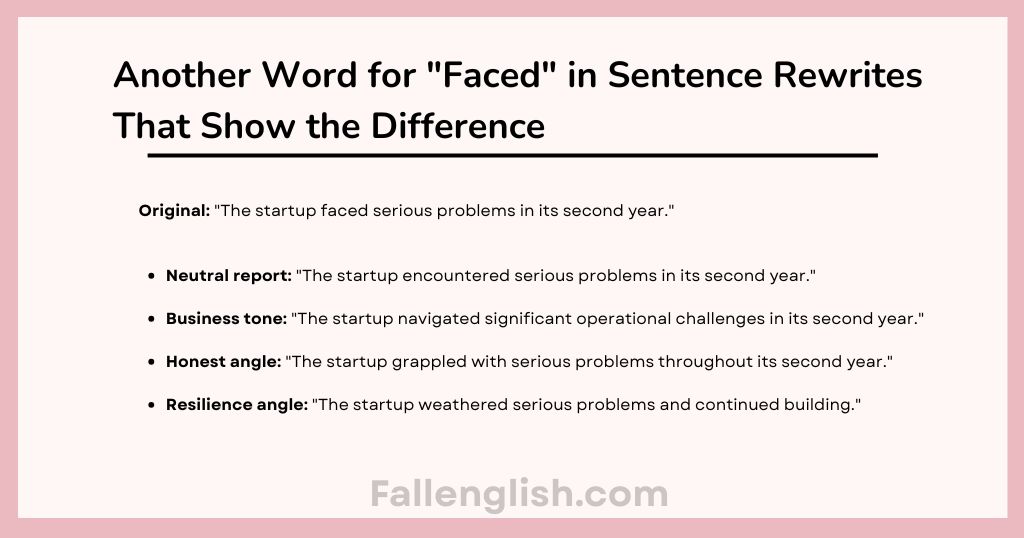
Original: “The startup faced serious problems in its second year.”
- Neutral report: “The startup encountered serious problems in its second year.”
- Business tone: “The startup navigated significant operational challenges in its second year.”
- Honest angle: “The startup grappled with serious problems throughout its second year.”
- Resilience angle: “The startup weathered serious problems and continued building.”
None of these change the facts. All of them change what the reader thinks of the company.
Original: “She faced her fear and walked onto the stage.”
- Vivid: “She braved her fear and walked onto the stage.”
- Literary: “She squared up to the fear she had carried for years and stepped forward.”
- Direct: “She confronted her fear and walked out anyway.”
“Braved” softens slightly. “Confronted” sharpens. “Squared up to” adds personal history. Same moment, three different characters.
Original: “The town faced years of economic decline.”
- Formal: “The town endured years of economic decline.”
- Resilient: “The town weathered years of economic decline.”
- Heavy: “The town suffered years of economic decline.”
- Resistant: “The town withstood years of economic decline.”
“Endured” emphasizes length. “Weathered” suggests survival. “Suffered” puts the pain first. “Withstood” implies the town didn’t fold. Choose based on the story you’re telling about that place.
Another Word for “Faced” Formal vs. Casual: Which Words Belong Where
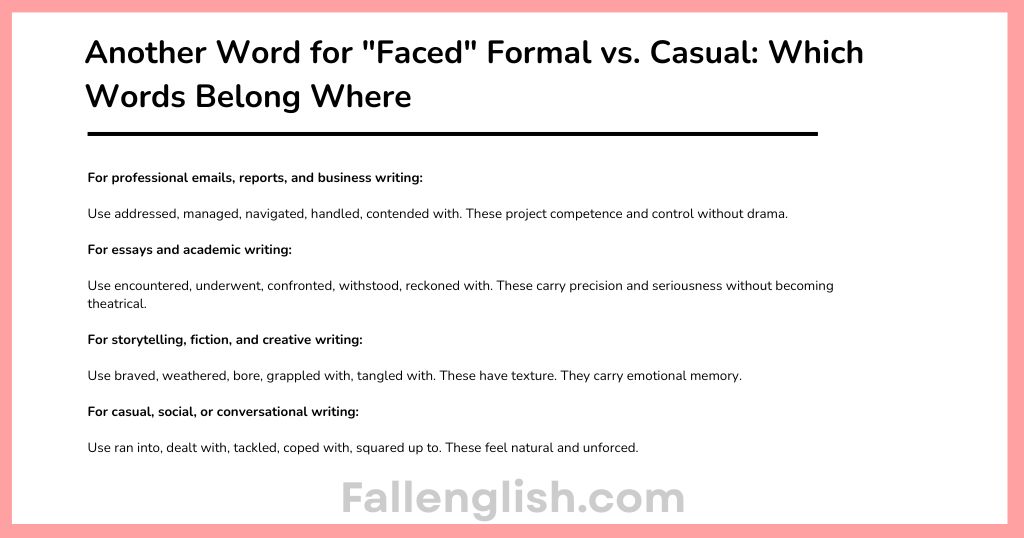
For professional emails, reports, and business writing:
Use addressed, managed, navigated, handled, contended with. These project competence and control without drama.
For essays and academic writing:
Use encountered, underwent, confronted, withstood, reckoned with. These carry precision and seriousness without becoming theatrical.
For storytelling, fiction, and creative writing:
Use braved, weathered, bore, grappled with, tangled with. These have texture. They carry emotional memory.
For casual, social, or conversational writing:
Use ran into, dealt with, tackled, coped with, squared up to. These feel natural and unforced.
Words to keep out of formal writing: ran into, tangled with, squared up to. They belong in conversation. In a report, they lose credibility fast.
Faced Synonym Mistakes Writers Make When Replacing “Faced”
Using “suffered” too loosely. It implies genuine harm. “The team suffered a scheduling conflict” sounds overdramatic. Use “dealt with” or “navigated” for minor friction.
Using “confronted” for neutral moments. “She confronted a beautiful morning” doesn’t land. “Confronted” needs something resistant or difficult on the other end.
Forgetting grammar when swapping. “Faced criticism” becomes “was met with criticism” not “was endured criticism.” Some replacements need a structural change, not just a word change.
Choosing heavy words for light events. “He braved the checkout line” reads as sarcasm unless your tone is deliberately playful. Reserve weight words for situations that carry real stakes.
Treating hardship words as identical. “Endured,” “withstood,” “weathered,” and “suffered” all deal with difficulty, but each one is doing something different. Endured is about time. Withstood is about resistance. Weathered is about survival. Suffered is about pain. They are not interchangeable.
Faced Synonym Related Words That Expand Your Range
Grappled with vs. dealt with: “Dealt with” signals control and resolution. “Grappled with” admits the struggle was real and maybe ongoing. One sounds efficient. The other sounds human.
Reckoned with: This phrase says something was too significant to ignore or sidestep. It carries a sense of inevitability. Use it for heavy, long-standing challenges.
Contended with: More formal than “dealt with.” Best used in writing where the difficulty was sustained and complex, not just a single moment.
Weathered: It carries time inside it. The difficulty was real, it went on, and something came through the other side intact. Quiet but powerful.
Bore: Literary and understated. It’s the word for someone who carried difficulty with dignity rather than complaint. It belongs in prose that rewards a careful reader.
Read more –
69+ Another Word for Audit: Smarter Alternatives for Every Context
41+ Another Word for “In Which”: Smarter Alternatives for Every Writing Style
34+ Another Word for Vampire: Names, Synonyms, and What They Really Mean
FAQ’s Another Word for “Faced”
Q: Is “confronted” always a strong upgrade over “faced”?
No. “Confronted” brings active opposition with it. If nothing was actually being opposed, it overstates the situation. “She confronted her to-do list” sounds unintentionally funny. Match the intensity of the word to the intensity of the moment.
Q: What separates “tackled” from “handled”?
Effort versus control. “Tackled” suggests visible energy, maybe even some difficulty in the process. “Handled” suggests smooth, competent resolution. If the task was easy, say “handled.” If it took real work, say “tackled.”
Q: Can “withstood” and “endured” ever be swapped?
Sometimes, but they lean differently. “Withstood” is about resistance, holding firm against something that pushed. “Endured” is about duration, staying with something painful over time. A soldier might withstand an attack but endure a long campaign.
Q: When should I just leave “faced” as it is?
When the sentence is already clear, direct, and doing its job. Replacing words for the sake of variety creates noise, not quality. If “faced” says exactly what you mean with no loss of tone or weight, keep it.
One Final Thought
“Faced” is not a bad word. It becomes a problem only when you reach for it by habit instead of by choice.
Every sentence you write is making a small argument about what happened, who the person is, and how the reader should feel about it. The right synonym does that work quietly, without announcing itself.
Browse this list when something feels flat. Trust the cluster that matches your meaning. Then let the sentence breathe on its own.

FallEnglish is run by a language enthusiast who explains word and text meanings in clear, simple ways. Each guide is carefully researched, original, and written to help real people understand language faster, with accuracy, context, and everyday examples you can trust.