

Looking for another word for vampire that fits your story, article, or Halloween project? The best choice depends on the feeling you want to create. Some words sound ancient and mysterious, while others come from real folklore and cultural traditions. This guide explores vampire synonyms, related creatures, and regional names so you can choose a term that feels natural, accurate, and meaningful for your readers.
What Exactly Is a Vampire?
At its core, a vampire is an undead creature believed to rise from the grave and feed on the blood of the living. That’s the baseline definition. But across cultures and centuries, this idea has taken dozens of different shapes. Some versions seduce. Some destroy. Some are tragic. Some are monstrous. The word you choose signals which version you mean.
Quick-Access Vampire Synonym Table
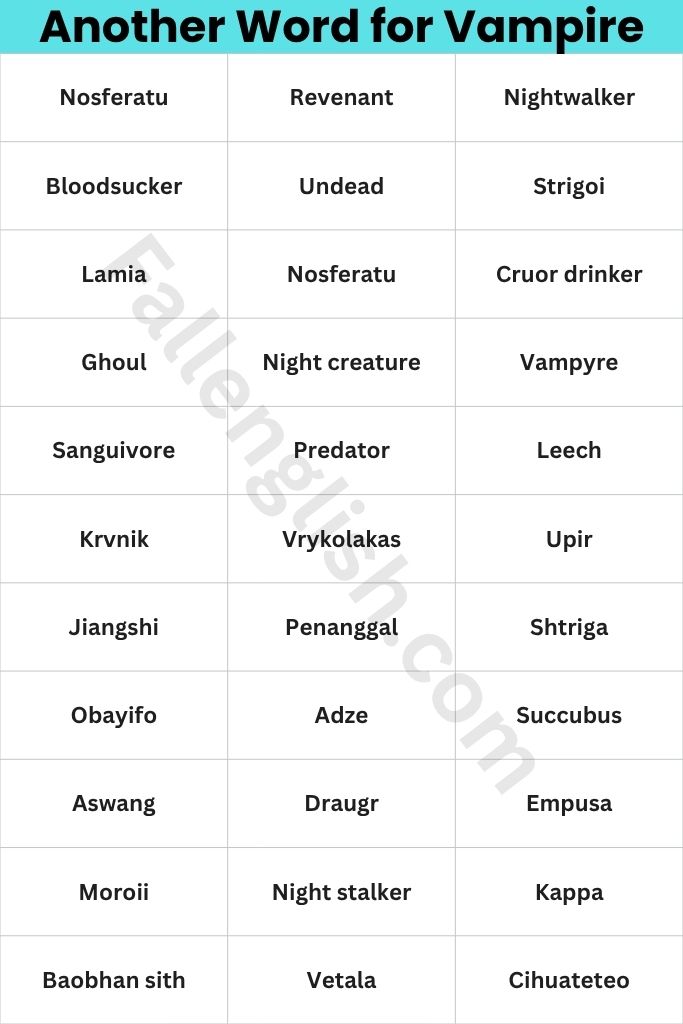
| Word | Tone | Best Used When |
| Nosferatu | Dark, archaic, eerie | Horror writing, old-world settings |
| Revenant | Literary, formal | Historical fiction, folklore essays |
| Nightwalker | Atmospheric, poetic | Fantasy, creative fiction |
| Bloodsucker | Blunt, negative | Casual speech, social criticism |
| Undead | Neutral, broad | General horror, gaming contexts |
| Strigoi | Regional, authentic | Eastern European folklore, scholarly writing |
| Lamia | Mythic, classical | Greek mythology, literary horror |
| Nosferatu | Cinematic, Gothic | Horror genre references |
| Cruor drinker | Rare, formal | Historical essays, Gothic fiction |
| Ghoul | Monstrous, grim | Horror where decay is central |
| Night creature | Vague, atmospheric | Broad supernatural storytelling |
| Vampyre | Archaic spelling | Period fiction, 19th-century style writing |
| Sanguivore | Scientific tone | Biology-adjacent fiction, academic parody |
| Predator | Neutral to cold | Action-focused scenes, non-supernatural |
| Leech | Figurative, mocking | Social commentary, metaphor |
| Krvnik | Regional, rare | Balkan folklore references |
| Vrykolakas | Cultural, precise | Greek undead tradition |
| Upir | Slavic, regional | Eastern European historical contexts |
| Jiangshi | Cultural, specific | Chinese supernatural fiction |
| Penanggal | Folkloric, eerie | Southeast Asian horror settings |
| Shtriga | Albanian, folkloric | Specific regional mythology |
| Obayifo | African, cultural | West African supernatural traditions |
| Adze | Distinct origin | Ewe folklore of Ghana and Togo |
| Succubus | Demonic, seductive | Medieval demonology, distinct origin |
| Aswang | Philippine, folkloric | Filipino horror and mythology |
| Draugr | Norse, undead | Nordic mythology, Viking settings |
| Empusa | Greek, archaic | Classical mythology references |
| Moroii | Romanian, regional | Romanian folklore distinction |
| Night stalker | Dramatic, tense | Thriller writing, informal contexts |
| Kappa | Japanese, aquatic | Japanese mythology (blood-draining version) |
| Baobhan sith | Celtic, rare | Scottish Highland folklore |
| Vetala | Hindu, ancient | Sanskrit texts, Indian mythology |
| Cihuateteo | Aztec, historical | Mesoamerican mythology, historical writing |
| Churel | South Asian | Pakistani and Indian folklore traditions |
Breaking Them Down: Vampire Synonym Meaning Clusters
Not every word here means the exact same thing. Grouping them by purpose helps you pick smarter.
The Classic Undead Category
Words like revenant, vampyre, and nosferatu all point toward the traditional idea of the dead coming back to feed. Revenant leans literary and suggests something that returned from death rather than was never alive. Vampyre is simply an older spelling, used in 19th-century Gothic literature. If you’re writing something set in that era, it adds authenticity without effort.
Nosferatu carries cinematic weight now because of the famous silent film, but originally it was used in Romanian contexts to refer to a specific type of plague-bringing vampire. Writers use it today for anything deeply sinister and old.
The Cultural Names
This group is where things get genuinely interesting. Many cultures developed their own vampire-like creatures completely independently, long before European horror fiction spread globally.
Strigoi from Romania. Vrykolakas from Greece. Upir from Slavic regions. Jiangshi from China. Aswang from the Philippines. Adze from West Africa. Vetala from ancient India.
Each of these is not just a synonym. They describe creatures with their own rules, weaknesses, and cultural meaning. A jiangshi hops and is stopped by holding your breath. A penanggal is a floating head with trailing organs. An adze possesses fireflies and preys on children.
Using these in your writing adds depth. But using them carelessly, as if they’re decorative synonyms, misrepresents real cultural traditions. If you name-drop strigoi in a horror novel, know what it actually means in Romanian belief.
Figurative and Social Vampire Synonym
Leech. Parasite. Bloodsucker. These three work when you’re not talking about supernatural creatures at all.
“The investors are leeches draining every startup they touch.”
“That policy is a parasite on the working class.”
None of these require fangs. They describe exploitative behavior using the imagery of something that takes without giving. Bloodsucker is the sharpest of the three. It’s also the most dated in formal writing, so be careful in professional contexts.
The Female-Specific Vampire Terms
Another word for vampire girl or female vampire specifically includes lamia, succubus, vampiress, shtriga, baobhan sith, and cihuateteo.
But these are not all the same thing. A succubus is a sexual demon from medieval demonology and is not technically a vampire. It feeds on energy, not blood. Lamia comes from Greek mythology and was described as a child-devouring monster, not always blood-focused.
Vampiress is the safest, most direct feminine equivalent. Use it in fiction without overthinking.
Baobhan sith comes from Scottish Highland tradition and describes female spirits that dance with men at night and then drain their blood. Deeply specific, but stunning in the right setting.
What Do You Call a Vampire in Different Languages?
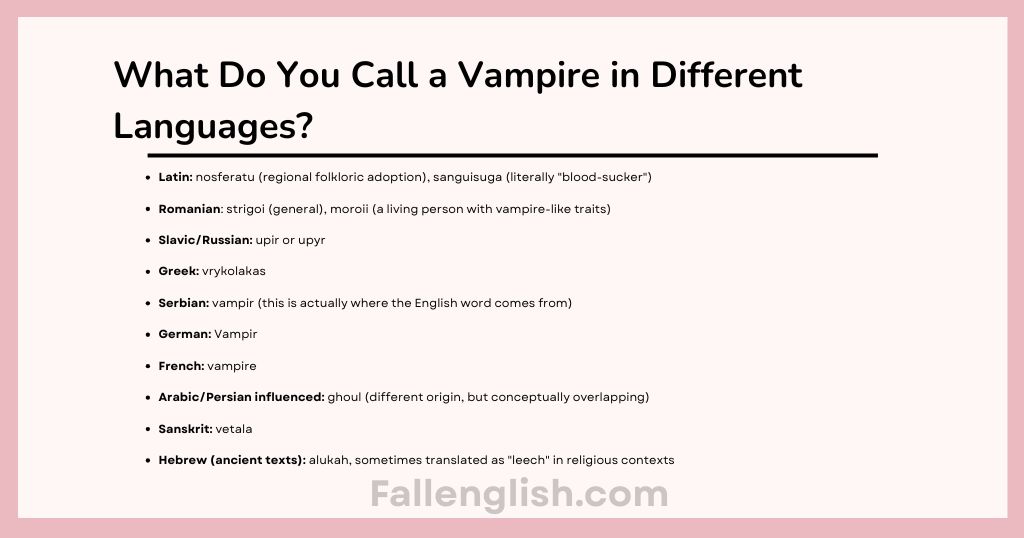
Writers sometimes need the word itself in another language, either for authenticity or naming a character.
- Latin: nosferatu (regional folkloric adoption), sanguisuga (literally “blood-sucker”)
- Romanian: strigoi (general), moroii (a living person with vampire-like traits)
- Slavic/Russian: upir or upyr
- Greek: vrykolakas
- Serbian: vampir (this is actually where the English word comes from)
- German: Vampir
- French: vampire
- Arabic/Persian influenced: ghoul (different origin, but conceptually overlapping)
- Sanskrit: vetala
- Hebrew (ancient texts): alukah, sometimes translated as “leech” in religious contexts
The English word “vampire” passed through Serbian and German before landing in English in the early 1700s. Before that, Europeans used regional names tied to local myths.
Another Word for Vampire Sentence Rewrites: Same Idea, Different Effect
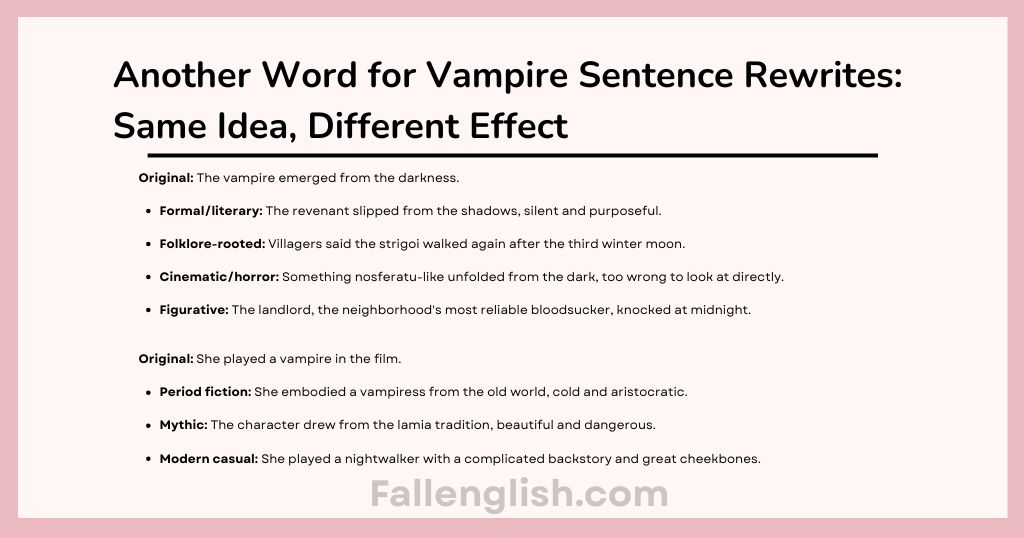
Here’s how changing one word shifts the entire feel of a sentence.
Original: The vampire emerged from the darkness.
- Formal/literary: The revenant slipped from the shadows, silent and purposeful.
- Folklore-rooted: Villagers said the strigoi walked again after the third winter moon.
- Cinematic/horror: Something nosferatu-like unfolded from the dark, too wrong to look at directly.
- Figurative: The landlord, the neighborhood’s most reliable bloodsucker, knocked at midnight.
Original: She played a vampire in the film.
- Period fiction: She embodied a vampiress from the old world, cold and aristocratic.
- Mythic: The character drew from the lamia tradition, beautiful and dangerous.
- Modern casual: She played a nightwalker with a complicated backstory and great cheekbones.
Notice how each swap creates a different atmosphere without needing extra description. The right word does the work for you.
Where Writers Go Wrong about Another Word for Vampire
A few common mistakes worth naming directly:
Ghoul is not a vampire. In original Arabic folklore, a ghoul is a desert creature that eats corpses and shapeshifts. It does not drink blood. Modern English has blurred this line, but if precision matters to you (especially in folklore-based writing), keep them separate.
Succubus is not a vampire. It’s a demonic entity with a completely different mythological origin. Using it as a synonym for female vampire suggests you haven’t researched either word.
“Undead” is too broad. Zombies, ghouls, revenants, and wraiths are all undead. Don’t use it as a specific substitute for vampire unless broad is exactly what you want.
Nosferatu as a generic term. Many people use it as if it simply means “old scary vampire.” But in its original context, it had specific folkloric meaning. Know before you use.
Overusing figurative synonyms in horror. If you’re writing actual supernatural fiction, words like “leech” or “predator” pull the reader out of the genre. Save them for metaphors and social commentary.
Vampire Synonym Related Words Worth Knowing
These aren’t synonyms exactly, but they orbit the same topic and help you write richer content:
- Sanguinarian: A real term used today by people who identify as “real vampires” and consume blood as a lifestyle practice. Distinct from fiction.
- Haematophage: Scientific term for blood-feeding organisms (like vampire bats). Useful in academic or biology-adjacent writing.
- Dhampir: In Balkan folklore, the child of a vampire and a human. Neither fully one nor the other. Great for character work.
- Lycanthrope: Not a vampire, but often paired with vampires in folklore and fiction. A werewolf. Knowing the difference matters.
- Moroi vs. Strigoi: In some Romanian traditions, these are distinct. A moroi is sometimes described as a living person with vampiric abilities, while strigoi is the undead version.
Read more –
69+ Another Word for Audit: Smarter Alternatives for Every Context
41+ Another Word for “In Which”: Smarter Alternatives for Every Writing Style
FAQ’s about Another Word for Vampire
What is the best another word for vampire in creative writing?
It depends on the tone. Nosferatu works well for Gothic horror, revenant suits literary fiction, and nightwalker fits fantasy stories. Choose a word that matches the mood of your scene rather than replacing “vampire” at random.
Are all vampire synonyms exactly the same?
No. Many words on vampire lists come from different cultures and traditions. For example, strigoi, jiangshi, and aswang are unique creatures with their own legends, behaviors, and meanings. They are related to vampires but are not identical.
What word should I use instead of vampire in an essay?
For formal or academic writing, revenant, undead creature, or the specific cultural term being discussed are often better choices. They can provide more accuracy and context than using “vampire” as a broad label.
What is the female version of a vampire called?
The most direct term is vampiress. Depending on the myth or story, words such as lamia, shtriga, or baobhan sith may also describe female blood-drinking supernatural beings.
The Bottom Line
You now have 34+ options, but the point was never to give you a list to copy from. It was to help you understand that each word carries a different history, tone, and expectation.
Writing about folklore? Use the regional name. Writing a horror story set in 19th-century Transylvania? Vampyre or strigoi. Writing social commentary about a greedy corporation? Leech or bloodsucker. Writing a strong female antagonist in a mythological fantasy? Lamia, baobhan sith, or shtriga depending on your world’s rules.
The right word is the one that tells your reader exactly how to feel before you’ve written another sentence. That’s what synonyms are actually for.
