

Speech is one of those words that means too many different things to have a single perfect replacement.
Quick Answer
The most useful alternatives depend on what kind of speech you mean:
- A formal public address → address, oration, lecture, keynote
- An informal talk → talk, remarks, words
- A prepared presentation → presentation, address
- The ability to speak → voice, articulation, verbal expression
- A character’s spoken words in fiction or drama → dialogue, monologue, lines
No single synonym covers all of these. The right replacement depends on the setting, the speaker, and what you are actually trying to say.
The Core Problem with “Speech”
Writers reach for an alternative to speech for different reasons:
- The word has been used too many times in the same piece
- It feels too vague for the specific situation
- The context is more formal (or more casual) than speech suggests
- The speaker is giving a very specific kind of address — a keynote, a toast, a lecture — and a more precise word exists
The first question to ask yourself is: What kind of speech am I describing?
Another Word for Speech When You Mean a Formal Public Address
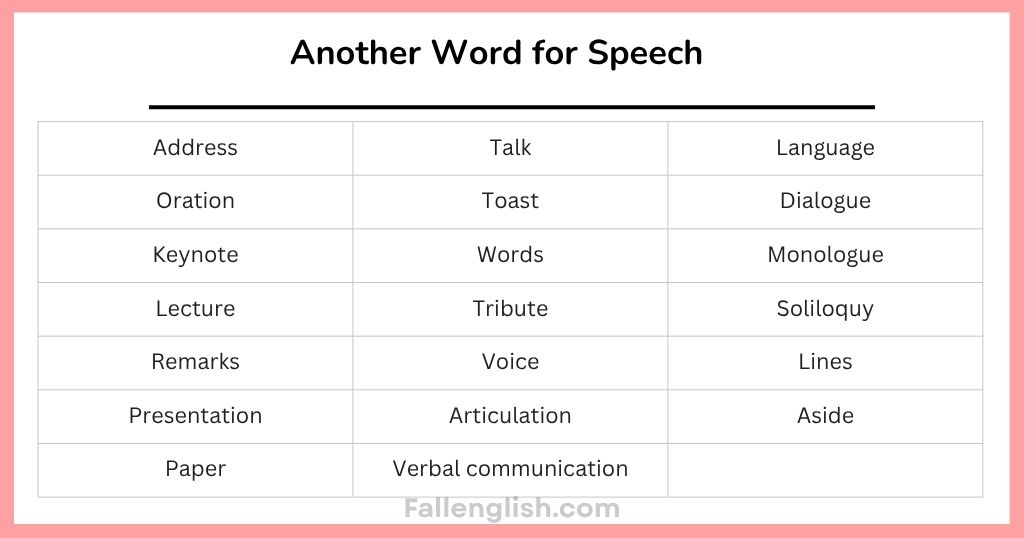
These are the strongest alternatives when someone is speaking formally to an audience.
| Word | Best for | Tone |
| Address | Political, ceremonial, official settings | Formal, dignified |
| Oration | Elevated, persuasive, or historically significant speeches | Formal, literary |
| Keynote | Opening or principal speech at a conference or event | Professional, modern |
| Lecture | Educational talk, usually with expert authority | Academic, instructional |
| Remarks | Brief or informal comments at a formal occasion | Understated, modest |
Address is the most versatile of these. It works naturally where speech would work, but it signals slightly more formality and purpose. The president’s address to the nation feels more official than the president’s speech to the nation, even though both are grammatically correct and widely used.
Oration carries weight. It implies careful rhetorical construction, emotional power, and a speaker who commands an audience. You would use it for Lincoln’s Gettysburg Address or Churchill’s wartime broadcasts — not for a quarterly company update.
Remarks is deliberately modest. Politicians and executives often use it to describe their own speeches to avoid sounding self-important: a few remarks signals brevity and approachability even when the talk runs twenty minutes.
When You Mean a Prepared Presentation
In professional and academic contexts, speech can sound slightly too casual.
Presentation is the natural choice in most workplace settings. It implies visual aids, a structured argument, and a professional audience. Saying someone gave a presentation tells the reader there was preparation and purpose behind it.
Paper works in academic contexts, where a speaker reads or discusses a written work: she delivered a paper at the conference. This is specific to academic culture and does not transfer naturally to other settings.
Talk sits between speech and presentation. It sounds less formal than either — closer to a conversation than a performance. TED Talks deliberately use this word to suggest informality and directness, even when the content is carefully prepared.
Another Word for Speech When You Mean an Informal Occasion
Not every speech is a ceremony. When someone raises a glass at a dinner or says a few words at a retirement party, speech may actually be the right word — but these alternatives work well when a lighter touch is needed:
- Toast — specific to celebratory occasions where a drink is raised. Cannot be used outside this context.
- Words — as in he said a few words — is the most understated option. It implies brevity and informality without drawing attention to the act of speaking.
- Tribute — when the purpose is to honor someone, particularly at a retirement, memorial, or award ceremony.
Tribute is worth noting separately because it describes the purpose rather than the act. A tribute is always in honor of someone; a speech can be about anything.
When You Mean the Human Ability to Speak
This is a completely different sense of speech, and synonyms for formal address will not fit here.
She lost her speech after the accident. Here, speech means the physical and cognitive ability to produce spoken language.
Useful alternatives in this sense:
- Voice — she lost her voice — though this is often taken to mean temporary hoarseness rather than a permanent or neurological condition
- Articulation — more clinical; it refers to the physical production of sounds and words
- Verbal communication — precise and neutral, useful in medical or therapeutic writing
- Language — in some contexts: the condition affects language and memory
These alternatives are not interchangeable with each other. Voice is the most natural in everyday writing; articulation belongs to clinical or educational language; verbal communication works in professional or psychological contexts.
When You Mean a Character’s Spoken Words
In fiction, screenwriting, or drama:
- Dialogue — spoken exchange between two or more characters
- Monologue — a long speech by one character, usually revealing inner thought or dominating a scene
- Soliloquy — a monologue spoken when the character is alone or treats the audience as confidant; specific to theatre
- Lines — the actual words a character speaks, particularly in a script
- Aside — a brief remark directed to the audience that other characters cannot hear; a theatrical term
These are not interchangeable with speech in the general sense. A playwright does not write a speech for Hamlet — they write a soliloquy. A novelist describes dialogue, not speeches, between characters unless one character is formally addressing others.
The Words That Look Right But Require Care
Discourse sounds like a sophisticated alternative, but it usually refers to extended, formal discussion or analysis in writing or speech — often academic or political in nature. Replacing speech with discourse in most sentences will either sound overly academic or shift the meaning.
Oration is often overused by writers reaching for an elevated tone. Reserve it for truly grand occasions. Calling a company all-hands meeting an oration will read as unintentionally comic.
Diatribe and tirade are sometimes listed as synonyms for speech, but both carry strongly negative connotations — an angry, one-sided attack. Do not use either unless that is exactly the tone you mean.
Spiel is informal and usually skeptical. It implies a rehearsed, self-serving talk — a salesperson’s pitch or a practiced excuse. Using it for a sincere formal address would read as mocking.
Read more: Another Word for Eye-Opening: Better Choices for What You Actually Mean
How Context Changes the Best Choice
| Situation | Better than “speech” |
| President speaks to the nation | Address |
| Academic conference presentation | Paper or talk |
| Conference opening remarks | Keynote |
| Friend’s wedding toast | Toast or words |
| Retirement party tribute | Tribute |
| Shakespeare play | Soliloquy or monologue |
| Hospital, after a stroke | Verbal communication or language |
| Tech event (informal style) | Talk |
| Ancient Rome, rhetorical tradition | Oration |
| Angry political rant | Tirade |
A Note on Register
Speech itself is neutral — it works in formal and informal writing without sounding out of place. Most of its alternatives shift the register in one direction or the other.
If you are replacing speech simply to avoid repetition and have no strong preference for tone, address and talk are the safest choices for opposite ends of the formality scale. Address slightly elevates; talk slightly relaxes. Both are natural.
Read more: Another Word for Liberation: Alternatives That Actually Fit Your Meaning
Making the Choice
The right replacement for speech is the word that captures three things at once: who is speaking, who is listening, and what the occasion demands. A senator gives an address. A professor gives a lecture. A best man gives a toast. A Shakespearean villain gives a soliloquy.
When you find yourself uncertain, talk and address cover the widest range of situations without risk. Reserve the more specific alternatives — oration, keynote, tribute, tirade — for the moments when that precision is exactly what the sentence needs.

FallEnglish is run by a language enthusiast who explains word and text meanings in clear, simple ways. Each guide is carefully researched, original, and written to help real people understand language faster, with accuracy, context, and everyday examples you can trust.