

Campaign is one of those words that works in almost every field — politics, marketing, military history, public health, fundraising — which is exactly why it can feel vague when you need to be specific.
Quick Answer
The most useful alternatives depend on what kind of campaign you mean:
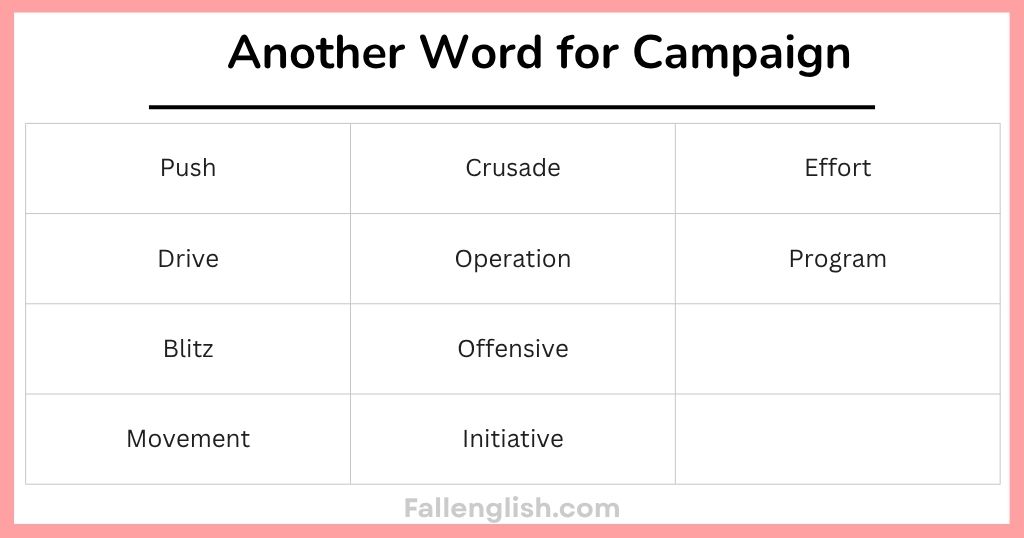
- Drive — for fundraising, awareness, or community action
- Initiative — for institutional or organizational efforts
- Operation — for military, security, or coordinated tactical action
- Push — for short, intensified efforts (informal)
- Effort — for broader, sustained work without a formal structure
- Crusade — for passionate, morally-driven causes (use carefully)
- Program — for long-term, structured institutional activity
No single word replaces campaign across all its uses. The best alternative depends on what you’re describing, who will read it, and how formal the context is.
What Makes “Campaign” Tricky to Replace
The word campaign carries a specific implication: organized, goal-directed activity with a defined purpose and a beginning and end. When you look for an alternative, you need a word that preserves at least that core idea — otherwise you lose the sense of coordinated intention.
Compare:
The company launched a campaign to reduce plastic waste.
The company launched an effort to reduce plastic waste.
The company launched a program to reduce plastic waste.
All three work, but they describe slightly different things. A campaign implies urgency and a coordinated push. An effort is more open-ended. A program suggests something structured and ongoing.
Another Word for Campaign by Context
When the context is marketing or advertising
Campaign is actually the industry standard here, so replacing it may make your writing sound less professional. That said:
- Push works in informal internal communication: “We’re doing a big push before the holidays.”
- Drive fits promotion tied to a specific goal: “a customer acquisition drive.”
- Blitz suggests concentrated, short-term advertising intensity: “a pre-launch media blitz.” Use it carefully — it can sound aggressive or dated.
When the context is politics or social change
- Movement is the strongest replacement when people are organizing around shared values over time. A movement is bigger than a single campaign — it implies community, identity, and sustained pressure rather than one goal-driven push.
- Crusade works when someone is driven by moral conviction: “a crusade against corruption.” It carries intensity, but also sounds old-fashioned and can feel self-righteous. In religious or historical contexts, be aware of the word’s literal connotations.
- Drive fits voter registration or petition efforts: “a voter registration drive.”
When the context is military or law enforcement
Operation is the natural professional term here. It suggests planning, command structure, and execution:
“Operation Desert Storm” rather than “Campaign Desert Storm.”
That said, campaign does have a long military history — “the Italian campaign,” “a ground campaign” — and should not be replaced with operation when describing historical strategy at a large scale.
Offensive works specifically for aggressive military action. It is not interchangeable with campaign in non-military contexts without sounding dramatic.
When the context is charity, health, or community
- Drive — “a blood drive,” “a fundraising drive” — is natural and widely understood.
- Initiative — “a public health initiative” — sounds more institutional and suits grant applications, press releases, and policy documents. It suggests something top-down rather than grassroots.
- Effort — “a community effort” — is warmer and less formal. It implies collaboration rather than coordination.
- Program — “a vaccination program” — is better when the activity runs for a long time and involves structured delivery rather than a one-time push.
The Words That Look Right But Often Aren’t
Project implies a contained, deliverable-focused task. A campaign is usually broader and more public-facing. “A marketing project” sounds like internal work; “a marketing campaign” faces outward toward an audience.
Mission has an almost spiritual or organizational-identity quality. It describes purpose more than activity: “our mission is to reduce hunger” is different from “we’re running a campaign to reduce hunger.” Using mission where you mean campaign can blur the distinction between values and action.
Strategy describes a plan, not an activity. You can have a campaign with a strategy, but you cannot replace one with the other.
Agenda carries political undertones in informal use. “A hidden agenda” implies manipulation. Be careful substituting it for campaign unless the context is genuinely about a scheduled set of items.
Read more: Another Word for Deeper: Choosing the Right Alternative for Every Context
Another Word for Campaign Tone Differences at a Glance
| Word | Tone | Best for |
| Campaign | Neutral, organized | General use across most contexts |
| Drive | Action-oriented, focused | Fundraising, recruitment, community efforts |
| Initiative | Formal, institutional | Policy, public health, corporate communications |
| Operation | Technical, structured | Military, security, logistics |
| Push | Informal, urgent | Internal comms, casual writing |
| Effort | Warm, collaborative | Community-focused, human-interest writing |
| Movement | Ideological, sustained | Social or political change over time |
| Crusade | Passionate, moral | Strong advocacy (use with awareness of its weight) |
| Program | Long-term, structured | Ongoing institutional delivery |
Read more: Another Word for Division: Alternatives for Every Meaning
A Decision You’ll Actually Need to Make
The most common confusion is between campaign, initiative, and program in professional and nonprofit writing.
- If it has a start date, an end date, and a specific goal: campaign
- If it was launched by an institution and sounds ongoing or policy-related: initiative
- If it runs continuously and involves repeating delivery or service: program
“We ran a two-month campaign to increase donations.”
“The ministry launched an initiative to address food insecurity.”
“The hospital’s wellness program has operated since 2019.”
These are not interchangeable. Using initiative for a short-term push, or campaign for a long-running service, creates a mismatch between the word and what you’re describing.
The right replacement for campaign is the one that matches the scale, duration, formality, and goal of what you’re actually describing. When the activity is coordinated, goal-driven, and time-bound, campaign is often still the clearest choice — the alternatives earn their place when you need greater precision.

FallEnglish is run by a language enthusiast who explains word and text meanings in clear, simple ways. Each guide is carefully researched, original, and written to help real people understand language faster, with accuracy, context, and everyday examples you can trust.