


Science is full of useful terms, and many important ones begin with the letter E. From energy and ecosystems to electrons and eclipses, these words appear in school lessons, science fairs, and everyday life. This guide to Science Words That Start With E is designed for students, parents, teachers, and English learners who want simple definitions and real-world examples.
Whether you’re studying biology, chemistry, physics, earth science, or astronomy, this list will help you build vocabulary in a clear and practical way. Use it to prepare for tests, complete assignments, or understand how science explains the world around you.
The 20 Most-Used Science Words That Start With E
Energy — The ability to do work or cause change.
Evolution — How species change across generations through natural selection.
Ecosystem — All living things plus their physical environment together.
Element — A pure substance made of only one type of atom.
Electron — A negatively charged particle found inside every atom.
Erosion — Land worn away gradually by wind, water, or ice.
Evaporation — A liquid slowly turning into vapor at its surface.
Enzyme — A protein that speeds up chemical reactions in the body.
Embryo — An organism in its earliest stage of development.
Eclipse — One space object blocking light from reaching another.
Electricity — The flow of electric charge through a conductor.
Equilibrium — A balanced state where opposing forces cancel out.
Extinction — When an entire species permanently dies out.
Exothermic — A reaction that releases heat into the surroundings.
Epidermis — The outermost protective layer of skin or a plant.
Estrogen — A hormone controlling female reproductive development.
Electrode — A conductor through which electric current enters or exits.
Exosphere — Earth’s outermost atmospheric layer, bordering outer space.
Embryology — The scientific study of embryo growth and development.
Epicenter — The point on Earth’s surface directly above an earthquake’s underground origin.
Physics Science Words That Start With E
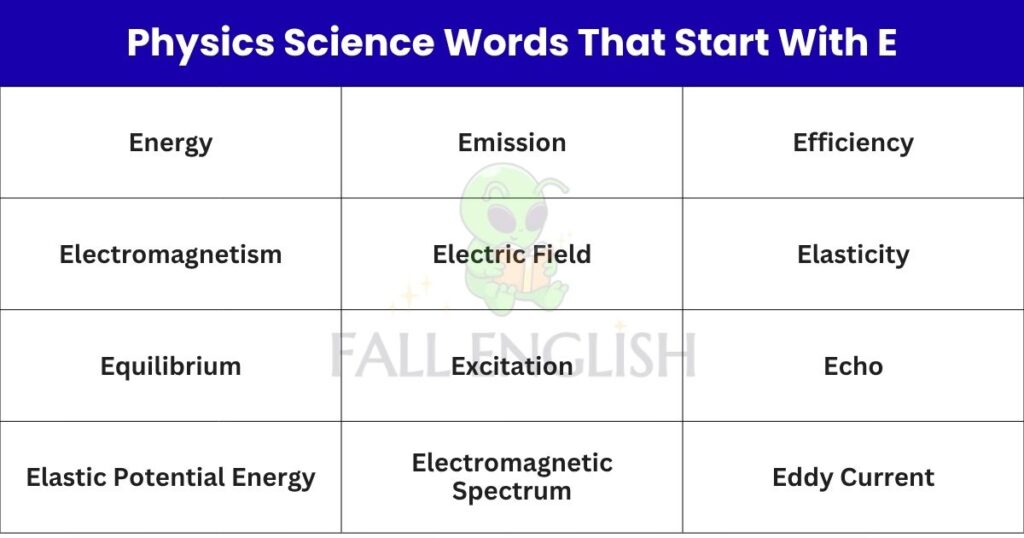
Energy — Every action needs it. Running, heating food, charging a phone. It never disappears — only changes form. That’s the law of conservation of energy.
Electromagnetism — One of nature’s four fundamental forces, unifying electricity and magnetism. Your microwave, phone screen, and MRI machine all depend on it.
Equilibrium — Every force acting on an object cancels out perfectly. A book on a table is in equilibrium. Push it — balance breaks.
Elastic Potential Energy — Energy stored in a stretched or compressed object. A pulled rubber band holds it silently. Release it — energy becomes motion.
Entropy — A measure of disorder in any system. Left alone, things naturally drift toward messiness. That’s entropy. A clean room slowly grows dusty — that’s it in action.
Emission — When an atom releases stored energy as light or radiation. Neon signs glow because excited atoms emit colored light at specific frequencies.
Electric Field — An invisible force region surrounding charged particles. Charges push or pull each other through this field without any physical contact.
Excitation — An electron absorbs energy and jumps to a higher orbital. This is the exact mechanism that causes atoms to emit light.
Electromagnetic Spectrum — The complete range of light waves: radio, microwave, infrared, visible, ultraviolet, X-ray, gamma. Human eyes detect only a narrow slice.
Efficiency — Useful output energy divided by total input energy. No machine ever reaches 100% — some always escapes as heat.
Elasticity — A material’s ability to return to its original shape after being stretched or compressed. Rubber is highly elastic. Concrete is not.
Echo — Sound reflecting off a surface back toward its source. Bats use precise echoes to navigate and hunt in complete darkness.
Eddy Current — Circular loops of electric current induced inside a conductor by a changing magnetic field. Metal detectors and induction cooktops both use this effect.
Electric Potential — The work required to move a unit of charge between two points. Measured in volts.
Electromotive Force (EMF) — The energy per unit charge that a power source delivers to push current through a circuit. Batteries generate it chemically.
Chemistry Science Words That Start With E
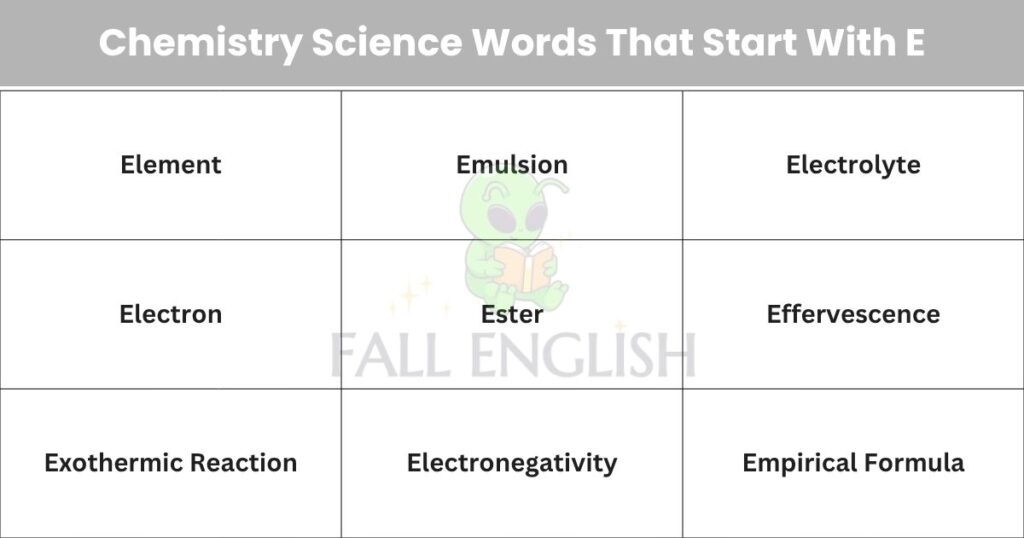
Element — Contains only one kind of atom. Cannot be broken down further by chemistry. Gold, oxygen, and carbon are each elements.
Electron — Negatively charged particles orbiting an atom’s nucleus. They govern chemical bonding, reactivity, and how materials conduct electricity.
Exothermic Reaction — Releases heat as it proceeds. Burning wood, lighting a match, cracking a hand warmer — energy exits into the surroundings. You feel it.
Endothermic Reaction — Absorbs heat from surroundings. A cold pack on a sprained ankle pulls warmth from your skin through an endothermic reaction inside the pack.
Electrolysis — Electricity forces a chemical reaction that won’t happen naturally. Water splits into hydrogen and oxygen this way. Industrially, it refines aluminum and coats metals.
Emulsion — Tiny droplets of one liquid distributed evenly through another. Salad dressing is an emulsion — oil suspended in vinegar until you stop shaking it.
Ester — Forms when an acid reacts with an alcohol. Most artificial fruit flavors — banana, strawberry, pineapple — are esters reproduced in chemistry labs.
Electronegativity — How strongly an atom pulls shared electrons toward itself inside a bond. Fluorine is the most electronegative element on the periodic table.
Electrolyte — A substance that conducts electricity when dissolved in water. Sports drinks contain electrolytes — sodium and potassium — to replace what sweat removes.
Effervescence — Visible bubbling when gas escapes during a reaction. Drop an antacid tablet in water. Those rising bubbles are effervescence.
Empirical Formula — The simplest whole-number atom ratio in a compound. Glucose is C₆H₁₂O₆, but its empirical formula reduces to CH₂O.
Esterification — The reaction producing esters. An acid and alcohol combine, releasing water as a byproduct.
Enthalpy — Total heat content in a chemical system. When it decreases during a reaction, energy releases to the surroundings.
Elimination Reaction — Atoms are removed from adjacent carbons to form a double bond between them. Common in organic chemistry synthesis.
Electrolytic Cell — A device using electrical energy to drive a non-spontaneous chemical reaction. Used industrially in metal refining and purification.
Biology Science Words That Start With E
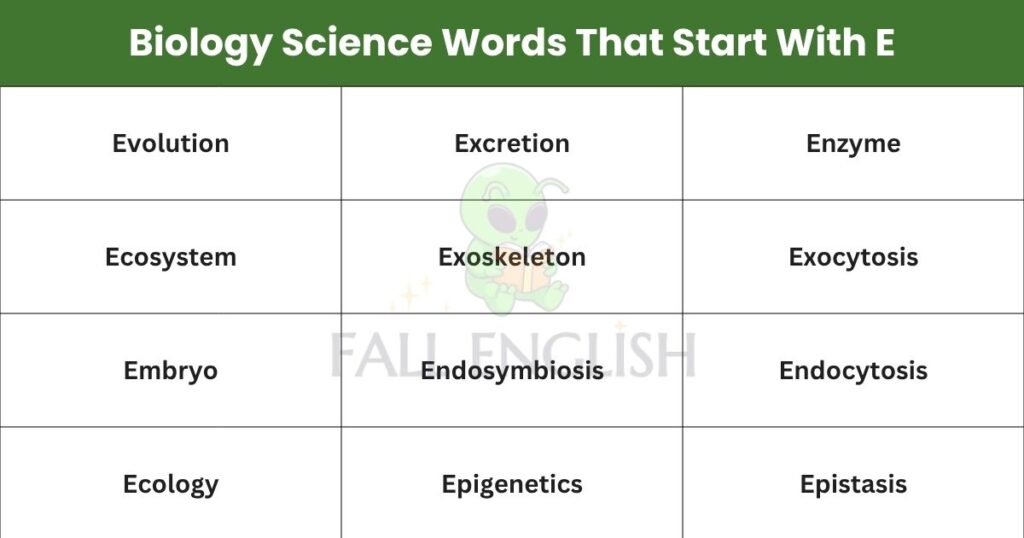
Evolution — Populations change across generations through natural selection. Every living thing on Earth shares a common ancestor. This single theory organizes all of biology.
Ecosystem — Every organism in an area — plants, animals, fungi, bacteria — plus the water, soil, and climate they interact with. A forest, a coral reef, a pond — each is one complete system.
Embryo — The earliest developmental stage of an organism. In humans, week one is microscopic yet already contains the complete genetic blueprint for a full person.
Ecology — The branch of biology studying how living things interact with each other and with their physical surroundings.
Eukaryote — An organism with cells containing a true membrane-enclosed nucleus. Every animal, plant, and fungus is a eukaryote. Bacteria are not.
Excretion — Removing metabolic waste from the body. Sweating, urinating, and exhaling CO₂ are all excretion — disposing of what the body has already processed and no longer needs.
Exoskeleton — A rigid outer shell supporting and protecting an animal’s body externally. Insects, crabs, and lobsters have exoskeletons instead of internal bones.
Endosymbiosis — Mitochondria and chloroplasts were once independent bacteria, absorbed into larger cells billions of years ago. This single event transformed the complexity of life permanently.
Epigenetics — Environmental signals switch specific genes on or off without altering the DNA sequence itself. Diet, stress, and exposure to chemicals all influence it.
Endangered Species — A species at serious risk of extinction in the wild. Habitat destruction and climate change are the primary drivers globally.
Enzyme — A protein that accelerates a specific chemical reaction without being consumed by it. Without enzymes, digestion, DNA copying, and cellular respiration would all cease.
Exocytosis — A cell expels materials by fusing internal vesicles with its outer membrane. Neurons release neurotransmitters exactly this way.
Endocytosis — A cell engulfs external materials by wrapping its membrane around them. White blood cells destroy bacteria through endocytosis.
Epistasis — One gene suppresses or alters the expression of another. It makes inheritance more complex than simple Mendelian predictions suggest.
Epigenome — The full set of chemical markers controlling which genes are expressed in a cell. Same DNA sequence, completely different behavior depending on these signals.
Earth Science Words That Start With E
Erosion — Wind, water, and ice physically scrape and carry away rock and soil over time. The Grand Canyon is the result of millions of years of river erosion cutting through rock.
Earthquake — Sudden ground shaking from movement along fault lines in Earth’s crust. Released energy travels outward as seismic waves in all directions.
Evapotranspiration — Water leaves an area through both surface evaporation and plants releasing vapor through their leaves simultaneously. A major driver of the water cycle.
Estuary — Where a freshwater river meets the saltwater ocean. Mixed salinity creates some of Earth’s richest habitats for fish, birds, and marine organisms.
Elevation — Height above sea level. Higher elevation means thinner air, colder temperatures, and noticeably different plant and animal communities.
Eolian — Shaped or deposited by wind. Sand dunes are eolian landforms, built grain by grain across thousands of years.
Extrusive Rock — Igneous rock formed when lava cools rapidly on Earth’s surface. Basalt and obsidian are common extrusive rocks.
Evaporite — Mineral deposits left behind after water evaporates from a basin. The salt flats of Utah and Bolivia formed through evaporite processes.
Effluent — Liquid waste discharged into rivers or oceans from factories, farms, or sewage systems. One of the leading sources of water pollution worldwide.
Earth’s Layers — Core (solid inner iron, liquid outer iron), Mantle (semi-molten rock in slow motion), Crust (thin solid shell broken into moving tectonic plates).
Space & Astronomy Science Words That Start With E
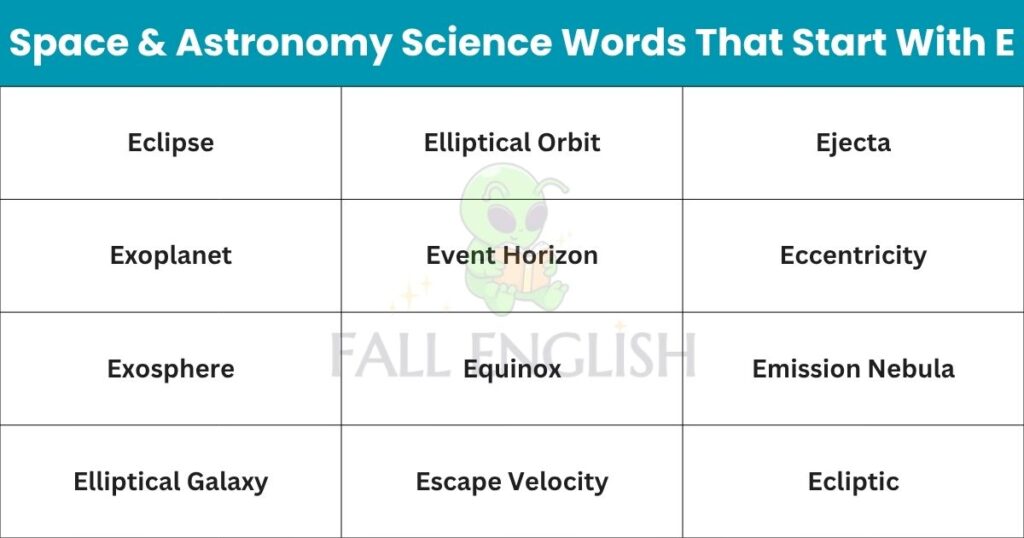
Eclipse — Solar eclipse: Moon sits between Earth and Sun. Lunar eclipse: Earth sits between Sun and Moon. Both require near-perfect orbital alignment.
Exoplanet — A planet orbiting any star besides our Sun. Over 5,500 confirmed. Scientists prioritize those in habitable zones where liquid water could theoretically exist.
Exosphere — Earth’s outermost atmospheric layer. No sharp boundary — it fades gradually into the vacuum of space over hundreds of kilometers.
Elliptical Galaxy — A smooth, oval-shaped galaxy containing mostly old stars with almost no active star formation and no visible spiral arms.
Elliptical Orbit — The oval path planets travel around their star. They accelerate when closer to the star, slow when farther — described by Kepler’s second law.
Event Horizon — The boundary around a black hole beyond which escape is impossible. Escape velocity there exceeds the speed of light. Nothing returns.
Equinox — Two moments per year when day and night are nearly equal everywhere on Earth. Spring equinox falls around March 20, autumn around September 22.
Escape Velocity — The minimum speed needed to break free from a planet’s gravity. Earth’s is approximately 11.2 km per second.
Ejecta — Debris flung outward by a meteor impact or volcanic eruption. Moon craters are visibly surrounded by ejecta fields radiating outward.
Eccentricity — Measures how stretched an orbit is. Zero equals a perfect circle. Higher values mean a more elongated elliptical path.
Emission Nebula — A glowing gas cloud energized by radiation from nearby hot stars. The Orion Nebula is one of the most visible from Earth.
Ecliptic — The flat plane of Earth’s orbit around the Sun. Most solar system planets orbit within a few degrees of this same plane.
Medical & Health Science Words That Start With E
Epidermis — In clinical medicine, burn and wound severity is classified by how deep damage penetrates through and beyond this outer skin layer.
Edema — Excess fluid trapped in body tissues causing visible swelling. Appears after injury and in patients with heart, kidney, or liver conditions.
Electrocardiogram (ECG/EKG) — Records the heart’s electrical activity as a wave pattern on a graph. Detects irregular rhythms, heart attacks, and structural abnormalities.
Endoscopy — A thin, flexible tube with a camera inserted into the body to examine internal organs — stomach, colon, or lungs — without open surgery.
Epidemiology — The science of how diseases spread through populations, who they affect, and how to contain them. Used constantly during outbreaks and public health crises.
Erythrocyte — The scientific name for a red blood cell. Each carries oxygen from the lungs to body tissues using a protein called hemoglobin.
Endocrine System (clinical) — When glands malfunction, the effects are system-wide. Thyroid disorders, diabetes, and adrenal insufficiency all originate here.
Endorphin — Natural brain chemicals released during exercise, laughter, and pain. They reduce discomfort and produce a brief, mild sense of calm without external drugs.
Ectopic Pregnancy — A fertilized egg implants outside the uterus, usually in the fallopian tube. Medically dangerous — requires immediate treatment.
Electrolyte Imbalance — When sodium, potassium, or calcium levels in blood fall outside safe ranges. Consequences range from muscle cramps to dangerous heart arrhythmia.
Excision — Surgical removal of tissue, a lesion, or an organ. Used in cancer treatment, wound debridement, and reconstructive procedures.
Enzyme Deficiency — The body produces insufficient amounts of a specific enzyme. Lactose intolerance is one example — not enough lactase enzyme to digest dairy sugar properly.
Embryonic Stem Cells — Cells from early embryos capable of developing into virtually any tissue type. Central to regenerative medicine and ongoing clinical research.
Technology & Applied Science Words That Start With E
Electrode — Moves electricity into or out of a device. Every battery has two: a positive terminal (cathode) and a negative terminal (anode).
Electromagnetic Induction — A moving or changing magnetic field generates electric current in a nearby conductor. Every power station on Earth generates electricity through this principle.
Encryption — Data is mathematically scrambled so only authorized parties can decode it. Every secure website, banking app, and private messaging platform uses it continuously.
Ethernet — A wired protocol connecting computers in a local network via cables. More stable and faster than Wi-Fi, still standard in offices, schools, and data centers.
Extrusion — Raw material is forced through a shaped opening to produce a continuous, uniform cross-section. Plastic pipes, aluminum window frames, and pasta are all made this way.
Electroplating — Electric current deposits a thin metal layer onto an object’s surface. Applied in jewelry finishing, automotive parts, circuit boards, and corrosion protection.
Ergonomics — Designing tools, furniture, and workspaces to match human body mechanics and reduce strain. Keyboard angles, chair heights, and steering wheel positions all reflect it.
Elastic Modulus — A number quantifying a material’s stiffness under applied stress. Structural engineers use it when calculating safe load limits for bridges and buildings.
Emitter — In transistor electronics, the terminal that releases charge carriers into a circuit. Critical in amplifiers, logic gates, and signal processors.
Easy Science Words That Start With E (Beginners & Kids)
| Word | Plain Meaning |
| Echo | Sound bouncing back from a surface |
| Egg | A reproductive cell or structure in animals |
| Earth | Our planet — third from the Sun |
| Energy | What makes things move or change |
| Eye | The organ used for vision |
| Erosion | Land slowly worn away by water or wind |
| Evaporation | Liquid slowly becoming vapor |
| Ecosystem | All living things sharing one environment |
| Electricity | Moving electric charge |
| Element | A basic, single-atom-type substance |
| Eclipse | One object in space blocking another |
| Embryo | A living thing in its earliest form |
Advanced Science Words That Start With E
Eigenvalue — In quantum mechanics, it represents a measurable property of a physical system’s state. Used to calculate energy levels of electrons in atoms.
Electrophoresis — An electric field pulls molecules through a gel medium, separating them by size and charge. Used in DNA forensics, disease diagnosis, and protein research.
Endothermy — The physiological ability to generate and maintain internal body temperature independently of the environment. Mammals and birds are endothermic.
Enantiomer — Two molecules with identical composition but mirror-image spatial arrangements. One form of a pharmaceutical may treat disease; its mirror image may cause harm.
Echolocation — Biological sonar. Bats and dolphins emit high-frequency pulses and interpret returning echoes to locate objects with remarkable precision in total darkness.
Enzyme Kinetics — Quantitative study of how fast enzymes catalyze reactions and how temperature, pH, and concentration change their speed.
Electroweak Force — Physics’ unified theory of electromagnetism and the weak nuclear force as a single fundamental interaction. Experimentally confirmed in the 1983.
Endoplasmic Reticulum — A network of membranes inside eukaryotic cells. The rough type makes proteins; the smooth type processes lipids and detoxifies chemicals.
Exon — The coding sections of a gene that carry instructions actually used to build proteins, after non-coding introns are removed during RNA processing.
Effective Nuclear Charge — The net positive charge that an electron in an atom actually experiences, accounting for the shielding effect of inner electrons.
Science Words That Start With E — By Grade Level
| Grade | Words to Know |
| Grade 5–6 | Echo, Earth, Egg, Energy, Erosion, Eclipse, Electricity, Element, Ecosystem, Evaporation |
| Grade 7–8 | Electron, Enzyme, Evolution, Embryo, Excretion, Exoskeleton, Effervescence, Electrolyte, Epicenter, Estrogen |
| Grade 9–10 | Electronegativity, Endothermic, Exothermic, Electromagnetic Spectrum, Eukaryote, Epidemiology, Electrolysis, Escape Velocity, Emission Nebula |
| Advanced | Eigenvalue, Electrophoresis, Epigenome, Enantiomer, Epistasis, Electroweak Force, Endosymbiosis, Exocytosis, Enzyme Kinetics, Enthalpy |
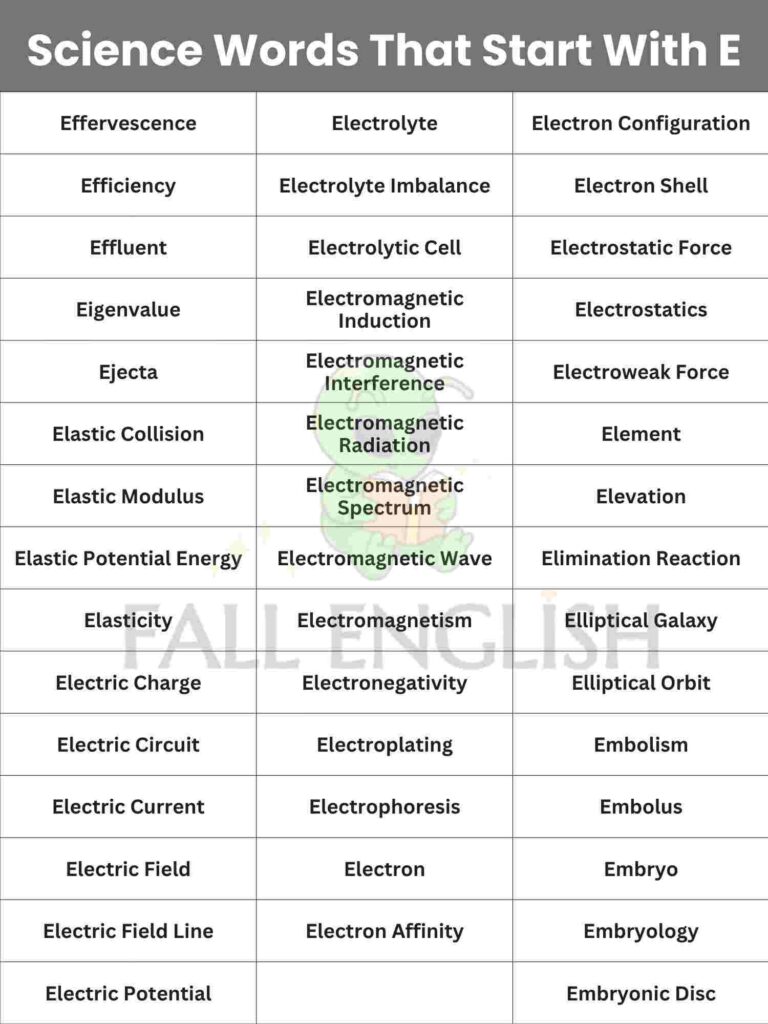
The Full List — 200+ Science Words That Start With E
Ear
Earth
Earth’s Core
Earth’s Crust
Earth’s Mantle
Earthquake
Eccentricity
Echolocation
Eclipse
Ecliptic
Ecology
Ecosystem
Ectoderm
Ectopic
Ectotherm
Eddy Current
Edema
Effervescence
Efficiency
Effluent
Eigenvalue
Ejecta
Elastic Collision
Elastic Modulus
Elastic Potential Energy
Elasticity
Electric Charge
Electric Circuit
Electric Current
Electric Field
Electric Field Line
Electric Potential
Electricity
Electrocardiogram
Electrochemical Cell
Electrode
Electrolysis
Electrolyte
Electrolyte Imbalance
Electrolytic Cell
Electromagnetic Induction
Electromagnetic Interference
Electromagnetic Radiation
Electromagnetic Spectrum
Electromagnetic Wave
Electromagnetism
Electronegativity
Electroplating
Electrophoresis
Electron
Electron Affinity
Electron Configuration
Electron Shell
Electrostatic Force
Electrostatics
Electroweak Force
Element
Elevation
Elimination Reaction
Elliptical Galaxy
Elliptical Orbit
Embolism
Embolus
Embryo
Embryology
Embryonic Disc
Embryonic Stem Cells
Emission
Emission Nebula
Emission Spectrum
Emitter
Emulsion
Enantiomer
Endangered Species
Endocrine Gland
Endocrine System
Endocytosis
Endoderm
Endometrium
Endorphin
Endoscopy
Endoskeleton
Endosymbiosis
Endothermic
Endothermy
Endonuclease
Endoplasmic Reticulum
Energy
Enthalpy
Entropy
Enzyme
Enzyme Deficiency
Enzyme Kinetics
Enzyme-Substrate Complex
Eolian
Epiblast
Epicenter
Epidemiology
Epidermis
Epigenetic Marker
Epigenetics
Epigenome
Epiglottis
Epinephrine
Epistasis
Equinox
Equilibrium
Equipotential
Ergonomics
Erosion
Erosional Surface
Erythrocyte
Erythropoiesis
Escape Velocity
Ester
Esterification
Estivation
Estrogen
Estuary
Ether
Ethernet
Eukaryote
Eukaryotic Cell
Eukaryotic Chromosome
Event Horizon
Event Horizon Telescope
Evaporation
Evapotranspiration
Excision
Excitable Cell
Excitation
Excitation Energy
Excited State
Exocrine Gland
Exocytosis
Exon
Exonuclease
Exoplanet
Exoskeleton
Exosome
Exosphere
Exothermic
Extrusion
Extrusive Rock
Eye
Effective Nuclear Charge
Eardrum
Ecosphere
Electrolytic Dissociation
Elongation
Empirical Formula
Endergonic Reaction
Endoparasite
Ependymal Cell
Epoxide
Equipotential Line
Erosion Rate
Eustachian Tube
Evoked Potential
Exergonic Reaction
Extensor Muscle
Efferent Neuron
Efferent Nerve
Excretory System
Electromagnetic Force
Eosinophil
Ectoparasite
Earth System
Exobase
Ethanol
Ene Reaction
Entropy Change
Electroencephalogram
Electromotive Force
Excited Electron
Exoergic
Endoergic
Exothermal
Endothermal
Edaphic
Epibenthic
Ecotone
Ecotype
Eigenfunction
Common Mix-Ups Worth Knowing
Exothermic vs. Endothermic Touch the container. Exothermic makes it warm — heat is leaving. Endothermic makes it cold — heat is entering from your hand. The sensation is the definition.
Exoskeleton vs. Endoskeleton Exo = shell on the outside (crab, beetle). Endo = framework on the inside (your bones).
Ecosystem vs. Ecology An ecosystem is the actual place and its inhabitants — the pond, the rainforest. Ecology is the scientific discipline studying how relationships within it work.
Excretion vs. Secretion Excretion removes waste the body has finished with. Secretion releases something useful — saliva, hormones, bile.
Embryo vs. Fetus In human development, the embryo stage runs from fertilization through week 8. After that it becomes a fetus, with recognizable human structures forming.
Evaporation vs. Condensation Evaporation moves water from liquid to gas — puddles disappear. Condensation moves water from gas to liquid — droplets form on a cold glass.
Electron vs. Element An element is a complete substance with its own row on the periodic table. An electron is a subatomic particle found inside every atom of every element.
Where These Words Actually Show Up
Hospitals and clinics — ECG, Edema, Endoscopy, Epidemiology, Erythrocyte, Enzyme Deficiency, Electrolyte Imbalance, Excision, Ectopic Pregnancy
Environmental news and reports — Erosion, Ecosystem, Endangered Species, Evapotranspiration, Effluent, Estuary, Ecotone
Physics and engineering work — Electromagnetism, Entropy, Elastic Modulus, Extrusion, Electroplating, Efficiency, EMF, Eddy Current
Space research and astronomy — Exoplanet, Escape Velocity, Eccentricity, Event Horizon, Equinox, Elliptical Orbit, Ejecta, Ecliptic
Genetics and research labs — Epigenetics, Exon, Endocytosis, Electrophoresis, Enzyme Kinetics, Eukaryote, Effective Nuclear Charge
Everyday life — Evaporation (cooking, weather), Echo (concert halls, caves), Electricity (everything), Erosion (coastlines, farmland), Electrolyte (sports drinks)
Memory Tricks for E Science Words
One prefix, consistent meaning across all fields Exo always means outside or outward — Exoskeleton, Exosphere, Exothermic, Exoplanet, Exocytosis. Endo always means inside or inward — Endoskeleton, Endothermic, Endocrine, Endocytosis, Endoplasmic Reticulum. Learn the prefix once. Apply it everywhere.
Cluster the energy words Energy, Entropy, Enthalpy, Excitation, Emission, Exothermic, Endothermic, EMF — all describe how energy moves, stores, or transforms. Study them as one connected family, not isolated definitions.
One sentence, six terms An embryo inside an ecosystem uses enzymes while erosion and evaporation reshape the world outside. Six real science words. One image. Far easier to recall than six separate flashcards.
Anchor abstract terms to physical sensations Event Horizon = the point you can never come back from. Earthquake = the ground cracking under your feet. Estuary = muddy brown water where a river pushes into the sea. Sensation and image beat pure definition every time.
Read also:
140+ Science Words That Start With D | Definitions, Examples & Full List
210+ Science Words That Start With F — Full List With Meanings
FAQs
What are the most common science words that start with E?
Some of the most frequently used terms are energy, ecosystem, element, electron, erosion, evaporation, evolution, enzyme, eclipse, and electricity. These words appear often in school science courses and standardized tests.
Which Science Words That Start With E are easiest for kids to learn?
Good beginner terms include Earth, egg, eye, echo, energy, erosion, evaporation, and ecosystem. These are easy to connect to things children can see and experience in daily life.
How can I remember difficult E science terms?
Focus on prefixes. For example, exo- means outside and endo- means inside. Grouping related words such as exosphere, exoskeleton, and exothermic makes them easier to recall.
Why are E words so common in science?
Many science terms come from Greek and Latin roots like eco-, electro-, epi-, and ex-. These roots are used across biology, chemistry, medicine, and physics.
Which E words appear most often in exams?
Words such as energy, element, electron, enzyme, evolution, exothermic, endothermic, equilibrium, epicenter, and eclipse are commonly tested from middle school through high school.
Bottom line
Learning Science Words That Start With E is a smart way to strengthen your understanding of science across many subjects. Some words explain tiny particles, while others describe planets, ecosystems, and the human body. Start with the common terms, then move to advanced ones as your knowledge grows. When you connect each word to a real example, it becomes easier to remember and use with confidence.

FallEnglish is run by a language enthusiast who explains word and text meanings in clear, simple ways. Each guide is carefully researched, original, and written to help real people understand language faster, with accuracy, context, and everyday examples you can trust.