

“Care” carries more weight than most writers realize — it spans emotional warmth, professional responsibility, physical attention, and cautious concern, often in the same paragraph.
Quick Answer
The right replacement depends on which sense of “care” you’re using:
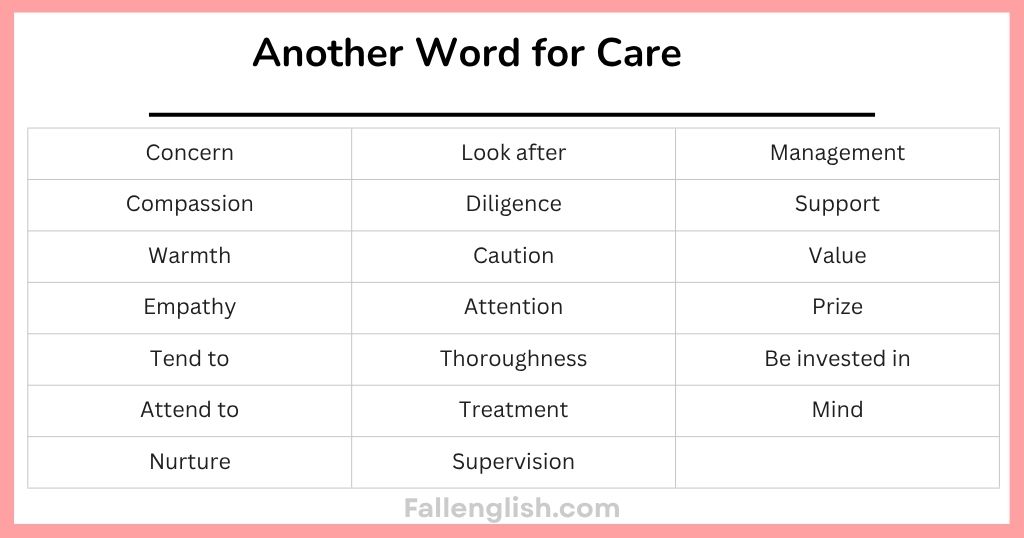
- Emotional concern → concern, compassion, warmth, tenderness
- Looking after someone → tend to, attend to, look after, nurture
- Caution or carefulness → caution, diligence, attention, thoroughness
- Professional or medical care → treatment, supervision, management
- Caring about something → value, prize, regard, be invested in
No single word covers all of these. The most common mistake is grabbing a synonym that fits one sense while distorting another.
The Core Problem with Replacing “Care”
“Care” works in so many different situations precisely because it is vague. That flexibility is also the reason it gets overused — and why writers reach for a thesaurus in the first place.
Consider these four sentences where “care” means something meaningfully different each time:
- She showed great care when handling the documents. → carefulness, precision
- He didn’t seem to care about the outcome. → concern, investment
- The nurse provided excellent care. → treatment, attention
- She raised the child with care and love. → tenderness, nurturing
Replacing “care” without identifying which sense you’re working with is where substitutions go wrong.
Another Word for Care by Meaning
When You Mean Emotional Concern
Concern is the most neutral swap for emotional “care.” It suits professional and formal writing where “care” might sound too personal.
The committee expressed concern about the welfare of residents.
Compassion goes further — it implies not just noticing someone’s suffering but being moved by it. Use it when the emotional response is active, not passive.
She responded with compassion rather than judgment.
Warmth describes a quality of character rather than a reaction to a specific situation. It works for describing people, not events.
Empathy is precise in contexts involving understanding another person’s inner experience — counseling, healthcare, social work. It is not interchangeable with “care” in most sentences; it describes how someone cares, not that they do.
When You Mean Looking After Someone
Tend to and attend to are both natural here, but they carry slightly different registers. “Tend to” sounds warmer and is common in caregiving contexts:
She tended to her elderly mother every evening.
“Attend to” is more formal and implies deliberate professional action:
The physician attended to each patient methodically.
Nurture emphasizes growth over time — a parent nurtures a child, a teacher nurtures talent. It does not fit short-term or clinical caregiving well.
Look after is the most conversational option. It works in everyday speech and informal writing but can sound casual in professional contexts.
Can you look after the dog while I’m away? ✓
The agency is responsible for looking after patient welfare. — workable, but “overseeing” or “managing” might fit better in a formal document.
When You Mean Caution or Careful Attention
This is where writers most often choose the wrong synonym, because the options here overlap with skill, precision, and method — not emotion.
Diligence emphasizes sustained, consistent effort. It suits academic, professional, and formal contexts.
The investigation was conducted with diligence.
Caution implies awareness of risk or danger — not just thoroughness, but watchfulness.
Proceed with caution. (standard)
Proceed with care. (slightly warmer, same meaning)
Attention is the cleanest replacement when “care” means focused concentration:
Pay attention to the details reads more plainly than take care with the details in instructional writing.
Thoroughness is more specific than “care” — use it when you want to emphasize completeness rather than general careful behavior.
When You Mean Professional or Medical Care
In clinical, institutional, or legal writing, “care” often has a technical meaning that casual synonyms cannot carry.
Treatment refers specifically to medical intervention. You can’t replace it with “care” when the sentence is about a specific procedure.
Supervision applies when someone is being monitored rather than actively helped.
Management is common in healthcare contexts involving ongoing conditions:
The management of chronic pain requires a long-term plan.
Support is broader and often preferred in social care or mental health contexts, where “treatment” may sound too clinical.
When You Mean Valuing Something
This is the sense in “I don’t care about money” or “she really cares about her work.” Here “care” means something closer to matter or value.
Value works when the caring is active and ongoing:
She values her independence.
Prize carries stronger weight — something prized is held in high regard:
He prized accuracy above all else.
Be invested in is useful in professional contexts where “care” might sound vague:
The team is genuinely invested in the outcome.
Mind works in negative constructions where “care” is casual:
I don’t mind. = I don’t care. (in the sense of having no objection)
These are not direct substitutions. “Value” is not the same as “care about” — valuing something is more deliberate; caring about it can be emotional and instinctive.
Words That Look Like Substitutes but Aren’t
Love — More intense and more personal than care. “She loved her patients” implies something different from “she cared for her patients.” Don’t upgrade to “love” simply because it sounds warmer.
Kindness — Describes a behavior or quality, not a level of attention. You can care for someone without being kind, and you can be kind without providing care.
Affection — Emotional and relational; it does not replace “care” in professional or practical contexts.
Interest — Covers intellectual engagement, not emotional investment. “I have an interest in his wellbeing” sounds cooler and more detached than “I care about his wellbeing.”
When “Care” Is Actually the Best Word
Some alternatives are technically accurate but create an unintended tone shift. In personal writing — letters, speeches, relationship contexts — replacing “care” with a more formal synonym can make the writing feel distant.
With care and affection → natural, warm
With diligence and compassion → sounds like a performance review
In creative writing, “care” often earns its place precisely because of its plainness. A character who cares is more relatable than one who demonstrates compassion or maintains diligence.
Quick-Reference about Another Word for Care Guide
| If you mean… | Use this instead |
| Emotional concern (formal) | concern, regard |
| Emotional concern (personal) | warmth, compassion, tenderness |
| Looking after someone (casual) | look after, tend to |
| Looking after someone (professional) | attend to, supervise, manage |
| Being careful | diligence, caution, attention |
| Medical/clinical care | treatment, support, management |
| Valuing something | value, prize, be invested in |
| Not caring (casual negative) | not mind, not bother |
Read also:
Another Word for Chaos: Alternatives That Actually Fit Your Meaning
Another Word for Proud: Better Alternatives for Any Context
Making the Choice
The strongest replacement for “care” is the one that names the specific thing you mean — not the word that sounds like a synonym. If your sentence is about emotional connection, go warmer. If it’s about professional responsibility, go more precise. If it’s about thoroughness, name the behavior directly.
The word “care” is often doing too much work in a sentence. Replacing it well means deciding which of its meanings you actually needed.

FallEnglish is run by a language enthusiast who explains word and text meanings in clear, simple ways. Each guide is carefully researched, original, and written to help real people understand language faster, with accuracy, context, and everyday examples you can trust.