


Science is full of important terms that begin with the letter F. From force and friction to fossils, fusion, and filtration, these words appear in physics, chemistry, biology, earth science, and medicine. Understanding them makes school lessons and everyday science much easier to follow.
This guide to Science Words That Start With F brings together over 210 useful terms with clear meanings and real-life examples. Whether you’re studying for a quiz, teaching a class, or building your vocabulary, you’ll find practical explanations that are easy to read and remember.
20 Most-Used Science Words That Start With F
Force — A push or pull that changes motion.
Friction — Resistance when two surfaces rub together.
Frequency — Number of wave cycles per second.
Fossil — Preserved remains of ancient living things.
Fusion — Two nuclei joining to release massive energy.
Fission — A nucleus splitting to release energy.
Filtration — Separating solids from liquids using a filter.
Fermentation — Breaking down sugars without oxygen.
Fluid — A substance that flows, such as a liquid or gas.
Fluorescence — Glowing when exposed to ultraviolet light.
Fertilization — Sperm and egg joining to form new life.
Food Chain — Energy passing from one organism to the next.
Fault — A crack in Earth’s crust where rock moves.
Fungi — A kingdom of organisms like mushrooms and mold.
Fetus — A developing mammal in the womb.
Fiber — Long, thin strands in plants or body tissue.
Flame — Hot, glowing gas produced during burning.
Flammable — Able to catch fire easily.
Flora — All plant life in a particular region.
Fog — Tiny water droplets suspended near the ground.
Physics Science Words That Start With F
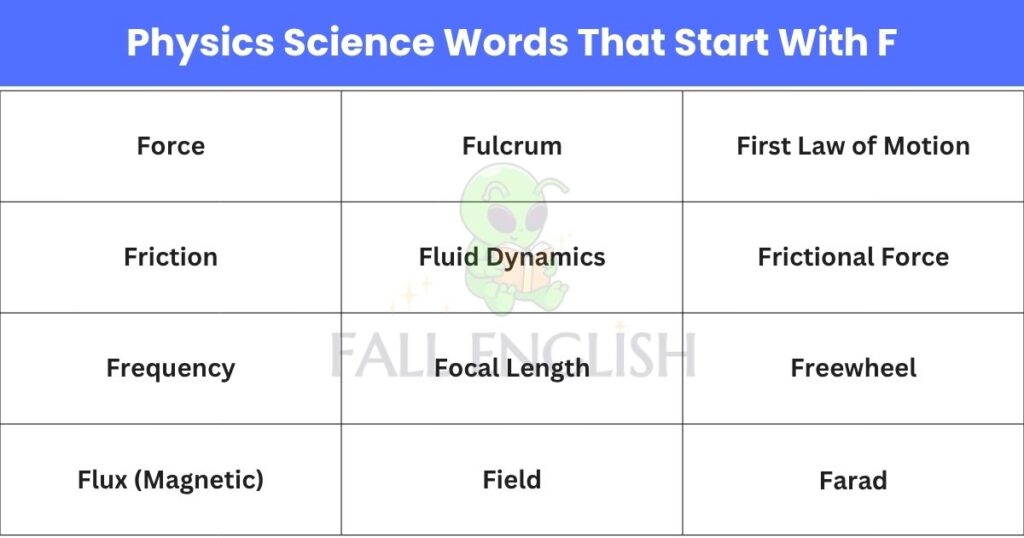
Physics studies energy, motion, forces, and matter. Some of the most foundational scientific terms in all of science live right here.
Force — Every time something moves, stops, or changes direction, a force is involved. Push a book off a table — that’s force. A car braking — force too. Measured in Newtons (N).
Friction — Slide your hand across a desk. That resistance? Friction. It acts opposite to motion. Without it, walking would be impossible and screws would never hold.
Frequency — How many times a wave completes one full cycle per second. Measured in Hertz (Hz). High frequency means higher pitch sound or more energetic light.
Flux (Magnetic) — The amount of magnetic field passing through a given area. Engineers use it to design motors and generators.
Free Fall — When gravity is the only force acting on an object. Astronauts in orbit are in continuous free fall — they just keep missing the Earth.
Fulcrum — The pivot point of a lever. Move it closer to the load and lifting gets easier. That’s why a crowbar works.
Fluid Dynamics — The study of how liquids and gases move. Used to design airplane wings, ship hulls, and artificial hearts.
Focal Length — Distance between a lens and the point where light rays meet. Used in cameras, microscopes, and telescopes.
Field — A region where a force acts. Earth has a gravitational field. Magnets create magnetic fields. Invisible but real and measurable.
Farad — The unit of electrical capacitance, named after Michael Faraday. A capacitor measured in farads stores electrical charge.
First Law of Motion — Newton’s rule: an object at rest stays at rest unless a force acts on it. The basis of inertia.
Frictional Force — The specific force produced by friction. It depends on surface type and the weight pressing down.
Freewheel — A mechanical device letting a wheel spin freely in one direction only. Found in bicycle gears.
Chemistry Science Words That Start With F
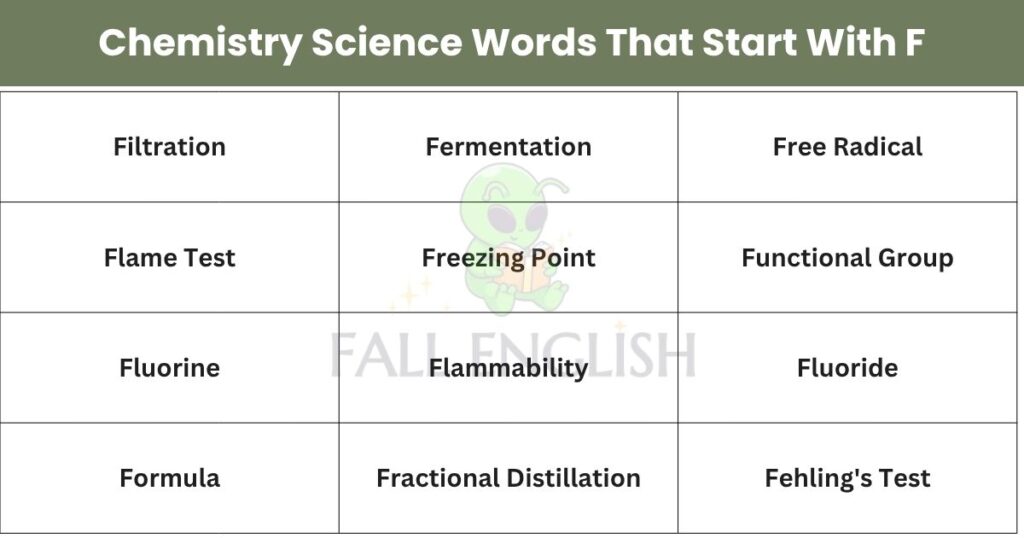
Filtration — A separation method where liquid passes through a filter, trapping solid particles. Making coffee is filtration. So is cleaning drinking water.
Flame Test — A lab technique where a metal compound burns to produce a characteristic color. Copper burns green. Sodium burns bright yellow. Chemistry that looks like fireworks.
Fluorine — The most reactive element on the periodic table. Pale yellow gas. Found in toothpaste as fluoride and in Teflon non-stick coatings.
Formula — Shorthand for a chemical compound. H₂O means two hydrogen atoms, one oxygen. Simple, precise, universal.
Fermentation (Chemistry angle) — Yeast converts sugar into alcohol and carbon dioxide. Bread rises this way. Beer is made this way. The same biology underlies both.
Freezing Point — The temperature where a liquid turns solid. Water freezes at 0°C. Add salt, the point drops — that’s why roads get salted in winter.
Flammability — How easily a substance catches fire. Chemists rate flammability to keep labs and factories safe.
Fractional Distillation — Separating a mixture by exploiting different boiling points. Crude oil refining works this way — petrol, diesel, and kerosene each separate at different temperatures.
Free Radical — An atom or molecule with an unpaired electron. Highly reactive. In the body, free radicals can damage cells. Antioxidants neutralize them.
Functional Group — A specific cluster of atoms in a molecule that controls its chemical behavior. All alcohols share the –OH group, which is why they react in similar ways.
Fluoride — A fluorine compound. Added to most toothpastes because it strengthens tooth enamel and resists decay.
Fehling’s Test — Detects reducing sugars like glucose. The solution turns brick-red when sugar is present. A classic school lab test.
Biology Science Words That Start With F
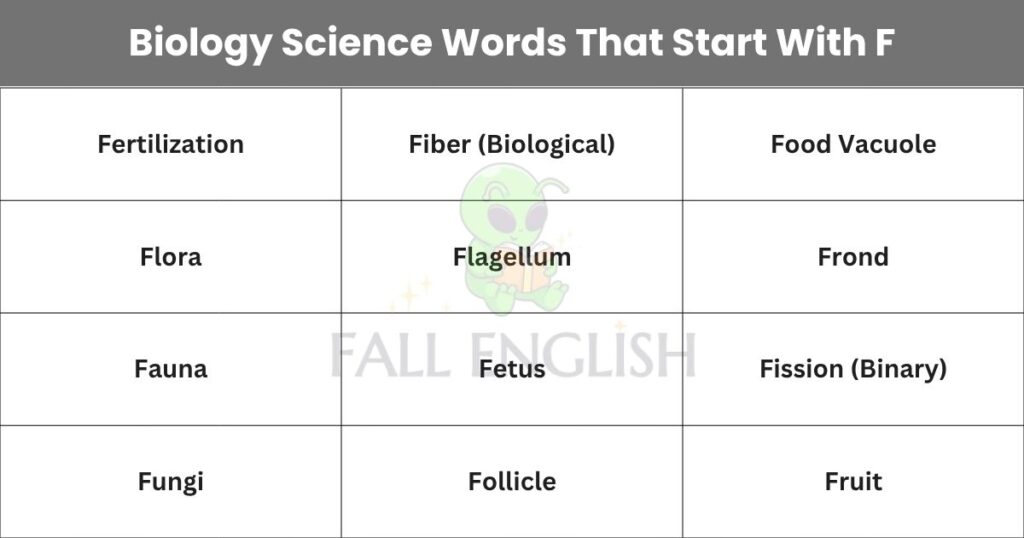
Fertilization — The moment a sperm cell and egg cell fuse. A new cell forms with a complete genetic blueprint. Every sexually reproducing organism begins here.
Flora — All plant species in a specific location. Rainforest flora and desert flora share almost nothing in common.
Fauna — All animal species in a region or time period. Flora and fauna together describe the living composition of any ecosystem.
Fungi — A kingdom of life separate from plants and animals. Mushrooms, mold, and yeast are all fungi. They decompose dead material and return nutrients to soil.
Food Chain — The sequence of who eats whom. Grass → grasshopper → frog → hawk. Energy transfers at each step.
Food Web — A realistic map of feeding relationships — multiple overlapping food chains showing the complexity of real ecosystems.
Fiber (Biological) — Thread-like structures in plant cell walls and animal muscles. Dietary fiber keeps the digestive system running well.
Flagellum — A whip-like tail helping cells move. Sperm cells use flagella to swim. Many bacteria do too.
Fetus — The stage of mammalian development after the embryo. In humans, from week 9 of pregnancy until birth.
Follicle — A small cavity or sac in the body. Hair follicles anchor hair to the scalp. Ovarian follicles contain developing eggs.
Fermentation (Biology angle) — Cells produce energy without oxygen through anaerobic respiration. When muscles work hard and run low on oxygen, lactic acid fermentation kicks in — that burning feeling is the result.
Fossil — Preserved remains or traces of ancient organisms. Fossils reveal creatures that lived millions of years before humans existed.
Food Vacuole — A temporary organelle in single-celled organisms that digests food particles. A stomach inside a single cell.
Frond — The leaf of a fern or palm. Ferns don’t have typical leaves — their fronds are large and feathery.
Fission (Binary) — How bacteria reproduce. One cell splits into two identical cells. One bacterium can become millions within hours.
Fruit — The mature ovary of a flowering plant, containing seeds. Tomatoes, cucumbers, and peppers are scientifically fruits — not just apples and oranges.
Filament (Flower) — The slender stalk holding the anther (pollen-producing part) in a flower.
Earth Science Words That Start With F
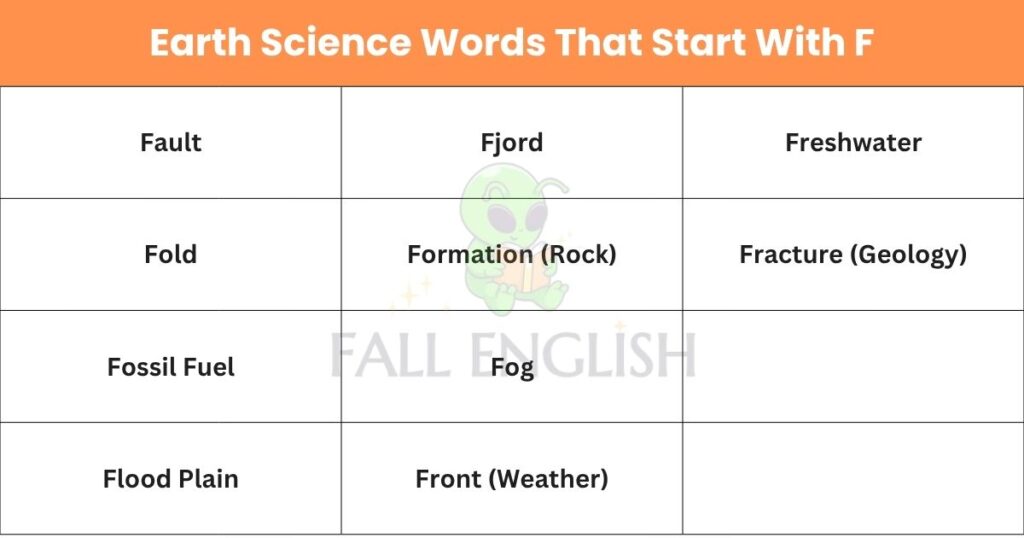
Fault — A fracture in Earth’s crust along which rocks move. Movement along faults causes earthquakes. The San Andreas Fault in California is one of the most studied on Earth.
Fold — Rock layers bending under internal pressure. Mountain ranges often form through folding over millions of years.
Fossil Fuel — Coal, oil, and natural gas formed from ancient organic matter compressed for millions of years. Burning them releases stored carbon into the atmosphere.
Flood Plain — Flat land beside a river that floods when water overflows. Rich in deposited soil — historically prized for farming.
Fjord — A deep, narrow coastal inlet carved by ancient glaciers. Norway’s coastline is defined by them. Steep cliffs rise on both sides.
Formation (Rock) — A body of rock with consistent characteristics. The Grand Canyon exposes hundreds of stacked rock formations like layers in a cake.
Fog — Essentially a ground-level cloud. Forms when moist air cools and water droplets condense near the surface.
Front (Weather) — The boundary between two air masses of different temperatures. Cold fronts bring storms. Warm fronts bring prolonged, gentler rain.
Freshwater — Water with very low salt content. Rivers, lakes, and most groundwater are freshwater. Only about 3% of Earth’s water qualifies.
Fracture (Geology) — A break in rock without significant movement. Different from a fault. Fractures weaken rock structures over time.
Fan (Alluvial) — A fan-shaped sediment deposit where a fast-moving stream slows, typically at a mountain’s base. Common in desert landscapes.
Feldspar — The most abundant mineral group in Earth’s crust. The pink and white material in granite is usually feldspar.
Fluvial — Relating to rivers. Fluvial erosion carved the Grand Canyon over millions of years.
Freezing Rain — Rain that freezes on contact with cold surfaces. Creates dangerous ice sheets on roads and power lines.
Space and Astronomy Science Words That Start With F
Fusion (Stellar) — Stars are powered by hydrogen atoms fusing into helium, releasing the energy we see as sunlight. The sun does this every second.
Flyby — A spacecraft passing close to a planet without orbiting or landing. NASA’s Voyager probes did flybys of Jupiter, Saturn, Uranus, and Neptune.
Solar Flare — A sudden energy burst from the sun’s surface, releasing X-rays and charged particles that can disrupt satellites and power grids on Earth.
Faint Object — Any astronomical body too dim to see without a telescope. Most galaxies from Earth are faint objects.
Fixed Star — A historical term for stars that appear stationary relative to each other, unlike planets. They do move — but the distances make it nearly undetectable over a human lifetime.
Filament (Solar) — A large arc of plasma extending from the sun’s surface, visible during solar eclipses as glowing loops.
Fomalhaut — A bright star about 25 light-years from Earth, notable as one of the first stars found to have a visible debris disk suggesting a developing planetary system.
Fraunhofer Lines — Dark lines in the sun’s spectrum caused by elements absorbing specific light wavelengths. They let scientists identify which elements exist in distant stars without ever visiting them.
Frequency (Electromagnetic) — Different electromagnetic radiation types differ by frequency. Radio waves sit at the low end. Gamma rays at the extreme high end. Visible light falls in the middle.
Medical and Health Science Words That Start With F
Fever — A temporary rise in body temperature as an immune response to infection. The body heats up to make conditions hostile for bacteria and viruses.
Femur — The thigh bone. The longest and strongest bone in the human body, connecting hip to knee.
Fibula — The thinner bone in the lower leg, running alongside the tibia.
Fracture (Medical) — A broken bone. Stress fractures are small cracks from overuse. Compound fractures break through skin. Hairline fractures are tiny cracks without displacement.
Fluoroscopy — Real-time X-ray imaging. Doctors use it to watch moving structures inside the body — a beating heart, or a swallowed object moving through the digestive tract.
Fibromyalgia — A condition causing widespread muscle pain and fatigue not detectable by standard tests. Diagnosed based on reported symptoms.
Follicle-Stimulating Hormone (FSH) — Controls reproductive development. Triggers egg development in females; supports sperm production in males.
Fascia — Connective tissue wrapping around muscles and organs. Fascia injuries are common in runners and athletes.
Fatigue — Extreme tiredness that rest doesn’t always relieve. A symptom of conditions ranging from anemia to thyroid disorders.
Frostbite — Tissue damage from extreme cold. Affects extremities first — fingers, toes, nose, ears. Severe cases require medical treatment.
Fungal Infection — Caused by fungi, not bacteria. Athlete’s foot, ringworm, and thrush are all fungal. Antibiotics won’t treat them — antifungal medication is needed.
Technology and Applied Science Words That Start With F
Fiber Optics — Thin glass or plastic strands carrying light signals. Internet data travels through them at the speed of light — far faster than copper wire.
Frequency Modulation (FM) — Encoding information in a radio wave by varying frequency. FM radio uses this method, producing cleaner audio than AM.
Firmware — Software built directly into hardware. Routers, printers, and keyboards all run firmware — it’s not downloaded, it’s baked in at manufacturing.
Feedback Loop — A system where output circles back and affects input. A thermostat uses negative feedback — too warm, heating shuts off. Positive feedback amplifies output further.
Fracture Mechanics — The engineering science of how cracks form and spread in materials. Critical in designing aircraft, bridges, and pressure vessels safely.
Frequency Response — How a device handles different input frequencies. Speaker manufacturers publish frequency response charts to show which sounds their products reproduce accurately.
Fuel Cell — Converts chemical energy directly into electricity through a hydrogen-oxygen reaction. The only byproduct is water. Used in some buses, spacecraft, and experimental vehicles.
Flux (Soldering) — A material used in welding and soldering to prevent oxidation. Without it, metal joints bond poorly. Distinct from magnetic flux.
Field-Effect Transistor (FET) — A transistor controlled by an electric field. Found in billions of units inside a single computer chip. The backbone of modern electronics.
Easy Science Words That Start With F
For younger students or anyone just entering science vocabulary.
| Word | Simple Meaning |
| Fire | Rapid burning producing heat and light |
| Float | Staying on top of water without sinking |
| Flower | The reproductive part of a plant |
| Food | Substance eaten for energy and growth |
| Freeze | Liquid turning solid by losing heat |
| Fur | Thick hair covering on some animals |
| Fin | A flat limb on fish used for steering |
| Frog | Amphibian living on land and in water |
| Feather | Light structure covering birds |
| Fern | Plant with feathery leaves, no flowers |
| Fish | Cold-blooded animal living in water |
| Flight | Movement through the air |
| Flow | Moving steadily in one direction |
| Flood | Water covering normally dry land |
| Flat | Having an even, level surface |
Advanced Science Words That Start With F
These terms appear in high school, university, or specialized science contexts.
Ferromagnetism — A property of certain materials (iron, nickel, cobalt) allowing strong magnetization. Refrigerator magnets work because of ferromagnetism.
Fluorescence Microscopy — Uses fluorescent dyes to light up specific structures inside cells. Scientists can watch individual proteins moving inside a living cell in real time.
Fourier Transform — A mathematical method breaking a complex signal into individual frequency components. Used in MRI machines, audio processing, and image compression.
Fluid Mechanics — The physics of how fluids behave under various forces. Essential in aeronautics, hydraulics, and cardiovascular medicine.
Fission Products — Radioactive atoms created when a heavy nucleus splits. Managing them safely is one of nuclear engineering’s central challenges.
Nitrogen Fixation — Converting atmospheric nitrogen gas (N₂) into forms plants can absorb. Certain soil bacteria do this naturally. Fertilizer factories replicate it chemically.
Fibrinogen — A blood plasma protein. When bleeding occurs, fibrinogen converts to fibrin — forming the clot that stops the bleeding.
Gibbs Free Energy — A thermodynamic value predicting whether a chemical reaction will proceed spontaneously. Negative value means it happens on its own.
Faraday’s Law — A changing magnetic field induces an electric current. Every electrical generator on Earth operates on this principle.
Frameshift Mutation — A DNA base insertion or deletion that shifts the entire genetic reading frame. A tiny change that scrambles the protein a gene was supposed to produce.
Fick’s Law — Describes how gases move across membranes through diffusion — from high concentration to low. Oxygen crossing from lungs into blood follows this law every breath.
Science Words That Start With F by Grade Level
Grade 3–4 Fire, Float, Flower, Fruit, Fur, Fin, Frog, Fern, Fog, Feather
Grade 5–6 Force, Friction, Fossil, Filtration, Fermentation, Flora, Fauna, Food Chain, Fault, Flood Plain, Fungi, Flame, Fluid, Fiber
Grade 7–8 Frequency, Fission, Fusion, Fertilization, Fluorescence, Fracture, Fossil Fuel, Weather Fronts, Flagellum, Fjord, Fraunhofer Lines
Grade 9–10 Faraday’s Law, Free Radical, Functional Group, Fractional Distillation, Fluid Dynamics, Focal Length, Ferromagnetism, Fibrinogen, Frameshift Mutation
Grade 11–12 and Beyond Fourier Transform, Fick’s Law, Gibbs Free Energy, Field-Effect Transistor, Fluorescence Microscopy, Fission Products, Fluid Mechanics, FRET
The Full List: 210+ Science Words That Start With F
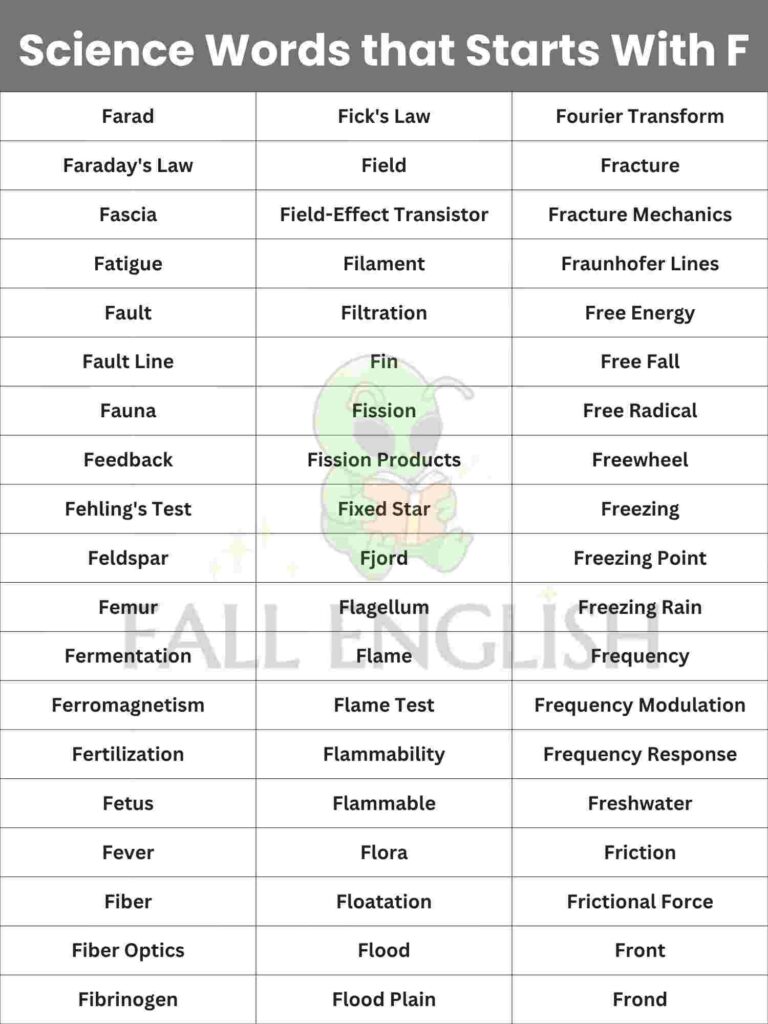
- Farad
- Faraday’s Law
- Fascia
- Fatigue
- Fault
- Fault Line
- Fauna
- Feedback
- Fehling’s Test
- Feldspar
- Femur
- Fermentation
- Ferromagnetism
- Fertilization
- Fetus
- Fever
- Fiber
- Fiber Optics
- Fibrinogen
- Fibromyalgia
- Fibula
- Fick’s Law
- Field
- Field-Effect Transistor
- Filament
- Filtration
- Fin
- Fission
- Fission Products
- Fixed Star
- Fjord
- Flagellum
- Flame
- Flame Test
- Flammability
- Flammable
- Flora
- Floatation
- Flood
- Flood Plain
- Flow
- Fluid
- Fluid Dynamics
- Fluid Mechanics
- Fluorescence
- Fluorescence Microscopy
- Fluoride
- Fluorine
- Fluoroscopy
- Flux
- Flyby
- Focal Length
- Fold
- Follicle
- Follicle-Stimulating Hormone
- Food Chain
- Food Vacuole
- Food Web
- Force
- Formation
- Fossil
- Fossil Fuel
- Fourier Transform
- Fracture
- Fracture Mechanics
- Fraunhofer Lines
- Free Energy
- Free Fall
- Free Radical
- Freewheel
- Freezing
- Freezing Point
- Freezing Rain
- Frequency
- Frequency Modulation
- Frequency Response
- Freshwater
- Friction
- Frictional Force
- Front
- Frond
- Frostbite
- Fruit
- Fuel Cell
- Fulcrum
- Functional Group
- Fungi
- Fungal Infection
- Fusion
- Facilitated Diffusion
- Fahrenheit
- Fallout
- Fatty Acid
- Ferrite
- Ferritin
- Fertile
- Filamentous
- Filter
- Fission Reactor
- Flash Point
- Flint
- Flocculation
- Flow Rate
- Fluorapatite
- Fluorescent Lamp
- Focal Point
- Foliation
- Food Energy
- Force Field
- Fossil Record
- Fragmentation
- Frequency Band
- Friction Coefficient
- Fuel Rod
- Full Moon
- Fulvic Acid
- Functional Anatomy
- Fungicide
- Faculae
- Fahrenheit Scale
- Fascicle
- Fat Cell
- Fatty Acid Oxidation
- Femtosecond
- Ferroelectric
- Field Capacity
- Field Line
- Fimbria
- First Law of Thermodynamics
- Fissure
- Fixative
- Flex
- Flow Cytometry
- Fluorine Cycle
- Foam
- Fractal
- Free Electron
- Freshwater Ecosystem
- Frontal Lobe
- Frost
- Fruit Development
- Fundamental Frequency
- Functional MRI
Common Mix-Ups Worth Knowing
Fission vs. Fusion Fission = splitting (nuclear reactors). Fusion = joining (the sun). Quick fix: Fission shares its “split” identity with the word separate — both have an S and both break things apart. Fusion = fuse = bond together.
Flora vs. Fauna Flora = plants (think: “flora” sounds like “flowers”). Fauna = animals (think: “fawn” — a baby deer).
Frequency vs. Wavelength Higher frequency = shorter wavelength. They move in opposite directions. Picture a jump rope — fast swings (high frequency) create small waves. Slow swings create big, stretched-out ones.
Friction vs. Force Force is the whole category. Friction is one specific type — the one that resists sliding motion. Every friction is a force. Not every force is friction.
Filtration vs. Distillation vs. Evaporation All separate mixtures — but differently. Filtration uses a barrier. Evaporation removes liquid by heating. Distillation captures that evaporated liquid by cooling it. Three tools. Three different problems.
Fluorine vs. Fluoride Fluorine = raw element, reactive gas, dangerous in pure form. Fluoride = compound containing fluorine, safe in small amounts, in your toothpaste right now.
Where These Words Actually Show Up
At the dentist — Fluoride treatment, fracture (dental), fissure sealant
In a weather report — Cold front, warm front, fog advisory, freezing rain, frost warning, flood watch
In a hospital — Fever, femur fracture, fluoroscopy, FSH levels, fibromyalgia diagnosis, frostbite treatment
At a nuclear power plant — Fission reaction, fuel rods, fission products, flux monitoring, feedback control systems
In your kitchen right now — Fermentation (bread rising, yogurt forming), freezing point (ice in your freezer), filtration (coffee brewing), flame (gas stove)
In space missions — Stellar fusion, flyby navigation, electromagnetic frequency for communication, solar flare alerts
In a school science lab — Flame test, filtration setup, Fehling’s test for sugar, lens focal length experiments
In a forest or park — Flora and fauna surveys, food chains, fossil hunting in exposed rock, fern identification, fungal decomposition on fallen logs
Memory Tricks for F Science Words
Force and Friction — Force is the team. Friction is the teammate who always pushes back against movement.
Fission and Fusion — A family breaking up = fission. A wedding = fusion. Two things becoming one.
Frequency — Visualize jumping rope. More jumps per second = higher frequency. Slower jumps = lower frequency.
Filtration — Your morning coffee is a filtration experiment. Water passes through. Grounds stay behind.
Fossil Fuels — Ancient forests and sea creatures buried under rock for hundreds of millions of years, compressed into fuel. Every fill-up at a gas station is ancient biology.
Fluorescence — That yellow safety vest glowing in dim light? Fluorescent material absorbing and re-emitting light.
Free Fall — Astronauts aren’t floating because there’s no gravity. They’re in constant free fall — moving forward so fast they keep missing the planet below.
Read also:
160+ Science Words That Start With C | Full List with Meanings
140+ Science Words That Start With D | Definitions, Examples & Full List
FAQs on Science Words That Start With F
What are the most common Science Words That Start With F?
Some of the most frequently used terms are force, friction, frequency, fossil, filtration, fertilization, fusion, fission, fungi, and fault. These words appear often in middle school and high school science.
What is the difference between fission and fusion?
Both are nuclear processes, but they work in opposite ways. Fission splits a large atomic nucleus into smaller parts and releases energy. Fusion joins small nuclei together and powers stars like the Sun.
Why is force one of the most important science terms?
Force explains how objects move, stop, and change direction. It is one of the first major concepts students learn in physics and helps describe everything from gravity to magnetism.
How can students remember Science Words That Start With F?
The easiest way is to connect each word to real life. For example, coffee making shows filtration, bread rising shows fermentation, and icy roads demonstrate friction and freezing point.
Which school subjects use these F science words?
These terms are used in biology, chemistry, physics, astronomy, earth science, environmental science, and health science. Many also appear in technology and engineering.
Bottom line
Learning Science Words That Start With F helps you understand how the world works, from the forces that move objects to the fusion reactions that power the Sun. Many of these terms are part of everyday life, even if you do not notice them at first. Start with the words you see most often, connect them to real examples, and your science vocabulary will grow naturally over time.

FallEnglish is run by a language enthusiast who explains word and text meanings in clear, simple ways. Each guide is carefully researched, original, and written to help real people understand language faster, with accuracy, context, and everyday examples you can trust.