

Science is full of useful terms, and many important ones begin with the letter C. From cell and carbon to circuit and climate, these words appear in biology, chemistry, physics, earth science, and medicine. This guide to Science Words That Start With C is designed for students, parents, teachers, and English learners who want clear meanings without complicated explanations.
Each word is explained in simple language so you can understand it quickly and remember it longer. Whether you are studying for a quiz, building vocabulary, or helping a child with homework, this list makes science terms easier to learn and use with confidence.
20 Most-Used Science Words That Start With C
Cell — Smallest unit of all living things.
Carbon — Element found in every living organism.
Circuit — Closed path that electric current travels through.
Catalyst — Substance that speeds up a chemical reaction without being consumed.
Condensation — Water vapor cooling and turning into liquid.
Chromosome — Structure inside a cell nucleus that carries DNA.
Compound — Two or more elements chemically bonded together.
Conduction — Heat or electricity moving through direct contact.
Convection — Heat transfer through moving fluid or gas.
Combustion — Reaction between fuel and oxygen producing heat and light.
Carnivore — Organism that eats only other animals.
Coral — Marine animal that builds reef structures.
Comet — Icy space object that develops a bright tail near the Sun.
Crust — Earth’s outermost layer.
Capillary — Smallest blood vessels in the body.
Clone — Genetically identical copy of an organism.
Cytoplasm — Gel-like fluid filling a cell and surrounding the nucleus.
Calcium — Mineral essential for bones, teeth, and nerve function.
Climate — Long-term weather patterns of a region.
Conservation — Protecting natural resources from depletion.
These appear most often across textbooks, tests, and science conversations.
Physics Science Words That Start With C
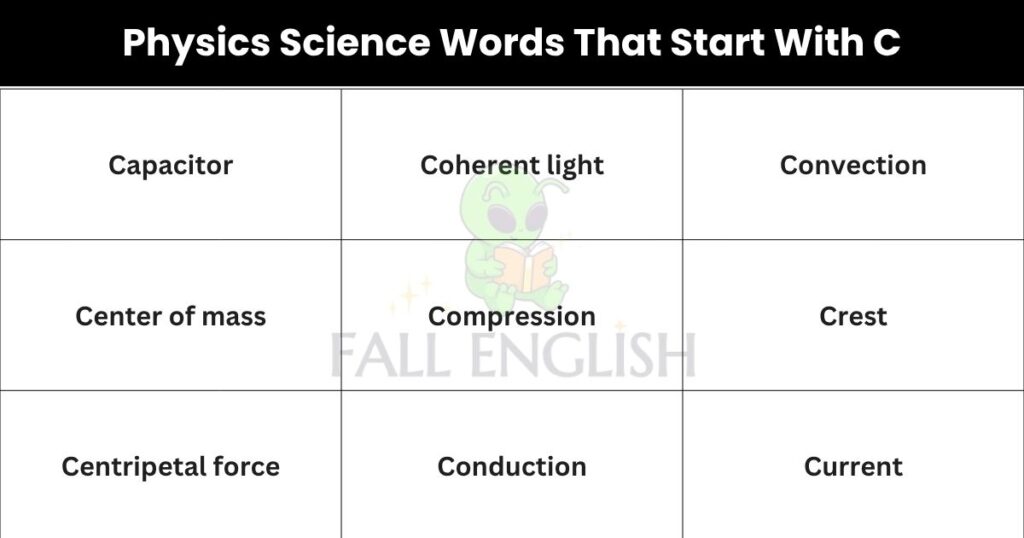
Capacitor — Stores electrical energy temporarily. Found inside cameras, computers, and radios.
Center of mass — The single point where an object’s weight is perfectly balanced. Explains why things tip or stay upright.
Centripetal force — The inward pull keeping an object moving in a circle. A ball swinging on a string stays in orbit because of this force.
Coherent light — Light waves moving in the same direction and phase together. Lasers produce coherent light.
Compression — A force pushing particles of a material closer together. Important in sound waves and structural engineering.
Conduction — Heat or electricity moving through direct material contact. A metal spoon in hot soup heats up through conduction.
Convection — Heat moving through a fluid in circular patterns. Hot water rises, cool water sinks — that cycle is convection.
Crest — The highest point of a wave. The opposite end is called the trough.
Current — The flow of electric charge through a conductor. Measured in amperes.
Circuit — A closed loop allowing electricity to travel from source through components and back again.
Chemistry Science Words That Start With C
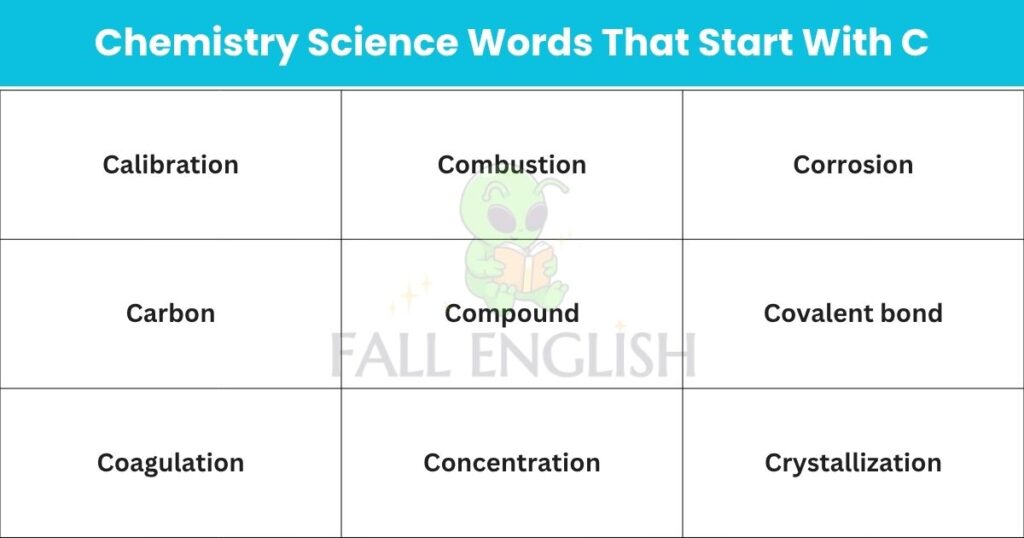
Calibration — Adjusting a measuring instrument so its readings are precise. Every lab tool must be calibrated before use.
Carbon — The backbone of organic chemistry. Present in all living organisms and thousands of compounds.
Coagulation — When a liquid thickens and clumps. Blood does this at a wound site to stop bleeding.
Combustion — Fuel reacting with oxygen to release heat and light. Car engines and candles both run on combustion.
Compound — Two or more elements chemically bonded into a new substance. Water (H₂O) is the most familiar example.
Concentration — How much solute is dissolved in a solution. High concentration means more particles packed into the same volume.
Corrosion — Gradual breakdown of metal through chemical reaction. Iron rusting in air is the clearest example.
Covalent bond — Two atoms sharing electrons to form a stable connection. Most molecules in living things use covalent bonds.
Crystallization — Atoms arranging themselves into a repeating, ordered structure as a substance cools or evaporates. Salt crystals and snowflakes both form this way.
Catalyst — A substance that speeds up a reaction without being used up in the process. Enzymes in digestion are biological catalysts.
Biology Science Words That Start With C
Camouflage — Color or pattern that helps an animal blend into surroundings. Octopuses and stick insects use it to hide from predators.
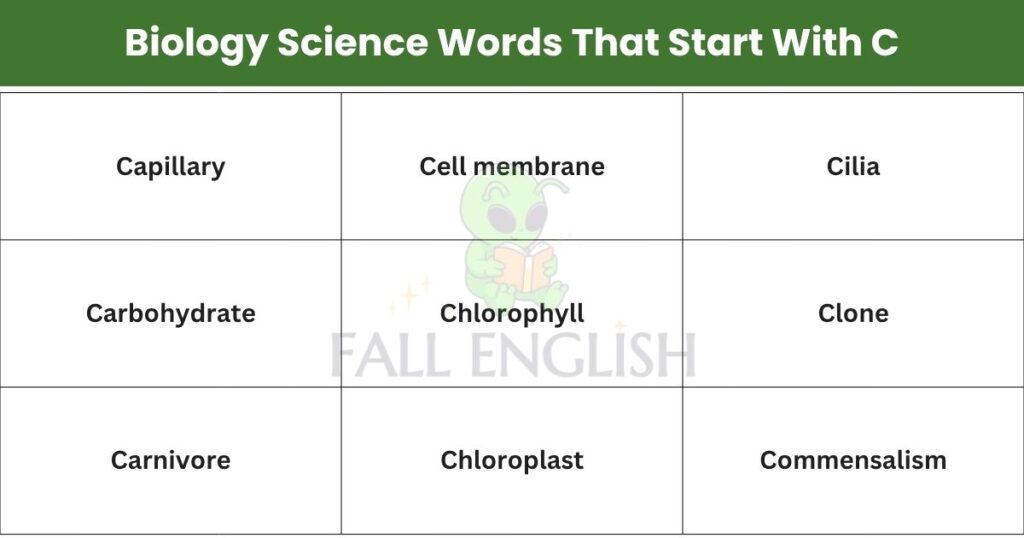
Capillary — The tiniest blood vessels — narrow enough that blood cells pass through single file. Oxygen and nutrients cross through capillary walls into body tissues.
Carbohydrate — A primary energy source. Bread, rice, and fruit are rich in carbohydrates; the body breaks them into glucose for fuel.
Carnivore — An animal that eats exclusively other animals. Lions, sharks, and eagles fall into this category.
Cell — The basic unit of life. Some organisms consist of just one cell; a human body contains roughly 37 trillion.
Cell membrane — A thin, flexible layer surrounding every cell. It decides what enters and what stays out.
Chlorophyll — The green pigment in plant leaves. Captures sunlight and makes photosynthesis possible.
Chloroplast — The organelle inside plant cells where photosynthesis takes place. Think of it as the cell’s built-in solar panel.
Chromosome — A tightly coiled structure carrying DNA inside the cell nucleus. Humans have 46 chromosomes total — 23 pairs.
Cilia — Tiny hair-like projections on cell surfaces. They sweep materials past the cell or help single-celled organisms move.
Clone — A genetically identical copy of an organism. Dolly the sheep, cloned in 1996, was the first mammal cloned from an adult cell.
Commensalism — A relationship between two species where one benefits and the other is completely unaffected.
Conifer — A cone-bearing tree like pine or spruce. Most conifers keep their leaves year-round and tolerate cold climates well.
Cortex — The outer layer of an organ. The cerebral cortex — the wrinkled outer surface of the brain — handles thinking, language, and sensory processing.
Cytoplasm — The gel-like substance filling a cell between the membrane and nucleus. It holds the cell’s organelles in place.
Earth Science Words That Start With C
Canyon — A deep, steep-walled valley carved by a river over thousands of years. The Grand Canyon is 277 miles long and over a mile deep.
Climate — The average weather conditions of a region measured across decades. Different from a single day’s weather.
Condensation — Water vapor in the air cooling and turning to liquid droplets. Morning dew on grass is condensation.
Conglomerate — A sedimentary rock made of rounded fragments cemented together by finer material.
Continental drift — The theory that Earth’s continents were once a single landmass that slowly separated over millions of years.
Coral reef — A massive underwater structure built by coral animals over centuries. Among the most biodiverse ecosystems on Earth.
Core — Earth’s center. The inner core is solid iron and nickel; the outer core is liquid and generates Earth’s magnetic field.
Crater — A bowl-shaped depression from a volcanic eruption or meteorite strike.
Crust — The solid outer layer of Earth. Continental crust under land is thicker; oceanic crust under the sea is thinner and denser.
Current (ocean) — Large-scale movements of seawater driven by wind, temperature, and salinity differences. The Gulf Stream is one of the most powerful.
Cyclone — A large rotating storm system. Called a hurricane in the Atlantic, a typhoon in the Pacific — same phenomenon, different names.
Space & Astronomy Science Words That Start With C
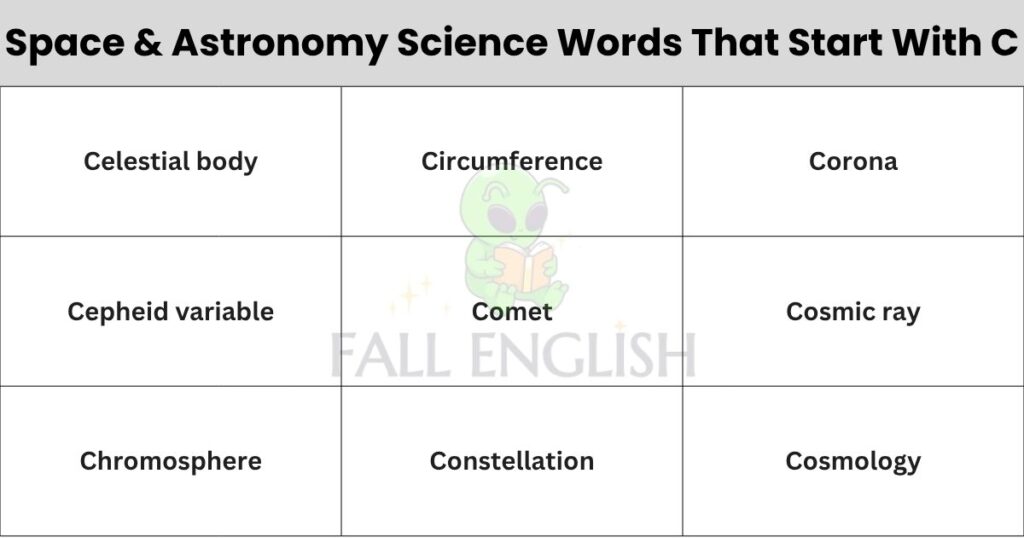
Celestial body — Any natural object in space — stars, planets, moons, and asteroids all qualify.
Cepheid variable — A star that pulses in brightness at regular intervals. Scientists use these predictable pulses to measure distances across the universe.
Chromosphere — The layer of the Sun’s atmosphere just above its visible surface. Appears as a reddish ring during a solar eclipse.
Circumference — The measured distance around a circular object. Used to calculate the size of planets and orbital paths.
Comet — A small, icy body orbiting the Sun. As it gets close, solar heat vaporizes its surface and creates a glowing tail of gas and dust.
Constellation — A group of stars forming a recognizable pattern as seen from Earth. Orion and Cassiopeia are among the best known.
Corona — The Sun’s outermost atmospheric layer, visible during a total solar eclipse as a glowing halo.
Cosmic ray — High-energy particles — mostly protons — traveling through space at nearly the speed of light.
Cosmology — The scientific study of the origin, structure, and eventual fate of the universe.
Crater — A large circular depression on the surface of a moon or planet, formed by meteorite impact.
Medical & Health Science Words That Start With C
Cardiac — Relating to the heart. A cardiac arrest is when the heart stops pumping blood entirely.
Cartilage — Flexible connective tissue at bone joints and in structures like the ears and nose. Softer than bone but tougher than muscle.
Cataract — Clouding of the eye’s lens that causes progressively blurry vision. Correctable with surgery.
Cerebral cortex — The brain’s outer layer responsible for reasoning, memory, language, and sensory interpretation.
Cerebrospinal fluid — Clear liquid that cushions and protects the brain and spinal cord from physical shock.
Chemotherapy — Cancer treatment using drugs that target and destroy rapidly dividing cells throughout the body.
Coagulation — Blood clotting. Without this process, even a small cut could cause dangerous blood loss.
Concussion — A brain injury from a sudden blow or jolt to the head. Symptoms include confusion, headache, and memory gaps.
Cornea — The transparent front surface of the eye. It refracts light entering the eye before it reaches the lens.
Cortisol — A hormone the body releases during stress. Helpful in short bursts; harmful when chronically elevated.
Technology & Applied Science Words That Start With C
Cable — A bundle of wires or optical fibers transmitting electricity or data.
Capacitor — A component that stores and releases electrical charge in a circuit. Critical in nearly all electronic devices.
Compiler — Software that converts human-written code into instructions a computer processor can execute.
Composite material — A material made by combining two or more substances to get properties neither has alone. Carbon fiber is a common example.
Conductivity — A material’s ability to carry heat or electricity. Copper has very high electrical conductivity.
Coolant — A fluid that absorbs and carries away heat from engines or industrial machinery to prevent overheating.
CPU (Central Processing Unit) — The processor that carries out every instruction a computer program gives. Often called the computer’s brain.
Cryptography — The science of encoding information so only intended recipients can read it. The foundation of online security.
Cybersecurity — The practice of protecting digital systems, networks, and data from unauthorized access or attack.
Science Words That Start With C — By Grade Level
Grade 3–5
Cloud, Cold, Color, Copper, Cactus, Cave, Caterpillar, Crop, Carbon dioxide, Coral
Grade 6–8
Compound, Catalyst, Condensation, Chromosome, Chlorophyll, Combustion, Climate, Canyon, Convection, Conduction
Grade 9–10
Covalent bond, Chloroplast, Capillary, Commensalism, Cortex, Constellation, Cardiac, Corrosion, Cytoplasm, Crystallization
Grade 11–12 and Above
Chromatography, Centriole, Cytogenetics, Chirality, Cryogenics, Chemosynthesis, Catecholamine, Complementary base pairing, Cosmology, Cepheid variable
Advanced Science Words That Start With C
Catecholamine — A group of neurotransmitters including adrenaline and dopamine. Released during stress and physical exertion.
Centriole — A small cylindrical structure in animal cells that organizes the process of cell division.
Cerebral cortex — Already defined in Section 7. See medical terms.
Chemosynthesis — Organisms producing food from chemical energy rather than sunlight. Happens near deep-sea hydrothermal vents where no light reaches.
Chirality — A molecule’s property of being non-superimposable on its mirror image. Critical in pharmaceutical chemistry — the wrong mirror version of a drug can be harmful.
Chromatography — A lab technique for separating the components of a mixture based on how fast each moves through a medium.
Complementary base pairing — The rule that adenine bonds with thymine (or uracil), and guanine bonds with cytosine in DNA and RNA. The rule that holds genetic code together.
Cryogenics — The branch of physics studying materials at extremely low temperatures, typically below −150°C.
Cytogenetics — A branch of genetics focused on the structure, function, and behavior of chromosomes.
Cyanobacteria — Ancient photosynthetic bacteria credited with producing the oxygen that transformed Earth’s early atmosphere.
The Complete List — 160+ Science Words That Start With C
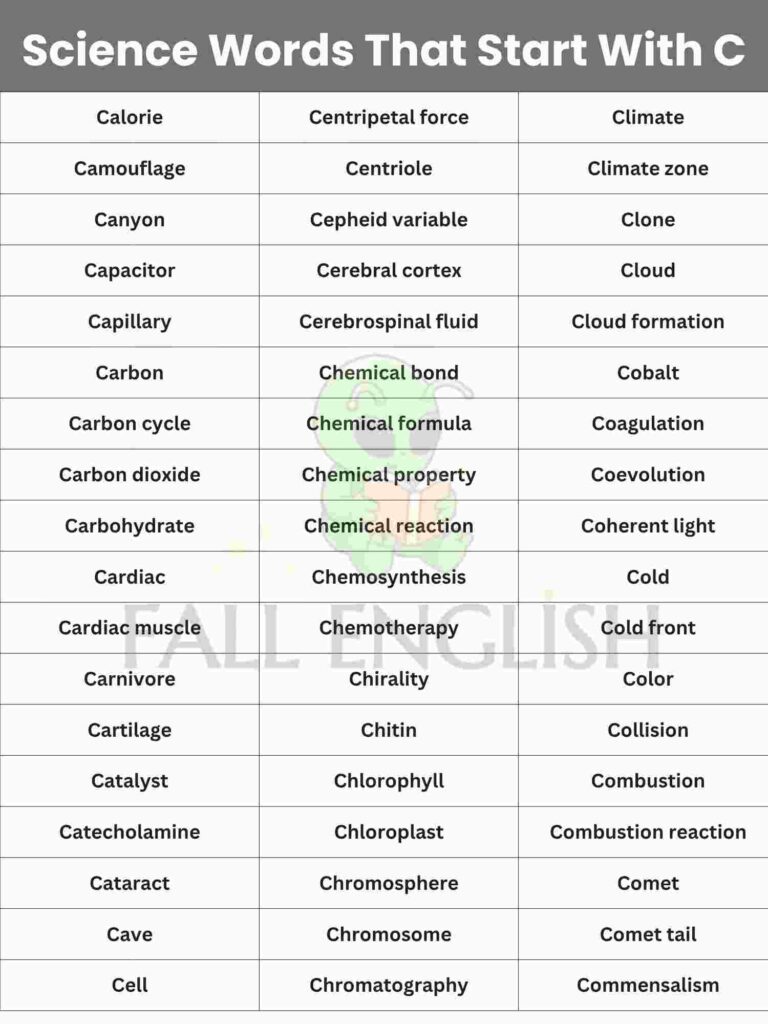
Calorie
Camouflage
Canyon
Capacitor
Capillary
Carbon
Carbon cycle
Carbon dioxide
Carbohydrate
Cardiac
Cardiac muscle
Carnivore
Cartilage
Catalyst
Catecholamine
Cataract
Cave
Cell
Cell division
Cell membrane
Cell nucleus
Cell theory
Celsius
Center of mass
Centripetal force
Centriole
Cepheid variable
Cerebral cortex
Cerebrospinal fluid
Chemical bond
Chemical formula
Chemical property
Chemical reaction
Chemosynthesis
Chemotherapy
Chirality
Chitin
Chlorophyll
Chloroplast
Chromosphere
Chromosome
Chromatography
Cilia
Circuit
Circulation
Climate
Climate zone
Clone
Cloud
Cloud formation
Cobalt
Coagulation
Coevolution
Coherent light
Cold
Cold front
Color
Collision
Combustion
Combustion reaction
Comet
Comet tail
Commensalism
Composite material
Compound
Compound eye
Compound microscope
Compression
Concentration
Concussion
Condensation
Condensation nuclei
Conduction
Conductivity
Conifer
Coniferous forest
Conservation
Constellation
Consumer
Consumer (ecology)
Continental drift
Continental shelf
Controlled experiment
Controlled variable
Convection
Convection current
Convective zone
Coolant
Copper
Core
Coral
Coral bleaching
Coral polyp
Coral reef
Corona
Cornea
Corneal refraction
Corrosion
Cortex
Cortical bone
Cortisol
Cosmic ray
Cosmic background radiation
Cosmology
Cotyledon
Covalent bond
CPU
Crater
Creatine
Creatine phosphate
Crest
Crest amplitude
Crop
Crop rotation
Cross-pollination
Cross-section
Crust
Crustal plate
Crystal lattice
Crystal growth
Crystallization
Cuticle
Cuticle layer
Cyanobacteria
Cyanide
Cyclic AMP
Cyclone
Cytokine
Cytoplasm
Cytogenetics
Cytosine
Cytoskeleton
Cable
Calcium
Calibration
Capillary action
Capillary tube
Clay
Codon
Colloid
Color spectrum
Condensation point
Conduction band
Common Mix-Ups Worth Knowing
Conduction vs. Convection vs. Radiation All three move heat — but through completely different mechanisms. Conduction needs physical contact. Convection requires a moving fluid. Radiation needs nothing — it travels through empty space. Sunlight reaching Earth is radiation.
Climate vs. Weather Weather is what is happening outside right now. Climate is the pattern built from decades of weather data. Confusing them is one of the most common errors in environmental discussions.
Compound vs. Mixture A compound has elements chemically bonded — you cannot separate them physically. A mixture has substances combined without chemical bonding — separating them is possible with physical methods like filtering or evaporation.
Chromosome vs. Gene vs. DNA DNA is the chemical instruction manual. A gene is one specific instruction within that manual. A chromosome is the physical structure that stores and organizes thousands of genes.
Carnivore vs. Consumer Every carnivore is a consumer — but not every consumer is a carnivore. Consumer includes herbivores and omnivores too. In ecology, consumer simply means an organism that gets energy by eating other organisms.
Where These Words Actually Show Up
In hospitals — Cardiac, Coagulation, Cortisol, Calcium, Concussion, Cornea, Cartilage, Cerebrospinal fluid, Chemotherapy
In a biology classroom — Cell, Chromosome, Chlorophyll, Chloroplast, Cytoplasm, Camouflage, Clone, Commensalism
In a chemistry lab — Catalyst, Combustion, Concentration, Corrosion, Crystallization, Chromatography, Calibration
In space research — Comet, Constellation, Corona, Cosmic ray, Cosmology, Cepheid variable, Chromosphere
In environmental science — Coral reef, Climate, Conservation, Carbon dioxide, Continental drift, Cyclone
In everyday technology — Circuit, CPU, Cable, Capacitor, Conductivity, Cryptography, Coolant
Memory Tricks for C Science Words
Catalyst = The helper that never gets tired. It speeds up reactions but stays unchanged. Think of a sports referee — essential to the game but not a player.
Condensation = Cold surface + warm humid air = water appears. That wet glass on a hot day is not sweating — it is condensation.
Chromosome = A DNA storage package. Each chromosome is tightly wound genetic material. Humans carry 46 of these packages in nearly every cell.
Covalent = “Co” means together. Two atoms sharing electrons — neither gives, neither takes, both share equally.
Convection = Hot rises, cold falls — always circular. Picture a lava lamp. That slow looping movement is convection.
Carnivore — remember “carne.” The Spanish and Latin word for meat. Once that root is locked in, the word never slips.
Corrosion = Slow chemical destruction. Rust is the obvious image — but corrosion happens to many metals, just at different speeds.
Read more:
190+ Science Words That Start With B | Full List with Meanings
250+ Science Words That Start With A | Full List with Meanings
FAQs
What are the most important science words that start with C for students?
The most common ones are cell, carbon, circuit, catalyst, condensation, chromosome, compound, climate, and carnivore. These words appear often in middle school science lessons and tests.
Why is “cell” one of the most important science words?
A cell is the basic unit of life. Every living thing is made of one or more cells, so understanding this word helps in nearly every biology topic.
How can students remember difficult science words?
Learn each word with a real example. For instance, think of water drops on a cold glass to remember condensation, or a lion to remember carnivore.
Are these words used outside school?
Yes. Terms like climate, cardiac, circuit, calcium, and concussion are common in weather reports, hospitals, technology, and daily life.
Which Science Words That Start With C appear most in exams?
Students often see cell, chromosome, compound, catalyst, combustion, condensation, convection, and climate in school assessments.
Bottom line
Learning Science Words That Start With C helps you understand the language used in textbooks, classrooms, and everyday life. Some words describe tiny parts of cells, while others explain weather, space, and technology. Start with the common terms, review the examples, and return to the list whenever you need a quick explanation. When science words are easy to understand, studying becomes less stressful and much more enjoyable.

FallEnglish is run by a language enthusiast who explains word and text meanings in clear, simple ways. Each guide is carefully researched, original, and written to help real people understand language faster, with accuracy, context, and everyday examples you can trust.