

When you write “her upbringing shaped who she became” or “his difficult upbringing left lasting marks,” the word upbringing does a specific job. It refers to the whole experience of being raised — the values taught, the environment, the parenting, the early influences. But sometimes the word feels repetitive, too casual for a formal essay, or not quite precise enough for what you mean.
The wrong replacement can quietly shift your meaning. “Childhood” is not the same as “upbringing.” “Background” carries different weight. Choosing well matters more than finding any substitute that fits the space.
The Best Another Word for Upbringing, and When to Use Each
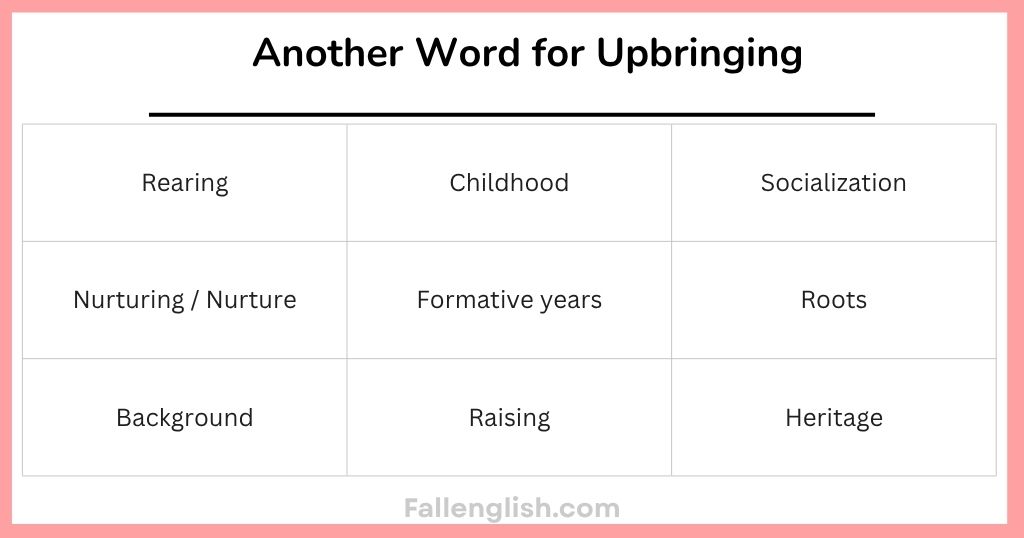
Rearing
This is the closest true synonym. It refers directly to the process of raising a child, covering care, discipline, and guidance over time. It’s a slightly formal word, more common in written English than in speech. Works well in academic writing, sociology, or any context where you want precision without emotional color.
Example: “The study examined how rearing practices differ across cultures.”
Nurturing / Nurture
Points specifically to the care and emotional support given during childhood. It carries warmth and tends to suggest positive attention. It doesn’t cover strict discipline or negative environments as naturally as “upbringing” does.
Example: “Her nurture gave her the confidence to take risks later in life.”
Use “nurture” when you want to emphasize love, support, and emotional development. Avoid it when the context is neglect or harsh conditions.
Background
Broader than upbringing. It includes family history, social class, culture, education, and more. If someone had “a working-class background,” that covers far more than just how they were raised — it implies a whole social context.
Example: “Candidates from every background were encouraged to apply.”
Use “background” when you mean the full picture of someone’s origins, not just the parenting they received.
Childhood
Refers to the period of time, not the process of being raised. A person can have a happy childhood but a strict upbringing, or a difficult childhood within a warm and caring upbringing. They overlap but are not interchangeable.
Example: “He spent his childhood in rural Scotland.”
Choose “childhood” when you mean the early years of life as a time, not the values or parenting involved.
Formative years
A phrase, but a useful one. It highlights the period when character, beliefs, and habits are shaped. It works well in reflective or biographical writing. The phrase implies that the experiences during that time had lasting impact.
Example: “Her formative years were spent between two very different households.”
Raising
More conversational than “rearing.” Common in everyday speech: “She had a tough raising.” Works naturally in dialogue or informal writing. In formal writing, it can sound slightly colloquial.
Example: “His raising didn’t prepare him for city life.”
Socialization
A more academic and sociological term. It refers to the process by which a person learns the norms, values, and behaviors of a society — usually through family, school, and community. It’s broader and more technical than “upbringing.”
Example: “Early socialization plays a large role in shaping a child’s worldview.”
Use this in academic or professional contexts. It would sound clinical in personal or creative writing.
Roots
Figurative, but widely understood. Points to a person’s origins, family, culture, and place. More emotional and identity-centered than “upbringing.” Often used when someone reflects on where they came from.
Example: “Despite moving away, she stayed connected to her roots.”
Heritage
Refers to the cultural, ethnic, or family traditions passed down through generations. It’s not a direct synonym for “upbringing,” but it works when the focus is on inherited values and cultural identity rather than parenting practices.
Example: “His heritage influenced everything from his cooking to his faith.”
Where Similar Upbringing synonyms Diverge
Several of these words get used as if they mean the same thing, but each puts the weight in a different place.
Upbringing vs. rearing: Nearly identical in meaning, but “rearing” feels slightly more clinical or formal. You’d see “rearing” in a psychology paper; “upbringing” fits better in personal narratives or journalism.
Upbringing vs. background: “Upbringing” is about how you were raised. “Background” is about everything that surrounds your origins — class, culture, education, family history. Background is always wider.
Upbringing vs. childhood: One is a process, the other is a time. Your upbringing is what was done and taught. Your childhood is when it happened. These overlap heavily, but they are not synonyms. Replacing one with the other can bleed meaning from your sentence.
Nurture vs. socialization: Both involve how environment shapes a person, but “nurture” is warmer and more personal. “Socialization” is cooler, more structural, and belongs in academic writing. Using “socialization” in a personal essay would feel stiff.
Upbringing synonyms That Look Right But Can Mislead
Upbringing → “breeding”
“Breeding” was used historically in the same way as “upbringing,” especially in British English (“a person of good breeding”). Today it sounds either archaic or condescending in most contexts. Outside of formal historical writing or conscious stylistic choice, avoid it.
Upbringing → “conditioning”
“Conditioning” suggests deliberate, often manipulative shaping — think behavioral psychology or control. It carries a negative charge. You wouldn’t say “his warm conditioning gave him strong values.” Save it for contexts where control or programming is the actual idea.
Upbringing → “origin”
“Origin” refers to where something comes from, not how it was shaped. A person’s origin might be a specific city or country. Using “origin” instead of “upbringing” removes all the parenting and values from the picture.
Upbringing → “development”
“Development” is a process word that could apply to anything growing or changing — a business, a skill, a photograph. Without more context, it doesn’t carry the specific meaning of being raised by people in a home environment.
Quick Decision Guide for Another Word for Upbringing
| If you mean… | Use… |
| The process of being raised, generally | upbringing or rearing |
| Emotional care and warmth during childhood | nurture or nurturing |
| The full picture of social and family origins | background |
| The early years as a period of life | childhood or formative years |
| Cultural and family traditions passed down | heritage |
| The academic/sociological process of socialization | socialization |
| Identity rooted in place, culture, or family | roots |
Upbringing synonym Tone Check
Most of these words sit in neutral-to-formal territory. “Upbringing” itself is fairly neutral and works across most registers. “Rearing” and “socialization” lean formal. “Raising” and “roots” lean casual or conversational. “Heritage” and “nurture” carry positive warmth. “Conditioning” carries negative weight.
If you’re writing a college essay, a biography, or a social work report, “rearing,” “formative years,” or “socialization” will land well. If you’re writing a novel or a personal reflection, “upbringing,” “roots,” or “nurture” will feel more natural.
Read also:
Another Word for Superstition: Choosing the Right One for Your Context
Another Word for Craziest: Words That Actually Work
A Practical Final Note
The most common mistake with this word isn’t choosing a bad synonym — it’s choosing a word that’s close in meaning but different in focus. Before swapping “upbringing” for anything else, ask what part of the idea matters most in your sentence: the parenting, the time period, the environment, the culture, or the emotional experience. That question will lead you to the right word faster than any list will.

FallEnglish is run by a language enthusiast who explains word and text meanings in clear, simple ways. Each guide is carefully researched, original, and written to help real people understand language faster, with accuracy, context, and everyday examples you can trust.