

Powerful is one of those words that works in almost any sentence — which is exactly why it can start to feel vague. Whether you’re writing about a person, an argument, a machine, or a moment, here are the alternatives that actually carry weight.
Quick Answer
The most useful replacements depend on what kind of power you mean:
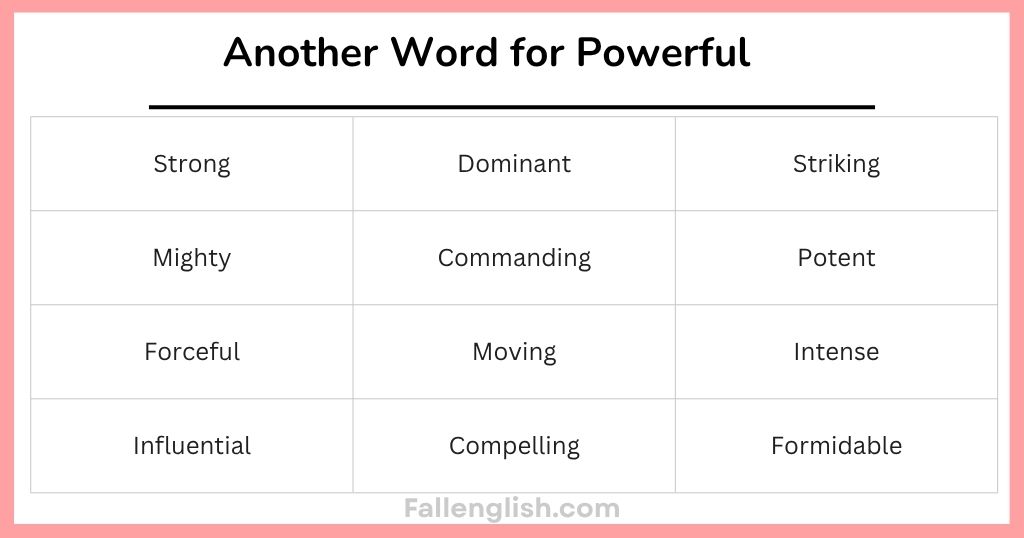
- Strength or force → strong, mighty, forceful
- Influence or authority → influential, dominant, commanding
- Emotional or artistic impact → moving, striking, compelling
- Scale or capacity → potent, intense, formidable
None of these are clean swaps for every use. The right word depends on what is being described and what you want the reader to feel.
The Core Problem with “Powerful”
Powerful does too many jobs. It can describe a car engine, a speech, a political figure, a drug, and a piece of music — all correctly. That versatility is a strength in casual use, but in careful writing it can leave the reader unsure exactly what you mean. Replacing it forces you to commit to one dimension of power: force, influence, size, emotional effect, or authority.
That commitment is usually an improvement.
Another Word for Powerful by What You Actually Mean
When you mean physical force or strength
Strong is the simpler, more direct choice. It works for people, structures, and materials. A strong grip. A strong current. A strong foundation. It lacks the dramatic weight of powerful but sounds more natural in everyday writing.
Mighty carries a sense of scale — something large enough to impress. It leans slightly archaic or literary, which makes it feel at home in storytelling or formal oratory (a mighty river, a mighty empire) but awkward in business writing or journalism.
Forceful narrows the focus to applied energy — something moving against resistance. A forceful shove. A forceful argument. It implies deliberate effort in a way that powerful doesn’t always.
When you mean influence, authority, or control
Influential shifts the meaning from raw power to effect on others. A powerful person has power; an influential person changes what others think or do. If that distinction matters to your sentence, influential is the more precise word.
Dominant suggests control over competition or surroundings — the most powerful by comparison. The dominant player in the market. The dominant species. It carries a slightly competitive edge that powerful lacks.
Commanding implies authority that others naturally defer to. It works well for leaders, voices, or presences. A commanding voice. A commanding lead. The word suggests something about the effect on other people, not just the quality itself.
When you mean emotional or artistic impact
This is where powerful gets replaced most often in writing — and most often replaced badly, with a word that is merely stronger, not more accurate.
Moving describes something that produces an emotional response. A speech, a film, or a scene can be moving without being physically powerful or politically influential. The word points inward, toward the audience’s feeling.
Compelling suggests that the reader or viewer cannot look away — there’s an intellectual or emotional pull. A compelling argument. A compelling performance. It works well when you want to convey that something holds attention rather than simply affecting emotion.
Striking emphasizes the immediate, almost physical impression something makes. A striking image hits you before you process it. It’s useful for visual or sensory descriptions but feels thin when applied to an argument or idea.
When you mean scale, potency, or capacity
Potent works well for concentrated effects — a potent drug, a potent symbol, a potent combination of factors. It suggests that a small amount produces a large result, which gives it a precision powerful lacks.
Intense focuses on degree rather than force or influence. An intense pain isn’t necessarily powerful, but it is strong in its immediate effect. Useful when you want to convey how something feels rather than what it can do.
Formidable describes something that inspires respect or wariness — impressive enough to seem difficult to challenge. A formidable opponent. A formidable task. It implies both power and resistance. You wouldn’t call a sunset formidable.
Where These Words Break Down
A common mistake is treating the most dramatic-sounding replacement as the best one. Mighty sounds bigger than powerful, but it belongs to a slightly different register — one that works in epic storytelling and sounds forced in a business memo.
Another trap: using influential when you mean powerful, or vice versa. They overlap, but a powerful figure and an influential figure are not the same thing. Influence is measured by what changes around you. Power can exist without producing any visible change at all.
Compelling is sometimes used to mean excellent in professional writing (a compelling proposal, a compelling candidate), which can dilute the word’s force. If you use it, make sure it’s doing its specific job — pointing to something that pulls a reader in — rather than simply meaning good or strong.
Read more: Another Word for Fear: Choosing the Right Alternative for What You Mean
Quick Decision Guide on Another Word for Powerful
| What you want to say | Better choice |
| Physically strong, large, or forceful | mighty, forceful, strong |
| Has authority over others | commanding, dominant |
| Changes what people think or do | influential |
| Produces emotional response in an audience | moving, compelling |
| Concentrated effect in a small amount | potent |
| Impressive and hard to challenge | formidable |
| Strong in immediate sensation or feeling | intense |
One Practical Note
Powerful rarely embarrasses you. If you’re writing quickly or speaking aloud, it’s fine. The effort to replace it is most worthwhile when the word has appeared recently in the same piece, when you need the reader to understand exactly what kind of power is at work, or when the sentence calls for a more specific emotional effect. That’s when precision pays off — and any of the words above can deliver it, if you’re choosing the right dimension of power.
Read more:
Another Word for Prevention: Choosing the Right Alternative
Another Word for Furthermore: Smarter Alternatives and When to Use Them

FallEnglish is run by a language enthusiast who explains word and text meanings in clear, simple ways. Each guide is carefully researched, original, and written to help real people understand language faster, with accuracy, context, and everyday examples you can trust.