

You’re midway through writing something, a story, an essay, a blog post, and you notice “superstition” has shown up four times already. You go to swap it out and suddenly realize: every replacement you try either sounds too harsh, too vague, or just plain wrong for the moment.
That’s the real challenge here. It’s not about finding any synonym. It’s about finding the right one for your tone, your reader, and your context.
This guide gives you 34+ genuine alternatives, sorted by how and when they actually work, with enough explanation that you won’t just pick a word, you’ll understand why it fits.
What the Word Really Carries
A superstition is a belief not supported by logic or evidence, usually tied to luck, fate, protection, or unseen forces. But it also carries a quiet judgment. Calling something a superstition implies the speaker thinks it’s unfounded.
That built-in skepticism is exactly why writers need alternatives. Sometimes you want neutral. Sometimes warm. Sometimes clinical. The word you choose shapes how your reader feels about the people holding the belief.
The Full Another Word for Superstition Table (34+ Words)
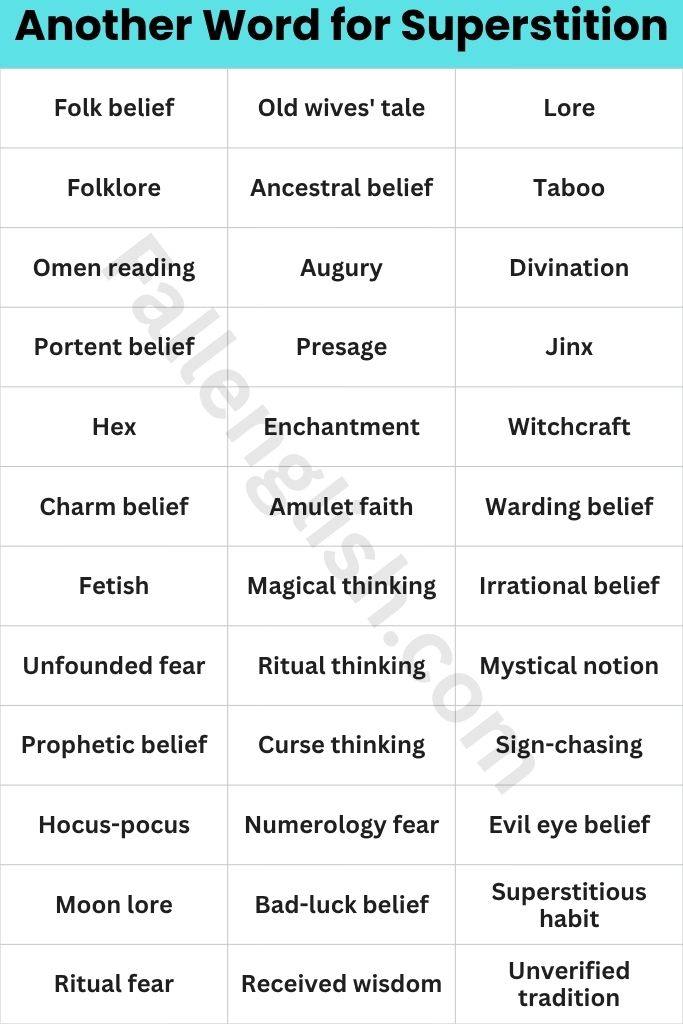
| Word | Tone | Best Used When |
| Folk belief | Neutral / Respectful | Writing about cultural traditions |
| Old wives’ tale | Informal / Light | Casual writing, everyday speech |
| Lore | Warm / Traditional | Storytelling, heritage, community |
| Folklore | Broad / Warm | Shared community stories and customs |
| Ancestral belief | Respectful | Inherited traditions across generations |
| Taboo | Cultural / Formal | Behavioral restrictions in a group |
| Omen reading | Neutral / Observational | Sign-based thinking and interpretation |
| Augury | Formal / Historical | Classical, Roman-era, or literary use |
| Divination | Spiritual / Neutral | Practices like tarot, astrology, or signs |
| Portent belief | Formal / Literary | Signs believed to predict future events |
| Presage | Literary / Rare | Formal prose, foreboding tone |
| Jinx | Casual / Playful | Bad luck beliefs in light writing |
| Hex | Dark / Dramatic | Curses, dark folklore, creative fiction |
| Enchantment | Poetic / Soft | Fantasy, magical atmosphere |
| Witchcraft | Strong / Cultural | Folklore, history, or fiction writing |
| Charm belief | Descriptive | Object-based superstitions, talismans |
| Amulet faith | Descriptive / Specific | Beliefs centered on protective objects |
| Warding belief | Specific | Protection-based superstitious thinking |
| Fetish | Anthropological | Object believed to hold spiritual power |
| Magical thinking | Psychological | Clinical, reflective, or analytical writing |
| Irrational belief | Direct / Critical | Academic critique or debunking content |
| Unfounded fear | Explanatory | Psychological or rational-minded writing |
| Ritual thinking | Neutral | Behavioral pattern descriptions |
| Mystical notion | Curious / Open | Thoughtful, non-judgmental writing |
| Prophetic belief | Neutral / Elevated | Fate or future-sign beliefs |
| Curse thinking | Casual / Creative | Fiction, informal narrative |
| Sign-chasing | Informal / Playful | Gently critical or humorous tone |
| Hocus-pocus | Very Casual | Openly dismissive or comedic writing |
| Numerology fear | Specific | Number-based superstitious patterns |
| Evil eye belief | Cultural / Specific | Mediterranean, South Asian, Middle Eastern traditions |
| Moon lore | Thematic | Lunar-cycle beliefs and customs |
| Bad-luck belief | Clear / Simple | Plain writing, any general audience |
| Superstitious habit | Behavioral | Repeated actions rooted in belief |
| Ritual fear | Descriptive | Fear-driven repeated behavior |
| Received wisdom | Ironic / Gentle | Beliefs passed down as unquestioned truth |
| Unverified tradition | Formal / Neutral | Respectful academic or journalistic use |
Superstition Synonym Meaning Clusters: Not All These Words Are Equal
Sorting by tone isn’t enough. These synonyms also split by what kind of superstition they describe. Getting this right prevents subtle errors.
Luck and Fate-Based Beliefs Superstition Synonyms
Jinx, bad-luck belief, charm belief, warding belief, amulet faith.
These all point to the idea that something, an object, an action, a number, can tilt your luck. They’re concrete and behavioral. When someone avoids the number 13 or carries a lucky coin, this cluster fits perfectly. Casual writing handles these words well.
Community and Heritage Beliefs Superstition Synonyms
Folk belief, folklore, lore, ancestral belief, unverified tradition.
These carry warmth and cultural weight. They don’t mock. They acknowledge that a belief belongs to a group’s shared history. A travel writer describing a village custom, a novelist building a world, a journalist covering a cultural event: all of these reach for words in this cluster.
Sign-Reading and Prophecy Beliefs Superstition Synonyms
Augury, omen reading, presage, portent belief, prophetic belief, divination.
These are older, more literary, and more formal. They belong to beliefs that interpret natural signs as messages. A crow landing on a windowsill. A blood moon before a battle. These words carry gravitas. They work in historical fiction, classical studies, and literary essays.
Psychological and Critical Framing
Magical thinking, irrational belief, unfounded fear, ritual thinking, sign-chasing.
Use these when your writing is examining a belief from the outside, analytically or critically. A psychologist writing about obsessive patterns might use “magical thinking.” A science journalist debunking a widespread fear might say “unfounded fear.” These words are honest, not cruel, but they are clearly skeptical.
Object and Ritual Centered Beliefs Superstition Synonyms
Fetish, enchantment, hex, witchcraft, curse thinking.
These focus on the practice or the physical object rather than the abstract belief. A hex is something done to someone. A fetish is an object holding believed power. Enchantment wraps the belief in atmosphere. These live most naturally in creative writing, folklore studies, and cultural history.
Superstition Synonyms Tone Ladder at a Glance
Sometimes you just need to know how strong a word hits before you use it.
Warmest / Most Respectful:
Ancestral belief, folk belief, lore, cultural tradition, unverified tradition
Neutral and Descriptive:
Folklore, omen reading, ritual thinking, mystical notion, prophetic belief
Mildly Skeptical:
Old wives’ tale, unfounded fear, magical thinking, received wisdom
Openly Critical:
Irrational belief, sign-chasing, hocus-pocus
Clinical or Academic:
Augury, divination, fetish, ritual thinking, magical thinking
This ladder matters. “Folk belief” and “hocus-pocus” technically describe the same thing. But one treats the believer with dignity. The other laughs at them.
Another Word for Superstition in Sentence Rewrites: Same Meaning, Different Feel
Original: “The sailors had a superstition about whistling on deck.”
- Respectful / Warm: “The sailors held a firm piece of seafaring lore against whistling on deck.”
- Formal: “An unverified tradition among sailors prohibited whistling while at sea.”
- Casual: “There was this old jinx sailors swore by: never whistle on deck.”
- Literary: “The deck held its silence by old law, whistling being the sea’s way of calling a storm.”
- Academic: “The crew exhibited ritual thinking around vocalization during active sailing conditions.”
Original: “She had a superstition about breaking mirrors.”
- Cultural: “Her folk belief about broken mirrors ran generations deep in her family.”
- Psychological: “Her discomfort around broken mirrors reflected classic magical thinking.”
- Casual: “She had this bad-luck belief about mirrors, nothing rational, just felt real to her.”
- Literary: “A shattered mirror, in her eyes, was never just glass.”
Each version communicates the same fact. But each one asks your reader to feel differently about the person involved. That’s the whole point of choosing carefully.
Another Word for Superstition Formal vs. Informal: Where Each Word Belongs
Best for academic essays:
Magical thinking, irrational belief, ancestral belief, augury, divination, ritual thinking, unverified tradition
Best for storytelling and fiction:
Lore, hex, enchantment, omen reading, presage, folk belief, curse thinking, portent belief
Best for everyday conversation or casual writing:
Old wives’ tale, jinx, bad-luck belief, sign-chasing, hocus-pocus
Words to avoid in formal contexts:
Hocus-pocus, sign-chasing, curse thinking, jinx. These sound dismissive or too light for serious writing. They undercut your credibility if the subject deserves careful handling.
Superstition Synonyms Common Mistakes Writers Make
Using “myth” as a default replacement. Myth usually implies a story, a narrative with characters and events. “The myth of knocking on wood” sounds strange because knocking on wood is a habit, not a tale. Myth works better when the superstition involves a story behind it.
Reaching for “delusion” too quickly. Delusion is a clinical term suggesting a serious break from reality. Calling someone’s lucky socks a delusion is disproportionate and can read as unkind. Save it for contexts where the belief is genuinely harmful or detached from reality in a significant way.
Treating “legend” and “superstition” as identical. A legend is a story, often about a hero or historical event. It can contain superstitions, but a superstition isn’t automatically a legend. Mixing these up flattens both words.
Using “phobia” loosely. Triskaidekaphobia (fear of 13) is a clinical term. Most everyday superstitions don’t qualify as phobias, which describe debilitating fear responses. Using phobia casually overstates the severity.
Picking “folklore” when you mean one specific belief. Folklore covers an entire tradition: stories, music, customs, and beliefs together. If you mean one specific bad-luck belief, “folk belief” is more precise than “folklore.”
Describing a Superstitious Person
Sometimes the person matters more than the belief. A few ways to say this without sounding harsh:
- Someone shaped by folk belief
- A person who reads signs in everyday events
- Someone prone to magical thinking (works in psychological contexts)
- A person deeply rooted in ancestral tradition
- Someone given to ritual thinking
For single-word options: credulous (believes too easily, formal tone) or superstitious itself remains the clearest descriptor when you’re talking about the person rather than the belief.
Superstition Synonym Related Words That Belong Nearby
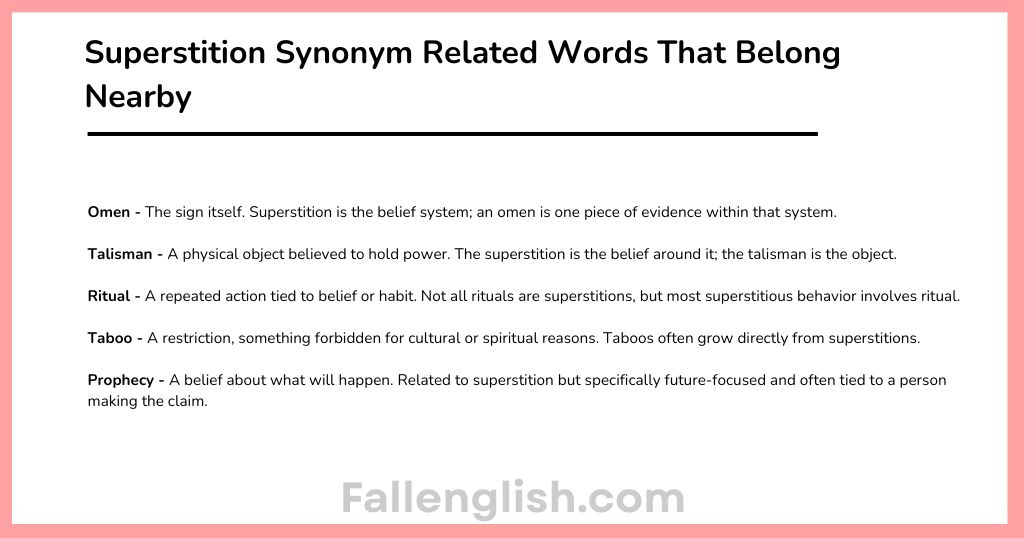
Omen – The sign itself. Superstition is the belief system; an omen is one piece of evidence within that system.
Talisman – A physical object believed to hold power. The superstition is the belief around it; the talisman is the object.
Ritual – A repeated action tied to belief or habit. Not all rituals are superstitions, but most superstitious behavior involves ritual.
Taboo – A restriction, something forbidden for cultural or spiritual reasons. Taboos often grow directly from superstitions.
Prophecy – A belief about what will happen. Related to superstition but specifically future-focused and often tied to a person making the claim.
Antonyms Worth Having Ready
When you want to contrast superstition with something else:
Fact, evidence, reason, logic, science, empirical knowledge, rational thought
A sentence like “Where the elders saw omen, the scientist saw coincidence” creates that contrast cleanly without needing the word superstition at all.
Read more –
69+ Another Word for Audit: Smarter Alternatives for Every Context
34+ Another Word for Vampire: Names, Synonyms, and What They Really Mean
34+ Another Word for “Faced”: Pick the Word That Actually Fits
FAQ’s about Another Word for Superstition
Is “magical thinking” offensive when applied to cultural beliefs?
It can be. The term comes from psychology and implies the thinking is flawed. When describing a sincere cultural or religious practice, it can feel reductive. Use it in reflective or clinical writing, not when describing someone’s heritage with respect.
Can “folklore” fully replace “superstition”?
Not always. Folklore is broader and warmer. It covers stories, songs, and customs alongside beliefs. When the belief is specifically about luck or harm, “superstition” stays more precise. Folklore works when you mean the wider tradition.
What is the difference between a jinx and a superstition?
A jinx is one type of superstition, specifically the belief that something or someone attracts bad luck. Every jinx involves superstitious thinking, but superstition covers far more than jinxes alone.
How do I write about superstition respectfully in academic work?
Use “folk belief,” “ancestral practice,” or “unverified tradition.” Avoid “irrational” unless your argument requires critical analysis. Framing it as a belief system rather than an error shows fairness and academic credibility.
Final Word
Three things decide which synonym fits: your tone, your relationship to the belief you’re describing, and your reader.
Writing with respect for the people behind the belief? Reach for folk belief, lore, or ancestral practice. Writing analytically or critically? Magical thinking or irrational belief gives you precision. Writing fiction where atmosphere matters? Hex, omen, lore, or enchantment carries the right weight.
Every word on this list describes the same human impulse: trying to find meaning and control in an uncertain world. Which word you use tells your reader how you feel about that impulse. Choose accordingly.

FallEnglish is run by a language enthusiast who explains word and text meanings in clear, simple ways. Each guide is carefully researched, original, and written to help real people understand language faster, with accuracy, context, and everyday examples you can trust.