

Something surprising, revelatory, or startling deserves a word that earns the reaction — and “eye-opening” has been stretched so far that it often delivers less than the moment deserves.
Quick Answer
The most useful alternatives depend on what made something eye-opening:
- Revelatory — it revealed something hidden or previously misunderstood
- Illuminating — it shed light on a complex subject
- Startling — it caught you off guard
- Sobering — it forced a serious rethink
- Striking — it made a strong impression
- Thought-provoking — it raised questions you hadn’t considered
None of these is simply “eye-opening with a different face.” Each one says something specific about how you were affected and what kind of insight followed.
Why “Eye-Opening” Often Falls Short
“Eye-opening” has become a reflex word — the kind that fills a gap without shaping meaning. Writers reach for it in book reviews, travel writing, professional reports, and personal essays, where it functions more as a signal of enthusiasm than a description of experience.
The real problem is that the word conflates several distinct reactions:
- Learning something you genuinely didn’t know
- Having a belief challenged or overturned
- Being surprised by scale, severity, or contrast
- Being unsettled in a way that changed your thinking
A single replacement rarely covers all four. The alternatives below are organized around these four situations, so you can match the word to what actually happened.
Another Word for Eye-Opening Comparison at a Glance
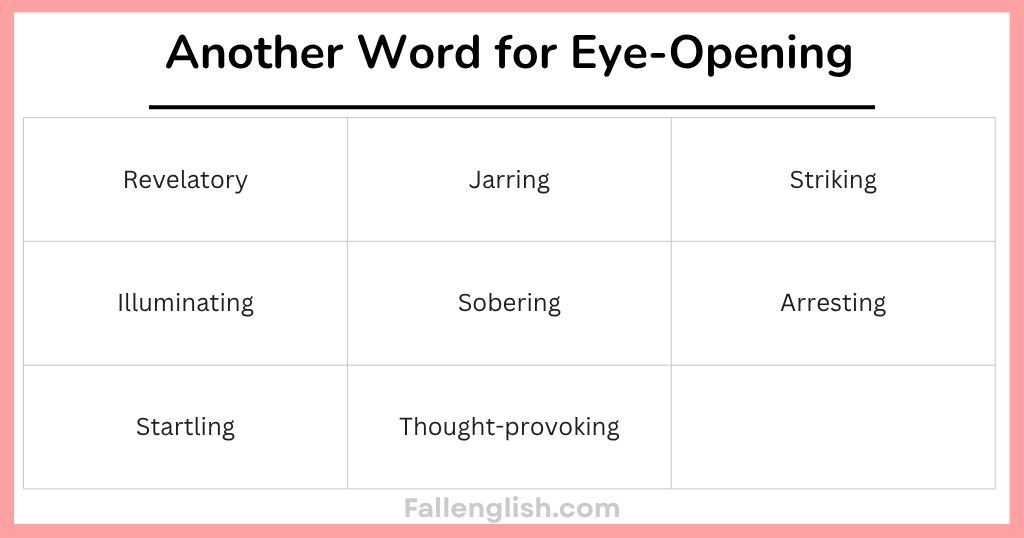
| Word | Best used when | Tone |
| Revelatory | Something hidden or misunderstood became clear | Thoughtful, serious |
| Illuminating | A complex topic became easier to understand | Measured, intellectual |
| Startling | The reaction was sudden surprise | Immediate, slightly urgent |
| Sobering | What you learned was serious or unsettling | Grave, grounded |
| Striking | It made a strong impression on you | Descriptive, versatile |
| Thought-provoking | It raised questions more than answered them | Reflective, measured |
| Jarring | It disrupted what you expected | Blunt, unsettled |
| Arresting | It stopped you — you couldn’t look away or move on | Literary, deliberate |
When Something Was Revealed
Revelatory is the most precise replacement when “eye-opening” means that something concealed, misunderstood, or overlooked finally came into focus.
The documentary was revelatory — it reframed events I thought I already understood.
The word carries intellectual and sometimes emotional weight. It implies that the new understanding matters, not just that the information was surprising. Journalists, critics, and essayists use it when a source, text, or experience genuinely shifts the reader’s picture of something.
Illuminating works when a complicated subject became clearer — rather than a hidden truth being uncovered, a confusing one became comprehensible.
Her explanation of the data was illuminating, particularly for those of us without a statistics background.
“Illuminating” is a warmer, slightly softer word. It’s common in academic writing, feedback, and professional contexts where you want to praise clarity without sounding dramatic.
The difference: revelatory implies something was waiting to be discovered; illuminating implies something was difficult to understand and now isn’t.
Another Word for Eye-Opening When the Reaction Was Surprise
Startling fits when the dominant feeling was being caught off guard — when the information arrived unexpectedly and the initial response was closer to a jolt than an insight.
The statistics were startling: nearly half the participants had no awareness of the policy at all.
It’s not a negative word, but it implies the surprise happened before the understanding. It’s one of the few direct replacements for “eye-opening” when surprise itself is the main point.
Jarring is stronger and leans negative. It suggests the surprise was disorienting or uncomfortable, not just unexpected.
The shift in tone midway through the report was jarring — it felt like a different document entirely.
Use “jarring” when the experience created friction or unease, not just attention.
When What You Learned Was Serious
Sobering is the right word when “eye-opening” doesn’t capture how unsettling or weighty the realization was. It implies that what you learned replaced something lighter — optimism, assumption, or ignorance — with something harder to carry.
Reading the environmental report was sobering. The timeline was far shorter than we had assumed.
This word does work that “eye-opening” cannot. It tells the reader not just that something was surprising, but that it required a serious response. It’s particularly strong in journalism, policy writing, and reflective personal essays.
Another Word for Eye-Opening When It Made You Think Rather Than Conclude
Thought-provoking belongs in a slightly different category. Where most alternatives describe an insight already reached, “thought-provoking” acknowledges that the experience raised questions without necessarily resolving them.
The lecture was thought-provoking, though I’m still not sure I agree with the central argument.
This is often more honest than “eye-opening” or “revelatory,” which imply clarity was achieved. Use “thought-provoking” when you want to describe intellectual engagement without claiming you walked away with answers.
When You Want a Descriptive Word, Not a Reaction Word
Striking is useful when you want to describe how something registered — as strong, notable, vivid — without specifying what kind of impact it had.
The contrast between the two neighborhoods was striking.
It’s versatile and never sounds overblown. Unlike “eye-opening,” which has been worn down through overuse, “striking” still carries descriptive precision.
Arresting is rarer and more literary. It describes something that stopped you entirely — that commanded attention so completely you couldn’t pass over it.
The opening image of the exhibition was arresting — a single photograph that made the rest of the room feel like an afterthought.
Use “arresting” in writing where the language itself is doing more work — creative nonfiction, criticism, literary essays. In a professional email or a school report, it would feel out of place.
Mistakes Worth Avoiding
Using “revelatory” for small surprises. The word carries serious weight. Calling a pizza recommendation “revelatory” damages your credibility as a writer. Save it for experiences that genuinely reframe understanding.
Using “thought-provoking” as pure praise. Writers sometimes use it as a compliment that avoids commitment — “I found it thought-provoking” can mean “I didn’t fully engage with it.” Use it only when the experience genuinely left questions open.
Using “sobering” for anything merely serious. “Sobering” implies a contrast — something that brought you back to reality from a more comfortable position. A fact can be disturbing without being sobering.
Stacking these words. Describing an experience as “revelatory, illuminating, and thought-provoking” in the same sentence signals that none of the words was chosen carefully.
Read also:
Another Word for Campaign: Choosing the Right Alternative for Your Context
Another Word for Risk: Alternatives That Actually Fit Your Meaning
Which Word Fits Your Sentence
| If you mean… | Use this |
| A truth came to light that was hidden before | Revelatory |
| A complex subject suddenly made sense | Illuminating |
| The reaction was mostly surprise | Startling |
| What you learned required a serious response | Sobering |
| It made a strong visual or emotional impression | Striking |
| It raised questions more than answered them | Thought-provoking |
| It disrupted your expectations uncomfortably | Jarring |
| It demanded and held your full attention | Arresting |
The best replacement for “eye-opening” is the one that names the specific shift that happened — in understanding, in expectation, in feeling, or in thinking. The moment you identify which of those actually occurred, the right word usually becomes obvious.

FallEnglish is run by a language enthusiast who explains word and text meanings in clear, simple ways. Each guide is carefully researched, original, and written to help real people understand language faster, with accuracy, context, and everyday examples you can trust.