


Science is full of useful terms, and learning them by letter makes them easier to remember. This guide to Science Words That Start With H brings together important vocabulary from biology, chemistry, physics, astronomy, earth science, and medicine. Each word is explained in clear, simple language so students can understand it quickly and use it with confidence.
Whether you’re preparing for a school assignment, building a science word list, or teaching new vocabulary, these Science Words That Start With H are organized to help you find what you need fast. From common terms like heat and habitat to advanced words like hydrolysis and heliosphere, this list is designed to be practical, accurate, and easy to scan.
The 20 Most-Used H Science Words
Hypothesis — Testable prediction made before an experiment
Heat — Energy moving from a warmer object to a cooler one
Hydrogen — Lightest, most abundant element in the universe
Homeostasis — Body’s system for keeping internal conditions stable
Heredity — Passing traits from parents to offspring through genes
Habitat — Natural environment where an organism lives
Humidity — Amount of water vapor in the air
Hormone — Chemical messenger produced by glands
Half-life — Time for half a radioactive substance to decay
Hardness — A mineral’s resistance to scratching
Herbivore — Animal that eats only plants
Host — Organism that carries a parasite or virus
Hybrid — Offspring of two genetically different parents
Hertz — Unit of frequency; cycles per second
Hemisphere — Half of a sphere; Earth’s northern or southern half
Hydrate — Compound holding water molecules in its structure
Helix — Spiral or coiled shape, like DNA
Hydrolysis — Breaking a molecule apart using water
Hyperthermia — Dangerously high body temperature
Humus — Decomposed organic matter in soil
Physics Words That Start With H
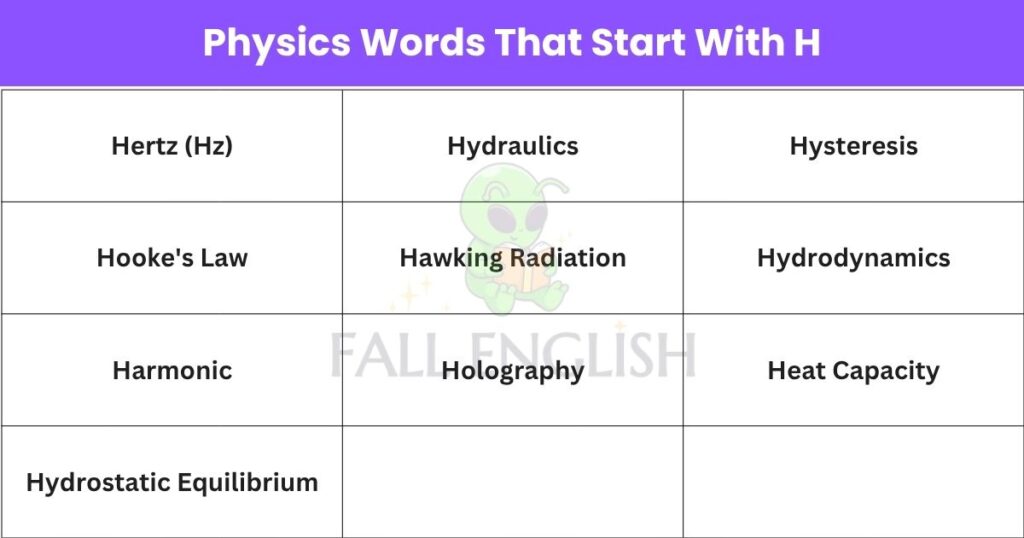
Hertz (Hz) — Measures wave frequency. Your FM radio at 98.5 broadcasts at 98,500,000 cycles per second — that’s hertz at work.
Hooke’s Law — A spring stretches in proportion to the force applied. Double the force, double the stretch — until the spring permanently deforms.
Harmonic — A wave vibrating at a whole-number multiple of a base frequency. Harmonics explain why a violin and a flute playing the same note still sound completely different.
Hydraulics — Pressurized liquid transmitting force through a system. Car brakes, excavator arms, and airplane landing gear all rely on hydraulic pressure.
Hawking Radiation — Theoretical energy predicted to slowly leak from black holes. Never directly observed yet, but mathematically supported.
Holography — Recording three-dimensional images using interfering laser beams. Captures actual depth information — standard photography cannot.
Hysteresis — A material’s response lags noticeably behind the force causing it. Stretch a rubber band repeatedly and it never quite returns to its original shape.
Hydrodynamics — The science of how fluids move and exert force. Ship hulls, aircraft wings, and water pipe systems are all designed using hydrodynamic principles.
Heat Capacity — Energy required to raise an object’s temperature by one degree. Water has an unusually high heat capacity — why oceans warm and cool slowly compared to land.
Hydrostatic Equilibrium — The balance between inward gravity and outward pressure inside a star. Without this balance, stars would either collapse or explode.
Chemistry Words That Start With H
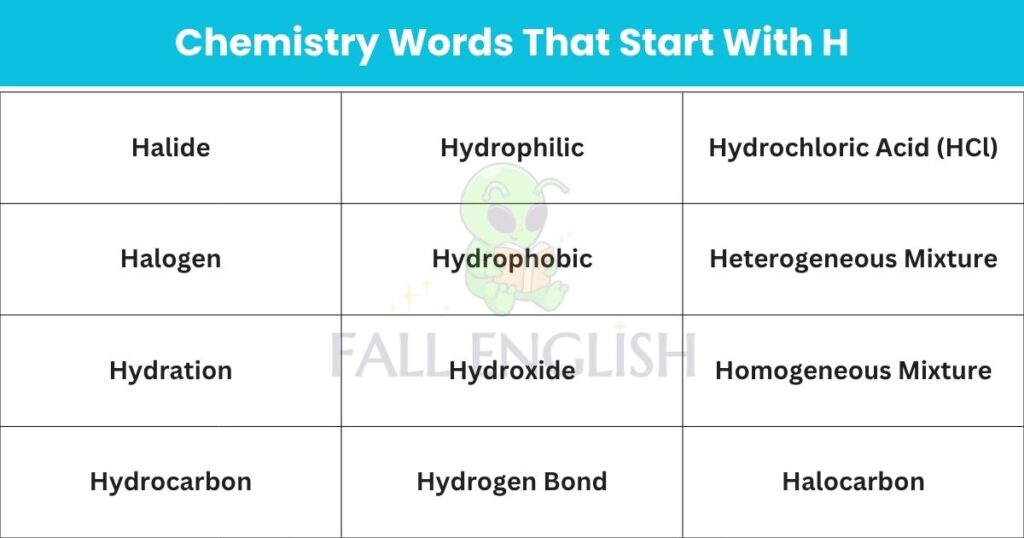
Halide — A compound formed when a halogen bonds with another element. Table salt — sodium bonded to chlorine — is one of the most familiar halides on Earth.
Halogen — A group of highly reactive nonmetals: fluorine, chlorine, bromine, iodine, and astatine. They appear in disinfectants, refrigerants, and fluorescent lighting.
Hydration — Water molecules chemically bonding to another substance. Mix cement powder with water and hydration hardens it permanently into concrete.
Hydrocarbon — A molecule built from only hydrogen and carbon atoms. Gasoline, natural gas, diesel, and candle wax are all hydrocarbons.
Hydrophilic — A substance that attracts and mixes readily with water. The hydrophilic end of a soap molecule bonds to water during washing.
Hydrophobic — Repels water entirely. Oil stays separate in water because its molecules are hydrophobic — there is no electrical attraction to water molecules.
Hydroxide — The OH⁻ ion, present in all chemical bases. Sodium hydroxide (drain cleaner) is strongly alkaline because of its high hydroxide content.
Hydrogen Bond — A weak attraction between a hydrogen atom and a strongly electronegative atom like oxygen. These bonds are why water boils at 100°C instead of far below zero.
Hydrochloric Acid (HCl) — A powerful acid your stomach produces naturally for digestion. Industrially, it strips rust from metal surfaces.
Heterogeneous Mixture — Components are visibly different and unevenly spread. Trail mix, concrete, and salad are classic examples.
Homogeneous Mixture — Appears identical throughout with no visible separation. Saltwater, air, and brass (a copper-zinc alloy) are homogeneous.
Halocarbon — A compound containing carbon bonded to one or more halogen atoms. Chlorofluorocarbons (CFCs), now banned, were halocarbons that thinned the ozone layer.
Biology Words That Start With H
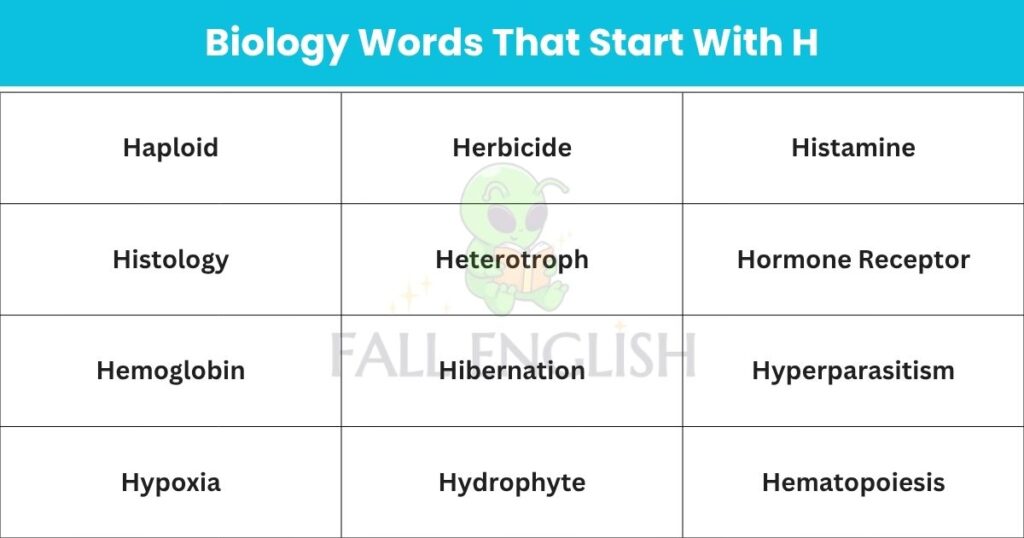
Haploid — A cell containing only one complete set of chromosomes. Human sperm and egg cells are haploid — each carries 23 chromosomes, combining to form 46 at fertilization.
Histology — Microscopic examination of body tissue structure. Pathologists depend on histology when evaluating biopsy samples for disease.
Hemoglobin — The iron-containing protein inside red blood cells that binds oxygen in the lungs and releases it throughout the body.
Hypoxia — Insufficient oxygen reaching tissues. Mountaineers above 8,000 meters experience severe hypoxia — judgment impairs before the climber even notices.
Hypha (Hyphae) — The branching, thread-like filaments forming a fungus’s body. What looks like a single mushroom is the visible tip of an enormous underground hyphal network.
Herbicide — A chemical agent targeting and killing unwanted plant growth. Selective herbicides kill weeds without damaging surrounding crops.
Heterotroph — Any organism incapable of producing its own food from raw materials. Animals, fungi, and most bacteria are heterotrophs.
Hibernation — A physiological state of dramatically reduced metabolism allowing animals to survive winter without eating. Body temperature drops, heart rate slows to just a few beats per minute.
Hydrophyte — A plant structurally adapted to live in waterlogged or fully submerged conditions. Water lilies, cattails, and mangroves are hydrophytes.
Histamine — A compound released by immune cells during allergic reactions, causing the familiar swelling, redness, and itching response.
Hormone Receptor — A specific protein on or inside a cell surface that binds only to a matching hormone, triggering a precise biological response.
Hyperparasitism — A biological situation where a parasite is itself attacked by another parasitic organism. Wasps that parasitize other parasitic wasps are a well-documented example.
Hematopoiesis — The continuous production of all blood cell types — red cells, white cells, platelets — occurring inside bone marrow.
Earth Science Words That Start With H
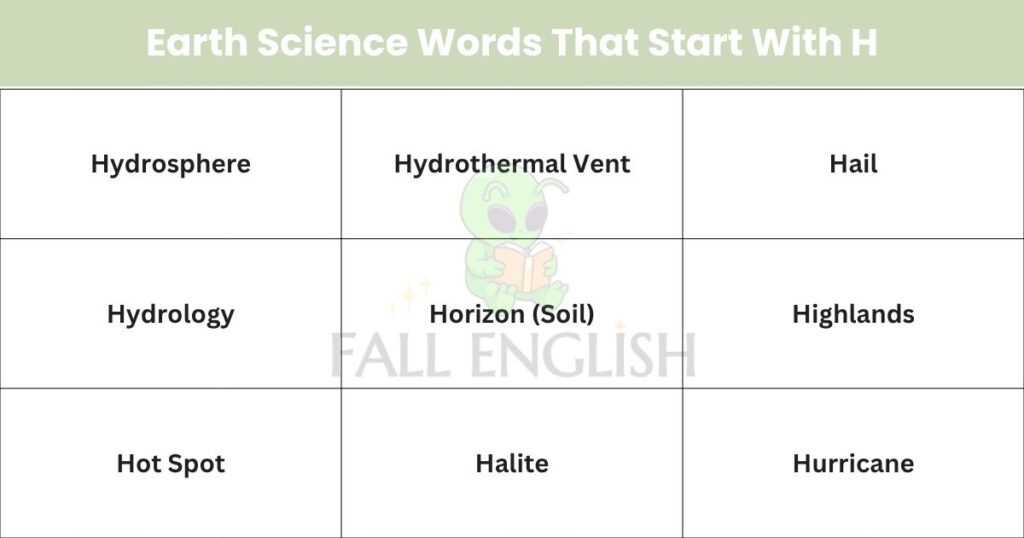
Hydrosphere — The complete system of all water on Earth: oceans, rivers, lakes, glaciers, groundwater, and atmospheric water vapor treated as one interconnected system.
Hydrology — The scientific discipline studying water’s movement, distribution, quality, and behavior across Earth’s surface and underground.
Hot Spot — A stationary column of superheated mantle material that burns through moving tectonic plates above it. The Hawaiian island chain formed as the Pacific Plate drifted over one.
Hydrothermal Vent — A crack in the deep ocean floor where seawater heated by magma shoots back out, carrying dissolved minerals. Entire ecosystems survive here entirely without sunlight.
Horizon (Soil) — A visually distinct horizontal layer within a soil profile. Scientists label them O (surface organic matter), A (topsoil), B (subsoil), and C (weathered rock) downward.
Halite — The mineral name for naturally occurring sodium chloride. Ancient inland seas left massive underground halite deposits that are now mined as rock salt.
Hail — Balls of ice that form when updrafts inside thunderstorm clouds repeatedly carry water droplets into freezing altitudes until they grow too heavy to stay airborne.
Highlands — Elevated terrain regions, typically mountainous or plateau-like. The Ethiopian Highlands and Scottish Highlands are prominent examples on different continents.
Hurricane — A tropical cyclone with sustained winds exceeding 119 km/h, organized around a calm central eye, powered by warm ocean water evaporation.
Space & Astronomy Words That Start With H
Heliocentrism — The astronomical model placing the sun at the center of the solar system. Copernicus formalized it in 1543, displacing over a thousand years of Earth-centered thinking.
Heliosphere — The vast bubble of solar wind particles that surrounds the entire solar system. Voyager 1 crossed its outer boundary in 2012 — the first human-made object to do so.
Hubble Constant — The measured rate at which the universe expands, expressed in kilometers per second per megaparsec. Its precise value remains actively debated among cosmologists.
Hypernova — A stellar collapse releasing energy hundreds of times greater than a standard supernova. These events are linked to gamma-ray bursts — the most energetic explosions in the observable universe.
Habitable Zone — The orbital band around a star where surface temperatures could allow liquid water. Earth sits squarely inside the sun’s habitable zone — Mars sits near its outer edge.
H-R Diagram — The Hertzsprung-Russell diagram plots stars by surface temperature against luminosity. It reveals immediately whether a star is young, middle-aged, dying, or dead.
Hot Jupiter — A gas giant exoplanet orbiting its star at extremely close range — closer than Mercury orbits the sun. Their existence forced astronomers to completely revise planet formation theory.
Hydrogen Burning — The nuclear fusion process converting hydrogen into helium inside a star’s core, releasing the energy that makes stars shine. The sun has been hydrogen burning for 4.6 billion years.
Hawking Radiation (Astrophysics) — If black holes slowly radiate energy as Hawking predicted, they gradually shrink and eventually vanish — a process taking longer than the current age of the universe.
Medical & Health Words That Start With H
Hypertension — Sustained blood pressure above 130/80 mmHg. Often symptomless for years while silently damaging arteries, the heart, and kidneys.
Hypotension — Blood pressure too low to adequately supply organs. Sudden drops cause dizziness, fainting, and in severe cases, shock.
Hemophilia — A genetic condition where clotting factors are absent or deficient. Even minor cuts can bleed dangerously long without treatment.
Hepatitis — Inflammation of liver tissue, most commonly triggered by hepatitis A, B, or C viruses. Each type transmits differently and carries different long-term risks.
Hernia — An internal organ, usually intestine, pushing through a weakened section of surrounding muscle wall. Common in the abdomen and groin.
Hyperthyroidism — The thyroid gland produces excess hormone, accelerating metabolism. Symptoms include rapid heartbeat, unintended weight loss, and persistent anxiety.
Hypothyroidism — The thyroid produces insufficient hormone, slowing metabolism. Fatigue, weight gain, and cold sensitivity are typical early signs.
Hypoglycemia — Blood glucose drops below the level needed for normal brain and muscle function. People with diabetes are at particular risk between meals or after insulin doses.
Hyperglycemia — Persistently elevated blood glucose. Left unmanaged, it damages blood vessels, nerves, kidneys, and eyesight over time.
Hematology — The medical specialty covering blood composition, blood-forming organs, and disorders ranging from anemia to leukemia.
Histopathology — Microscopic analysis of removed tissue to identify disease at the cellular level. The definitive diagnostic step in most cancer confirmations.
Hypersensitivity — An immune reaction disproportionate to the actual threat. Anaphylaxis, hay fever, and contact dermatitis are all hypersensitivity responses.
Hyperplasia — Tissue enlarging because its normal cells multiply abnormally. Unlike cancer, the cells themselves remain structurally normal.
Technology & Applied Science Words That Start With H
Hardware — Every physical component in a computing system: processors, memory chips, storage drives, display screens, and input devices.
Hash Function — A mathematical algorithm converting any input data into a fixed-length output string. Websites store hashed versions of your password — not the password itself.
Heat Sink — A passive cooling component that absorbs heat from a processor and disperses it into surrounding air through metal fins. Without one, modern CPUs overheat within seconds.
Hydraulic Press — A machine amplifying force through pressurized fluid. Used in stamping car body panels, crushing scrap metal, and forming aircraft components.
Hologram — A three-dimensional light recording viewable without special glasses. Used in credit card security strips, medical visualization, and experimental display technology.
Hybrid Engine — A drivetrain combining an internal combustion engine with one or more electric motors. The electric motor handles low-speed driving; the combustion engine takes over at higher speeds.
Haptics — Technology that simulates the physical sensation of touch through vibration or motion feedback. Surgical training simulators use advanced haptics so trainees feel realistic tissue resistance.
Hyperspectral Imaging — Simultaneously captures image data across dozens or hundreds of light wavelengths. Agricultural drones use it to detect crop stress weeks before visible symptoms appear.
Full Alphabetical List: 180+ Science Words Starting With H
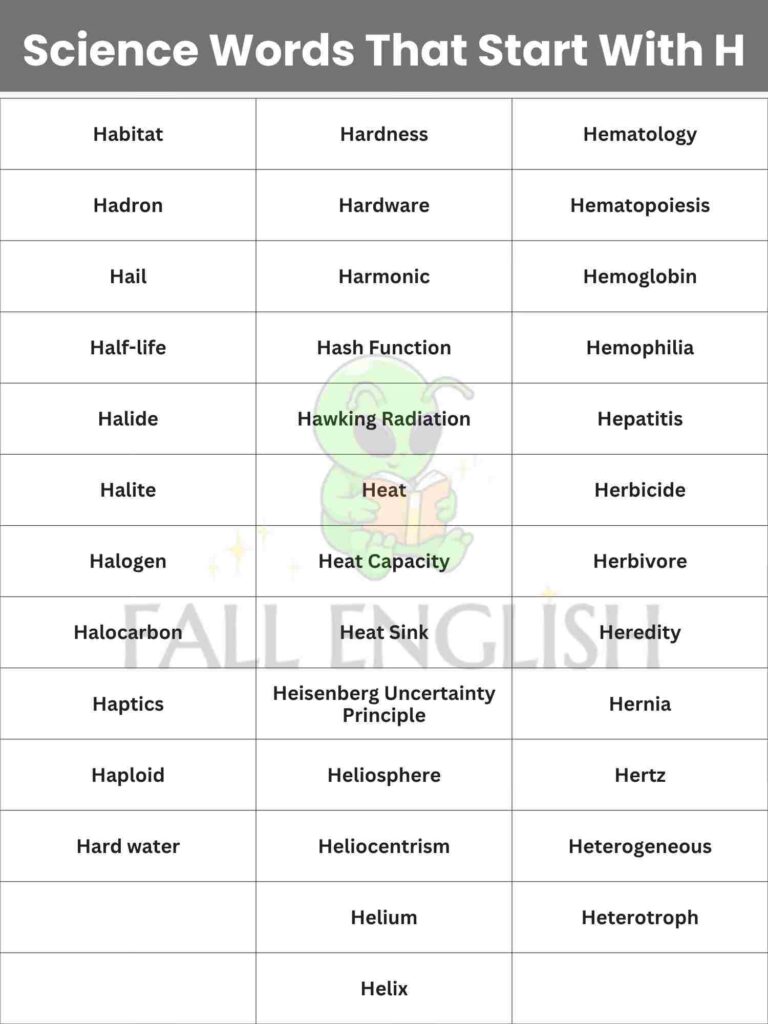
Habitat — natural home of a living organism
Hadron — subatomic particle made of quarks
Hail — frozen precipitation from storm clouds
Half-life — time for radioactive material to halve
Halide — halogen-element compound
Halite — rock salt mineral
Halogen — reactive nonmetal element group
Halocarbon — carbon-halogen compound
Haptics — digital touch-sensation technology
Haploid — cell with one chromosome set
Hard water — water with high dissolved mineral content
Hardness — mineral’s scratch resistance
Hardware — physical computer components
Harmonic — wave at a whole-number multiple of base frequency
Hash Function — data-to-fixed-code conversion algorithm
Hawking Radiation — theoretical energy emission from black holes
Heat — thermal energy in transfer between objects
Heat Capacity — energy needed to raise temperature by one degree
Heat Sink — device dispersing processor heat
Heisenberg Uncertainty Principle — position and momentum cannot both be precisely known simultaneously
Heliosphere — sun’s particle bubble surrounding the solar system
Heliocentrism — sun-centered solar system model
Helium — second lightest element; stellar fusion product
Helix — spiral three-dimensional shape
Hematology — medical study of blood
Hematopoiesis — blood cell production in bone marrow
Hemoglobin — oxygen-carrying iron-protein in red blood cells
Hemophilia — genetic blood-clotting disorder
Hepatitis — viral liver inflammation
Herbicide — plant-killing chemical agent
Herbivore — plant-eating animal
Heredity — genetic trait transmission across generations
Hernia — organ protruding through tissue wall
Hertz — unit of frequency; cycles per second
Heterogeneous — visibly uneven mixture
Heterotroph — organism requiring external food sources
Heuristic — practical problem-solving shortcut method
Highlands — elevated land region
Hillslope — slope between hilltop and valley
Histamine — allergy-triggering immune chemical
Histology — microscopic tissue structure study
Histopathology — microscopic diseased tissue examination
Holography — laser-based 3D image recording
Holomorphic Function — complex function differentiable at every domain point
Homeostasis — biological internal balance maintenance
Homogeneous — uniform mixture with no visible separation
Homologous Chromosomes — matched chromosome pairs in diploid cells
Hooke’s Law — spring extension proportional to applied force
Horizon — distinct soil layer; also sky-land visual boundary
Hormonal Therapy — medical treatment adjusting hormone levels
Hormone — blood-carried chemical messenger between organs
Hormone Receptor — cell protein binding specific hormones
Host — organism harboring parasite or pathogen
Hot Jupiter — massive exoplanet orbiting extremely close to its star
Hot Spot — rising magma plume beneath tectonic plate
H-R Diagram — star classification chart by temperature and luminosity
Hubble Constant — measured rate of universe expansion
Hubble Space Telescope — orbital telescope operational since 1990
Humus — decomposed organic soil layer
Hurricane — tropical cyclone exceeding 119 km/h
Hybrid — offspring of genetically distinct parents
Hybrid Engine — combined combustion and electric drivetrain
Hydrate — compound chemically containing water molecules
Hydration — water bonding chemically to a substance
Hydrocarbon — molecule containing only hydrogen and carbon
Hydrochloric Acid — strong acid; stomach and industrial use (HCl)
Hydrodynamics — science of fluid motion and force
Hydrodynamic Stability — study of conditions triggering fluid turbulence
Hydrogen — lightest element; atomic number 1
Hydrogen Bond — weak intermolecular hydrogen attraction
Hydrogen Burning — stellar hydrogen-to-helium nuclear fusion
Hydrology — scientific study of Earth’s water systems
Hydrolysis — water-driven molecular breakdown
Hydrophilic — water-attracting substance
Hydrophobic — water-repelling substance
Hydrophyte — water-environment adapted plant
Hydrosphere — all of Earth’s water as one system
Hydrostatic Equilibrium — gravity-pressure balance inside stars
Hydrothermal Vent — superheated mineral-rich seafloor opening
Hydroxide — OH⁻ ion present in chemical bases
Hygiene — health-maintaining cleanliness practices
Hypha — fungal thread-like growth filament
Hyperglycemia — dangerously high blood glucose
Hyperlink — clickable digital document connection
Hypernova — extreme stellar explosion exceeding supernova energy
Hyperparasitism — parasite attacked by a second parasite
Hyperplasia — excessive but structurally normal cell growth
Hypersensitivity — exaggerated immune system response
Hyperspectral Imaging — simultaneous multi-wavelength image capture
Hyperthermia — dangerous core body temperature elevation
Hyperthyroidism — overactive thyroid gland
Hypertension — chronically elevated blood pressure
Hyperbolic Geometry — geometry on negatively curved surfaces
Hypoglycemia — dangerously low blood glucose
Hypotension — abnormally low blood pressure
Hypothermia — dangerous core body temperature drop
Hypothesis — falsifiable, testable scientific prediction
Hypothyroidism — underactive thyroid gland
Hysteresis — material response lagging behind applied force
Common Mix-Ups Worth Knowing
Hypothesis vs. Theory A hypothesis is an untested prediction. A scientific theory has survived repeated, independent testing. Calling evolution “just a theory” misuses the word — in science, theory means strongly supported, not weakly guessed.
Hydrophilic vs. Hydrophobic “Philic” means attracted to. “Phobic” means repelled by. Soap works because one end of its molecule is hydrophilic (grabs water) and the other is hydrophobic (grabs grease). Both ends are necessary.
Herbivore vs. Heterotroph Heterotroph is the broader category — any organism that eats rather than makes its food. Herbivore is one specific type within it. All herbivores are heterotrophs; most heterotrophs are not herbivores.
Humidity vs. Precipitation Humidity is invisible water vapor suspended in air. Precipitation is water that physically falls. High humidity increases the likelihood of precipitation but the two describe different states of water entirely.
Hyperthermia vs. Hyperthyroidism Both begin with “hyper” but describe unrelated conditions. Hyperthermia is a body temperature crisis. Hyperthyroidism is a hormonal imbalance in one specific gland. Different systems, different treatments.
Homeostasis vs. Hibernation Homeostasis is constant and never stops — your body regulating temperature, blood sugar, and pH every second. Hibernation is a deliberate seasonal shutdown. One is ongoing maintenance; the other is a survival strategy.
Memory Tricks That Actually Work
“Hyper” = too much. “Hypo” = too little. This single pair unlocks dozens of science and medical terms instantly. Hyperglycemia/hypoglycemia. Hypertension/hypotension. Hyperthyroidism/hypothyroidism. Learn the prefix — not each word separately.
Helix = spiral staircase. Picture one clearly. DNA is a double helix — two staircases coiled around each other. Every biology diagram of DNA is that image.
Half-life reads itself. The word “half” is already in it. Each period, the quantity halves again: 100 → 50 → 25 → 12.5. The math is in the name.
Hertz = wave zigzag. The Z in Hz visually resembles a wave. Hertz counts how many complete wave cycles occur every second. The letter shape is a reminder.
“Hydro” prefix = water connection. Any unfamiliar science word beginning with “hydro” relates to water in some way. Use this to make educated guesses about words you’ve never seen before.
Read more:
200+ Science Words That Start With E | Full List, Meanings & Use
180+ Science Words That Start With G | Meanings, Examples & Full List
FAQs
What are the most important Science Words That Start With H for students?
The most common ones are hypothesis, heat, habitat, hydrogen, heredity, hormone, and homeostasis. These appear often in middle school and high school science classes.
How can I remember difficult H science words?
Focus on prefixes. For example, hydro usually relates to water, hyper means too much, hypo means too little, and hemo refers to blood.
What is the difference between hypothesis and theory?
A hypothesis is a testable prediction. A theory is a well-supported explanation based on repeated experiments and evidence.
Are these words useful for competitive exams?
Yes. Many of these terms appear in standardized tests, science quizzes, and entrance exams because they are core scientific vocabulary.
Which branches of science use H words the most?
Biology and medicine use many H terms, but chemistry, physics, geology, and astronomy also include important H-based vocabulary.
Bottom line
180+ science words starting with H — organized by field, difficulty, and real-world context. The top-20 table gives the fastest overview. Category sections provide working definitions with genuine examples. The full alphabetical list is your quick-scan reference. Mix-ups and memory tricks close the gaps that lists alone cannot fill.
Learning roots — “hydro,” “hyper,” “hypo,” “hemo” — matters more than memorizing individual definitions. Master four prefixes and a large portion of this entire list becomes decodable on sight.

FallEnglish is run by a language enthusiast who explains word and text meanings in clear, simple ways. Each guide is carefully researched, original, and written to help real people understand language faster, with accuracy, context, and everyday examples you can trust.