

When “life-changing” starts to feel overused — or when the experience you’re describing is too specific for such a broad phrase — these alternatives can say the same thing more precisely.
Quick Answer
The most useful alternatives to life-changing depend on what kind of change you mean:
- Transformative — deep internal change in how someone thinks or feels
- Pivotal — a turning point that redirected a path
- Defining — shaped who someone is or became
- Formative — gradual shaping, especially in earlier life
- Momentous — a major event with lasting weight
- Consequential — significant in its outcomes and effects
No single word works in every context. The right choice depends on whether the change is sudden or gradual, personal or circumstantial, internal or external.
What “Life-Changing” Actually Means — and Why It Can Feel Inadequate
The phrase life-changing does a lot of heavy lifting. It covers:
- A sudden event that altered someone’s direction (a life-changing accident)
- A slow process that reshaped a person’s identity (a life-changing relationship)
- An opportunity that opened new paths (a life-changing scholarship)
- An emotional or spiritual shift (a life-changing realization)
The problem is that the phrase has been applied so broadly — in self-help writing, testimonials, travel blogs, product marketing — that it can feel imprecise or even hollow. Readers may glide past it without registering what was actually meaningful about the experience.
A more specific word can restore that weight.
Another Term for Life-Changing, and When Each One Fits
Transformative
Transformative describes change that goes beneath the surface — a shift in how someone sees themselves, processes the world, or approaches life. It implies genuine internal movement, not just a change in circumstances.
The year she spent abroad was transformative — she came back thinking differently about almost everything.
Use transformative when the change is primarily about the person, not just the event. It tends to work well in personal writing, academic prose, and thoughtful professional contexts. It has a slightly formal feel, which makes it well suited to essays, speeches, and reflective writing.
What to watch: Transformative has been picked up heavily by marketing and education sectors, where it risks losing the same credibility as life-changing. In those contexts, specificity helps — say what transformed, and how.
Pivotal
Pivotal suggests a turning point: the moment when a path branched and a different direction was taken. It emphasizes before-and-after structure — something happened, and nothing was the same afterward.
Losing that job was pivotal. It pushed me into work I actually cared about.
It works particularly well when the change came from a specific decision, event, or encounter. Pivotal carries a narrative quality — it belongs in memoir, biography, and storytelling contexts where the writer is tracing a life’s shape.
Unlike transformative, which focuses on internal change, pivotal focuses on the moment or event itself.
Defining
Defining suggests that an experience didn’t just change someone — it helped determine who they are. It implies a relationship between event and identity.
That summer was defining for him in ways he couldn’t fully explain at the time.
Defining works well in retrospect. It’s often used when looking back on formative experiences — the things that, in hindsight, made a person who they became. It has a slightly more permanent feel than pivotal and a more identity-focused feel than transformative.
Formative
Formative describes experiences, relationships, or periods that shaped a person during development — especially in childhood, adolescence, or early career. It implies gradual molding rather than a sudden shift.
Her formative years were spent in a small fishing community, and that environment never fully left her.
Don’t use formative for sudden adult experiences unless you’re specifically describing a period of growth. It carries an implication of development over time, and it tends to feel odd applied to a single moment in a fully developed adult life.
Momentous
Momentous shifts the emphasis from internal change to the significance of the event itself. It suggests weight, gravity, consequence — something that mattered, historically or personally.
The announcement was momentous. No one in the room spoke for a long time.
It’s less about how the event changed a person and more about the scale of what happened. Use momentous when you want to honor the gravity of an occasion without claiming to know its full personal impact. It suits ceremonies, historical writing, journalism, and formal speeches.
Consequential
Consequential means the thing had real, lasting effects. It’s the most neutral of these alternatives — analytical rather than emotional.
The decision was consequential in ways the committee hadn’t anticipated.
It suits professional writing, journalism, and policy contexts where emotional language would feel out of place. It’s not a warm word. If the goal is to convey personal significance, consequential tends to feel clinical.
Another Term for Life-Changing Comparison at a Glance
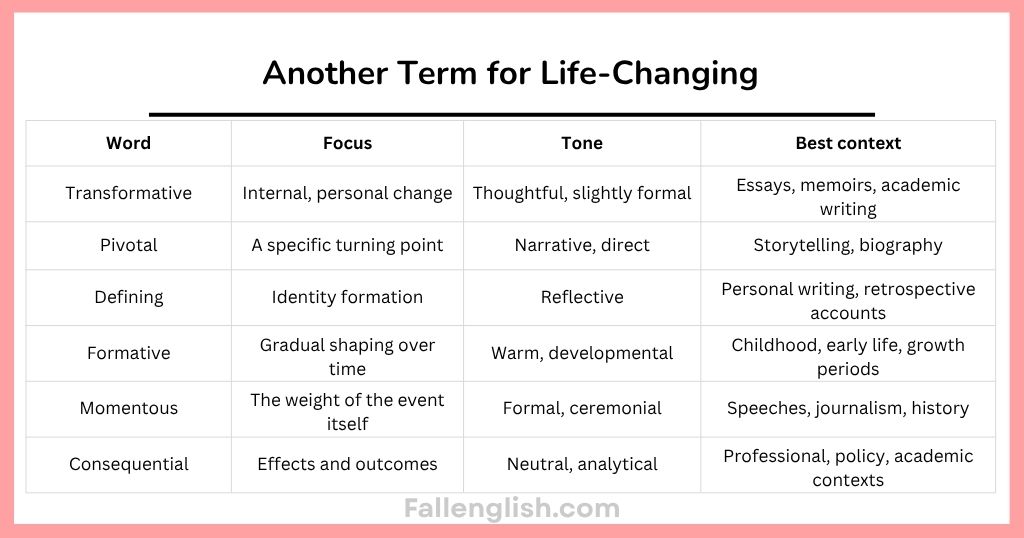
| Word | Focus | Tone | Best context |
| Transformative | Internal, personal change | Thoughtful, slightly formal | Essays, memoirs, academic writing |
| Pivotal | A specific turning point | Narrative, direct | Storytelling, biography |
| Defining | Identity formation | Reflective | Personal writing, retrospective accounts |
| Formative | Gradual shaping over time | Warm, developmental | Childhood, early life, growth periods |
| Momentous | The weight of the event itself | Formal, ceremonial | Speeches, journalism, history |
| Consequential | Effects and outcomes | Neutral, analytical | Professional, policy, academic contexts |
Life-Changing Alternatives Worth Knowing — With Important Caveats
Watershed (as in a watershed moment) works similarly to pivotal — it marks a before and after. It’s borrowed from geography and carries a slightly formal, journalistic quality. It fits well in writing about collective or historical change: a watershed moment for the civil rights movement. It can feel heavy-handed in personal, intimate writing.
Groundbreaking belongs in discussions of firsts — inventions, discoveries, movements. It describes something that opened new territory. Don’t use it as a synonym for personally significant, because it implies novelty and precedent rather than personal impact.
Revelatory is useful when the change came from understanding something new — a sudden clarity or insight. It’s more specific than life-changing in exactly the right way when the change was intellectual or perceptual.
The book was revelatory for him — it reframed everything he thought he understood about his own history.
Where “Life-Changing” Still Works Best
There are situations where life-changing is genuinely the right phrase:
- When writing for a general audience and precision isn’t the priority
- When the change was across every dimension of someone’s life (making a specific word feel too narrow)
- In direct speech or quoted dialogue, where more formal alternatives would sound unnatural
- In marketing or testimonials, where the phrase carries recognized emotional shorthand — even if that shorthand has become familiar
The phrase is not broken. It simply needs a context where breadth is an asset rather than a liability.
Read also:
Another Word for Meticulous: Choosing the Right Alternative
Another Word for Blue: Better Choices for Different Contexts
Making the Choice
Ask two questions before choosing:
What kind of change was it? If it was gradual shaping, formative. If it was a sudden turn, pivotal. If it went deep into identity, defining. If it reshaped perception, transformative. If the event itself carried enormous weight, momentous. If the effects were what mattered, consequential.
What tone does the writing need? Warm and personal writing tends toward defining, formative, or transformative. Formal or analytical writing tends toward momentous, consequential, or pivotal. Creative and narrative writing often benefits from pivotal or revelatory.
The word that fits is the one that captures the specific kind of change — not just the fact that something changed.

FallEnglish is run by a language enthusiast who explains word and text meanings in clear, simple ways. Each guide is carefully researched, original, and written to help real people understand language faster, with accuracy, context, and everyday examples you can trust.