

Science vocabulary can feel overwhelming when you meet unfamiliar terms in biology, chemistry, physics, and Earth science. This guide to Science Words Start With G brings the most useful terms together in one place and explains them in simple language.
Whether you are studying for a test, helping a child with homework, or improving your English, you will find clear definitions, practical examples, and an organized list you can scan quickly and understand with ease.
20 Most-Used Science Words Start With G
Gravity — Pull between masses
Gene — DNA unit coding for a trait
Glucose — Sugar cells burn for energy
Germination — Seed beginning to sprout
Galaxy — System of billions of stars and gas
Geology — Study of Earth’s structure
Greenhouse Effect — Atmospheric heat trapping causing warming
Gamete — Reproductive cell — sperm or egg
Glacier — Slow-moving mass of ice on land
Gas — Matter with no fixed shape or volume
Genome — All genetic material in an organism
Geothermal — Heat energy from inside Earth
Gradient — Rate of change across a distance
Ganglion — Nerve cell cluster outside brain/spinal cord
Graphite — Carbon form used in pencils and electrodes
Gestation — Embryo development period inside the mother
Gravitational Wave — Spacetime ripple from violent cosmic events
Gyroscope — Rotation-stabilizing orientation device
Genotype — An organism’s actual DNA code
Glycogen — Glucose stored in liver and muscle
Physics Science Words Start With G
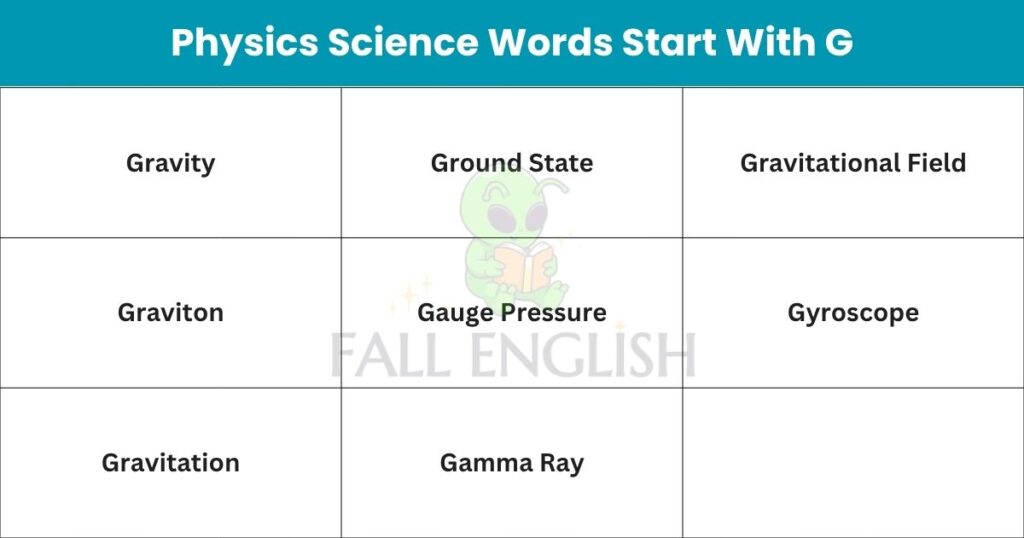
Gravity — Every object with mass pulls every other object. It holds the Moon in orbit and keeps you on the ground. The more mass, the stronger the pull.
Graviton — The theoretical particle believed to carry gravitational force. Not yet detected — one of physics’ biggest unsolved problems.
Gravitation — The universal force of attraction between any two masses anywhere. Gravity is Earth’s version; gravitation is the universal concept.
Ground State — An atom sitting at its lowest possible energy level. Energize it with heat or light, electrons jump up — when they fall back, they release light.
Gauge Pressure — Pressure measured against atmospheric pressure rather than from absolute zero. Your bike tire pressure reading is gauge pressure.
Gamma Ray — Highest-energy electromagnetic radiation, produced by nuclear reactions and certain stars. Penetrates most materials; used clinically in cancer treatment.
Gravitational Field — The region around a mass where other objects feel its gravitational pull. The Sun’s field extends past Neptune — that’s why planets orbit it.
Gyroscope — A spinning device that resists changes in orientation. Used in aircraft navigation, smartphones, drones, and space telescopes.
Chemistry Science Words Start With G
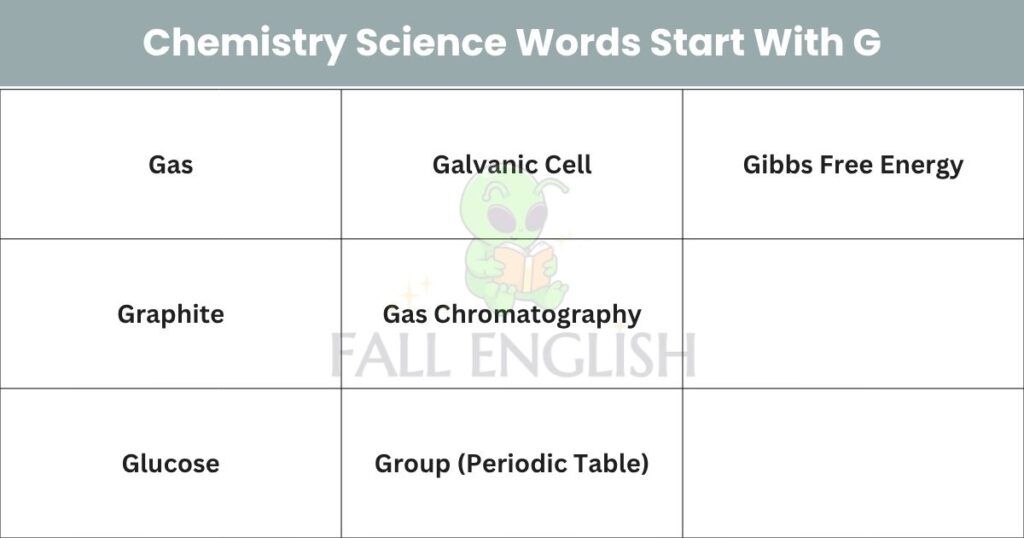
Gas — No fixed shape, expands to fill any container. Air is a gas mixture — mostly nitrogen and oxygen.
Graphite — Pure carbon in flat sliding layers. Those layers glide easily, making smooth pencil marks and efficient battery electrodes.
Glucose — The cell’s primary fuel molecule. Produced from food, broken down through cellular respiration to release energy.
Galvanic Cell — Converts a chemical reaction into electrical current. Every battery is one — named after Luigi Galvani.
Gas Chromatography — Lab technique that separates mixtures by moving them through a gas phase. Used in drug testing, food safety, and forensics.
Group (Periodic Table) — A vertical column in the periodic table. Elements sharing a group behave similarly because they have identical outer electron counts.
Gibbs Free Energy — Predicts whether a chemical reaction will occur spontaneously. If the value decreases during a reaction, it proceeds without outside energy input.
Biology Science Words Start With G
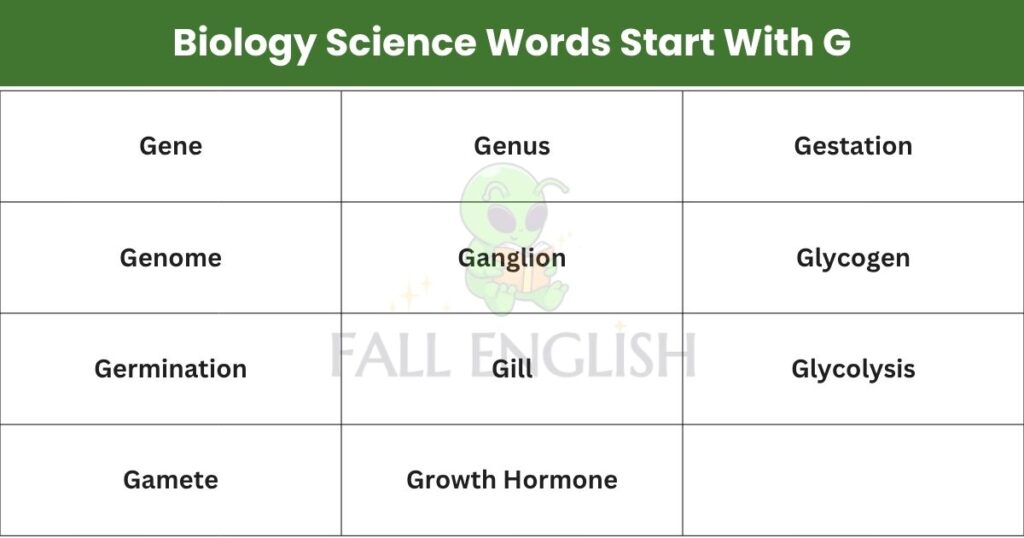
Gene — A specific DNA sequence that codes for a protein or trait. Controls things like eye color, blood type, and enzyme production.
Genome — The complete collection of all genes in an organism. Human genome: ~3 billion base pairs, fully mapped in 2003.
Germination — A seed breaking dormancy and beginning to grow. Warmth and moisture trigger it — water the bean, a shoot appears.
Gamete — Reproductive cell carrying half the chromosomes needed for a new organism. Sperm and eggs are human gametes.
Germline — Cells that pass genetic information to offspring. Germline mutations can be inherited; mutations in other cells typically cannot.
Genus — Classification level just above species. Lions and tigers differ by species but share the genus Panthera.
Ganglion — Nerve cell cluster outside the brain and spinal cord, relaying signals between the nervous system and body.
Gill — Breathing organ in fish and some amphibians. Extracts dissolved oxygen from water — the underwater equivalent of lungs.
Growth Hormone — Released by the pituitary gland to signal cells to grow and divide. Excess or deficiency causes measurable medical conditions.
Genotype — The actual DNA sequence of an organism. Distinct from phenotype, which is the observable expression of that sequence.
Gestation — Development period inside the mother before birth. Humans: ~40 weeks. Elephants: ~22 months.
Glycogen — Stored glucose in liver and muscle tissue, ready for quick energy release when the body needs it.
Glycolysis — Breakdown of glucose into smaller molecules to release energy. Occurs in almost every living cell — the entry point of cellular energy production.
Earth Science Words Start With G
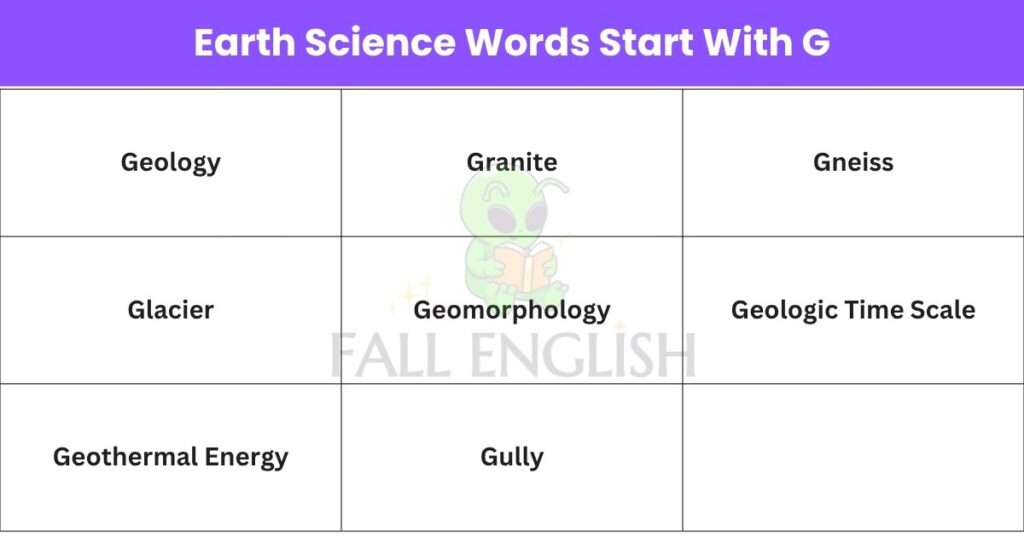
Geology — Study of Earth’s materials, structures, and processes. Rock layers are the records geologists read.
Glacier — A massive river of ice moving across land, sometimes just centimeters per day. Glaciers shaped the valleys and lakes visible on maps today.
Geothermal Energy — Heat from Earth’s interior, escaping through volcanoes and hot springs. Iceland powers much of its grid this way.
Groundwater — Water stored underground in rock and soil, feeding wells and springs. Over-extraction causes land to sink in some regions.
Granite — Hard igneous rock from slowly cooled magma, composed mainly of quartz and feldspar. Common in mountain ranges and kitchen countertops.
Geomorphology — Study of how Earth’s surface landforms develop and change through erosion, tectonics, and water movement.
Gully — A steep channel cut into soil by running water. Grows rapidly during heavy rain; signals serious erosion on farmland.
Gyres — Large rotating ocean current systems. Five exist globally. Slow-moving centers collect floating plastic waste.
Gneiss — Coarse-grained metamorphic rock with distinct banding, formed under extreme heat and pressure deep in Earth’s crust.
Geologic Time Scale — The system dividing Earth’s 4.5-billion-year history into eons, eras, periods, and epochs.
Space & Astronomy Science Words Start With G
Galaxy — Billions of stars, gas, dust, and dark matter held together by gravity. The Milky Way is ours. Estimated galaxies in the observable universe: over two trillion.
Gravitational Wave — Ripples in spacetime from violent events — colliding black holes or neutron stars. Einstein predicted them in 1915; detected for the first time in 2015.
Gravitational Lensing — Massive objects bend light passing nearby. Astronomers use this effect to study objects too distant or faint to see directly, including dark matter.
Gas Giant — A planet of mostly hydrogen and helium with no solid surface. Jupiter and Saturn are the solar system’s gas giants.
Geocentric Model — The historical, now-disproved idea that Earth is the universe’s center. Overturned by Copernicus and Galileo’s observations.
Globular Cluster — A dense, spherical group of hundreds of thousands of old stars orbiting a galaxy’s outer region.
Gamma-Ray Burst — The most energetic explosion type known — releasing more energy in seconds than our Sun will produce across its entire lifetime.
Galactic Plane — The flat disk of the Milky Way where stars, gas, and dust concentrate. Earth sits inside it, which is why we see the Milky Way as a band.
Gravitational Constant (G) — The fixed number in Newton’s law of gravitation, determining how strongly two masses attract each other.
Medical & Health Science Words Start With G
Gangrene — Tissue death from lost blood supply or bacterial infection. Requires urgent intervention, sometimes amputation.
Gastritis — Stomach lining inflammation caused by bacteria, alcohol, or chronic painkiller use. Produces pain and nausea.
Glucagon — Pancreatic hormone that raises blood sugar by signaling the liver to release stored glucose. Works opposite to insulin.
Glioma — Brain tumor originating in glial cells, the nervous system’s structural support cells.
Gluten — Protein in wheat, rye, and barley. In celiac disease, it triggers immune damage to the small intestine lining.
Genetic Mutation — A change in DNA sequence — harmless, beneficial, or disease-causing depending on location and type. Can be inherited or acquired.
Gonads — Reproductive glands producing gametes and hormones. Ovaries in females; testes in males.
Gastroenterology — Medical specialty covering the digestive system: stomach, intestines, liver, pancreas, and gallbladder.
Technology & Applied Science Words Starting With G
Gradient Descent — Machine learning algorithm that adjusts model settings incrementally toward minimum error — like descending a hill always choosing the steepest step down.
Gigabyte — Digital storage unit. 1 gigabyte ≈ 1,000 megabytes. A single smartphone photo typically takes several megabytes; videos consume gigabytes.
GPS (Global Positioning System) — Calculates location using timed signals from at least four satellites simultaneously. Pure applied geometry.
Graphene — Single layer of carbon atoms in a hexagonal grid. Extraordinarily strong and thin — being explored for batteries, flexible screens, and medical implants.
Grid Computing — Distributed computing where multiple machines share processing load. Used in climate modeling and particle physics analysis.
Geofencing — A virtual boundary around a physical location. When a device crosses it, a preset action fires — an alert, notification, or automated response.
Science Words Start With G by Grade Level
| Grade | Words to Know |
| 4–6 | Gravity, Gas, Germ, Galaxy, Gill, Germination, Glacier, Granite, Groundwater, Growth |
| 7–8 | Gene, Genome, Gamete, Geothermal, Geology, Glycolysis, Genus, Gestation, Gradient |
| 9–10 | Gravitation, Gravitational Field, Gibbs Free Energy, Ganglion, Genotype, Glioma, Geomagnetic Storm |
| College+ | Gravitational Singularity, Gauge Boson, Gyrokinetics, Glycosylation, Gradient Descent, Gravitational Lensing |
The Full List: 180+ Science Words Start With G
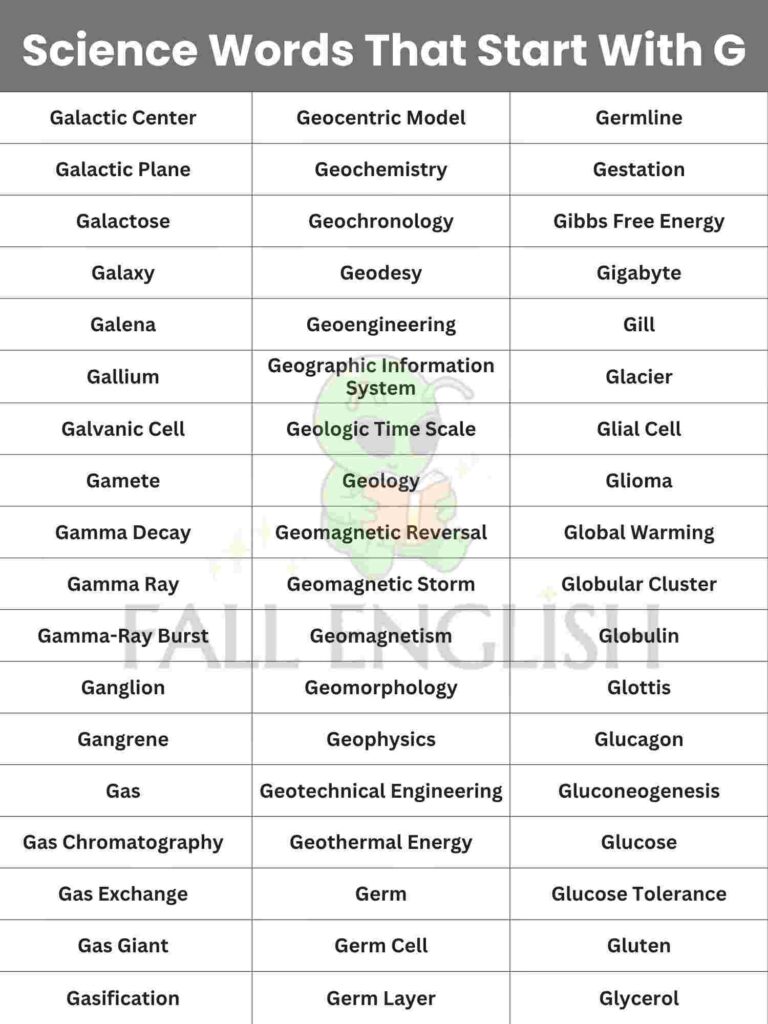
Galactic Center
Galactic Plane
Galactose
Galaxy
Galena
Gallium
Galvanic Cell
Gamete
Gamma Decay
Gamma Ray
Gamma-Ray Burst
Ganglion
Gangrene
Gas
Gas Chromatography
Gas Exchange
Gas Giant
Gasification
Gastric Acid
Gastritis
Gastroenterology
Gastrulation
Gauge Boson
Gauge Pressure
Gel Electrophoresis
Gene
Gene Expression
Gene Pool
Gene Therapy
Generator
Geocentric Model
Geochemistry
Geochronology
Geodesy
Geoengineering
Geographic Information System
Geologic Time Scale
Geology
Geomagnetic Reversal
Geomagnetic Storm
Geomagnetism
Geomorphology
Geophysics
Geotechnical Engineering
Geothermal Energy
Germ
Germ Cell
Germ Layer
Germ Theory
Germicide
Germinal
Germination
Germline
Gestation
Gibbs Free Energy
Gigabyte
Gill
Glacier
Glial Cell
Glioma
Global Warming
Globular Cluster
Globulin
Glottis
Glucagon
Gluconeogenesis
Glucose
Glucose Tolerance
Gluten
Glycerol
Glycine
Glycogen
Glycolysis
Glycosylation
Gneiss
Gonads
Gonorrhea
GPS
Gradient
Gradient Descent
Gram Stain
Granite
Graphene
Graphite
Gravitation
Gravitational Constant
Gravitational Field
Gravitational Lensing
Gravitational Singularity
Gravitational Wave
Graviton
Gravity
Gravitropism
Gray Matter
Green Chemistry
Greenhouse Effect
Greenhouse Gas
Grid Computing
Geofencing
Ground State
Ground Tissue
Groundwater
Growth
Growth Hormone
Growth Plate
Guanine
Gully
Gyres
Gyration
Gyrokinetics
Gyroscope
Genotype
Genome
Genomics
Genus
Common Mix-Ups about Science Words Start With G
Gravity vs. Gravitation Gravity = Earth’s pull on you. Gravitation = the same force operating between any two masses in the universe. One is local; the other is universal.
Gene vs. Genome A gene is one instruction. The genome is the complete instruction set — roughly 20,000 genes in humans.
Genotype vs. Phenotype Genotype is the DNA code itself. Phenotype is the visible outcome — two people can have brown eyes (same phenotype) through different genetic combinations.
Glacier vs. Iceberg Glaciers sit on land and move slowly inland or toward coasts. Icebergs are chunks that broke off and float in ocean water.
Glucagon vs. Glucose Glucose is the sugar. Glucagon is the hormone signaling the liver to release it. One is fuel; the other is the ignition.
Germ vs. Germination Germ has two science meanings — a microorganism causing disease, or an early-stage embryo. Germination is exclusively a seed sprouting. Context separates them.
Memory Tricks for G Science Words
Gravity → Grab — It grabs mass toward it.
Genome → Gene’s Home — Every gene lives inside the genome.
Glacier → Slow Glass — Solid, but flowing over centuries.
Glucose → Cell Gasoline — Every cell burns it for energy.
Gamete → Half a Set — Two gametes combine to make a complete chromosome set.
Gradient → Steepness — Whether it’s a hill or a temperature shift, it measures how steep the change is.
Germination → Waking Up — The seed stops sleeping and starts becoming a plant.
Read also:
210+ Science Words That Start With F — Full List With Meanings
200+ Science Words That Start With E | Full List, Meanings & Use
FAQs
What are the most important science words that start with G?
The most common terms include gravity, gene, glucose, germination, galaxy, geology, genome, glacier, gas, and greenhouse effect. These appear often in school science lessons and exams.
What is the difference between gene and genome?
A gene is a small section of DNA that controls a specific trait. A genome is the complete set of all DNA in an organism, including every gene.
Why is gravity one of the most important science words?
Gravity affects everything with mass. It keeps planets in orbit, causes objects to fall, and shapes the structure of stars and galaxies.
Which Science Words Start With G are easiest for younger students?
Students in elementary and middle school usually begin with gravity, gas, germ, galaxy, glacier, granite, groundwater, and growth.
How can I remember difficult science vocabulary?
Connect words to simple images or ideas. For example, “Gravity grabs,” “Genome is gene’s home,” and “Glucose is cell fuel.”
Bottom line
Every major science G-word — sorted by subject, graded by difficulty, explained without unnecessary complexity, and free of repeated definitions.
The category sections give depth. The grade table gives direction. The full list gives breadth. The mix-ups section saves you from the most common exam errors.
That’s the complete picture.

FallEnglish is run by a language enthusiast who explains word and text meanings in clear, simple ways. Each guide is carefully researched, original, and written to help real people understand language faster, with accuracy, context, and everyday examples you can trust.