

Science can feel overwhelming when every chapter brings a new set of terms. This guide to Science Words That Start With S makes things easier by breaking complex ideas into clear, everyday language. Whether you’re studying for a test, helping your child, or just curious, these words are explained in a way that actually makes sense.
You’ll find practical meanings, simple examples, and connections to real life so the words stick—not just for exams, but for understanding the world around you.
⚡ 20 Most-Used Science Words That Start With S
- Speed — How fast something moves
- Solution — A liquid mixture where one substance dissolves in another
- Solar — Related to the Sun
- Species — A group of living things that can reproduce together
- Sound — A vibration that travels through air or matter
- Sediment — Particles that settle at the bottom of water or soil
- Symbiosis — Two different species living in close relationship
- Stem cell — A cell that can develop into many different cell types
- Sublimation — Solid turning directly into gas, skipping liquid
- Static electricity — Electric charge built up on a surface
- Spectrum — The full range of colors or frequencies light contains
- Seismic — Related to earthquakes
- Spore — A tiny reproductive unit in fungi and some plants
- Salinity — The amount of salt dissolved in water
- Synapse — The gap between two nerve cells where signals pass
- Supernova — A massive star explosion
- Semiconductor — A material that sometimes conducts electricity
- Soil — The top layer of Earth where plants grow
- Synthesis — Building complex molecules from simpler ones
- Stimulus — Something that triggers a response in an organism
Physics Science Words That Start With S
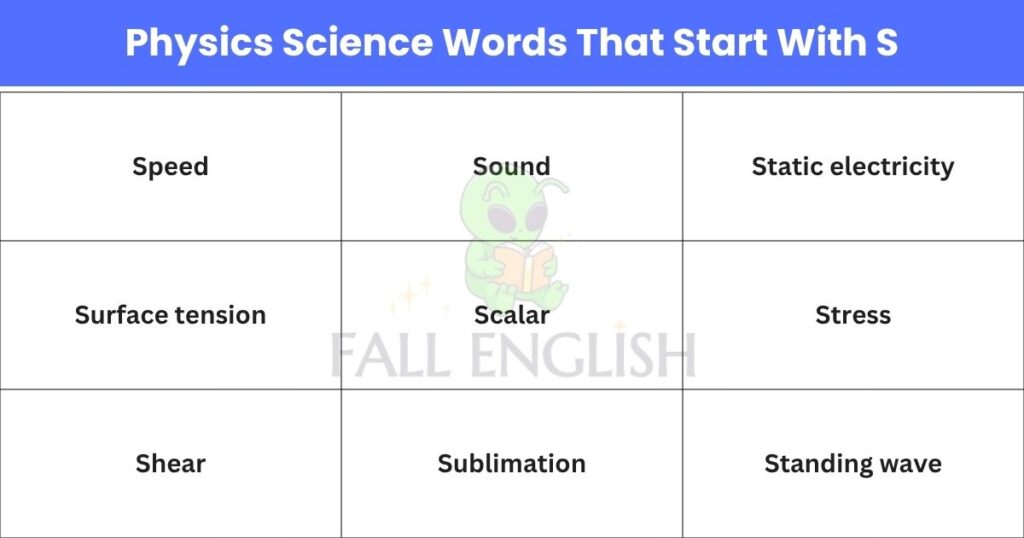
Speed — Distance covered per unit of time. Not the same as velocity — velocity also includes direction.
Sound — A mechanical wave produced by vibrations. Needs a medium (air, water, solid) to travel. Cannot move through empty space, which is why space is silent.
Static electricity — Electric charge that builds up on a surface instead of flowing. That shock from touching a metal door in winter? That’s static releasing.
Surface tension — The invisible “skin” on water that lets small insects walk on it. Caused by water molecules pulling on each other.
Scalar — A quantity with size only, no direction. Temperature and mass are scalars.
Stress — Force applied over an area. Engineers calculate stress when designing bridges and buildings.
Shear — A force that causes one part of a material to slide sideways over another.
Sublimation — When a solid skips the liquid stage and becomes gas directly. Dry ice does this at room temperature. Iodine crystals do it when heated. (Appears in chemistry too, same definition applies.)
Standing wave — A wave pattern that looks stationary. Forms when two waves cancel and reinforce each other at fixed points.
Specific gravity — How dense a substance is compared to water. Tells you whether something sinks or floats.
Specific heat — Energy needed to raise one gram of a material by one degree. Water has very high specific heat — that’s why oceans warm slowly.
Chemistry Science Words That Start With S
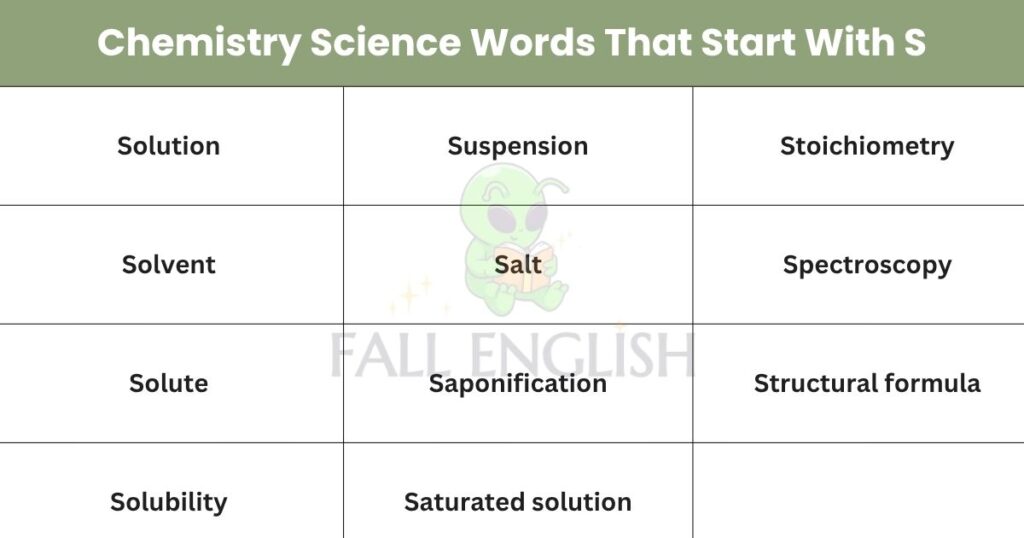
Solution — One substance dissolves completely in another. Salt water is the classic example.
Solvent — The liquid doing the dissolving. In salt water, water is the solvent.
Solute — The substance being dissolved. Salt is the solute.
Solubility — How much of a substance can dissolve in a liquid at a given temperature. Sugar dissolves more in hot water than cold.
Synthesis — A reaction where two or more substances combine to form one new product.
Suspension — A mixture where particles float temporarily but eventually settle. Muddy water is a suspension.
Salt — In chemistry, a salt forms when an acid and base react. Table salt is just one type.
Saponification — The chemical process that makes soap. Fats react with a strong base.
Saturated solution — A solution holding as much dissolved substance as it possibly can.
Supersaturated — Holds more dissolved material than normally possible, usually achieved by heating. Rock candy forms when a supersaturated sugar solution cools slowly.
Stoichiometry — Calculating exact quantities of reactants and products in a chemical reaction. It’s the math backbone of chemistry.
Spectroscopy — Using light to identify what a substance contains. Scientists use this to analyze distant stars without ever visiting them.
Structural formula — A diagram showing exactly how atoms are arranged and bonded in a molecule.
Biology Science Words That Start With S
Species — A group of organisms that share traits and can reproduce together. Lions and tigers are different species.
Symbiosis — A long-term relationship between two different species. It can benefit both, harm one, or have no effect on one partner.
Stimulus — Anything that causes a living thing to react. Light, heat, pain, and smell are all stimuli.
Spore — A tiny, usually single-celled structure that grows into a new organism. Ferns and mushrooms reproduce using spores.
Stem cell — A cell that can develop into many specialized cell types. Central to medical research for treating diseases and repairing damaged tissue.
Synapse — The tiny gap between two neurons where chemical signals pass. Every thought you have crosses thousands of synapses.
Semipermeable membrane — A barrier that lets some substances through but blocks others. Cell membranes work this way.
Succession — The gradual change of an ecosystem over time. After a forest fire, plants return in a predictable order — that process is succession.
Sexual reproduction — Reproduction combining genetic material from two parents. Produces offspring with genetic variety.
Somatic cell — Any body cell that isn’t a reproductive cell. Skin, muscle, and liver cells are all somatic.
Stamen — The male reproductive part of a flower. It produces pollen.
Stomata — Tiny pores on leaves that let gases in and out. Plants breathe through stomata.
Saprophyte — An organism that feeds on dead organic matter. Fungi and some bacteria are saprophytes — essential for recycling nutrients back into soil.
Earth Science Words That Start With S
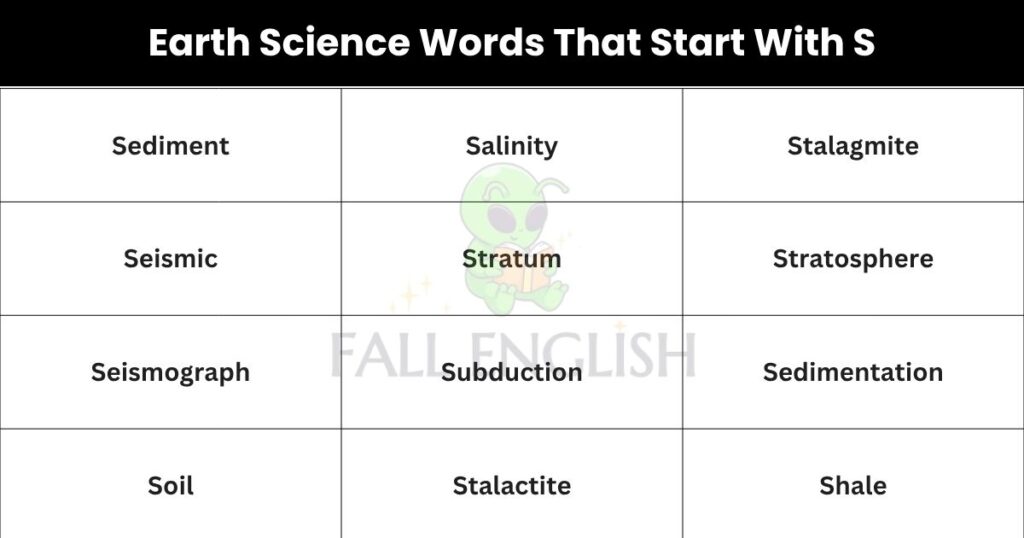
Sediment — Tiny particles of rock, sand, and organic material carried by water or wind and deposited somewhere new.
Seismic — Related to earthquakes or vibrations inside Earth. Seismic waves travel through Earth’s interior layers.
Seismograph — The instrument that detects and records earthquake vibrations.
Soil — Earth’s upper surface layer. Contains rock particles, organic matter, air, water, and microorganisms all working together.
Salinity — Concentration of dissolved salt in water. Ocean water averages about 3.5% salinity.
Stratum — A single layer of rock or soil. Multiple layers are called strata. Each one tells scientists something about Earth’s past.
Subduction — When one tectonic plate slides under another. These zones often produce both earthquakes and volcanoes.
Stalactite — A mineral formation hanging from cave ceilings, built up over thousands of years by dripping mineral-rich water.
Stalagmite — Grows from the cave floor upward — the ground-based partner to stalactites.
Stratosphere — The atmospheric layer above the troposphere. The ozone layer sits here.
Sedimentation — The process of sediment accumulating in layers over time.
Shale — Sedimentary rock made from compressed clay. One of the most common rock types on Earth.
Space & Astronomy Science Words That Start With S
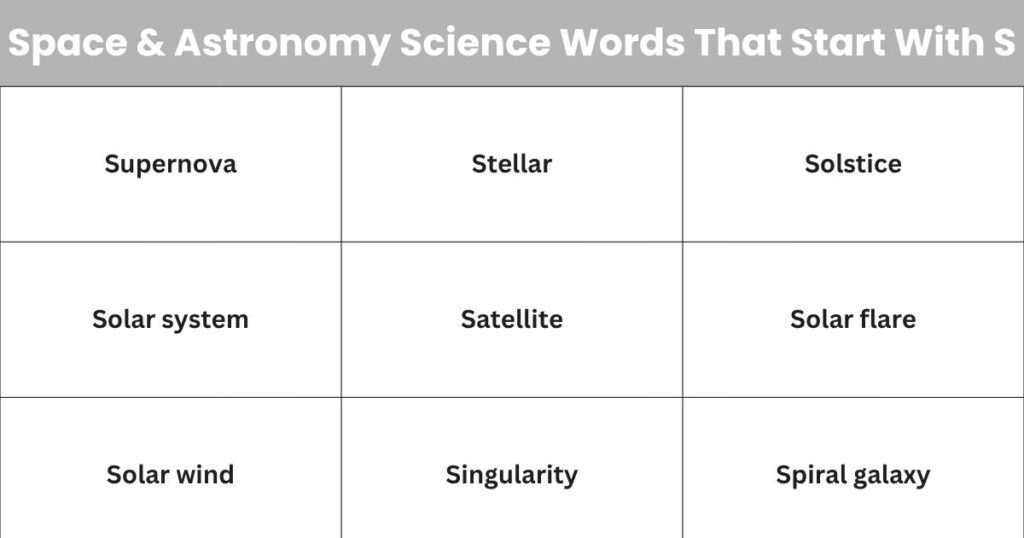
Supernova — The explosive death of a massive star. A single supernova can briefly outshine an entire galaxy.
Solar system — The Sun and everything gravitationally bound to it: planets, moons, asteroids, and comets.
Solar wind — A continuous stream of charged particles flowing outward from the Sun in all directions.
Spectrum — The full range of light frequencies, from radio waves to gamma rays. Visible light is a small slice of it.
Stellar — Relating to stars. “Stellar evolution” describes a star’s entire life cycle.
Satellite — Any object that orbits another. The Moon is Earth’s natural satellite; GPS relies on artificial ones.
Singularity — The theoretical center of a black hole, where density becomes infinite and normal physics breaks down.
Solstice — The two days each year when the Sun reaches its highest or lowest point in the sky. The reason summer and winter exist.
Solar flare — A sudden burst of radiation from the Sun’s surface. Strong flares can disrupt GPS signals and power grids on Earth.
Spiral galaxy — A galaxy with curved arms of stars spreading from a central core. The Milky Way is one.
Medical & Health Science Words That Start With S
Serotonin — A brain chemical regulating mood, appetite, and sleep. Low serotonin is linked to depression.
Systolic — The top number in a blood pressure reading. Measures pressure when the heart actively pumps.
Sepsis — A dangerous, body-wide response to infection. Life-threatening if not treated quickly.
Subcutaneous — Located just beneath the skin. Many insulin injections are given subcutaneously.
Stenosis — Narrowing of a passage in the body — a blood vessel or heart valve, for example.
Scoliosis — An abnormal sideways curve in the spine.
Stroke — When blood supply to part of the brain is cut off, causing brain cells to die rapidly. Every second counts.
Symptom — A change noticed by the patient — pain, fever, dizziness.
Syndrome — A cluster of symptoms that consistently appear together, pointing to a specific condition.
Technology & Applied Science Words That Start With S
Semiconductor — Conducts electricity under some conditions but not others. Silicon is the most used — it’s what computer chips are built from.
Sensor — Detects a physical change (heat, light, pressure) and converts it into a readable signal.
Software — The programs and instructions that run on a computer.
Signal — Information transmitted as a wave or electrical pulse.
System — Connected parts working toward a shared function. A circuit is a system. So is the human body.
Simulation — A computer model imitating a real process. Used to predict weather, test aircraft designs, and train surgeons.
Sonar — Uses sound waves to detect underwater objects. Submarines and dolphins both use versions of it.
Solar panel — Converts sunlight into electricity using photovoltaic cells.
Structural engineering — Designs and analyzes structures — buildings, bridges, towers — to safely carry loads.
🟢 Easy Science Words That Start With S
Perfect starting point for younger students or anyone just entering science vocabulary.
- Sun — The star at the center of our solar system
- Seed — Part of a plant that grows into a new plant
- Soil — Ground layer where plants grow
- Sound — What you hear when something vibrates
- Shadow — Dark shape formed when something blocks light
- Sink — To go below the surface of a liquid
- Solid — State of matter with a definite shape
- Speed — How fast something moves
- Star — A glowing ball of gas in space
- Steam — Water turned to vapor by heat
- Stem — The part of a plant supporting leaves and flowers
- Swamp — Wet, low-lying land area with trees
- Shell — Hard outer covering of animals like crabs or snails
Advanced Science Words That Start With S
These appear in high school, AP exams, and college-level courses.
Spectrophotometry — Measuring how much light a substance absorbs at different wavelengths. Used to identify chemicals in a sample.
Sympathetic nervous system — The part of the nervous system that prepares the body for “fight or flight” responses.
Superposition — In physics: two waves overlapping and combining. In geology: older rock layers sit beneath newer ones.
Sympatric speciation — A new species developing from an existing one without any geographic separation between them.
Synergism — When two things together produce a greater effect than each would separately.
Stochastic — Randomly determined, involving probability. Used in genetics and climate modeling.
Superconductivity — Certain materials conducting electricity with zero resistance at extremely low temperatures.
Somatosensory — Related to body sensations — touch, temperature, and pain signals traveling to the brain.
Science Words That Start With S — By Grade Level
Grade 5–6 Solid, Seed, Sound, Stem, Shadow, Soil, Star, Speed, Species, Spore, Salinity, Satellite, Solar
Grade 7–8 Solution, Sublimation, Symbiosis, Stimulus, Sediment, Seismic, Stratum, Stomata, Spectrum, Static electricity, Synthesis, Succession
Grade 9–10 Stoichiometry, Semiconductor, Subduction, Spectroscopy, Saprophyte, Synapse, Serotonin, Scoliosis, Systolic, Sonar
Grade 11–12 / College Superconductivity, Stochastic, Superposition, Somatosensory, Sympatric speciation, Spectrophotometry, Sepsis, Sympathetic nervous system
The Full List: 130+ Science Words That Start With S
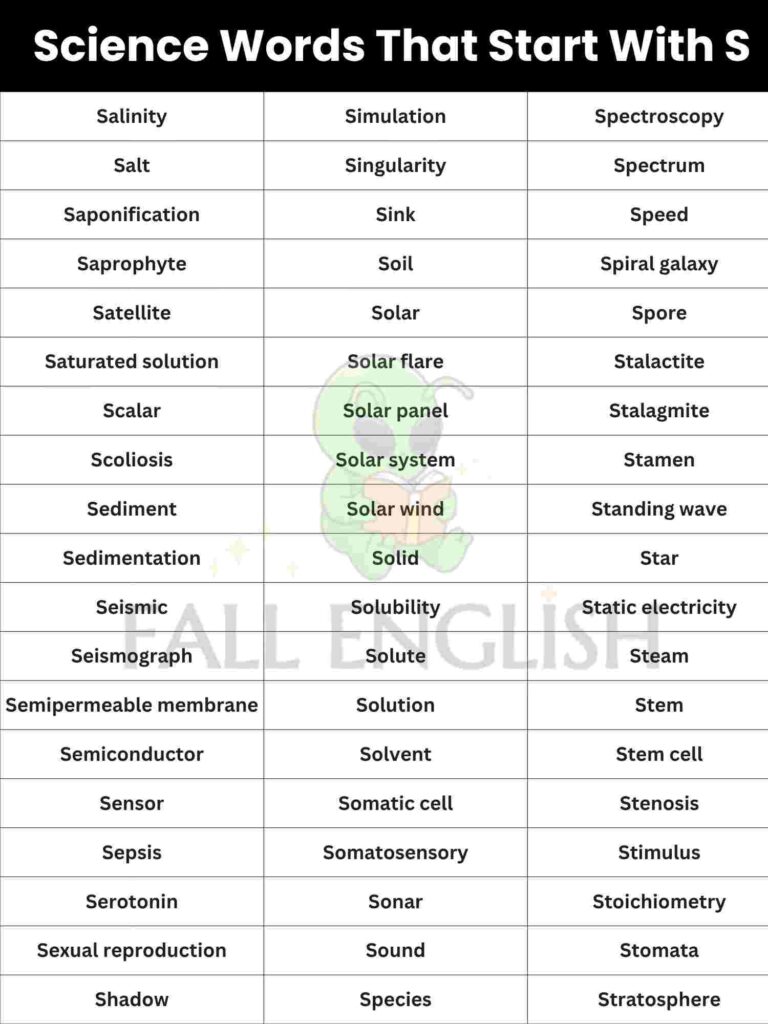
Salinity
Salt
Saponification
Saprophyte
Satellite
Saturated solution
Scalar
Scoliosis
Sediment
Sedimentation
Seismic
Seismograph
Semipermeable membrane
Semiconductor
Sensor
Sepsis
Serotonin
Sexual reproduction
Shadow
Shale
Shear
Signal
Simulation
Singularity
Sink
Soil
Solar
Solar flare
Solar panel
Solar system
Solar wind
Solid
Solubility
Solute
Solution
Solvent
Somatic cell
Somatosensory
Sonar
Sound
Species
Specific gravity
Specific heat
Spectrophotometry
Spectroscopy
Spectrum
Speed
Spiral galaxy
Spore
Stalactite
Stalagmite
Stamen
Standing wave
Star
Static electricity
Steam
Stem
Stem cell
Stenosis
Stimulus
Stoichiometry
Stomata
Stratosphere
Stratum
Stress
Stroke
Structural engineering
Structural formula
Subduction
Subcutaneous
Sublimation
Succession
Sun
Superconductivity
Supernova
Supersaturated
Superposition
Surface tension
Suspension
Swamp
Symbiosis
Sympathetic nervous system
Sympatric speciation
Symptom
Synapse
Synergism
Syndrome
Synthesis
System
Scalar
Seed
Shell
Software
Solstice
Somatosensory
Specific gravity
Stellar
Stochastic
Swamp
Common Mix-Ups Worth Knowing
Stalactite vs Stalagmite Stalactites hang from the ceiling — “c” for ceiling. Stalagmites rise from the ground — “g” for ground. This mix-up shows up on earth science tests more than almost any other.
Solute vs Solvent The solvent dissolves. The solute gets dissolved. In lemonade: water is the solvent, sugar and lemon are the solutes.
Speed vs Velocity Speed is how fast. Velocity is how fast AND in which direction. A car doing 60 km/h has speed. Going 60 km/h north has velocity.
Suspension vs Solution A solution is clear and stays permanently mixed. A suspension looks cloudy and particles eventually settle.
Symptom vs Syndrome A symptom is a single sign — a cough, a fever. A syndrome is a named pattern of multiple symptoms appearing together.
Stimulus vs Response The stimulus triggers. The response is what happens because of it. Hot pan (stimulus) → pull your hand away (response).
Where These Words Actually Show Up
In a hospital: Serotonin, Sepsis, Stenosis, Stroke, Systolic, Scoliosis, Symptom, Syndrome, Subcutaneous, Stem cell
In a garden or forest: Seed, Stem, Stomata, Stamen, Spore, Succession, Saprophyte, Soil, Symbiosis
In a weather or news report: Stratosphere, Salinity, Seismic, Solar wind, Solar flare
In a physics or chemistry lab: Speed, Sound, Static electricity, Sublimation, Spectrum, Stoichiometry, Solution, Surface tension
In space news: Supernova, Stellar, Solar system, Singularity, Satellite, Spiral galaxy, Solstice
In your phone or computer: Semiconductor, Sensor, Software, Signal, Simulation, Sonar
Memory Tricks for S Science Words
Stalactite vs Stalagmite: “Stalactites hold tight to the ceiling. Stalagmites might reach the ceiling someday.”
Solute vs Solvent: The solVENT is the big liquid environment. The solutE is what gets swallowed into it.
Sym- words: “Sym” comes from Greek meaning together. Symbiosis, synapse, syndrome, synthesis — all involve things connecting or working together.
Seismic: Sounds like “seize.” The ground seizes and shakes.
Sublimation: “Sublime” means rising to something higher. In science, the substance rises straight from solid to gas — skipping liquid entirely.
Spectrum: Picture a prism splitting white light into a rainbow. That rainbow IS the visible spectrum.
You may also like:
150+ Verbs That Start With C: The Only Guide You’ll Ever Need
150+ Science Words That Start With T | Meanings, Examples & Full List
FAQs
1. I keep forgetting science words. What actually helps them stick?
Try linking each word to something real. For example, think of “static electricity” as that small shock you feel when touching metal. When a word connects to a real moment, your brain remembers it faster than just reading definitions.
2. How many science words should I learn at once?
Don’t overload yourself. Start with 5–10 words a day. Focus on understanding them, not memorizing blindly. Once you can explain a word in your own simple sentence, you’ve learned it properly.
3. Are these words important for exams or just general knowledge?
Both. Many of these terms appear directly in school exams, especially in middle and high school. But they also help you understand topics like weather, health, and technology in daily life.
4. What’s the fastest way to revise before a test?
Use quick comparisons and examples. For instance, remember “solute vs solvent” by thinking: solvent does the dissolving, solute gets dissolved. Short tricks like this save time and improve recall.

FallEnglish is run by a language enthusiast who explains word and text meanings in clear, simple ways. Each guide is carefully researched, original, and written to help real people understand language faster, with accuracy, context, and everyday examples you can trust.