


Learning Science Words That Start With T doesn’t have to feel overwhelming. Whether you’re studying for a test, helping a child, or improving your English, the right explanations make all the difference.
This guide keeps things clear and practical, focusing on words you’ll actually see in school and real life. From “temperature” to “tissue,” each term connects to something familiar—your body, the weather, or everyday technology. Instead of memorizing random definitions, you’ll understand how these words work, where they show up, and why they matter.
10 Most Common Science Words Starting With T
Temperature — Measure of heat energy in a substance
Tissue — Group of similar cells working together
Tectonic — Related to Earth’s moving crustal plates
Transpiration — Water loss from plant leaves into air
Thrust — Forward force that moves an object
Tsunami — Giant ocean wave from seismic activity
Toxin — Poisonous substance made by living things
Trajectory — Curved path of a moving object
Taxonomy — Science of classifying living organisms
Troposphere — Lowest atmospheric layer where weather occurs
Physics Science Words That Start With T
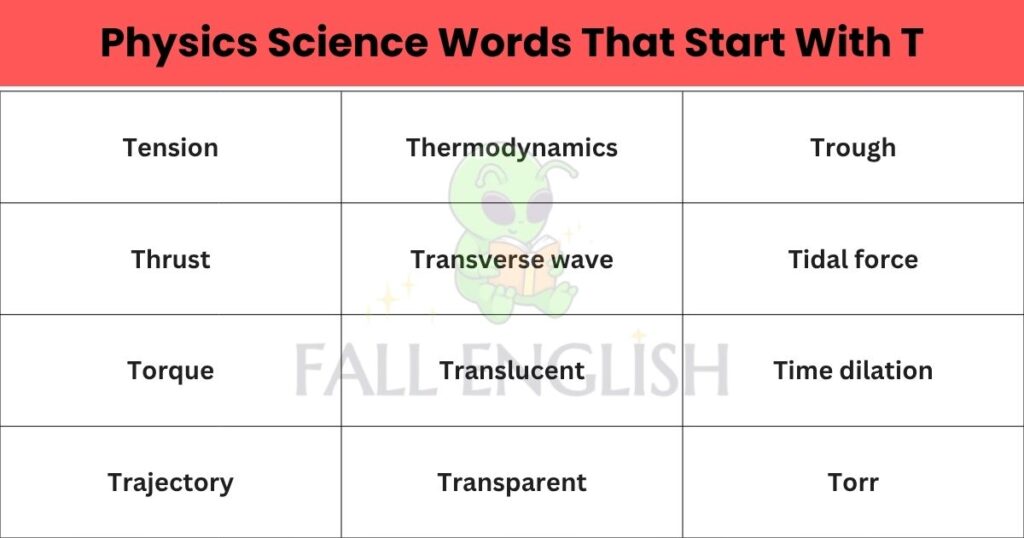
Tension — The pulling force inside a stretched rope or cable. Tug-of-war makes this easy to visualize.
Thrust — Force pushing a rocket or aircraft forward. No thrust, no flight.
Torque — A twisting force. Turning a wrench applies torque to a bolt.
Trajectory — The curved path an object follows after being launched. A basketball arc is a trajectory.
Thermal energy — Total heat inside an object, based on how fast its particles move.
Thermodynamics — The study of how heat moves and converts into other energy forms.
Transverse wave — A wave where particles move perpendicular to the wave’s direction. Light travels this way.
Translucent — Lets some light through but scatters it. Frosted glass is translucent.
Transparent — Lets light pass through completely without scattering. A clean window is transparent.
Terminal velocity — The maximum falling speed when air resistance equals gravity. Skydivers reach this.
Trough — The lowest point of a wave, opposite of the crest.
Tidal force — Gravitational pull that stretches objects. The Moon’s tidal force creates Earth’s ocean tides.
Time dilation — From Einstein’s relativity — time genuinely passes slower at very high speeds or near massive objects.
Torr — A unit of pressure. One atmosphere equals 760 torr.
Chemistry Science Words That Start With T
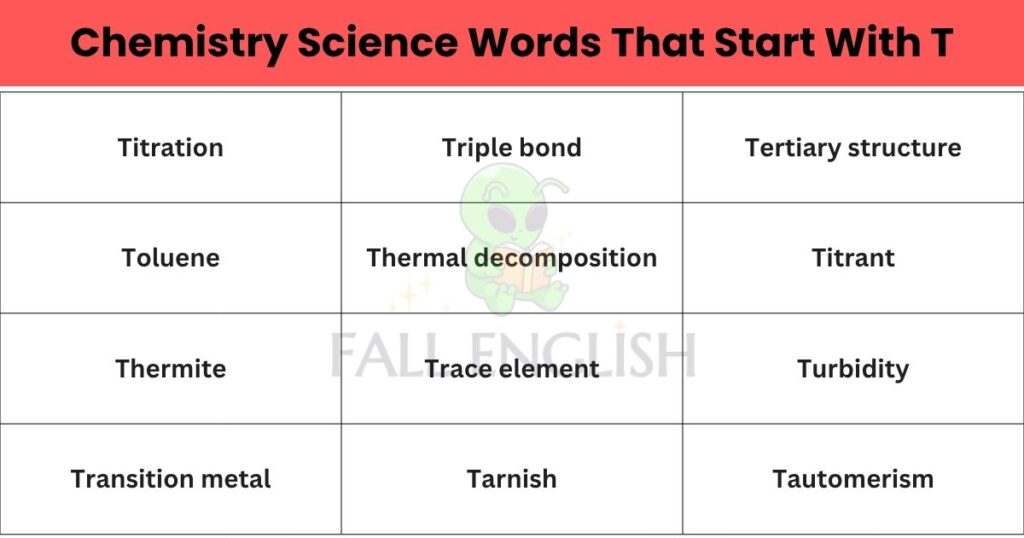
Titration — A lab technique where a measured solution is slowly added to another to find its exact concentration. Common in acid-base experiments.
Toluene — A clear solvent found in paint thinner and gasoline.
Thermite — Aluminum mixed with iron oxide that burns at extreme temperatures. Used in industrial welding.
Transition metal — Metals in the periodic table’s central block — iron, copper, gold. Good electrical conductors.
Triple bond — When two atoms share three electron pairs. Nitrogen gas (N₂) uses one.
Thermal decomposition — Heat breaking a compound into simpler substances.
Trace element — A chemical element living things need in tiny amounts. Zinc and iodine are examples.
Tarnish — When a metal reacts with air or moisture and loses its shine. Silver does this.
Tertiary structure — The complete three-dimensional folded shape of a protein.
Titrant — The solution of known concentration used during titration.
Turbidity — How cloudy a liquid appears due to suspended particles.
Tautomerism — When a molecule can exist in two different structural forms that interconvert.
Biology Science Words That Start With T
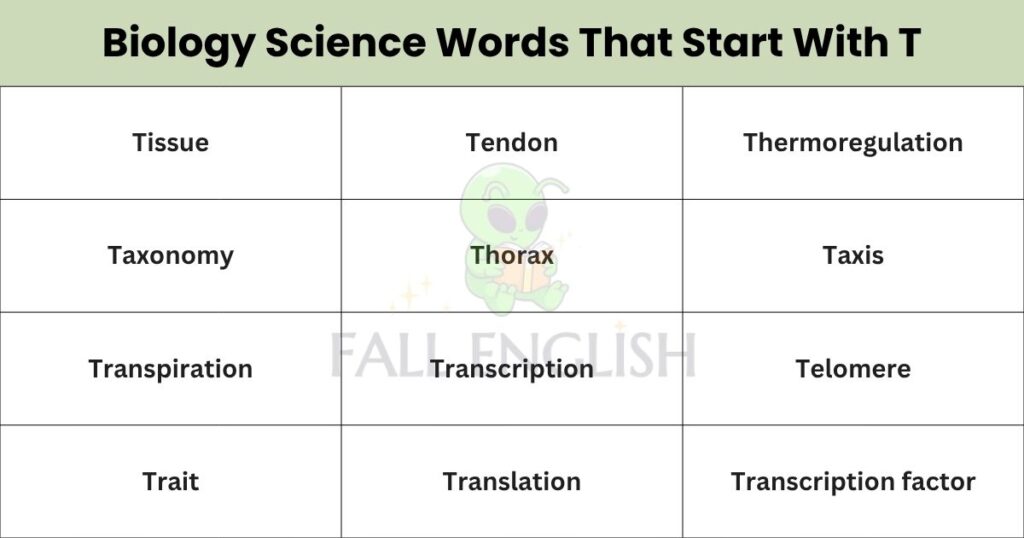
Tissue — Cells of the same type grouped together to do one job. Muscle, skin, and nerve tissue are examples.
Taxonomy — The science of naming and organizing all living things into groups. Carl Linnaeus built the system still used today.
Transpiration — Plants release water vapor through tiny leaf pores called stomata. This pulls more water up from the roots.
Trait — Any inherited characteristic — eye color, fur texture, drought resistance.
Trophic level — A position in a food chain. Plants sit at level one. Predators higher up.
Trachea — In humans, the windpipe. In insects, a network of tubes delivering oxygen directly to cells.
Tendon — Tough fibrous tissue connecting muscle to bone.
Thorax — The chest region in humans. In insects, it’s the middle body section where legs attach.
Transcription — Step one of protein production. DNA is copied into RNA inside the cell nucleus.
Translation — Step two. RNA instructions are decoded to assemble a protein.
Turgor pressure — Water pushing against a plant cell’s wall from inside. This keeps plants upright. When water is lost, plants wilt.
Thermoregulation — How an organism keeps its internal temperature stable. Sweating is one method.
Taxis — Movement toward or away from a stimulus. Moths flying toward light is phototaxis.
Telomere — Protective caps on chromosome ends that shorten with each cell division. Linked to aging.
Transcription factor — A protein that switches specific genes on or off.
Trilobite — An extinct marine arthropod common in fossils, alive hundreds of millions of years ago.
Earth Science Words That Start With T
Tectonic plates — Massive rocky slabs making up Earth’s outer shell. Their slow movement causes earthquakes and builds mountains.
Tremor — A small seismic shake, often before or after a larger earthquake.
Topography — The physical shape of a land surface — hills, valleys, plains, and rivers.
Tsunami — A series of large ocean waves triggered by underwater earthquakes, eruptions, or landslides.
Tundra — Earth’s coldest biome. The subsoil stays permanently frozen, called permafrost.
Tropical — Warm, humid climate zone sitting near the equator.
Talus — Rocky debris piled at the base of a cliff, broken off by weathering.
Thermocline — An ocean layer where temperature drops sharply with depth.
Till — Rock, clay, and sand deposited directly by a glacier.
Trade winds — Steady winds blowing east to west near the equator.
Turbidity current — An underwater current driven by sediment-heavy water moving downslope.
Topsoil — The uppermost soil layer richest in nutrients — where most plant roots live.
Space & Astronomy Science Words That Start With T
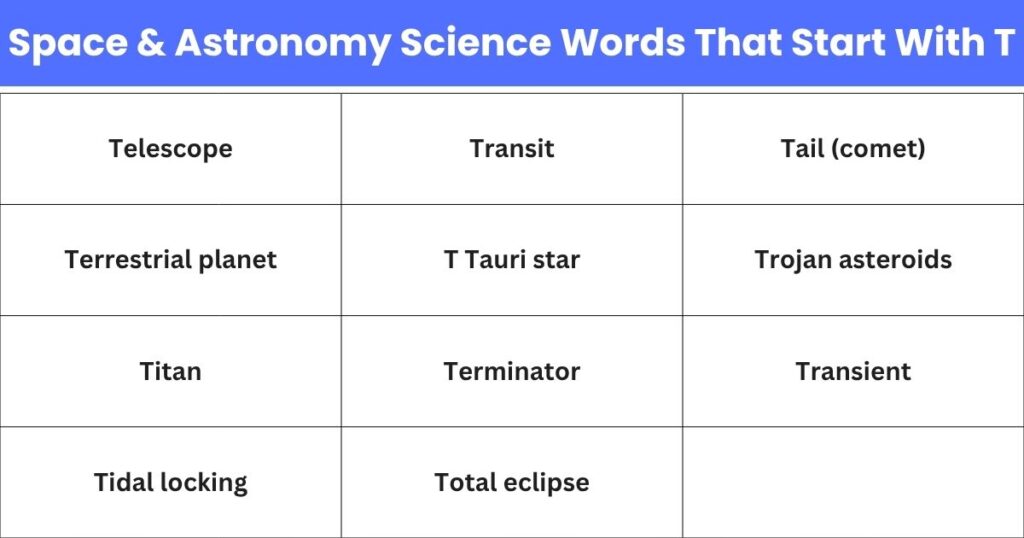
Telescope — Collects light from distant objects to make them appear larger and clearer.
Terrestrial planet — A rocky planet close to the Sun. Mercury, Venus, Earth, and Mars qualify.
Titan — Saturn’s largest moon. Its lakes contain liquid methane, not water.
Tidal locking — When a moon always shows the same face to its planet. Earth’s Moon is tidally locked.
Transit — When a smaller object crosses in front of a larger one. Astronomers use planetary transits to detect distant worlds.
T Tauri star — A young, still-forming star not yet stable enough to burn like our Sun.
Terminator — The dividing line between a moon or planet’s lit and dark sides.
Total eclipse — When one celestial body completely blocks another’s light.
Tail (comet) — The stream of gas and dust trailing a comet as it approaches the Sun.
Trojan asteroids — Asteroid clusters that share a planet’s orbit at stable gravitational points.
Transient — A short-lived astronomical event. Supernovae are transients.
Medical & Health Science Words That Start With T
Tachycardia — A resting heart rate above 100 beats per minute.
Tendinitis — Tendon inflammation from overuse. Knees and elbows are common sites.
Thrombosis — A blood clot inside a vessel that can block blood flow.
Thyroid — A neck gland shaped like a butterfly that controls metabolism and energy levels.
Tonsils — Lymphatic tissue in the throat that helps fight infections.
Transplant — Replacing a failing organ with a healthy donor organ.
Trauma — Severe physical injury, or in mental health, a deeply distressing experience.
Tumor — Abnormal uncontrolled cell growth. Benign tumors don’t spread. Malignant ones do.
Triage — The system emergency teams use to prioritize patients by urgency.
Triglycerides — Blood fats that, at high levels, raise heart disease risk.
Tympanic membrane — The eardrum. It vibrates in response to sound waves.
Teratogen — Any substance that causes birth defects during pregnancy.
Toxicology — Study of how poisons and chemicals affect the body. Used in medicine and forensics.
Technology & Applied Science Words That Start With T
Transistor — A tiny electronic switch. Billions fit inside a single modern chip.
Turbine — A spinning machine converting fluid or air movement into electricity. Wind turbines and jet engines both use this.
Telemetry — Automatic data collection and transmission from remote sensors. Used in spacecraft, race cars, and patient monitoring.
Thermistor — A sensor whose electrical resistance changes with temperature.
Transformer — Changes electrical voltage levels. The large cylinders on power poles are transformers.
Thermal imaging — Technology that reads heat instead of light to produce images. Used in medicine, security, and firefighting.
Topology — In networking and mathematics, the study of how systems and shapes connect.
Transmission — Sending signals or power from one point to another — in cables, radio waves, or vehicle drivetrains.
Science Words That Start With T by Grade Level
Grades 3–5
Thunder, tide, tadpole, tooth, tongue, tree ring, transparent, twin, tropical, thermometer, temperature
Grades 6–7
Tissue, tectonic, toxin, transpiration, trachea, turbine, tremor, tundra, trajectory, trait, thermal, trophic level
Grades 8–9
Taxonomy, thermodynamics, transcription, translation, turgor pressure, thermoregulation, titration, transition metal, topography, terminal velocity
Grade 10+
Telomere, thermohaline circulation, transcription factor, tautomerism, thermoluminescence, teratogen, topoisomerase, torsion, time dilation, tidal force
The Full List — 150+ Science Words That Start With T
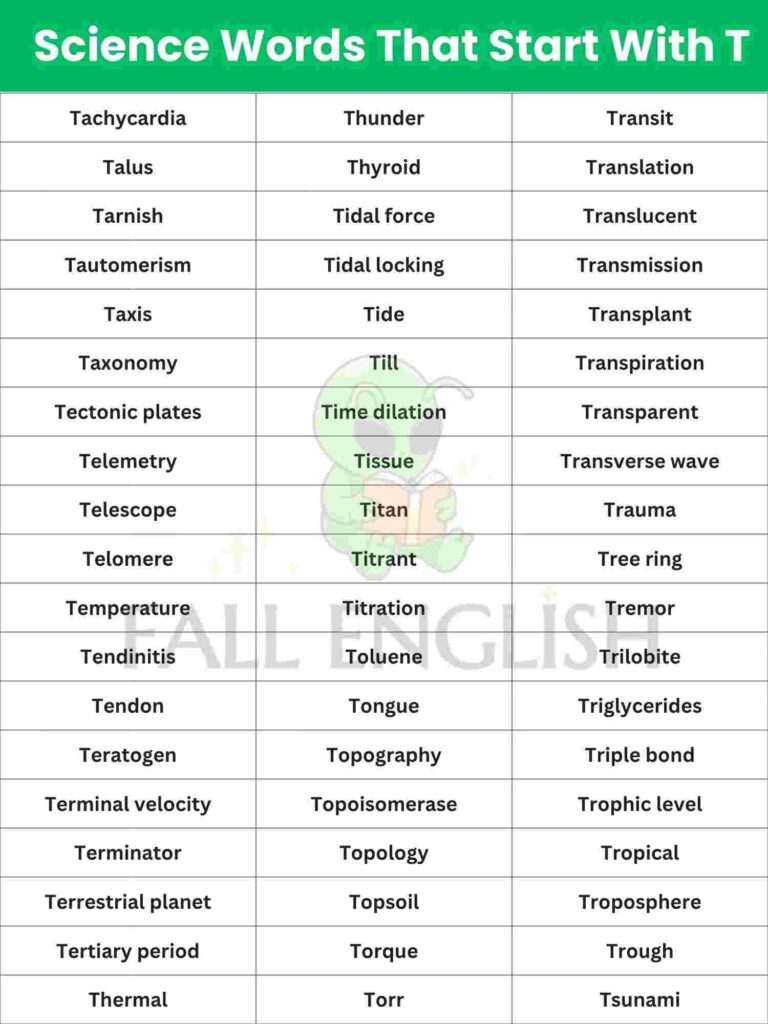
Tachycardia
Talus
Tarnish
Tautomerism
Taxis
Taxonomy
Tectonic plates
Telemetry
Telescope
Telomere
Temperature
Tendinitis
Tendon
Teratogen
Terminal velocity
Terminator
Terrestrial planet
Tertiary period
Thermal
Thermal decomposition
Thermal energy
Thermal imaging
Thermistor
Thermite
Thermohaline circulation
Thermoluminescence
Thermometer
Thermoregulation
Thermodynamics
Thorax
Thrombosis
Thrust
Thunder
Thyroid
Tidal force
Tidal locking
Tide
Till
Time dilation
Tissue
Titan
Titrant
Titration
Toluene
Tongue
Topography
Topoisomerase
Topology
Topsoil
Torque
Torr
Torsion
Toxicology
Toxin
Trachea
Trade winds
Trait
Trajectory
Transcription
Transcription factor
Transformer
Transient
Transistor
Transit
Translation
Translucent
Transmission
Transplant
Transpiration
Transparent
Transverse wave
Trauma
Tree ring
Tremor
Trilobite
Triglycerides
Triple bond
Trophic level
Tropical
Troposphere
Trough
Tsunami
Tumor
Tundra
Turbidity
Turbidity current
Turbine
Turgor pressure
Twin
Tympanic membrane
T Tauri star
Tail (comet)
Taproot
Tarsal
Telophase
Temperate
Tensile strength
Tension
Territorial
Thermocline
Thigmotropism
Tidal bore
Tidal flat
Tissue culture
Tonicity
Trace element
Tracheal system
Transfusion
Transition zone
Tree line
Tributaries
Triple point
Trophoblast
Tropism
Typhoon
Common Mix-Ups Worth Knowing
Transpiration vs. Respiration Both happen in plants. Transpiration is water leaving through leaf pores. Respiration is cells releasing energy from glucose. Different processes, different purposes.
Transparent vs. Translucent Transparent — full light passes through, clear image. Translucent — light passes through but blurs. A window vs. frosted glass.
Tremor vs. Earthquake A tremor is small seismic activity. An earthquake is the main rupture event. Tremors can precede or follow earthquakes.
Trachea vs. Esophagus Same throat region, opposite destinations. Trachea leads to lungs. Esophagus leads to stomach. The epiglottis flap prevents food from entering the trachea.
Tsunami vs. Tidal wave Tsunamis have nothing to do with tides. They’re caused by underwater earthquakes, eruptions, or landslides. Scientists stopped using “tidal wave” for this reason.
Tumor vs. Cancer All cancerous growths are tumors. Not all tumors are cancerous. Benign tumors grow without spreading. Malignant tumors invade surrounding tissue.
Where These Words Actually Show Up
In your body right now — Tendons are moving your muscles. Your trachea is carrying air. Your thyroid is regulating energy this very moment.
Outside — Wind means turbulence in the troposphere. Rivers shape topography. Storms form in the same atmospheric layer where planes fly.
In hospitals — Thrombosis is screened through blood tests. Tumors are found using thermal imaging. Triage happens every time an ambulance arrives.
In space programs — Engineers calculate trajectory before every launch. Telemetry sends spacecraft data back to Earth continuously.
In farming and food — Transpiration keeps crops cool. Temperature controls fermentation. Trace elements in soil directly affect plant health.
Memory Tricks for T Science Words
Transpiration → “Trans” + “Perspiration.” Plants perspire. Water exits through leaf pores, just like sweat through skin.
Tectonic → “Tons of rock moving.” That’s exactly the reality.
Trophic level → Think “trophy for eating.” Each level up the food chain earns a bigger one.
Taxonomy → Picture a “taxi” sorting passengers by destination. Taxonomy sorts organisms by relationship.
Telomere → “Telo” = end, “mere” = part. The end-part of a chromosome.
Turgor pressure → Imagine a tightly inflated water balloon. That firmness is what turgor pressure gives a plant cell.
Read also about:
200+ Verbs That Start With D — For Students, Writers & Word Lovers
150+ Verbs That Start With C: The Only Guide You’ll Ever Need
FAQs about Science Words That Start With T
1. What are the easiest science words starting with T for beginners?
Start with words you already hear often—like temperature, tissue, thunder, and telescope. These are easier because you can connect them to real-life experiences, which helps memory stick.
2. How can I remember science terms faster?
Break words into parts and link them to something familiar. For example, “transpiration” sounds like “perspiration,” which helps you remember that plants release water like sweat.
3. Why do many science words begin with T?
Many come from Greek and Latin roots like “therm” (heat) and “trans” (across). These roots are used across different science fields, so the letter T appears often.
4. Are these words important for exams?
Yes, especially words like tissue, taxonomy, tectonic plates, and transpiration. These commonly appear in middle school science tests and build a strong base for higher studies.
5. How do these words help in real life?
They help you understand everyday things—like how your body works (thyroid, tendon), how weather forms (troposphere), and how machines operate (turbine, transistor).
Bottom line
This guide covered 150+ science words starting with T across eight subject areas, organized by grade level, clarified common confusions, and connected vocabulary to real situations.
Science terms aren’t isolated facts. Thermoregulation links biology to medicine. Thermal energy connects physics to Earth science. Tectonic connects geology to geography. The more of these words you own, the more the bigger picture comes into focus.

FallEnglish is run by a language enthusiast who explains word and text meanings in clear, simple ways. Each guide is carefully researched, original, and written to help real people understand language faster, with accuracy, context, and everyday examples you can trust.