


Verbs that start with D describe an enormous range of human activity — physical movement, deep emotion, professional achievement, and intellectual work. Words like dance, decide, describe, and dread each belong to different worlds of meaning. This guide organizes 200+ D verbs into focused categories with detailed entries, practical writing tips, word-game lists, and clear examples — built for students, writers, and word-game players alike.
Quick Reference: Top 10 Most Useful Verbs That Start With D
| Verb | Best Use |
| Describe | Essays, explanations, academic writing |
| Develop | Professional, research, business writing |
| Deliver | Resumes, business communication |
| Discover | Storytelling, science writing |
| Decide | Persuasive and formal writing |
| Demonstrate | Academic papers, formal reports |
| Design | Creative and technical projects |
| Direct | Leadership contexts, resumes |
| Drive | Motivational and business writing |
| Dream | Emotional and creative writing |
Verbs That Start With D for Kids (Beginner List)
Short, common, and easy to use in simple sentences. These are the first D verbs a young learner needs.
- Dab — Dab the paint gently on the paper.
- Dial — Dial Grandma’s number after school.
- Dip — Dip the cookie into the milk.
- Do — Just do your best today.
- Dress — She dressed herself for the first time.
- Drink — Drink your water before you go out.
- Drop — Don’t drop the eggs.
- Dry — Dry your hands before eating.
- Duck — Duck! The ball is coming right at you.
- Dump — He dumped his bag by the door.
- Dust — Please dust the shelves before guests arrive.
Sound tip for kids: The letter D makes one clean, firm sound in almost every English verb — exactly like the D in dog. Say it strong at the start and you’ll always be right.
Physical Action Verbs That Start With D
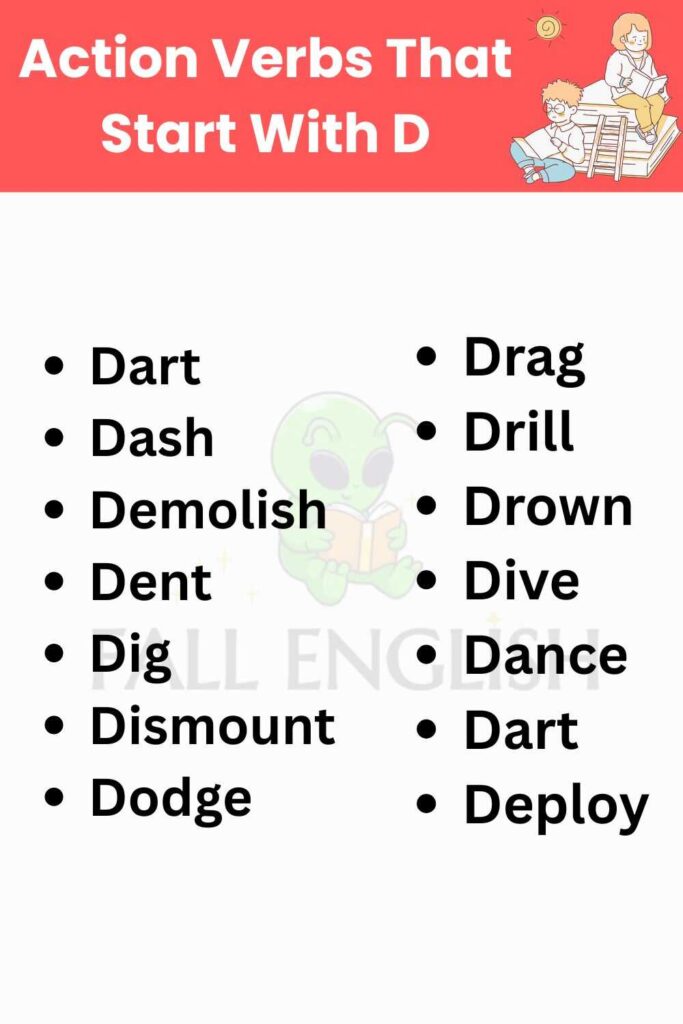
These are body-movement words that put people, characters, and objects in motion. Notice that none of the beginner verbs from Section 1 are repeated here — this list moves into more specific, adult, and literary action.
- Dart
- Dash
- Demolish
- Dent
- Dig
- Dismount
- Dodge
- Drag
- Drill
- Drown
- Dive
- Dance
- Dart
- Deploy (physical deployment — troops, equipment)
Weak vs. Strong — see the difference:
Weak: He moved through the crowd. Strong: He dodged through the crowd.
Dodged tells you he was avoiding people on purpose, under pressure. One verb replaces an entire phrase.
Communication Verbs That Start With D
These cover speaking, writing, arguing, questioning, and sharing. Many of the strongest ones fall under verbs that start with DE — one of the most productive prefixes in English.
- Debate
- Declare
- Demand
- Dictate
- Direct (as in: to direct a conversation)
- Disclose
- Dispute
- Distinguish
- Divulge
- Draft
- Dub
- Discuss
Emotional and Abstract Verbs That Start With D
These work beneath the surface — inner states, invisible forces, and the feelings that drive behavior.
- Daydream
- Despair
- Delight
- Devote
- Dignify
- Disappoint
- Discourage
- Dishearten
- Dote
- Doubt
- Dread
- Dwell
- Desire
Academic and Professional Verbs That Start With D
These appear in essays, lab reports, research papers, and formal business documents.
- Define
- Deduce
- Derive
- Designate
- Detail
- Detect
- Determine
- Diagnose
- Differentiate
- Discriminate (in the analytical sense: to tell apart)
- Distribute
- Divide
- Document
- Dominate (in data or argument context)
Positive and Growth Verbs That Start With D
These carry forward energy. They describe building, achieving, contributing, and committing.
- Dare
- Dedicate
- Diversify
- Donate
Verbs That Start With D to Describe a Person
These paint a picture of how someone behaves, moves through the world, or treats others. They’re essential for character writing, personality descriptions, and storytelling.
- Deceive
- Defy
- Deliberate (to think carefully before acting)
- Deviate
- Differ
- Distract
- Disturb
- Display (as in: to display generosity)
- Dominate (as in: to dominate a room)
Example in use: “He doesn’t just lead — he dominates every room he enters. She defies expectations quietly, without making noise about it.”
Dominates and defies paint sharper pictures than “he leads well” or “she does well.” The verb is doing all the work.
Negative Verbs That Start With D
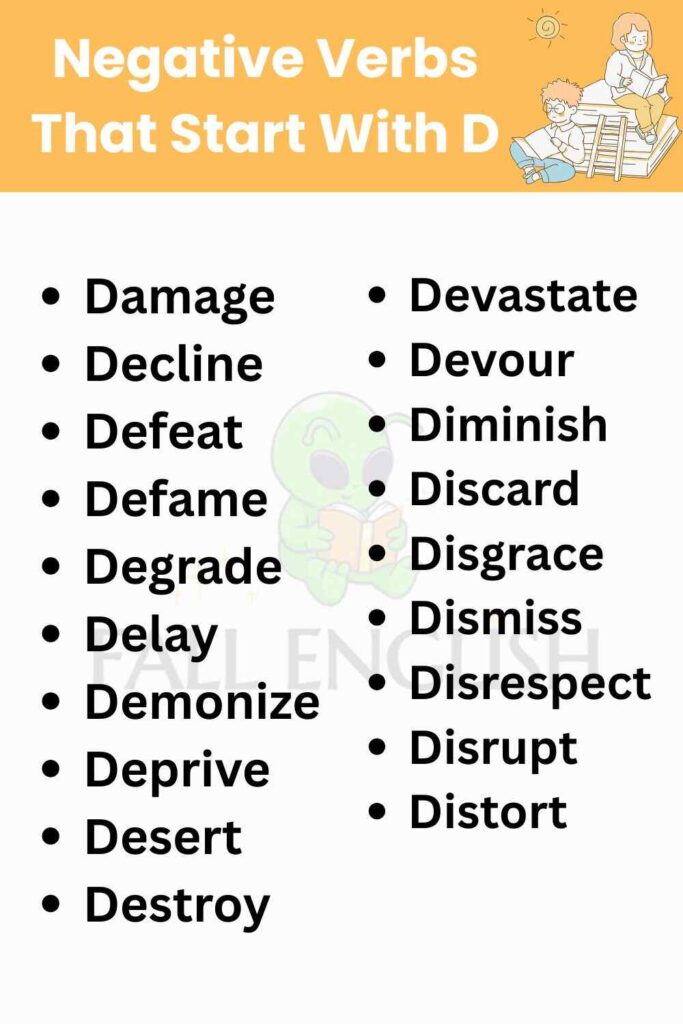
Most vocabulary guides skip this entirely. Negative D verbs — words describing destructive, harmful, or discouraging actions — are just as important to know. Writers need them for conflict. Students need them for full vocabulary range.
- Damage
- Decline (to refuse or worsen)
- Defeat
- Defame
- Degrade
- Delay
- Demonize
- Deprive
- Desert (to abandon)
- Destroy
- Devastate
- Devour (destructive sense)
- Diminish
- Discard
- Disgrace
- Dismiss
- Disrespect
- Disrupt
- Distort
Why these matter in writing:
Weak: He was unkind to her. Strong: He diminished her confidence with every comment he made.
Diminished is active, specific, and painful to read. That’s what good conflict scenes require. Avoiding negative verbs leaves your writing with no teeth.
Resume and Business Verbs That Start With D
These are for professionals writing cover letters, performance reviews, LinkedIn profiles, and resumes. Each one makes an achievement sound intentional and results-driven.
- Delegated — Delegated tasks across a team of eight to meet a quarterly deadline
- Deployed — Deployed a software update with zero service interruption
- Decreased — Decreased customer complaints by 40% in six months
- Diagnosed — Diagnosed recurring system failures and eliminated root causes
- Directed — Directed a cross-functional team of 12 across two time zones
- Documented — Documented all product changes across three platforms
- Drove — Drove adoption of new communication tools across the department
- Delivered — Delivered the project three weeks ahead of schedule
- Developed — Developed a sales strategy that increased revenue by 30%
- Designed — Designed a new onboarding workflow for 200+ employees
- Determined — Determined the root cause of repeated workflow breakdowns
Creative Writing: Weak vs. Strong Verbs That Start With D
| Weak Verb | Strong D Verb | Why It Works Better |
| Walk slowly | Dawdle | Paints laziness and mood in one word |
| Move down | Descend | Adds formality and visual depth |
| Fall suddenly | Drop | Faster and more abrupt — better for shock moments |
| Remove | Discard | Implies deliberate rejection, not just removal |
| Look intensely | Devour (with eyes) | Shows obsession and fixation |
| Try hard | Drive (forward) | Active and motivational in tone |
| Shake hard | Detonate (emotions) | Explosive in conflict scenes |
| Make bigger | Double | More concrete and visual than “increase” |
Here’s the catch: Every time you write make, move, or do — pause. Ask yourself if there’s a D verb that’s more specific. Most of the time there is, and finding it takes about three seconds.
Modern and Tech Verbs Starting With D
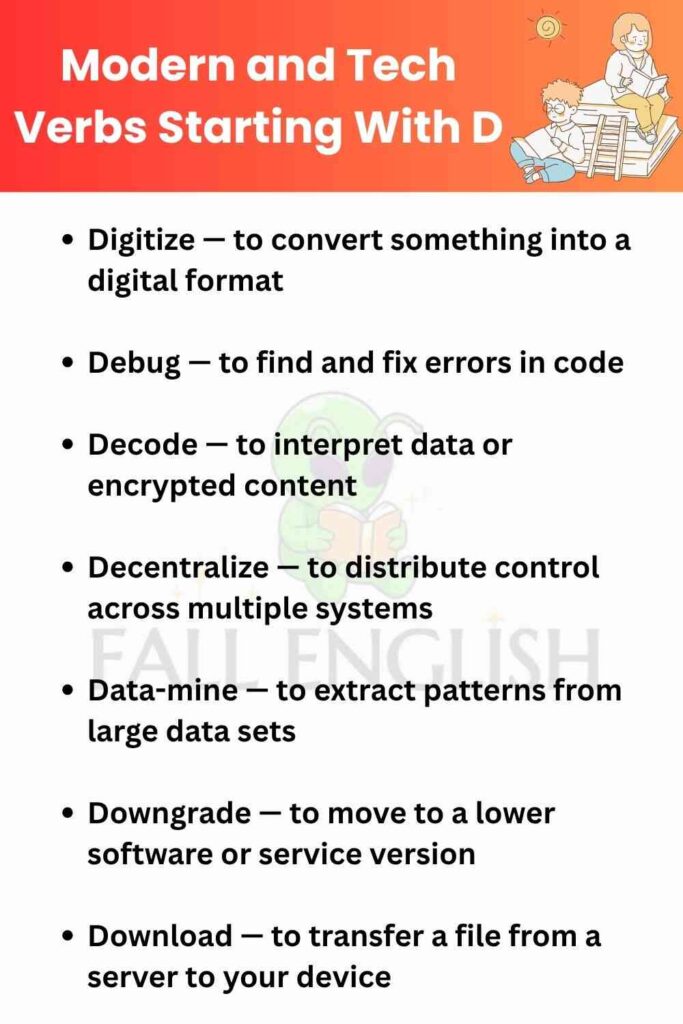
These newer or technology-influenced verbs are now common in professional, digital, and casual writing.
- Digitize — to convert something into a digital format
- Debug — to find and fix errors in code
- Decode — to interpret data or encrypted content
- Decentralize — to distribute control across multiple systems
- Data-mine — to extract patterns from large data sets
- Downgrade — to move to a lower software or service version
- Download — to transfer a file from a server to your device
- De-platform — to remove someone from a social or tech platform
Phrasal Verbs That Start With D
Phrasal verbs combine a verb with a preposition or adverb to create a new, specific meaning. These are different from all single-word verbs listed elsewhere in this guide.
- Deal with — to handle a situation (She dealt with the complaint calmly and professionally.)
- Dig into — to investigate something deeply (He dug into the old financial records.)
- Drag on — to continue for too long (The meeting dragged on well past noon.)
- Dream up — to invent or imagine something (She dreamed up the entire concept in one afternoon.)
- Drop off — to fall asleep, or to leave something somewhere (He dropped off the package before 8 a.m.)
- Drop out — to stop participating in something (Three students dropped out before the final exam.)
- Die down — to become quieter or less intense (The argument finally died down after midnight.)
- Do away with — to eliminate completely (The company did away with its paper-based system.)
- Double up — to share a space, or to increase suddenly (They doubled up in the small apartment during the renovation.)
- Draw on — to use a skill or experience as a resource (She drew on ten years of field research for the lecture.)
Word Length Lists (Word Stacks, Scrabble & Word Games)
These are organized purely by letter count for fast word-game lookup.
3-Letter D Verbs:
- Dam
- Die
- Dim
- Dub
4-Letter D Verbs:
- Dare
- Deal
- Dine
- Dote
- Draw
- Drum
5-Letter D Verbs:
- Daunt
- Delay
- Droop
- Drone
- Dwarf
6-Letter D Verbs:
- Dampen
- Darken
- Deepen
- Denote
- Decode
- Double
- Defuse
8+ Letter D Verbs:
- Decimate
- Deprecate
- Dismantle
- Disqualify
- Dissipate
- Duplicate
- Dramatize
Full Master List of 200+ Verbs That Start With D (Alphabetical Reference)
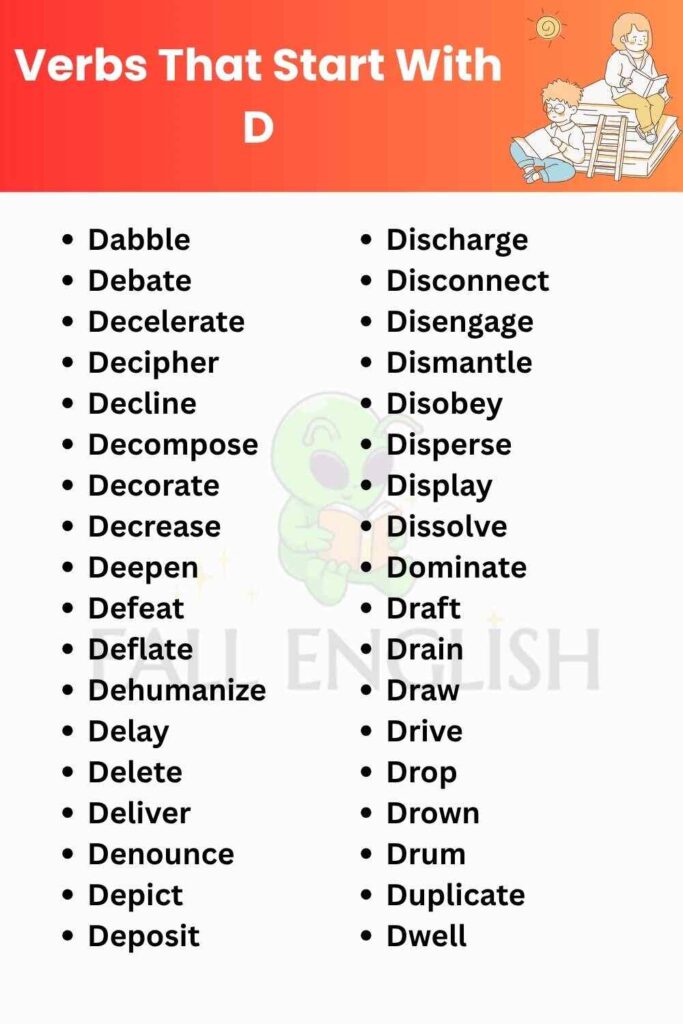
- Dabble
- Debate
- Decelerate
- Decipher
- Decline
- Decompose
- Decorate
- Decrease
- Deepen
- Defeat
- Deflate
- Dehumanize
- Delay
- Delete
- Deliver
- Denounce
- Depict
- Deposit
- Descend
- Desert
- Deter
- Deviate
- Diffuse
- Diminish
- Dip
- Discharge
- Disconnect
- Disengage
- Dismantle
- Disobey
- Disperse
- Display
- Dissolve
- Dominate
- Draft
- Drain
- Draw
- Drive
- Drop
- Drown
- Drum
- Duplicate
- Dwell
- Daunt
- Dawdle
- Dazzle
- Debunk
- Deflect
- Delay
- Denote
- Deprive
- Derive
- Describe
- Designate
- Despise
- Destabilize
- Detail
- Detect
- Devour
- Differ
- Discard
- Discourage
- Displace
- Dispute
- Disrespect
- Disrupt
- Distort
- Disturb
- Diverge
- Divulge
- Dodge
- Dominate
- Donate
- Doubt
- Downgrade
- Draft
- Dream
- Drill
- Duplicate
- Dye
- Defrost
- Dangle
- Dart
- Dash
- Debug
- Decentralize
- Declare
- Dedicate
- Degrade
- Demolish
- Deploy
- Desire
- Determine
- Devastate
- Digitize
- Disclose
- Disenfranchise
- Dismantle
- Distinguish
- Diversify
- Document
- Dominate
- Double
- Dramatize
- Drift
- Dump
- Dust
D Verbs Contextual Meaning: Same Verb, Different Worlds
The same verb can do completely different jobs depending on the field. Most vocabulary guides never explain this.
Drive:
- Everyday: She drives to work every morning.
- Business: The CEO drives the company’s vision.
- Tech: The hard drive stores your system files.
- Emotional: Pure ambition drives him forward.
Develop:
- Everyday: He developed a bad cold on Tuesday.
- Academic: The team developed a new hypothesis.
- Photography (historical): She developed the film in a darkroom.
- Business: They developed a new pricing model.
Detect:
- Everyday: She detected something odd in his tone.
- Medical: The scan detected an irregularity.
- Tech: The system detects unauthorized login attempts.
Same word. Entirely different job each time. Understanding this is what separates a good vocabulary from a great one.
Common Confusions With D Verbs
These pairs trip up even strong, experienced writers.
Deny vs. Decline:
- Deny = say something is not true (He denied making the comment.)
- Decline = politely refuse (She declined the invitation.) Using deny when someone simply says no to something is a very common error.
Discover vs. Invent:
- You discover something that already existed but was unknown (Scientists discovered the compound in 1987.)
- You invent something that did not exist before. This confusion appears regularly in science essays and history papers.
Devise vs. Design:
- Devise = create a method or plan (They devised a workaround for the problem.)
- Design = plan the visual or structural form of something (She designed the interface from scratch.)
Disinterested vs. Uninterested (and their verb forms):
- Disinterested means neutral, without bias
- Uninterested means simply not curious or engaged Mixing these two in formal writing signals a gap in precision.
Deprecate vs. Depreciate:
- Deprecate = to formally disapprove of something, or to mark something as outdated (common in software: “this function is deprecated”)
- Depreciate = to decrease in value over time (used in finance and economics) These sound almost identical and are confused constantly.
Mini Quiz on D Verbs
Pick the stronger verb for each sentence, then check below.
Question 1: He _____ through the crowd to reach the exit before the doors closed. A) moved B) dodged
Question 2: The study _____ a clear pattern across all four research groups. A) showed B) demonstrated
Question 3: After the loss, she _____ on it for the rest of the week. A) thought B) dwelt
Question 4: The team _____ the entire legacy system in under two months. A) removed B) dismantled
Answers:
- B — Dodged. It shows urgency, direction, and physical awareness. Moved conveys almost nothing about what actually happened.
- B — Demonstrated. In research and academic contexts, demonstrated signals proof and rigor. Showed works but carries a casual weight that weakens formal writing.
- B — Dwelt. The phrase dwelt on specifically describes unhealthy, repeated mental focus on a negative event. Thought about is too neutral to carry that weight.
- B — Dismantled. It implies a systematic, deliberate process — piece by piece. Removed suggests a single action, not a complex operation.
Read also – 150+ Verbs That Start With C: The Only Guide You’ll Ever Need
FAQ about Verbs That Start With D
What are common verbs that start with D?
The most frequently used D verbs in everyday English are do, decide, describe, develop, deliver, design, dream, drive, discuss, and dare.
What are positive verbs that start with D?
Strong positive D verbs include dedicate, diversify, donate, dare, daydream, dazzle, and devote. They all carry a sense of purpose, energy, or generosity.
What are verbs that start with D for kids?
The easiest ones for young learners are dab, dial, dip, do, dress, drink, drop, dry, duck, and dust. They’re short, clear, and used in everyday situations.
What are negative verbs that start with D?
Negative D verbs include damage, defeat, defame, degrade, destroy, devastate, diminish, discard, disgrace, and distort. These describe harmful or destructive actions.
What are verbs that start with DE?
The DE prefix group includes declare, define, defeat, defend, describe, develop, devote, delight, deploy, detect, determine, differentiate, and depict. This prefix often signals a reversal or intensification of an action.
What are some D verbs for Word Stacks?
Short D verbs perfect for Word Stacks and similar games include dam, die, dim, dub, dare, deal, dine, dote, draw, and drum.
Conclusion
D verbs stretch across every register of the English language — from a child’s first dip of a cookie to a scientist’s careful determination of results. The difference between weak and strong writing is usually not grammar. It’s verb choice.
Every time you settle for do, make, or move, there is almost always a more precise D verb waiting. Dodge instead of move. Demonstrate instead of show. Dwell instead of think. One specific verb replaces a whole explanatory phrase — and leaves the reader with something sharper, clearer, and more memorable.
Use this guide as a working reference. Come back to it when you need the right word for a resume, an essay, a story, or your next round of Scrabble.

FallEnglish is run by a language enthusiast who explains word and text meanings in clear, simple ways. Each guide is carefully researched, original, and written to help real people understand language faster, with accuracy, context, and everyday examples you can trust.